
Hand Release Push-Ups: Form, AFT and Air Force Standards
Hand Release Push-Ups: Form, Standards, and How to Add Reps
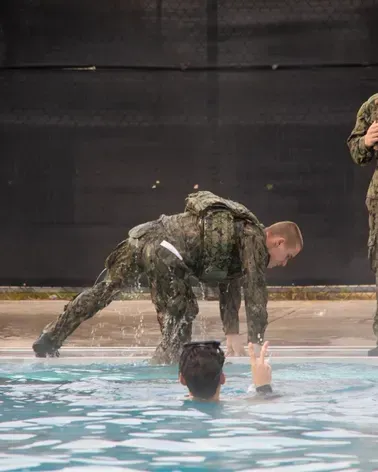
A hand release push up is a push-up taken all the way to the ground, where both hands come completely off the deck at the bottom before you press back up. The
Army scores it as a test event. The Air Force offers it as one of two strength options on the fitness assessment. That is why most people look this movement up: not for a new chest exercise, but because a grader is about to count it. Our tactical fitness programs build it into structured training instead of leaving it for test week. This guide covers the form, the current Army and Air Force standards, the faults that get reps no-repped, and a progression that adds reps.
Key Takeaways:
The hand release push-up removes the bounce at the bottom, so every rep starts from a dead stop.
It is a scored event on the Army Fitness Test, performed for two minutes with an arm extension at the bottom.
The Air Force offers two minutes of hand-release push-ups as an alternative to one minute of standard push-ups.
Most failed reps come from incomplete chest contact, hands that never fully leave the ground, and sagging hips.
Standard push-up strength does not transfer one for one, so train the dead-stop press on its own.
What Is a Hand Release Push-Up?
A hand release push-up is a push-up performed to full chest, hip, and thigh contact with the ground, where both hands lift clear of the deck at the bottom before the press begins. Lifting the hands eliminates the stored elastic energy in the bottom position, so every repetition starts from a complete stop.
That single change is why militaries adopted it. A standard push-up can be shortened by inches without a grader seeing it. A hand release push-up cannot. Either the chest reached the ground and the hands came off, or the rep did not happen.
If you arrived here from a test event, what PT means in the military explains how service fitness tests fit into readiness.
How to Do a Hand Release Push-Up
Set up in the front leaning rest with hands under the shoulders, feet together or no more than a boot width apart, and a straight line from head to ankles.
Lower under control until the chest, hips, and thighs touch the ground at the same time. Partial contact is a no-rep.
Lift both hands clear of the ground. Under the Army standard, extend both arms straight out to the sides into a T position without moving your head, body, or legs.
Return the hands to the starting position beside the chest.
Press up until the elbows lock out, moving the whole body as one unit. Hips and shoulders rise together.
The arm extension is where standards differ. The Army event is named the hand-release push-up arm extension, and the T position is part of the repetition. The Air Force option and most gym versions require only that the hands leave the ground. Train the version your test uses. If it includes the arm extension, practice it every session, since adding it under fatigue is the most common reason a rep does not count.
Hand Release vs Regular Push-Up
The hand release version is harder, slower, and easier to judge. A standard push-up lets you reverse out of the bottom while the chest and connective tissue are still loaded, which is the stretch-shortening cycle doing part of the work for you. Take the hands off the floor and that contribution is gone. Research on push-up variations in law enforcement cadets found a large difference in reps completed between the two, and standard push-up performance explained only about 39 percent of the variation in hand-release performance. Being good at one does not make you good at the other.
Figure 1.1 - the hand-release push-up compared with the standard push-up across bottom position, elastic contribution, rep count, judging and use. A standard push-up reverses out of the bottom while the chest and connective tissue are still loaded, so the stretch-shortening cycle returns some of that energy into the press. The hand release removes it: the chest, hips and thighs touch down together, the movement stops, and both arms extend straight out to the sides into a T before the hands return under the shoulders and the press begins, five distinct actions against three that run together. That makes every rep start from a dead stop, adds shoulder and upper-back work a standard push-up never asks for, lowers the count, and leaves a grader nothing to argue with. In 41 male law enforcement cadets, the difference in reps completed between the two carried a large effect size, and standard push-up performance explained only 39 percent of the variation in hand-release performance, meaning 61 percent of what determines the hand-release number is something the standard test never measured. The hand release is the Army Fitness Test event, scored as maximum reps in two minutes; most other services and public safety tests still use the standard push-up. Sources: Lopes dos Santos et al., Journal of Strength and Conditioning Research 37(9), 2023; U.S. Army Fitness Test event standards.
The ACFT Hand Release Push-Up Standard
The event most people still search as the ACFT hand release push-up is now scored on the Army Fitness Test, which replaced the ACFT as the test of record on June 1, 2025. The movement did not change. You perform as many hand-release push-ups with arm extension as possible in two minutes, resting only in the front leaning rest position.
As of September 2026, the published Army standard for ages 17 to 21 sets 10 repetitions as the 60-point minimum for both men and women. The 100-point maximum is 57 repetitions for men and 53 for women in that age group. Requirements shift across the other age groups, and combat specialties carry a separate bar: 21 designated combat military occupational specialties require at least 60 points in every event and 350 points total, on sex-neutral standards, effective January 1, 2026 for the active component and June 1, 2026 for the Reserve and National Guard.
Army hand-release push-up scoring anchors, ages 17 to 21 (current as of September 2026)
Figure 1.2 - Army Fitness Test hand-release push-up scoring anchors for ages 17 to 21, scored as maximum repetitions in two minutes. Ten reps is the minimum passing standard at 60 points, identical for men and women. The hundred-point ceiling splits by sex: 57 reps for men, 53 for women. Soldiers in the 21 combat specialties are held to a different arrangement entirely, scored sex-neutral and age-normed, needing 60 points in every event and 350 points overall against 300 for everyone else, effective 1 January 2026 for the active component and 1 June 2026 for the Reserve and National Guard. Thresholds move with age band; these are the 17 to 21 figures. Sources: U.S. Army Hand-Release Push-Up event standards, U.S. Army Fitness Test scoring scales.
Scoring tables move. Rather than reprint the full scorecard, the ACFT scoring standards breakdown carries the current point tables by event and age group. The other individually scored endurance event is covered in the Army two-mile run standard, and the separate body composition requirement in Army height and weight standards.
The Air Force Hand Release Push-Up Standard
The Air Force treats hand-release push-ups as an alternate strength component, not a mandatory event. Airmen choose between one minute of standard push-ups and two minutes of hand-release push-ups, and the strength component is worth 15 percent of the total score under the updated assessment.
The rest of the updated test shapes how you train for it. Cardio is worth 50 percent and can be met with a two-mile run or the 20-meter High Aerobic Multi-Shuttle Run. The core component is worth 15 percent and can be met with sit-ups, cross-leg reverse crunches, or a forearm plank. Waist-to-height ratio accounts for the remaining 20 percent. Testing moves to twice a year, with a diagnostic window opening March 1, 2026 and official scored testing beginning July 1, 2026.
The choice between the two options is real. The hand release option gives you twice the clock, but every rep costs more. Strong pressing endurance favors the two-minute option, while fast turnover for sixty seconds favors standard push-ups. Test both and pick by score, not preference. Rep requirements are set by age and gender and the hand release option carries its own table, so run your numbers through the Air Force PT test scoring guide first.
Airmen usually meet the movement in basic training, alongside the conditioning covered in our Air Force boot camp workouts guide.
Why the Hand Release Version Exists: Benefits
Three benefits are real, and one common claim is not.
It standardizes depth. Every rep goes to the same place, which makes reps countable across a formation.
It removes the elastic bounce. The press starts from rest, so more of the work falls on the muscles rather than on stored energy.
It exposes scapular control. Pressing from a dead stop shows whether the shoulder blades stay controlled, which a bouncing push-up hides.
What it is not is a better chest builder: the load is still your bodyweight. If your goal is passing a test that uses it, or building pressing endurance without momentum, it earns its place.
Common Mistakes and Why Reps Get No-Repped
Graders watch for a short list of faults, and each one is fixable.
Incomplete chest contact. Chest, hips, and thighs should touch together. Bringing only the chest down, or reaching with the chin, is the most common no-rep.
Hands not fully clearing the deck. Sliding the hands or lifting only the fingers does not count. Lift the palms clear.
Arms not extending where the standard requires it. On the Army event, both arms go out to the sides in a T. A half-hearted flare is a no-rep.
Sagging or piking hips. Alignment stays generally straight from head to ankles, and the knees never touch first.
Resting anywhere but the front leaning rest. On the Army event that is the only authorized rest position. Dropping to the knees ends your set.
Pressing up unevenly. Shoulders and hips rise together. Snaking the chest up first is a fault, and a sign the trunk gave out before the arms.
Practice the way you will be graded. A training partner who counts reps and calls faults out loud removes the surprises.
Hand Release Push-Up Variations
Related movements are judged differently.
The CrossFit hand release push-up
The CrossFit version is not the Army version. Chest and thighs touch the floor, the hands lift off, and the rep finishes locked out with the body moving as a unit. There is no arm extension to the sides. If you learned it in a class and you are testing on the Army event, add the T position before test week.
The double hand release push-up
This one has no governing standard. It usually describes releasing the hands at the bottom and adding a second hand lift at the top. It is a control drill, not a test event, and no service scores it.
Pike push-ups
Pike push-ups shift the angle so the shoulders carry most of the load. They help anyone whose reps fail because the shoulders fatigue before the chest does.
Decline push-ups
Elevating the feet moves load onto the upper chest and shoulders and raises the share of bodyweight your arms carry.
Diamond push-ups
Hands together under the chest shifts emphasis to the triceps. Lockout is where hand release reps die at high counts, so triceps work pays off directly.
How to Improve Your Hand Release Push-Up Score
If you cannot reach the minimum yet, train the movement three times a week in submaximal sets. Take a number you can hit cleanly, cut it in half, and do five to six sets of that with full rest. Volume at good form builds reps faster than failing at max sets.
If you are already passing and want a higher score, build two qualities separately. Train the dead-stop press with paused reps, three seconds on the ground with the hands off, for sets of three to five. Train endurance with density work, such as sets every ninety seconds at 60 percent of your max, adding a set each week.
Useful accessory work is narrow: weighted pressing, rows and face pulls to keep the shoulders healthy under the volume, and hard trunk work so alignment holds.
The habit that stalls people is hammering a max set every session. Maximum effort measures your current number instead of building a new one, and the fatigue degrades the next session. Retest every four to six weeks, not every Monday. For a full beginner framework built around Army test events, our Army PT workouts for beginners guide lays out the weekly structure.
Where the Hand Release Push-Up Fits in Your Training
A test event is a measurement, not a training program. Hand release push-ups belong in your week as one piece of a pressing plan that also includes loaded pressing, pulling volume, and trunk work. Train only the test and you get good at the test right up until progress stops, which is the pattern covered in testing fitness versus real readiness.
Most Soldiers and Airmen meet this movement in unit PT, built for a formation rather than for your weak point. Our comparison of app-based training versus unit PT covers where each one works. If you are weighing options, the guide to choosing a training program walks through what to look for, and our structured tactical training programs overview answers the common questions about how guided programming runs.
FAQ: Frequently Asked Questions
What muscles do hand release push-ups work?
Hand release push-ups work the chest, front deltoids, and triceps as primary movers, with the serratus anterior and trapezius controlling the shoulder blades and the trunk and glutes holding alignment. Removing the bounce loads the pressing muscles harder at the start of each rep.
Are hand release push-ups harder than regular push-ups?
Yes. Most people complete noticeably fewer hand release push-ups than standard push-ups in the same time. The full range to the ground and the loss of stored elastic energy at the bottom make each rep more expensive, and research on push-up variations confirms the gap.
How many hand release push-ups do you need for the Army test?
For ages 17 to 21, 10 repetitions in two minutes earns the 60-point minimum, and 57 repetitions for men or 53 for women earns the 100-point maximum. Requirements differ by age group. Soldiers in the 21 designated combat specialties need at least 60 points in every event and 350 total.
Does the Air Force use hand release push-ups?
Yes, as an option rather than a requirement. Airmen choose between one minute of standard push-ups and two minutes of hand-release push-ups for the strength component, which counts for 15 percent of the assessment score. Both options are scored against age and gender standards.
Is the CrossFit hand release push-up the same as the Army version?
No. The CrossFit version requires chest and thighs to the floor, hands lifted, and a locked-out finish with the body moving as one unit. The Army event adds a full arm extension into a T position at the bottom.
How do I get better at hand release push-ups?
Train it three times a week in submaximal sets rather than testing your max every session. Add paused reps from the ground for the dead-stop press, density sets for endurance, and weighted pressing, pulling volume, and trunk work around it. Retest every four to six weeks.
The hand release push-up is a scoring instrument. It exists because it cannot be shortened, cannot be bounced, and cannot be argued with by a grader. Train it as its own skill, learn the exact standard your service scores, and take the guesswork out of test day. Build it into a program that develops pressing strength and endurance year round, and the score follows.
References:
U.S. Army. "Army Fitness Test (AFT)." army.mil.
U.S. Army. "Hand-Release Push-Up (HRP), AFT Event 2." goarmy.com.
U.S. Army. "Army establishes new fitness test of record to strengthen readiness and lethality." army.mil, 2025.
U.S. Air Force. "Air Force updates fitness test requirements." af.mil.
Air & Space Forces Magazine. "Air Force Drops 2-Mile Run Requirement on New PT Test, Moves Start to July."
Air & Space Forces Magazine. "Twice-a-Year PT Tests, 2-Mile Runs Coming in 2026."
Task & Purpose. "Airmen can now swap out the 2-mile run on both yearly fitness tests." 2026.
Military.com. "New Air Force Fitness Assessment Options and Standards."
Lopes dos Santos M, Thompson M, Dinyer-McNeely T, Torrence T, Lockie RG, Orr RM, Dawes JJ. "Differences and Relationships Between Push-up and Sit-up Variations Among Male Law Enforcement Cadets." Journal of Strength and Conditioning Research, 2023.
Komi PV. "Stretch-shortening cycle: a powerful model to study normal and fatigued muscle." Journal of Biomechanics, 2000;33(10):1197-1206.
Ebben WP, Wurm B, VanderZanden TL, et al. "Kinetic analysis of several variations of push-ups." Journal of Strength and Conditioning Research, 2011;25(10):2891-2894.
Ludewig PM, Hoff MS, Osowski EE, Meschke SA, Rundquist PJ. "Relative balance of serratus anterior and upper trapezius muscle activity during push-up exercises." American Journal of Sports Medicine, 2004;32(2):484-493.
Yang J, Christophi CA, Farioli A, et al. "Association Between Push-up Exercise Capacity and Future Cardiovascular Events Among Active Adult Men." JAMA Network Open, 2019;2(2):e188341.
Disclaimer: This article is for general information and training education. Fitness standards and scoring tables are set by each service and change over time, so confirm current requirements with your unit, your service's official publications, or your fitness assessment cell before testing. Consult a qualified medical professional before starting or changing a training program.


