
Military Fitness Program Buying Guide (2026): How to Choose
How to Pick the Best Military Fitness Program for Your Goal
Choosing the right military fitness program is not the same as picking a general workout plan. Tactical athletes, whether preparing for special forces selection, law enforcement roles, or simply pursuing elite performance, require a system that develops multiple capacities simultaneously: endurance, strength, resilience, and durability under stress.
The problem is that most “military-style” programs fall short. They are often random, overly intense, or lack long-term progression. This guide is written for one job: helping you choose a military fitness program you'll still be following in twelve weeks, not abandoning in two. We'll cover what real structure looks like, how to judge tactical specificity, and the five buying mistakes that quietly end most training cycles before they pay off.
This 2026 Military Fitness Program Buying Guide breaks down:
What a true tactical program should include
The key features to evaluate before buying
Common mistakes to avoid
How to choose the right program based on your level and goals.
What Is a Military Fitness Program (Really)?
A true military fitness program is not just “hard workouts.” The distinction matters in practice. A random high-intensity circuit can leave you gassed and sore without moving any single quality forward, while a structured program sequences aerobic base, strength, and work capacity so each adapts on its own timeline. Picture two soldiers prepping for the same selection: one chases daily soreness, the other follows phased blocks. Twelve weeks later, the second can ruck, run, and lift under fatigue. The first is just tired. Structure, not punishment, is what separates a program from a workout.
It is a structured system designed to develop:
Aerobic capacity (running, rucking, swimming)
Strength and power
Work capacity and durability
Movement quality and injury resilience
Operational readiness under fatigue
The best programs are:
Periodized (not random)
Scalable (for beginners to advanced)
Specific (aligned with real-world demands)
Step 1: Define Your Goal Before You Buy
Before choosing a program, the most important question is:
What are you training for?
Different goals require completely different structures. This is the single decision that determines everything downstream. A candidate prepping for SFAS needs long-duration rucking and grip endurance; a firefighter needs repeat-effort power and heat tolerance; a lifter adding size while staying deployable needs a different split again. Buy the program that matches the outcome you're training toward, not the one with the most impressive-looking workouts. If you're unsure which category you fall into, a structured program finder will route you faster than guessing.
Common Goal Categories
1. General Tactical Fitness
Build strength, endurance, and overall performance
Example: Combat Fitness ONE (broad access to multiple programs)
2. Selection / Pipeline Prep
SFAS, SEAL, PJ, CSOR, etc.
Requires highly specific programming (rucking, water confidence, long-duration endurance)
3. Strength & Hypertrophy Focus
Building size and strength while maintaining conditioning
4. Running or Endurance Focus
Marathon, 5-mile performance, aerobic base development
5. No Equipment / Minimal Setup
Bodyweight-based training for deployment or travel
If the program doesn’t clearly align with your goal, it’s the wrong program, no matter how “hard” it looks.
Step 2: Look for Structured Progression (Not Random Workouts)
One of the biggest mistakes buyers make is choosing programs that look intense but lack structure. Intensity is easy to manufacture and easy to sell; structure is harder and far more valuable. The test is simple: open the program and look twelve weeks ahead. Can you see how week ten differs from week two? If the answer is "more of the same, but harder," you're looking at a grinder, not a plan. Real progression manipulates volume, intensity, and exercise selection across phases so adaptation keeps stacking instead of stalling. Soreness is a side effect, not a goal. This isn't a stylistic preference, the training-load research is consistent that gradual, progressive workload (not maximal intensity) is what builds capacity while controlling injury risk (Gabbett, 2016).
What to Look For:
Progressive overload (strength, volume, intensity)
Phased training blocks (not daily randomness)
Long-term development (12+ weeks minimum)
Red Flag:
“Daily WOD-style” workouts with no progression
Programs that rely on intensity instead of structure
Combat Fitness solves this with a periodized infinite progression system, meaning:
Programs evolve over time
Athletes don’t plateau or “finish” and restart randomly
Training adapts to long-term development
Step 3: Evaluate Program Breadth and Specialization
Most platforms force you into one type of training. High-level systems allow switching between programs based on your needs. Breadth matters because your needs change faster than most programs allow. A deployment kills your gym access; an injury rules out running for six weeks; a selection date moves up and rucking suddenly becomes the priority. A platform that lets you switch between a bodyweight block, a running build, and a rucking phase without starting over protects months of accumulated fitness. The library below is organized exactly this way, so athletes change focus without changing platforms or losing progression.
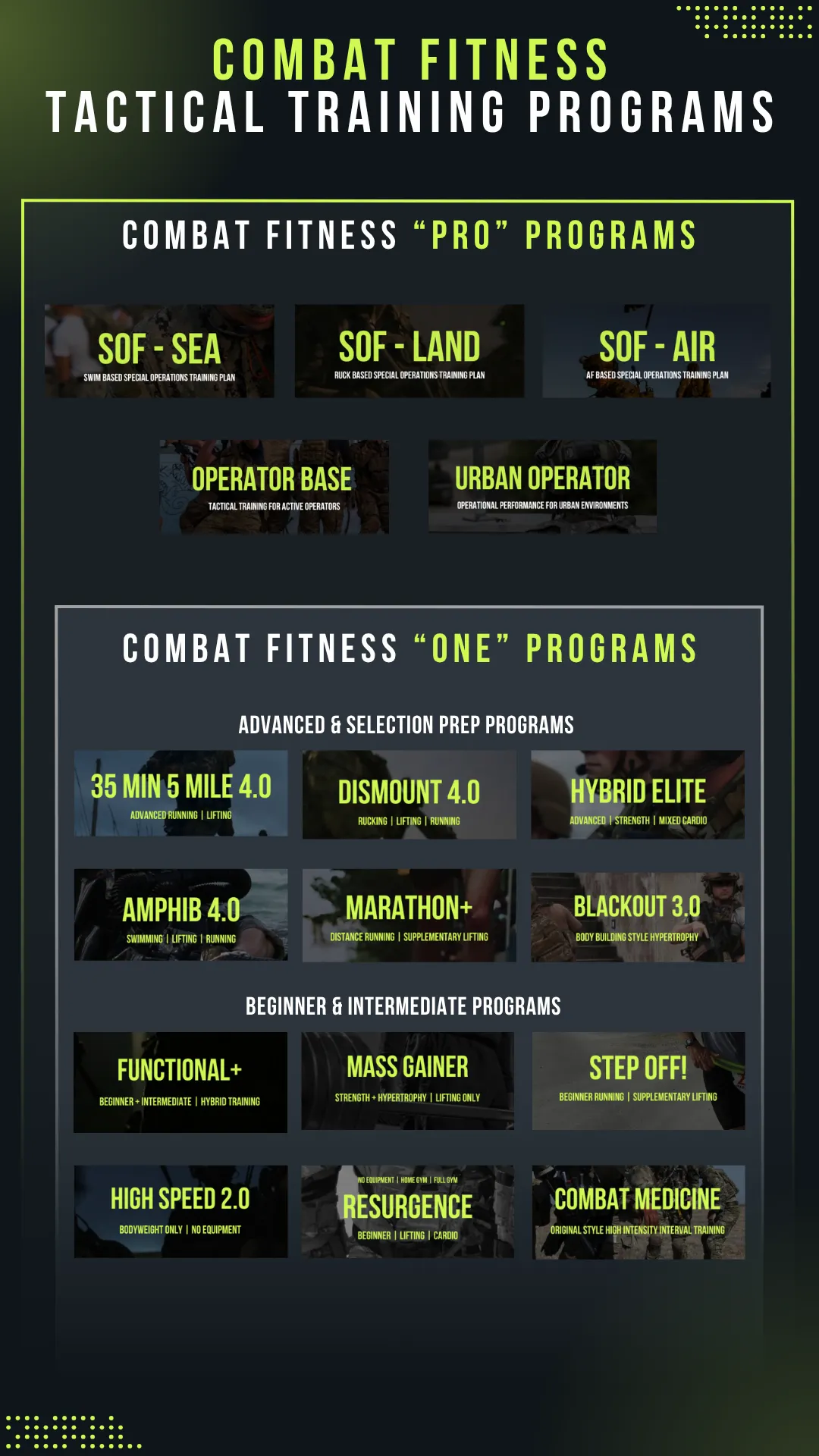
Combat Fitness Program Ecosystem
Beginner & Intermediate Options
Step Off! – Entry-level running + lifting
Resurgence – Foundational strength + conditioning
Combat Medicine – High-intensity functional training
Mass Gainer 2.0 – Strength + hypertrophy
HighSpeed 2.0 – Bodyweight-only training
Functional + – Balanced hybrid training
Advanced & Specialized Programs
35M5M 4.0 – Advanced running + lifting
AMPHIB 4.0 – Swimming + running + strength
Dismount 4.0 – Rucking-focused tactical training
Hybrid Elite – High-level strength + endurance
Marathon + – Distance running + supplemental strength
Blackout 3.0 – Hypertrophy-focused system
This range allows athletes to:
Start at any level
Progress without switching platforms
Match training to life demands
Step 4: Assess Real Tactical Specificity
Many programs claim to be “military-focused” but are generic. True tactical programs are built for specific pipelines and roles. Specificity is where most "military-style" programs quietly fail. BUD/S, with its water confidence and cold exposure, shares almost nothing with the load-carriage reality of SFAS, which in turn looks nothing like the short, explosive intensity a SWAT call-out demands. A program written for "the military" as one audience optimizes for none of them. The specialization tracks below exist because preparing for a maritime pipeline and an airborne one are genuinely different jobs.
Combat Fitness PRO Specialization Tracks
SOF-LAND
Built for: SFAS, Rangers, airborne units
Focus: Rucking, running, strength endurance
SOF-SEA
Built for: SEALs, divers, maritime units
Focus: Swimming, water confidence, hybrid endurance
SOF-AIR
Built for: PJ, CCT, TACP
Focus: Rescue strength, aerobic engine, power endurance
SOF OPERATOR Base
Built for: Active operators and support units
Focus: Longevity, resilience, sustainable performance
Tactical URBAN
Built for: SWAT, FBI HRT, police tactical units
Focus: Short-duration intensity, agility, strength
This level of specificity is rare, and critical if the goal is selection or operational readiness.
Step 5: Coaching, Support, and Accountability
Most programs are just PDFs or static apps. That’s a major limitation. The limitation shows up the moment something goes wrong. A static PDF can't tell you whether to push through a tweaked knee or back off, can't adjust your week when a deployment compresses your training time, and can't flag that your run pace has stalled for a month. Coaching closes that gap. It won't do the work for you, but for athletes chasing a selection date or a hard standard, the feedback loop between effort and adjustment is often what separates passing from injured.
What High-Level Systems Provide:
Direct coaching access
Feedback and guidance
Program adjustments
Performance tracking
Combat Fitness Structure
Combat Fitness ONE
Full access to training programs
App-based delivery
Program switching flexibility
Combat Fitness PRO
Everything in ONE
Direct coach support
Expanded program library
Nutrition guidance
Performance resources
Partner discounts
This hybrid model allows athletes to:
Start independently
Upgrade when needed
Step 6: Scalability and Long-Term Use
A good program works for 4–8 weeks. A great system works for years. The math favors the system that lasts. A program you outgrow in eight weeks means a new purchase, a new learning curve, and usually a reset in progression. A platform that carries you from beginner base-building through advanced selection prep compounds instead, because every block builds on a known starting point rather than a guess. Longevity also means the program survives the disruptions, injuries, deployments, life changes, that end most training plans before they ever pay off.
Key Questions:
Can you progress without changing platforms?
Does it adapt to injury, time constraints, or new goals?
Can beginners and advanced athletes both use it?
Combat Fitness is designed as a lifecycle system, meaning:
Beginner → Intermediate → Advanced → Selection
All within the same ecosystem
Step 7: Common Buying Mistakes to Avoid
Every one of these mistakes traces back to the same root: buying on emotion instead of fit. Hard workouts feel productive, advanced programs feel ambitious, a low price feels efficient, none of which has anything to do with whether the program moves you toward your actual goal. The five errors below are the ones that most often end a training cycle early. Read them as a pre-purchase checklist, not a list of other people's failures, disciplined athletes fall into them too.
1. Choosing Based on Intensity Alone
Hard does not equal effective.
2. Ignoring Specificity
A general program will not prepare you for selection.
3. Lack of Progression
Random workouts lead to plateaus.
4. Overcommitting to the Wrong Level
Starting too advanced leads to injury and burnout.
5. No Support System
Without guidance, most athletes stall.
Why Combat Fitness Stands Out
When compared to typical military fitness programs, Combat Fitness offers:
Structured, periodized programming (not random workouts)
Full ecosystem of programs (beginner → elite)
True tactical specialization tracks
App-based delivery with flexibility
Coaching support when needed
Infinite progression system for long-term development
Instead of being a single program, it functions as a complete training system for tactical athletes. In our assessment, that ecosystem model is the real differentiator, and it's also the honest caveat: if you only want a single eight-week plan, a one-off program will serve you fine and cost less. Combat Fitness earns its keep for athletes who train across years and roles and want one place to move from base-building to selection prep without rebuying. That's an editorial view, not a neutral fact, weigh it against your own goals and budget before deciding.
Final Thoughts
The best military fitness program is not the hardest one.
It’s the one that:
Matches your goal
Progresses over time
Builds all required capacities
Keeps you training consistently
Most people fail not because they lack effort, but because they chose the wrong system.
Choosing correctly at the start saves months, or years, of wasted training.
FAQ Section
What is the best military fitness program in 2026?
The best program is one that matches your goal and provides structured progression. Systems like Combat Fitness stand out due to their scalability and specialization.
Are military fitness programs good for beginners?
Yes, if they include scalable options. Programs like Step Off! or Resurgence are designed specifically for beginners.
Do I need equipment for a military fitness program?
Not always. Some programs (like HighSpeed 2.0) are fully bodyweight-based, while others require gym access.
How long should I follow a military fitness program?
Ideally, indefinitely. The best systems provide ongoing progression rather than short-term plans.
What’s the difference between general fitness and tactical fitness?
Tactical fitness focuses on real-world performance: endurance, strength, resilience, and operational readiness, not just aesthetics or isolated fitness goals.
Is coaching necessary?
Not always, but it significantly improves results. Coaching adds accountability, guidance, and faster progress.
References
Gabbett, T. J. (2016). The training - injury prevention paradox: should athletes be training smarter and harder? British Journal of Sports Medicine, 50(5), 273–280.


