
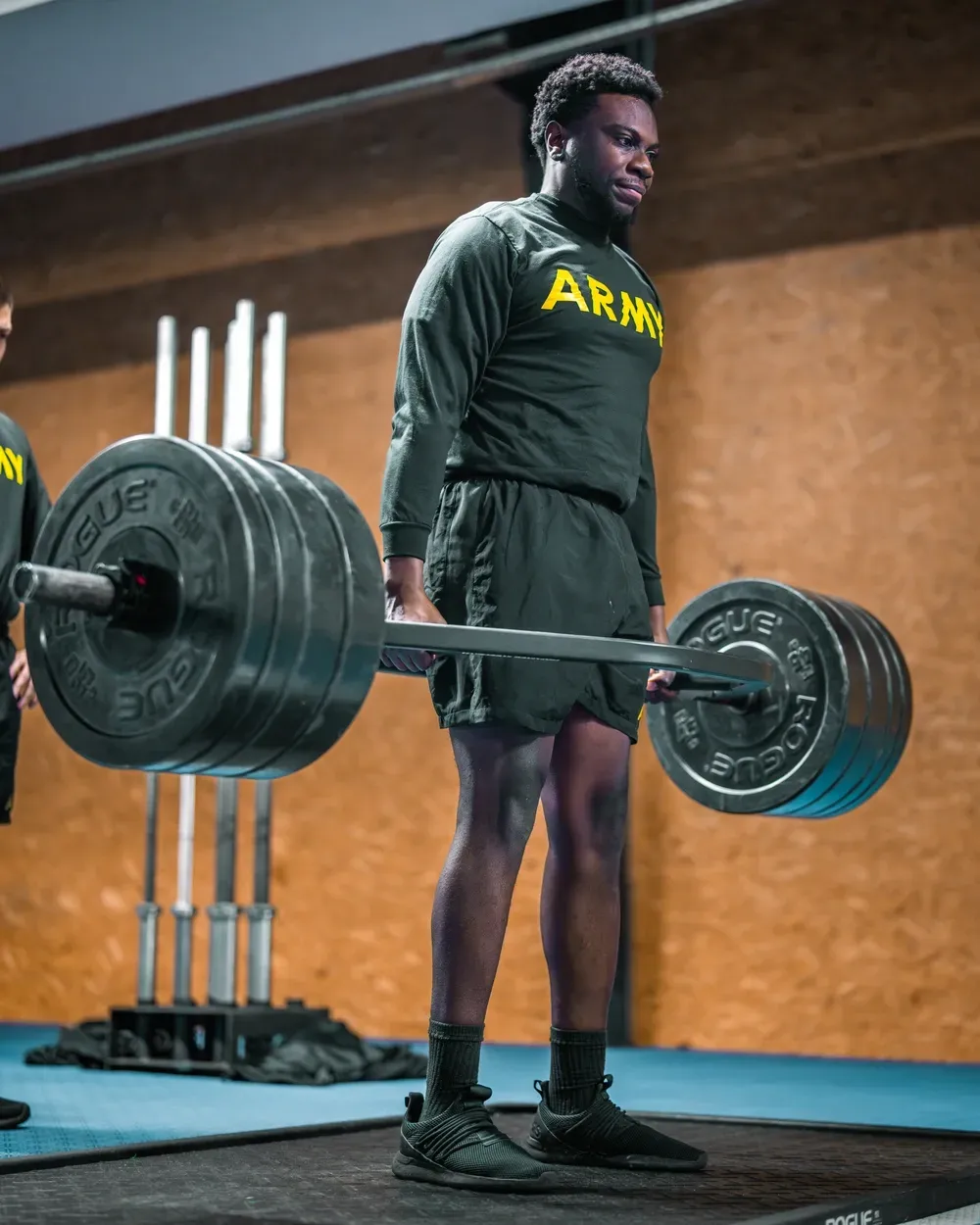
AFT Score Chart (Formerly ACFT): Army Standards & Scoring
AFT Score Chart (Formerly ACFT): Standards, Scoring & How to Read Your Scorecard
Ever heard a soldier mention their AFT score and had no idea whether a 450 is good, bad, or average? You're not alone. Effective June 1, 2025, the Army replaced the Army Combat Fitness Test (ACFT) with the Army Fitness Test (AFT): five events, a 500-point scale, and two pass/fail lines. This guide is the full AFT score chart, it breaks down the scoring standards for each event, explains the 300-point general and 350-point combat thresholds, and shows you exactly how to read your scorecard. Because so many soldiers still train and search by the old test, it also maps the AFT back to the six-event, 600-point ACFT framework it grew out of, so a legacy ACFT scorecard and a current AFT scorecard both make sense here.
The Army Fitness Test (AFT) Scoring System Explained (Formerly the ACFT)
Each AFT event targets a different physical quality, which is why understanding the scoring is more than memorizing a chart, it tells you what kind of athlete the Army expects you to be. The same scoring logic underpins everything from the 60-point per-event minimum to the specific Sprint-Drag-Carry standards and the rules for alternate cardio events. The test is, in effect, a full-body syllabus of functional fitness. Soldiers who want a structured training program built around the exact physical qualities the AFT measures, strength, explosive power, anaerobic capacity, core stability, and aerobic endurance, can find one through CF ONE training programs.
The current AFT is a five-event test. The ACFT included a sixth event, the Standing Power Throw, which the Army retired in the 2025 transition. All six are described below, with the SPT flagged as ACFT-only:
The six events are:
3 Repetition Maximum Deadlift (MDL): Measures raw, full-body strength for lifting heavy loads.
Standing Power Throw (SPT): Tests explosive power by throwing a 10-pound medicine ball backward.
Hand-Release Push-Up (HRP): Assesses upper-body endurance with a strict push-up variation.
Sprint-Drag-Carry (SDC): A high-intensity shuttle run with a sled and kettlebells to test agility and power under fatigue.
Plank (PLK): A straightforward but grueling test of core strength and stability.
2-Mile Run (2MR): The classic capstone event for aerobic endurance.
Event Standards: What Each of the Six Events Actually Tests
Understanding what each event actually tests, and why, helps soldiers train with purpose rather than just logging hours.
The 3 Repetition Maximum Deadlift (MDL) tests the lower body and posterior chain strength needed to lift casualties, equipment, and heavy loads under field conditions. The three-rep format tests maximal strength rather than endurance, making it unique among the six events. For soldiers specifically looking for Army-focused training programs built around ACFT standards, Army fitness programs covers the full range of options available.
The Standing Power Throw (SPT) an ACFT event the AFT removed in 2025, assesses explosive hip extension power, the same quality needed for jumping obstacles, pushing through resistance, and generating force quickly. Throwing a 10-pound ball overhead and backward demands full-body coordination under maximal effort.
The Hand-Release Push-Up (HRP) is stricter than a standard push-up. The "hand-release" component, lifting the hands off the ground at the bottom of each rep, eliminates momentum and demands true upper-body pressing strength from a dead stop. This directly mirrors the ability to push off the ground or push through resistance in operational environments.
The Sprint-Drag-Carry (SDC) is the most operationally specific event. It includes a sprint, a backward sled drag, lateral shuffles, a kettlebell carry, and a final sprint, all within a 50-meter shuttle course. It simulates the mixed-demand nature of combat: explosive starts, sustained effort, and carrying loads under fatigue.
The Plank (PLK) tests trunk stability, which underpins every other physical task a soldier performs. Without adequate core strength, load carriage efficiency drops, injury risk rises, and movement quality under fatigue degrades.
The 2-Mile Run (2MR) is the aerobic capstone. A soldier who can run two miles efficiently has the cardiovascular base to sustain effort over time, recover between intense efforts, and remain cognitively sharp under physical stress.
AFT Scoring Explained: How the 500-Point System Works (and the ACFT's 600)
So how does the Army turn a two-mile run time or a heavy deadlift into a final score? The AFT scoring system works like an exam with sections. Each event is worth a maximum of 100 points. Because the AFT has five events, the highest possible total is a perfect 500, the six-event ACFT topped out at 600, which is why you'll still see the 600 figure quoted in older material. The better the raw performance, running faster, lifting more, holding the plank longer, the more points the soldier earns on that event's scoring chart.
To pass the AFT, a soldier must be competent on every event, not just strong on the ones that play to their strengths. The Army sets a minimum of 60 points per event, and missing that mark on even one event fails the entire test regardless of the other scores, there is no averaging and no points-back from a stronger event. On top of the per-event floor, the AFT carries a total-score line: 300 points to pass the General Standard (60 × 5) and 350 points for soldiers in the 21 combat MOSs under the Combat Standard. A well-rounded performer clears the low-400s, and a rare top performer approaches the 500 ceiling. (Under the retired ACFT, the same logic produced a 360 floor and a 600 ceiling across six events.)
AFT Scoring by Age, Gender, and MOS: Why Standards Differ
Comparing AFT scores between two soldiers is rarely apples-to-apples. The test acknowledges that physical performance changes across a career and that different military occupational specialties (MOS) carry different physical demands. Under the General Standard, the Army uses age-group and gender-specific scoring charts, a 45-year-old does not need to lift the same weight or run the same time as a 20-year-old to earn the same 80 points. The Combat Standard, which applies to 21 combat MOSs, is different: it is sex-neutral and age-normed, meaning men and women in those specialties are scored against the same physical requirements. Either way, the structural frame, five events, a 60-point per-event minimum, a 500-point ceiling, is identical across the force.
Beyond the age and gender adjustments, the required passing total varies by Military Occupational Specialty. Soldiers in the 21 combat-coded MOSs, such as infantry (11B), combat engineer (12B), and field artillery cannon crewmember (13B), must clear the 350-point Combat Standard, while general-service MOSs pass at 300. This tiering ensures soldiers are not just generally fit but specifically prepared for the operational demands of their role. For soldiers evaluating which military fitness program best fits their preparation timeline and goals, the military fitness program buying guide walks through how to choose the right option.
The result is two pass/fail lines that operate at once. First, the soldier must score at least 60 points on every event, no exceptions, no averaging. Second, the total must meet the standard for their MOS: 300 for general service, 350 for combat specialties. A combat-MOS soldier can clear the 60-point floor on all five events and still fall short of the 350 total, because 60 × 5 is only 300, a 50-point gap from the combat line. Understanding both thresholds is the difference between training to pass and training to pass at your job's required level.
ACFT to AFT: What the 2025 Transition Changed
Effective June 1, 2025, the U.S. Army replaced the Army Combat Fitness Test (ACFT) with the Army Fitness Test (AFT) under Army Directive 2025-06. Three things changed. First, the Standing Power Throw was removed, cutting the test from six events to five and the maximum score from 600 to 500. Second, the Army introduced two standards: a General Standard (age- and gender-normed, 300 to pass) and a sex-neutral Combat Standard (350 to pass) for 21 combat MOSs, phased in for the active component on January 1, 2026 and for the Reserve and National Guard on June 1, 2026. Third, the body-composition exemption threshold moved to 465 points, replacing the old ACFT 540 mark. What did not change is the underlying scoring logic: each event is still scored 0–100, the 60-point per-event floor still applies, and the five surviving events are graded exactly as they were. That is why this guide covers both, the current AFT standards a soldier tests against today, and the six-event ACFT framework those standards evolved from. For the exact scoring scales, always confirm against the official Army source.
ACFT vs APFT: Why the Army Replaced the Old Fitness Test
The ACFT replaced the older Army Physical Fitness Test (APFT) for a fundamental reason. The Army Physical Fitness Test (APFT) measured three things: push-ups, sit-ups, and a two-mile run.
The Army Physical Fitness Test (APFT) measured three things: push-ups, sit-ups, and a two-mile run. The test was simple to administer and easy to prepare for, but the assessment was also fundamentally incomplete. A soldier could max the APFT, perfect push-ups, perfect sit-ups, sub-13-minute two-mile, while being genuinely unprepared for the physical demands of combat: dragging a casualty, carrying ammunition cans across broken ground, throwing explosive force against resistance, or maintaining performance after twenty minutes of mixed-demand work. The ACFT was designed specifically to close that operational gap.
By adding the deadlift, the Standing Power Throw, the Sprint-Drag-Carry, and the plank, the Army built a test that more closely mirrors what soldiers actually do under operational conditions. A soldier who scores well on the ACFT is not just cardiovascularly fit. They are strong, explosive, agile, and have the core stability to sustain performance under load. That profile is far more operationally relevant than the narrow fitness picture the APFT captured.
The shift also changed how serious soldiers train. Meeting the ACFT standard requires programming that addresses multiple physical qualities simultaneously, not just running more miles and doing push-up circuits. Understanding what is tactical conditioning explains the training framework that underpins this multi-quality approach, and why the ACFT's design reflects a genuine operational performance philosophy rather than an administrative fitness standard.
How to Train for the AFT: Programming for All Five Events
Understanding the AFT scorecard is one thing. Building the fitness to earn a strong score across all five events is something else entirely, and the second part is where most soldiers' preparation falls apart.
The AFT rewards well-rounded tactical athletes, soldiers whose training intentionally spans strength, anaerobic capacity, core stability, and aerobic endurance at once. This is why single-dimensional preparation produces lopsided scorecards: soldiers who only run will struggle to clear competitive points on the deadlift, while soldiers who only lift heavy will lose ground on the 2-mile run and Sprint-Drag-Carry. The 500-point ceiling is reachable only by athletes who refuse to neglect any of the qualities the test rewards.
An effective AFT preparation block addresses every quality the five events test (the sixth item below, the Standing Power Throw, applied only to the retired ACFT and is included for soldiers training against legacy standards):
Strength: Progressive deadlift training, hip hinge patterns, and posterior chain work for the MDL.
Explosive power: Medicine ball throws, jump training, and hip extension work for the SPT. (ACFT only - the AFT retired the SPT in 2025):
Upper-body endurance: Push-up volume progressions with proper hand-release form for the HRP.
Anaerobic capacity: Sprint intervals, sled work, and loaded carries for the SDC.
Core stability: Plank holds and anti-rotation work for the PLK.
Aerobic base: Structured zone 2 running and progressive mileage for the 2MR.
These qualities are not trained equally inside a single training week, that produces a watered-down stimulus on every quality and a measurable improvement on none. A well-structured AFT preparation program periodizes them, bringing each quality to peak readiness in sequence so that all five events are sharp on test day rather than two being sharp and three being stale. Soldiers building their AFT running performance should read the military running program guide, which covers how structured pace work and aerobic base development translate directly into 2-mile run performance.
How to Read Your AFT Scorecard: Raw Performance, Points, and Pass/Fail
After the test, soldiers receive a scorecard, the current official version is DA Form 705, showing their raw performance in each event alongside the points earned. Reading the AFT scorecard correctly requires understanding three distinct columns:
Raw performance: Your actual result. How much you lifted, how fast you ran, how far you threw.
Points earned: The number of points that raw performance translates to based on your age group, gender, and MOS standards.
Pass/Fail status: Whether your points in each event met the 60-point minimum, and whether your total met your MOS threshold.
A scorecard showing 460 total points but a zero on one event is a failure, the high total earns nothing. A scorecard showing 320 total points with at least 60 on every event and a total that meets the MOS minimum is a clean pass. The AFT scorecard is also the single best diagnostic tool a soldier has for prioritizing their next training block: weak events show exactly where training investment is needed. A soldier who scores 95 on the deadlift but 62 on the 2-mile run has an unambiguous priority, protect the deadlift, attack the run — and a soldier who is 90+ on every event except a 70 on the Sprint-Drag-Carry knows their anaerobic capacity is the ceiling on their total. Soldiers who want to understand how AFT body composition standards connect to their scoring eligibility should review the Army height and weight standards guide, which covers the body composition requirements that sit alongside ACFT fitness standards for readiness certification.
What Is a Good AFT Score? Passing, Excellent, and the Perfect 500
Passing the AFT is the official requirement, but most serious soldiers strive for more, and the unofficial benchmarks the force actually uses are worth understanding. Clearing 400 points maxes out the AFT's fitness contribution to promotion points and marks a genuinely competitive soldier; pushing past 465, the threshold that exempts a soldier from body-composition taping under AR 600-9, is broadly recognized as an excellent AFT score. Either mark signals a soldier has moved past simply meeting the standard and into genuine mastery of the test, with strong performance across all five events rather than just two or three.
At the top sits the pinnacle: a perfect 500. Earning the maximum 100 points on all five events is the athletic equivalent of a perfect standardized test score, extremely rare and a sign of elite, all-around physical prowess. The three-tier framework, Passing (300 general or 350 combat, all events ≥60), Excellent (465+), and Max (500), gives every soldier a clean mental model for placing any AFT total in context and for setting their next training target. For soldiers with specific questions about military fitness program structure and what to expect from a well-designed preparation system, the military fitness program FAQ covers the most common questions in one place.
What a Perfect 500 AFT Score Actually Requires
A perfect 500 AFT score is not achieved by simply training hard. It is achieved by training specifically and progressively across every quality the five events demand, managing fatigue intelligently across the multi-event test day, and peaking each quality at the same time rather than rotating peaks across a training year. This is a programming problem, not an effort problem, which is why most soldiers who chase a maximum score hit a plateau in the 440-to-460 range until they fix their structure.
A soldier chasing a perfect 500 on the AFT needs:
A deadlift at the upper end of their strength capacity.
Medicine ball throw distance well above average (ACFT-era only - the SPT is not part of the current AFT).
60+ hand-release push-ups in strict form.
An SDC time that reflects genuine explosive endurance.
A 2-minute plank that feels controlled rather than maximal.
A 2-mile run under 13 minutes for most male soldiers in younger age groups.
Each of those requires dedicated training investment. None of them can be neglected. This is why the AFT is a genuinely difficult test for most soldiers, not because any single event is impossible, but because excelling across all five simultaneously requires the kind of multi-domain fitness that only structured, intelligent programming produces. Soldiers beginning their AFT preparation from a general fitness base should start with Army PT workouts for beginners, a practical entry-point framework built around the movement patterns and standards the ACFT tests from day one.
Reading an AFT Score: From Raw Number to Real Readiness
What was once just military jargon is now a clear picture of physical readiness. You have moved from hearing an acronym to understanding the AFT's five events, the 500-point scoring system, and the age-, gender-, and MOS-specific thresholds that sit behind any soldier's score. A total in the mid-400s no longer reads as a mystery, you can see the strong, well-rounded performance behind it, sitting comfortably above the 300-point general and 350-point combat passing lines and reflecting real preparation across every event the test measures.
Understanding what is a tactical athlete gives every soldier the professional identity context behind what the ACFT is actually measuring: the multi-domain physical readiness that defines an operator who can perform reliably under the full range of demands military service places on the body. The full definition of what is tactical fitness gives every soldier and family member who has read this post the complete picture of what the AFT's multi-event design is trying to produce: a physically capable, durable, and operationally ready soldier across the full demands of military service.
References
U.S. Army. "Army Fitness Test (AFT)." army.mil/aft. AFT Scoring Scales, effective June 1, 2025.
U.S. Army. "Fitness | goarmy.com" - AFT events, 60-point per-event minimum, 300-point General Standard, 500-point maximum.
Army Directive 2025-06, "Army Fitness Test" - replacement of the ACFT, Combat Standard (350) enforcement dates for active (Jan 1, 2026) and Reserve/National Guard (Jun 1, 2026) components.
Army Regulation (AR) 600-9, "The Army Body Composition Program" - 465-point AFT exemption from body-composition assessment.
***Disclaimer: This content is provided for general informational purposes only. Combat Fitness is not affiliated with the U.S. Department of Defense, and official standards may change at any time. Always consult official military publications for the most up-to-date requirements.***


