
What Is PT in the Military? Meaning, Standards & Daily Workouts
What Does PT Stand For in the Military?
PT in the military stands for Physical Training, the mandatory, leader-led group workout that every service member performs as a scheduled part of the duty day. When most civilians picture military training, they imagine a drill sergeant shouting at recruits doing push-ups in the mud. That moment happens, but the daily reality is far more structured: like the most effective military fitness programs, PT is built around mission readiness, formal fitness standards, and team cohesion, and it shapes a service member's entire career from day one of basic training through every promotion board that follows.
PT means the same thing across every branch: Physical Training. Whether a soldier says "Army PT," a Marine says "PT formation," or an airman says "PT test prep," they are all referring to the same daily, structured group workout that is a scheduled part of duty hours. PT is led by a supervisor, usually a Non-Commissioned Officer, and performed as a unit before the day's primary mission work begins. Unlike a personal trip to the gym, it is not optional, not individually programmed, and not designed around aesthetics. Every military PT session is built for one purpose: preparing service members for the demanding physical realities of their job, whether that job is dismounted infantry, aircraft maintenance, or shipboard damage control.
What Does a Daily Military PT Session Look Like?
Most of the time, military PT is conducted as a group session called unit PT, the formation-wide workout that every soldier, sailor, airman, or Marine in the unit completes together. An NCO (Non-Commissioned Officer) leads the formation through the day's session, sets the cadence, and corrects form. This group format does two things at once: it builds individual fitness and it forges unit cohesion, since the formation succeeds or struggles as one body. That shared experience, sweating, suffering, and finishing together, is one of the reasons military fitness culture feels fundamentally different from civilian gym culture.
A typical military PT session follows a familiar three-part pattern that has stayed consistent across decades and across branches:
It begins with a dynamic warm-up to get muscles ready and prevent injury, often involving stretches and light jogging.
The main workout follows, which might focus on cardio, like a group run, or on strength, using bodyweight exercises.
Finally, the session ends with a cool-down and stretching to aid recovery.
The workouts themselves focus on exercises that build practical, functional strength rather than gym-mirror physique work. You'll see a lot of the classics, push-ups, squats, sit-ups, pull-ups, lunges, and burpees, often performed in a synchronized group cadence that doubles as a discipline drill. Running, sprints, and ruck marches handle the conditioning side. The goal isn't to build large muscles for their own sake; it's to develop the all-around durability that lets a service member perform their job under load, in heat, on no sleep, after a long movement. That durability is what tactical athletes call work capacity, and it is the single trait that separates someone who looks fit from someone who is mission-capable. Developing that capacity on purpose, rather than leaving it to chance, is the entire point of structured tactical athlete training.
Why Is This Daily Training So Important?
While the daily workouts certainly build individual fitness, the true goal is what the military calls mission readiness. The principle is simple: every service member must be physically prepared to perform their duties under the most demanding conditions the job can produce, often with little or no warning. PT is the system that produces that state of readiness. It is the difference between a soldier who can technically pass a fitness test and one who can carry a wounded teammate, in armor, up a flight of stairs, under stress, and still keep functioning afterward. From sustained combat operations to hurricane relief deployments, mission readiness is the standard PT exists to enforce.
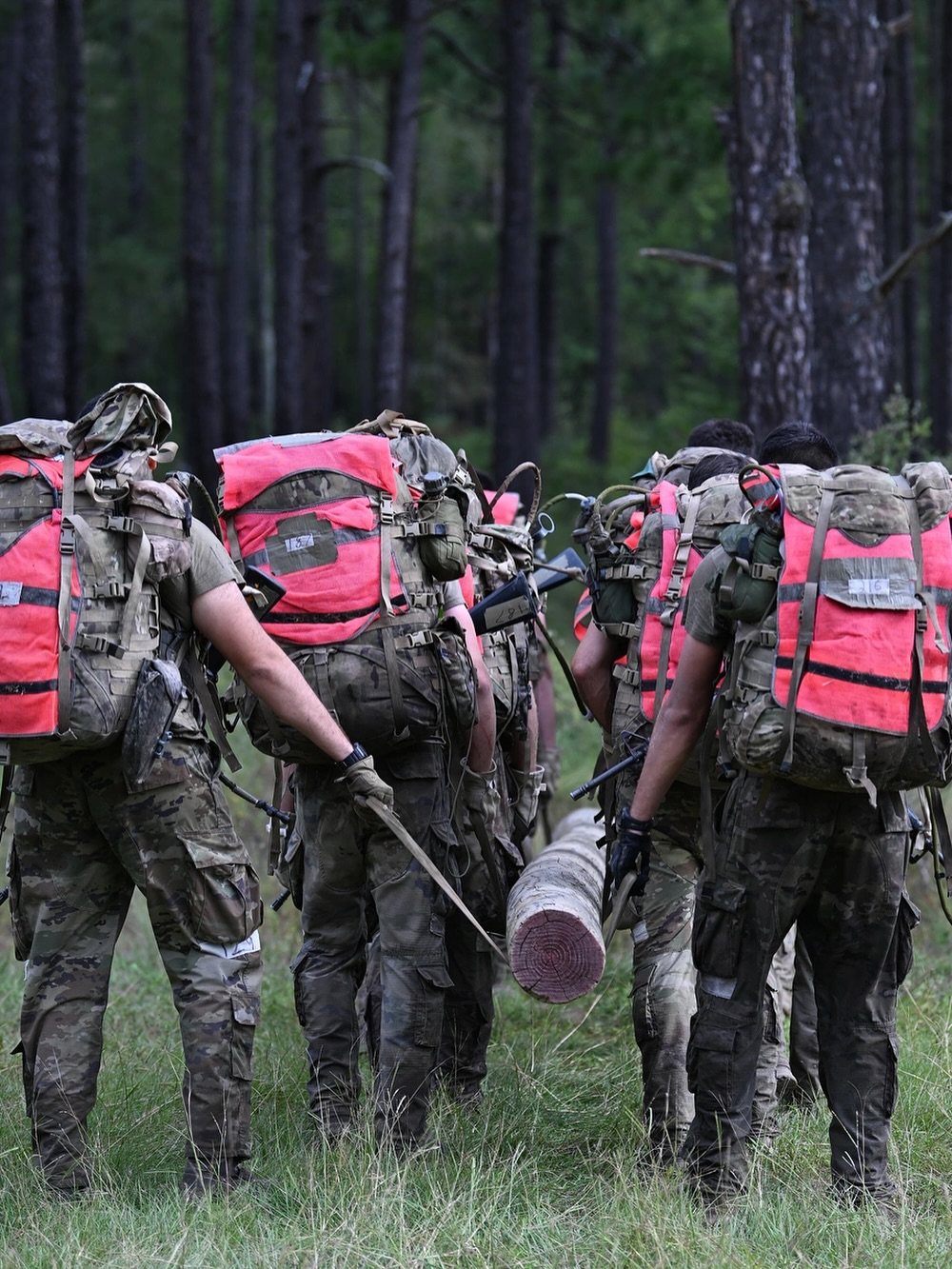
This focus on readiness explains why the exercises are so practical. Endurance work from running translates directly to covering long distances on foot under load. Functional strength translates to carrying heavy gear, lifting casualties, and breaching obstacles. The classic example is the ruck march, marching a set distance with a weighted rucksack on your back, typically 35 to 45 pounds for routine training and significantly heavier for selection courses. The ruck is the single most defining movement of the modern infantry soldier, and it shows up in some form in nearly every branch's tactical pipeline, from Ranger School to Marine Corps infantry training to Air Force Pararescue assessment. PT programming that ignores rucking is not preparing anyone for the actual job.
How Is Military Fitness Officially Measured?
To ensure every service member meets the physical standards mission readiness demands, the military runs regular, formal fitness tests. A military fitness test is not another daily workout, it is a recurring, scored physical exam with documented pass/fail standards, and the results go on the record. Each branch runs its own version: the Army has the AFT, the Marine Corps has the PFT and CFT, the Navy has the PRT, and the Air Force has its own annual assessment. The events differ, but the purpose is the same: provide a clear, objective measurement of a service member's strength, endurance, and durability against the standards their job actually demands.
The most-discussed example is the U.S. Army's Army Fitness Test (AFT), the test most people mean when they say the new PT test. The AFT became the Army's official test of record on June 1, 2025, replacing the Army Combat Fitness Test (ACFT), which had itself replaced the decades-old APFT. The update cut the awkward standing power throw and brought the test down to five events, each chosen to measure the strength, power, and multi-domain capacity a soldier actually needs in combat. The AFT measures functional fitness across five events:
a three-repetition maximum deadlift,
a two-minute set of hand-release push-ups,
the sprint-drag-carry, a five-shuttle event using kettlebells and a weighted sled,
a maximum-duration plank,
and a timed two-mile run.
Scoring runs from 60 points, the minimum to pass, up to 100 points per event, for a maximum of 500 across the five. Most soldiers test against the general standard: at least 60 points per event and 300 total, scored by age and gender. Soldiers in 21 designated combat specialties, including infantry and armor, face a tougher combat standard, a sex-neutral, age-normed scale that requires at least 60 per event and 350 total, phasing in for the active component on January 1, 2026.
Passing a military fitness test is mandatory across every branch, but the score is much more than a pass or fail stamp. PT test results carry significant weight in personnel files, performance evaluations, and promotion boards, and they directly influence the trajectory of a service member's entire career. A maxed-out score does not just signal physical capability, it signals discipline, work ethic, and the kind of professional identity that the military's most demanding assignments require.
Why a PT Test Score Is More Than Just a Number
In the military, a PT test score is a crucial part of every service member's performance review. High scores signal discipline, work ethic, and operational readiness, all qualities promotion boards weight heavily, and they consistently make a soldier, sailor, airman, or Marine more competitive for the next rank. It is one of the few measurable, objective data points a board can use to separate two otherwise-equivalent candidates.
Exceptional fitness opens doors to specialized schools and the military's most demanding jobs. Roles like Army Rangers, paratroopers, Special Forces candidates, Marine Recon, and Air Force Pararescue all require physical performance far above the minimum branch standard, and most of these pipelines publish their own elevated PT entry scores. A high baseline PT score is a non-negotiable prerequisite for these career paths, acting as a hard gatekeeper for the military's most challenging assignments, selection courses do not start with a chance to get fit; they assume you arrived fit.
Conversely, failing to meet the minimum PT test score puts a career on hold. A failed test bars a service member from promotions, blocks attendance at special schools, and triggers mandatory remedial PT programs. Service members get chances to retest, but repeated failures can eventually lead to administrative separation from the service entirely. That consequence chain is exactly why physical readiness is not treated as optional in any branch, it is treated as a core occupational qualification, the same way a marksmanship qualification or a security clearance is.
Do You Have to Be an Athlete Before Basic Training?
The short answer is no, you are not expected to arrive at boot camp as a finished athlete. The whole point of basic training is to systematically build a recruit from a civilian baseline into a physically capable service member who can pass the branch's entry-level PT test and survive the rest of training. The drill instructors expect you to be unfit on day one. That is the design. How long that builds actually takes depends on the branch, and the Navy boot camp timeline is a useful benchmarks for that the process demands week to week.
That said, arriving with a baseline fitness level makes the initial shock dramatically easier to absorb. Recruits who show up already conditioned can focus their attention on learning the military skills basic actually exists to teach, drill, marksmanship, navigation, first aid, branch-specific doctrine, instead of spending every ounce of available energy just surviving the daily PT sessions. A modest pre-basic prep block buys back that cognitive bandwidth and accelerates the transition from civilian to service member. That same principle carriers past basic into job-specific schooling like Advanced Individual Training, where the physical demands do not simply disappear.
A realistic pre-basic fitness goal for someone with no training background looks like this: run a mile without stopping at any pace, perform 15 to 20 strict push-ups in a single set, hold a plank for 60 seconds, and walk three to five miles without significant discomfort. That baseline will not let you ace the branch fitness test on graduation day, but it will keep you from being the recruit who gasses out in week one and spends the next eight weeks playing catch-up. Branch-specific drills help even more, and a set of Air Force BMT workout tips maps directly onto the exercises basic training emphasizes most. For anyone serious about arriving ready, structured beginner-level military fitness programming makes far better use of the prep window than random workouts off social media.
From Morning Workout to Career Foundation
The classic image of military PT, the dawn formation, the cadence, the synchronized push-ups, is only the surface of the system. Physical Training is a daily commitment to mission success, a method for forging team cohesion, and a measurable career metric that follows a service member from boot camp to retirement. PT is the engine that builds a soldier, holds a unit accountable, and defines what professional military fitness actually looks like. Whether the goal is passing a branch fitness test, preparing for basic training, or qualifying for a selection course, the answer starts the same way: structured, intelligent training that respects what the standards actually demand.
***Disclaimer: This content is provided for general informational purposes only. Combat Fitness is not affiliated with the U.S. Department of Defense, and official standards may change at any time. Always consult official military publications for the most up-to-date requirements.***


