
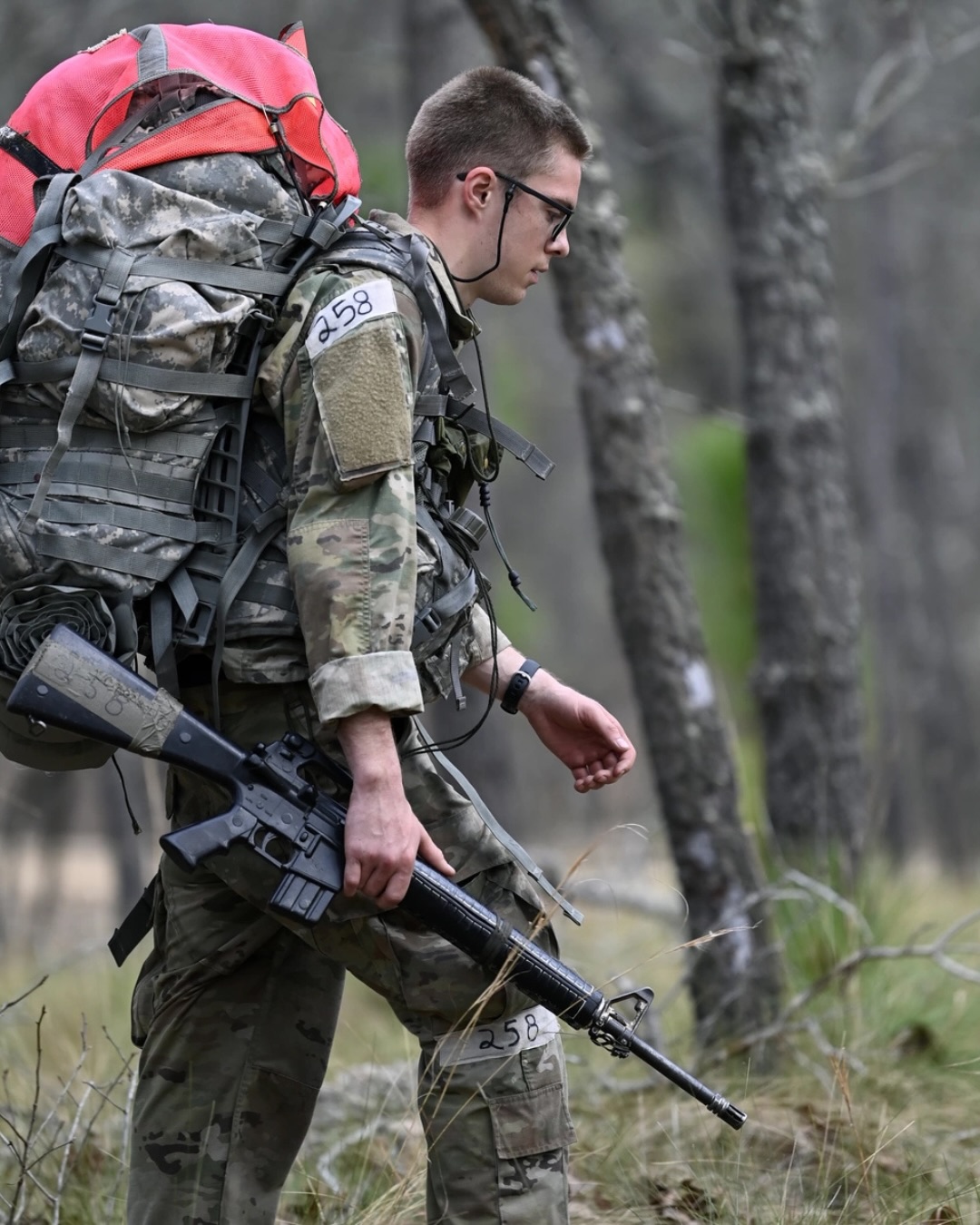
Ruck March: Army Standards, Weight and Pace | Combat Fitness
Ruck March: Army Standards, Weight, Pace and How to Train for One
A ruck march is a timed movement on foot over a set distance while carrying a loaded rucksack, and the US Army uses it as both a training event and a graded standard. If you want the event built into a structured plan, our tactical fitness programs program it for you.
The benchmark most soldiers know is 12 miles in three hours with 35 pounds of dry weight, but that number is not universal. Standards change by school, by badge, and by year. This guide lays out the Army ruck march standards by event with the governing publication named, explains what counts toward the weight, and covers the pace, training, foot care, and injury management that decide whether you finish under the clock.
Key Takeaways:
A ruck march is a graded, loaded, timed foot march. Rucking is the general activity.
The most common Army standard is 12 miles in 3 hours with 35 pounds of dry weight, per USAIS Pamphlet 350-6 for the Expert Infantryman Badge.
Three hours for 12 miles means a 15-minute mile, far faster than the doctrinal tactical march rate of about 4 km per hour.
Weight is checked at the finish on graded events. Finish light and you fail, even under the time.
Most ruck injuries come from too much load, too often, too soon, plus untested boots.
What Is a Ruck March?
A ruck march is a timed foot movement over a fixed distance carrying a loaded rucksack, used across the US military to build and test load-carriage capacity. The Army's doctrinal term is "foot march," and the governing manual is ATP 3-21.18, Foot Marches. Soldiers call it a ruck march, a road march, or simply "the ruck."
Ruck marching matters because it is the closest thing to the job. Soldiers move on foot under load, and no run time or barbell number predicts that capacity as directly. That is why ruck marches show up in basic training, in badge tests, and in every selection course the Army runs. For the wider picture of load work outside the graded event, see the tactical athletes rucking guide.
The Air Force, allied militaries, and civilian events such as the Fan Dance and Dancon marches all run ruck marches, but the Army standard is the one most people train toward.
Ruck March vs Rucking vs Forced March vs Hump: What Is the Difference?
The four terms overlap, but they are not interchangeable. A ruck march is timed and graded. Rucking is the general activity of walking under load. A forced march is a doctrinal term for moving farther and harder than normal. A hump is Marine Corps slang for a loaded movement.
Figure 1.1 - four terms for moving under load, and what separates them. A ruck march is a loaded foot march against a time standard, timed and graded, used in Army badge and selection courses, though the Army's own written term is foot march. Rucking is the general activity of walking under load, with nothing assessed. A forced march is doctrine: one of three methods of tactical movement, and ATP 3-21.18 is specific that it is achieved by adding hours to the marching day rather than by marching faster. A hump is Marine slang for what the schedule calls a conditioning hike, which in recruit training runs five to fifteen kilometres at forty to sixty pounds. Only forced march appears in Army doctrine by name, the term that sounds most official, ruck march, is the one nobody publishes, and the doctrinal four-kilometre-an-hour rate already has the ten-minute hourly halt counted into it. Sources: ATP 3-21.18, Foot Marches, April 2022 edition, paragraph 1-5, superseded by a July 2025 edition; published Marine Corps recruit training references.
ATP 3-21.18 notes that forced marches are normally achieved by adding marching hours per day, not by raising the rate of march. On a training schedule, the term usually just means a hard, fast ruck.
Army Ruck March Standards by School and Event
Army ruck march standards are set by the school or badge that runs the event, not by one Army-wide rule. The most widely used standard is 12 miles in three hours with 35 pounds of dry weight, set for the Expert Infantryman Badge in USAIS Pamphlet 350-6. Check each course's current packing list before you train to a number.
Army ruck march standards (verified September 2026)
Figure 1.2 - Army ruck march standards across eight events, side by side: distance, load, time limit and the governing document behind each. Five of the eight run on the same number, 12 miles in three hours, a flat 15:00 per mile, and five carry the same 35 lb of dry weight in the rucksack, with water, load-bearing equipment and a weapon that is never allowed inside the ruck all riding outside that figure; Ranger School is the only one that states the wet total out loud at 47 lb. Three publish no clock at all: RASP and SFAS withhold theirs as a selection tool, while Basic Combat Training's 16 km (10-mile) march is pass-by-completion. Sources: USAIS Pamphlet 350-6 (30 Aug 2023), TRADOC Regulation 672-9 (24 Jul 2020), MEDCoE Pamphlet 350-10 (1 Jun 2024), TRADOC Regulation 350-6 (8 Dec 2022), Airborne & Ranger Training Brigade via Infantry Magazine, U.S. Army Warrior Training Center, goarmy.com, U.S. Army Special Warfare Center and School.
The regulation behind the EIB event is specific. Candidates must carry 35 pounds of dry weight in the ruck for the entire course, in addition to water and personal equipment. Units must weigh rucks at the finish or run a packing-list layout, and a candidate who finishes light is eliminated even if they beat the time.
Selection courses use the ruck as a filter. RASP includes the 12-miler in Phase 1, and the pre-RASP PT test lists a 12-mile march with a 35-pound ruck alongside a five-mile run in under 40 minutes. SFAS selection does not publish its ruck standards, which is deliberate: candidates do not know the distance or the cutoff, so they have to move at a hard pace without a finish line to pace against.
The 12-Mile Ruck March: The Army Benchmark
The 12-mile ruck march is the benchmark event: 12 miles, three hours, 35 pounds dry, with water and personal kit on top. It appears in the EIB, Ranger School, Air Assault School, and RASP, which is why the same number keeps coming up.
Three hours for 12 miles is a 15-minute mile. Hold 15:00 and you have no margin, so most candidates target 13:30 to 14:30 per mile and bank time early on flat ground. Shorter 4-, 6-, and 8-mile tests and longer 15-mile events follow the same logic.
It also carries weight in special operations. The 12-mile event is a core part of the Army Ranger requirements, and older doctrine set a similar bar: FM 21-18 stated that after a 30-day preparatory period, soldiers could march 12 miles in under three hours loaded to about 60 pounds. This section covers the standard itself; the training build comes later in this guide.
Ruck March Weight: What You Carry
Ruck march weight is usually stated as dry weight: the rucksack and its contents before water and consumables. Total weight is higher. Ranger School's 35 pounds dry, for example, becomes about 47 pounds once water is added, and that is before the rifle and fighting load carrier.
Graded weight is fixed by the standard. Training weight should start below it and build toward it, because load drives most ruck injuries. Doctrine has long capped the numbers: FM 21-18 set a fighting load of no more than 48 pounds and an approach march load of no more than 72 pounds, about 45 percent of body weight for a fit soldier. ATP 3-21.18 frames the issue as how much a soldier can carry without losing combat effectiveness.
The physiology behind those limits is covered in strength endurance for load carriage. Rucking to lose weight works because loaded walking raises energy cost, but the load that burns the most calories is not the load that trains the standard best.
What Pace Do You Need to Hit the Ruck March Standard?
A 12-mile, three-hour standard requires an average pace of 15 minutes per mile, or 4 miles per hour. That is far quicker than the doctrinal march rate in ATP 3-21.18, which plans roughly 4.8 km per hour moving and 4 km per hour overall once a 10-minute hourly rest is included.
Most soldiers cannot walk a 15-minute mile under load for three hours, so they shuffle. A short, low-impact shuffle on flats and downhills, with a fast walk on the climbs, holds pace without the pounding of a full run. Research explains why pace falls apart late: in a 2024 study of 82nd Airborne infantrymen carrying about 87 pounds, fatigue shortened stride length, widened stride width, and increased torso sway. A wider, wobblier gait wastes energy and loads the hips and knees unevenly, so your last three miles need to be trained, not hoped for.
How to Train for a Ruck March
Train for a ruck march by building load and distance gradually, one variable at a time, with one long ruck per week and pace work at standard weight in the final weeks. Here is the short version:
Start with a ruck well under the graded weight and a distance you can finish comfortably.
Ruck once a week, and add either distance or weight, never both in the same week.
Build a long ruck toward the test distance, with progressive marches that FM 21-18 set at 5, 10, 15, and 20 miles.
Add pace work at the graded weight in the last month to learn your 14-minute mile.
Taper in the final week so your feet and legs arrive fresh.
FM 7-22, Holistic Health and Fitness, lays out a 20-week ruck marching progression, which tells you how long the Army expects the build to take. Basic training candidates face progressive marches, so arrive able to walk several miles under a light pack.
We cover the full week-by-week build in our ruck training progression, so it is not repeated here.
Boots, Feet and Ruck March Packing List
Your feet decide the ruck march before your lungs do. Break boots in over several weeks of rucking, never on test day. Use a moisture-wicking sock system, tape known hot spots before you start, and stop to fix a hot spot the moment you feel it. ATP 3-21.18 includes a full appendix on foot care, blister prevention, and sock and boot fit.
Pack the ruck so the load sits high and tight against your back. Heavy items go close to the spine, and nothing should shift as you move. After the march, dry your feet, check for blisters, and treat any you find per your unit's medical guidance. For boot and pack recommendations, see boots, packs and plates.
Ruck March Events You Can Enter
Civilians and service members can enter three main kinds of ruck march events: foreign military badge marches, memorial marches, and charity rucks. Schedules change every year, so check each organizer's official site for current dates rather than trusting a list.
Foreign badge marches: The best known is the Norwegian Foot March: 30 km with an 11 kg pack, per the Norwegian Armed Forces. The German Armed Forces Proficiency Badge includes a march of up to 12 km in 120 minutes with at least 15 kg. The Nijmegen Four Days Marches requires 40 km a day for four days with at least 10 kg for most male military walkers. Czech proficiency marches follow a similar model.
Memorial marches: The Bataan Memorial Death March at White Sands Missile Range runs a heavy division carrying 35 pounds. Memorial Day, Veterans Day, and KIA memorial rucks run in many cities.
Charity rucks: Mission 22 and veteran suicide-awareness rucks, including events like the Chicago Veterans ruck march, raise funds and awareness at a range of distances.
To find a ruck march near you, check local veterans' organizations and installation MWR pages.
Common Ruck March Mistakes and Injuries
The same five mistakes cause most ruck march failures and injuries:
Going out too fast. The first mile feels easy, and the cost arrives at mile nine.
A low, loose ruck. A sagging load pulls you backward and forces a forward lean that loads the lower back.
Untested boots. New boots and long distance produce blisters.
Ignoring hot spots. A hot spot fixed at mile three is a blister avoided at mile eight.
Over-striding under load. Long strides with a heavy ruck overload the shins and hip flexors.
Military research has tracked these for decades. Studies of long road marches find foot blisters are the most common injury, with back complaints, metatarsalgia, and rucksack palsy also reported. Load and frequency are the levers you control, which is why injury risk under load falls when your general conditioning is strong.
Where Rucking Fits in a Tactical Program
Ruck once a week for most training blocks, and twice only in a short, targeted build. Rucking adds leg and foot stress on top of your running and strength work, so heavy ruck weeks need lighter running weeks. Most people ruck too heavy and too often, then wonder why their shins hurt and their run times drop.
The best programs balance rucking, running, and strength. If you are comparing options, start with choosing a ruck training program, which covers ruck-specific plans. If you need to build strength and aerobic capacity together, hybrid strength and endurance programs cover that middle ground. For a broader view, our guide to choosing a military fitness program walks through how to match a plan to your job or selection.
FAQ: Frequently Asked Questions
What is a ruck march?
A ruck march is a timed foot march over a set distance carrying a loaded rucksack. The US Army uses it as both a training event and a graded standard for badges, schools, and selection. Doctrine calls it a foot march and covers it in ATP 3-21.18.
What is the difference between a ruck march and rucking?
A ruck march is timed and graded against a standard, with a fixed distance and a verified weight. Rucking is the general activity of walking under load for training or fitness, with no set standard. Every ruck march is rucking, but most rucking is not a ruck march.
What are the Army ruck march standards?
The most common Army standard is 12 miles in three hours or less with 35 pounds of dry weight, per USAIS Pamphlet 350-6 for the EIB. Ranger School and Air Assault School use a similar 12-mile, three-hour event. Standards vary by school and change over time, so check the current course documents.
How much weight do you carry on a ruck march?
Most graded Army ruck marches require 35 pounds of dry weight in the rucksack, plus water and personal equipment on top. That brings total weight closer to 45 to 50 pounds. Graded events weigh rucks at the finish, and finishing under weight fails the event.
What is the standard time for a 12-mile ruck march?
The standard time for a 12-mile ruck march is three hours or less, which works out to a 15-minute mile. Most candidates aim for 13:30 to 14:30 per mile to build a buffer for hills and stops.
How do you train for a ruck march, and what boots should you wear?
Build load and distance gradually, ruck once a week, and add pace work at the graded weight in the final month. Wear boots you have broken in over several weeks of rucking, with a moisture-wicking sock system. Never test new boots on a graded ruck march.
A ruck march is simple to describe and hard to pass: a fixed distance, a verified weight, and a clock that does not care how you feel at mile ten. Know the standard for your school, build toward it one variable at a time, and protect your feet as carefully as your pace. Then build the capacity on purpose. Start a structured plan with Combat Fitness and arrive at the start line ready to finish under time with the weight still on your back.
References:
Headquarters, Department of the Army. ATP 3-21.18, Foot Marches. April 2022.
US Army Infantry School. USAIS Pamphlet 350-6, Expert Infantryman Badge. 15 December 2022.
Headquarters, Department of the Army. FM 21-18, Foot Marches, Chapter 5: Soldier's Load Management and Training for Foot Marches. June 1990 (superseded by ATP 3-21.18).
Headquarters, Department of the Army. FM 7-22, Holistic Health and Fitness. October 2020.
Bloch AE, Steckenrider JJ, Zifchock RA, Freisinger GM, Bode VG, Elkin-Frankston S. Effect of Fatigue on Movement Patterns During a Loaded Ruck March. Military Medicine. 2024;189(1-2):e15-e20.
Knapik JJ, Reynolds KL, Harman E. Soldier load carriage: historical, physiological, biomechanical, and medical aspects. Military Medicine. 2004;169(1):45-56.
Knapik J, Reynolds K, Staab J, Vogel JA, Jones B. Injuries associated with strenuous road marching. Military Medicine. 1992;157(2):64-67.
Reynolds KL, White JS, Knapik JJ, Witt CE, Amoroso PJ. Injuries and risk factors in a 100-mile (161-km) infantry road march. Preventive Medicine. 1999;28(2):167-173.
Knapik JJ, Reynolds KL, Duplantis KL, Jones BH. Friction blisters: pathophysiology, prevention and treatment. Sports Medicine. 1995;20(3):136-147.
Knapik JJ, Reynolds K, Barson J. Risk factors for foot blisters during road marching. Military Medicine. 1999;164(2):92-97.
Military load carriage effects on the gait of military personnel: a systematic review. Applied Ergonomics. 2021.
US Army. Army Rangers (RASP and pre-RASP requirements).
US Army. Air assault course maximizes Soldiers potential in units. Army.mil, 31 January 2023.
US Army. Earning the Army's Expert Field Medical Badge. Army.mil, 30 August 2022.
US Army. Trainees "Forge" into Soldiers during Basic Combat Training's new exercise. Army.mil, 16 July 2018.
Norwegian Armed Forces. The Norwegian Foot March (NFM).
International Four Days Marches Nijmegen. Military individual distances.
German Armed Forces Badge for Military Proficiency (foot march requirements).
White Sands Missile Range. Things to know for the Bataan Memorial Death March.
US Army Special Forces selection and training (SFAS overview, "the Trek").
Disclaimer: This article is for general education and does not replace official course documents, command guidance, or advice from a qualified medical professional. Ruck march standards vary by school and change over time; confirm current requirements with your unit or course before training to a number. Load carriage carries injury risk. Stop and seek medical care for persistent pain, numbness, or foot injury.


