
Strength-Endurance for Load Carriage: Train for Heavy Rucks
Why Rucking Breaks Athletes Who Can Deadlift
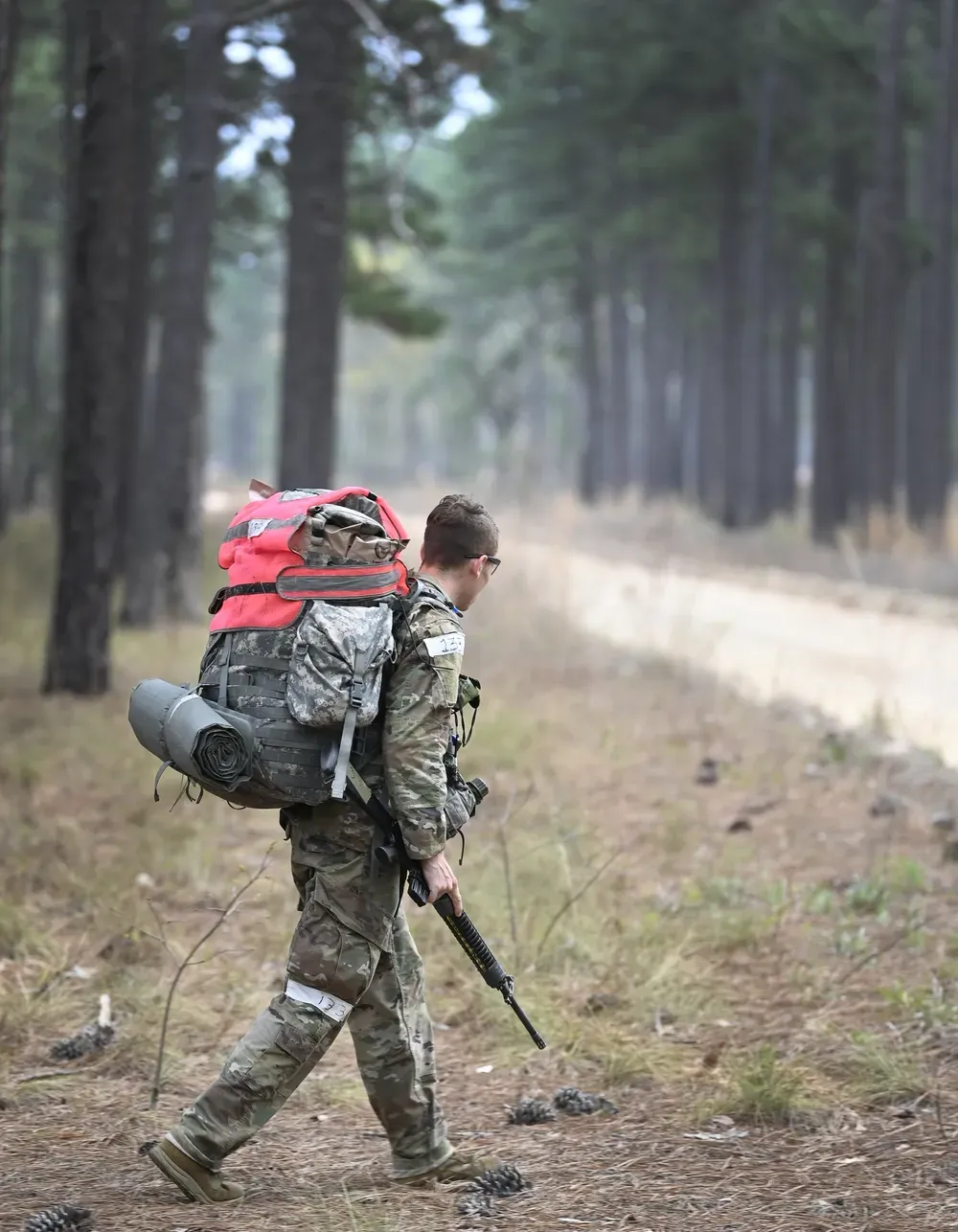
Load carriage is the defining physical demand of tactical work. Soldiers move under 50 to 80 lb rucks for miles, firefighters operate in 60+ lb turnout gear and SCBA, and law enforcement officers carry 20 to 30 lb duty loads through full shifts. These loads are not single-effort lifts. They must be carried for distance, for time, and across repeated efforts under fatigue. That demand is what strength-endurance for load carriage trains the body to meet.
This is why raw strength alone fails under load. The ability to deadlift heavy once does not guarantee an athlete will finish a 12-mile ruck, climb 30 flights in gear, or stay operational on hour six of a patrol. Tactical performance is governed by strength-endurance, the capacity to produce force repeatedly, under fatigue, while maintaining posture and gait. Programs built around that exact demand are available through our CF ONE training programs where load-carriage-relevant training sits inside every progression.
The Load Carriage Progression
The progression that matters is not how fast you can add weight. It is how slowly you have to, because connective tissue sets the pace and it is slower than your lungs.
Figure 1.1 - A twelve-week load carriage progression checked against Army Public Health Center, DoD HPRC and NSCA TSAC guidance. Pace targets hold exactly: fifteen minutes per mile is the 12-mile tactical foot march standard of twelve miles in three hours with a minimum 35 lb rucksack, and eighteen to twenty minutes per mile matches the doctrinal 4.8 kph march rate. Two figures do not. The pack weight column gives percentages and pounds as equivalents when they are computed on a 100 lb bodyweight - for a 180 lb athlete, 20 to 25 percent is 36 to 45 lb and 30 to 35 percent is 54 to 63 lb, heavier than the Army's 48 lb fighting load. And the prescribed two to three ruck sessions per week is eight to thirteen marches a month against a published ceiling of four, with HPRC and NSCA TSAC both recommending one march every seven to fourteen days. Reference points: Army fighting load 30 percent bodyweight or 48 lb; approach march load 45 percent or 72 lb. Sources: Defense Centers for Public Health, DoD Human Performance Resources by CHAMP, NSCA TSAC Report, Army foot march doctrine, Bohm et al. tendon meta-analysis, Buist et al. graded progression trial. Verify standards against current unit guidance before official testing.
The rules that govern the table:
Start at 20 to 25% of bodyweight, not at event weight. A true beginner starts nearer 10%
Add no more than 5 to 10% of load or distance per week, and never both in the same week
Cap at 2 to 3 ruck sessions weekly. More is where injuries come from, not where fitness comes from
Pull back every fourth week. The deload is not a rest week you have earned. It is the week the adaptation actually consolidates
Progress load first, then distance, then pace. Never all three
The standards you are training toward, so you know what the table is building to:
US Army standard: 12 miles at 35 lb, under 3 hours (15 min/mile)
Sapper Leader Course: 12 miles at 35 to 45 lb, 3 hours
Norwegian Foot March: 18.6 miles (30 km) at 24.2 lb (11 kg), 4 hours 30 minutes
Ranger School Darby phase: field movements at 45 to 65 lb
For candidates preparing specifically for military selection courses and load-carriage-intensive pipelines like SFAS, RASP, and BUD/S, our selection prep programs collection covers the full range of purpose-built preparation paths.
What Breaks, and at What Load
Figure 1.2 - Four load carriage bands as a percentage of bodyweight, with the 180 lb equivalents, the limiting quality and the training response for each, checked against the load carriage biomechanics literature. All four conversions are arithmetically correct: 20 percent is 36 lb, 30 percent is 54 lb, 45 percent is 81 lb, 50 percent is 90 lb. Three claims need adjustment. Postural compensation is not minimal under 20 percent - trunk forward lean increases more than 5 degrees at just 10 percent of bodyweight and does not increase further to 20 percent, and forward head posture is established from around 15 percent. Metabolic cost does not rise sharply between 30 and 45 percent - a Military Medicine study testing exactly those two loads over complex terrain found no inflection point, and metabolic rate increases linearly with added load. And only one boundary in the table has independent support: 30 percent of bodyweight is both the published safety ceiling for load carriage and the Army's doctrinal fighting load, while 20 percent and 45 to 50 percent are conventions rather than measured breakpoints. Approach march load is 45 percent of bodyweight; full structural firefighting PPE, SCBA and external load reaches 90 lb. Sources: Biomechanics of Military Load Carriage and Resulting Musculoskeletal Injury review, ISBS 2008 backpack loading study, Metabolic Costs of Military Load Carriage over Complex Terrain (Military Medicine 2018), Pandolf equation literature, Army foot march doctrine, NSCA TSAC Report, Fire Engineering.
The band that matters for most tactical athletes is 30 to 45% of bodyweight. That is where a 50 to 80 lb ruck lands for a typical soldier, and it is the band where an athlete with a good aerobic engine and no trunk endurance will degrade regardless of how fit they are on a run test.
What Is Strength-Endurance in Load Carriage?
Strength endurance is the ability to:
Sustain muscular effort over time
Repeatedly produce force
Maintain posture under load
Continue performing while fatigued
In the context of load carriage, this means:
Carrying a ruck for extended distances
Climbing stairs with gear
Advancing under equipment weight
Moving efficiently under fatigue
Research from Knapik and colleagues at the U.S. Army Research Institute of Environmental Medicine shows that load carriage places compounding stress on both the muscular and cardiovascular systems, with metabolic cost rising disproportionately as load and duration scale together. That same body of work associates higher aerobic fitness with better load carriage performance and lower injury risk, which is why the aerobic base in Table 1 is not optional.
This makes strength-endurance one of the most decisive qualities for the tactical athlete, more decisive in many operational contexts than maximal strength or raw aerobic capacity alone.
Why Maximal Strength Alone Fails Under Sustained Load
Maximal strength remains essential for the high-force, single-effort moments tactical work inevitably produces:
Lifting heavy equipment
Dragging or carrying casualties
Handling sudden high-force tasks
But load carriage is rarely a single effort. It usually involves:
Continuous movement
Repeated steps
Long durations
Moderate loads
Training only for maximal strength, with no repeated-effort work underneath it, produces predictable failures under sustained load:
Rapid fatigue
Poor posture under load
Slower movement speeds
Increased injury risk
Multiple studies in military populations confirm that strength and endurance contribute jointly to load carriage performance and to injury reduction across training cycles. Neither quality alone is protective at operational loads. For athletes evaluating which military fitness program actually fits their load carriage preparation timeline, goals, and experience level, the military fitness program buying guide walks through exactly how to choose the right option.
Posture Under Load: The Hidden Performance Limiter
Most athletes who fail under prolonged load do not fail because their legs give out. They fail because their posture collapses.
Coaches who have watched candidates drop out of selection events repeatedly observe the same sequence: forward head, rounded thoracic spine, anteriorly tilted pelvis, shortened stride, and accelerating fatigue thereafter.
When the trunk flexors and extensors fatigue, the spine rounds forward. This shifts the load distribution away from the hips and onto the lower back and knees. Injury risk rises. Energy cost rises. Pace slows. Each of those three feeds the other two, which is why postural failure late in a ruck is not gradual. It compounds.
The athletes who maintain posture under load longest are not necessarily the strongest in raw terms. They are the athletes with the best trunk endurance, meaning the ability to sustain a stable spine position across the duration of the task rather than to brace hard once.
This is why effective core training for load carriage is not crunches, sit-ups, or unloaded planks. It is anti-flexion, anti-extension, and anti-rotation work performed under sustained external load. Loaded carries, single-arm farmer walks, suitcase carries, Pallof presses under load, and weighted plank variations build the specific trunk endurance that posture maintenance under load demands. Bodyweight ab work cannot replicate it, because the stimulus that matters is the sustained external load itself.
The practical framework for managing the rate at which that capacity is built across a full selection preparation cycle is covered in training load management during selection prep, which addresses exactly how to structure progressive load so tissue adapts rather than breaks down.
The Physiology of Load Carriage Breakdown
Load carriage stresses several systems at once.
Muscular Demands
Primary muscles involved:
Quadriceps
Glutes
Hamstrings
Calves
Core
Upper back and shoulders
These muscles must:
Stabilize the body under load
Absorb repeated impact
Sustain effort over time
The demand is not evenly distributed across terrain. Descending under load is the most damaging phase of any ruck, because the quadriceps and the anterior shin are working eccentrically to control the mass on every step. Uphill hurts more and damages less; downhill feels easier and does more tissue damage. Athletes who train exclusively on flat ground and then meet a course with descent arrive with the wrong tissue prepared.
Cardiovascular Demands
As load increases:
Heart rate rises
Oxygen demand increases
Energy expenditure rises significantly
Research by Pandolf and colleagues established the predictive equations still used today to model how load, grade, terrain and speed combine to determine metabolic cost. The finding that matters here is that cost does not scale linearly with load. Doubling the weight on your back costs you more than double the energy, and the penalty grows as grade and terrain difficulty increase.
The equation itself was developed and validated for standing and slow walking, so its precision degrades at faster paces. The principle holds regardless of pace, and it is the reason load carriage cannot be trained as a pure strength task or a pure endurance task. It is a hybrid demand that requires both qualities developed in parallel.
The Physical Demands of Load Carriage on the Tactical Athlete
Load carriage stresses several systems at once.
Muscular Demands
Primary muscles involved:
Quadriceps
Glutes
Hamstrings
Calves
Core
Upper back and shoulders
These muscles must:
Stabilize the body under load
Absorb repeated impact
Sustain effort over time
The demand is not evenly distributed across terrain. Descending under load is the most damaging phase of any ruck, because the quadriceps and the anterior shin are working eccentrically to control the mass on every step. Uphill hurts more and damages less; downhill feels easier and does more tissue damage. Athletes who train exclusively on flat ground and then meet a course with descent arrive with the wrong tissue prepared.
Cardiovascular Demands
As load increases:
Heart rate rises
Oxygen demand increases
Energy expenditure rises significantly
Research by Pandolf and colleagues established the predictive equations still used today to model how load, grade, terrain and speed combine to determine metabolic cost. The finding that matters here is that cost does not scale linearly with load. Doubling the weight on your back costs you more than double the energy, and the penalty grows as grade and terrain difficulty increase.
The equation itself was developed and validated for standing and slow walking, so its precision degrades at faster paces. The principle holds regardless of pace, and it is the reason load carriage cannot be trained as a pure strength task or a pure endurance task. It is a hybrid demand that requires both qualities developed in parallel.
Core Components of Strength Endurance for Load Carriage
1) Base Strength
Maximal strength forms the foundation that every other quality is built on top of. Without a credible strength base, endurance training simply builds an athlete who can be tired for longer.
Stronger muscles:
Handle loads more efficiently
Reduce joint stress
Delay fatigue
Key areas:
Lower-body strength
Core stability
Upper-back strength
Grip strength
2) Muscular Endurance
Muscular endurance is what converts a strong athlete into a durable one. It allows:
Repeated steps under load
Sustained posture
Long-duration efforts
Strength-endurance for load carriage is trained specifically with:
Moderate loads (typically 50–70% of 1-rep-max)
Higher repetitions (8–20 reps per set, often more for carries)
Short rest intervals (30–90 seconds between sets)
Density work and circuits that accumulate fatigue across multiple movements
3) Aerobic Support
Aerobic capacity helps:
Sustain long efforts
Recover between tasks
Reduce fatigue accumulation
Higher aerobic fitness is associated with improved load carriage performance and lower injury risk (Knapik & Reynolds, 2004).
How to Train Strength Endurance for Load Carriage
Effective strength-endurance training for load carriage integrates three elements that work in parallel rather than in sequence. Treating them as separate phases (a strength block, then an endurance block, then a ruck block) is one of the most common programming errors in tactical fitness, and one of the most reliable ways to underperform on selection day.
Strength foundation work should include heavy posterior chain training: deadlifts, Romanian deadlifts, trap bar carries, and hip-dominant movements that build the glutes, hamstrings, and lower back that bear the majority of rucking load. Upper back work, including rows, face pulls, and loaded carries, supports the postural endurance required to keep the pack high and tight.
Strength endurance conditioning should use moderate loads at higher densities: farmer carries, suitcase carries, sandbag carries, and loaded step-ups performed in circuits with short rest intervals. These teach the body to sustain force production across repeated efforts under accumulated fatigue.
Loaded carriage practice, meaning actual progressive rucking under realistic pack weight, builds the specific tissue tolerance and movement pattern that no amount of gym work fully replicates. Bone mineral density in the metatarsals and tibia, plantar fascia resilience, Achilles and posterior tibialis tolerance, and ankle stability under load all require direct exposure that only loaded walking provides. Table 1 above gives the progression.
A note on the equipment, because it is not a side issue. More rucks are ended by feet than by fitness.
Break boots in before you load them. Never take new footwear into a long ruck, and never into an event
Pack fit matters more than pack quality. The hip belt should carry the majority of the load, sitting on the iliac crest, with shoulder straps stabilizing rather than bearing. A pack riding low pulls you into the forward-lean posture described above before fatigue has done any of the work
Manage hot spots the moment you feel them, not at the next scheduled stop. A hot spot addressed at mile three is a non-event. The same spot at mile eight is a blister that changes your gait, and an altered gait under load is how a foot problem becomes a knee or hip problem
Train in the boots and pack you will use, not in trainers with a weight vest
The full framework for structuring these elements together is covered in a framework for strength-endurance balance, which maps exactly how to prioritize, sequence, and progress strength and endurance qualities across a training cycle so neither undermines the other.
Common Training Mistakes
Only Training Strength
Heavy lifting alone:
Does not prepare the body for long-duration loads
Leaves endurance gaps
Increases fatigue during operations
Only Doing Long Cardio
Cardio-only training, running for distance with no concurrent loading or resistance work, actively erodes the qualities that protect a load-bearing athlete:
Reduces load tolerance and muscular reserve under pack weight
Increases overuse injury risk in the feet, shins, and knees
Limits sustained performance under equipment weight beyond ~30 minutes
Strips the postural strength that prevents trunk collapse late in a ruck
Increasing Load Too Quickly
Sudden spikes in:
Pack weight
Distance
Frequency
are a major cause of overuse injuries in tactical populations.
Gradual progression is critical.
Managing Load Accumulation During Preparation Phases
One of the most common and damaging mistakes in load carriage preparation is treating rucking as cardio or general conditioning rather than as a progressive, dose-managed training stimulus. Rucking is a loaded resistance exercise performed against gravity over thousands of repetitions per session. Programmed like cardio, it grinds connective tissue down. Programmed like a strength stimulus with appropriate progression, it builds the most durable athletes in the room.
Athletes who ruck frequently and heavily without managing total accumulated load are not building durability. They are consuming it. Stress fractures, shin splints, Achilles tendinopathy, and knee pain in tactical populations are frequently the result of ruck volume spikes that exceed tissue adaptation rates.
The principle is simple: tissue adapts to load far more slowly than the systems that make you feel fit. A candidate can feel prepared for a demanding ruck long before their bones and tendons are ready.
The mismatch is real and it has a mechanism. The fast-adapting side of endurance is largely peripheral, meaning changes inside the muscle cell such as mitochondrial content and capillary density, and much of it lands within the first two to four weeks of consistent training. That is what produces the feeling of readiness. Bone remodeling and tendon collagen turnover operate on a schedule measured in months, not weeks, and no amount of aerobic fitness accelerates them.
So the athlete who feels ready at week four and rucks accordingly is loading tissue that is nowhere near caught up. That gap is where the stress fractures live.
If you already have pain, stop reading this as a training article. Localized bone pain that worsens with loading, shin pain that persists at rest, Achilles pain that is worse on the first steps of the morning, or any pain that changes how you walk are not training problems to be progressed through. See a qualified medical professional, ideally one who works with tactical or military populations, before adding any load. Bone stress injuries in particular get dramatically worse and dramatically more expensive when trained through, and the progression rules on this page assume a healthy athlete building from a healthy baseline.
This is why load management is not a programming preference. It is an injury-prevention requirement for any athlete building toward selection courses, deployment cycles, or sustained high-volume operational demands. For candidates preparing specifically for military selection, hybrid training for military selection candidates addresses the exact strength-endurance balance required to meet the sustained load demands of selection environments without arriving injured.
Understanding what is work capacity gives the performance outcome of this preparation its full definition, describing what well-developed strength-endurance for load carriage is ultimately building toward, and why it is the quality that separates athletes who sustain operational output across long days from those who degrade rapidly under accumulated demand. For athletes whose training history has produced durability debt through years of accumulated load mismanagement, durability debt in military training explains how that debt accumulates silently and what it costs to address before it surfaces as a selection-ending or career-ending injury.
Practical Takeaways
To build strength endurance for load carriage:
Develop a strong strength foundation
Include strength endurance circuits weekly
Maintain aerobic conditioning
Perform regular load carriage sessions
Progress load gradually over time
Load carriage is not about one heavy effort. It's about sustaining performance under weight for extended periods.
Strength-endurance is what allows tactical athletes to move efficiently, resist fatigue, and stay operational under load, not for one effort, but across the full duration of a mission, shift, or selection event. Understanding what is strength-endurance gives every athlete reading this post the complete physiological definition of the quality this post has been building toward, explaining what happens at the neuromuscular and metabolic level when strength-endurance is tested under real load carriage demands.
Frequently Asked Questions
How often should I ruck?
Two to three sessions per week, and two is enough for most athletes who are also lifting and running. Rucking is a loaded resistance stimulus, not cardio, and it needs to be recovered from like one. More frequency is the single most common way athletes generate overuse injuries in preparation.
How much weight should I start with?
Twenty to 25% of bodyweight for a trained athlete, closer to 10% if you have never rucked. Start below what you think you can handle. The limiting factor is your tendons and bones, and they give you no warning before they complain.
How fast should I add weight?
No more than 5 to 10% per week, and never add load and distance in the same week. If you are training toward a 35 lb standard from 20 lb, that is a build of roughly eight weeks, not two.
How long does it take to be ready for a 12-mile ruck?
Twelve weeks from a reasonable base is a realistic build to the Army standard of 12 miles at 35 lb under three hours. You can get cardiovascularly ready faster than that. Your connective tissue cannot, which is the entire argument of this article.
Should I run or ruck to prepare for rucking?
Both, and they do different jobs. Running builds the aerobic base that determines your recovery between efforts. Only rucking builds the specific tissue tolerance, the gait pattern under load, and the trunk endurance that decides whether you finish. Running alone leaves you fit and fragile.
Why do my shoulders hurt more than my legs?
Usually a pack fit problem rather than a fitness problem. The hip belt should be carrying the majority of the load on the iliac crest, with the shoulder straps stabilizing. A pack riding too low transfers load onto the shoulders and pulls you into forward lean, which then accelerates the postural collapse described above.
Is rucking bad for your knees?
Progressed properly, no. Progressed badly, yes, and the mechanism is usually postural rather than direct. When the trunk fatigues and the spine rounds forward, load shifts off the hips and onto the lower back and knees. The knee pain is the symptom; the trunk endurance is the cause. Persistent knee pain should be assessed by a qualified professional rather than trained through.
References
Knapik, J. J., & Reynolds, K. L. (2004). Soldier load carriage: Historical, physiological, biomechanical, and medical aspects. Military Medicine, 169(1), 45-56.
Pandolf, K. B., Givoni, B., & Goldman, R. F. (1977). Predicting energy expenditure with loads while standing or walking very slowly. Journal of Applied Physiology, 43(4), 577-581.
Gledhill, N., & Jamnik, V. K. (1992). Characterization of the physical demands of firefighting. Canadian Journal of Sport Sciences, 17(3), 207-213.


