
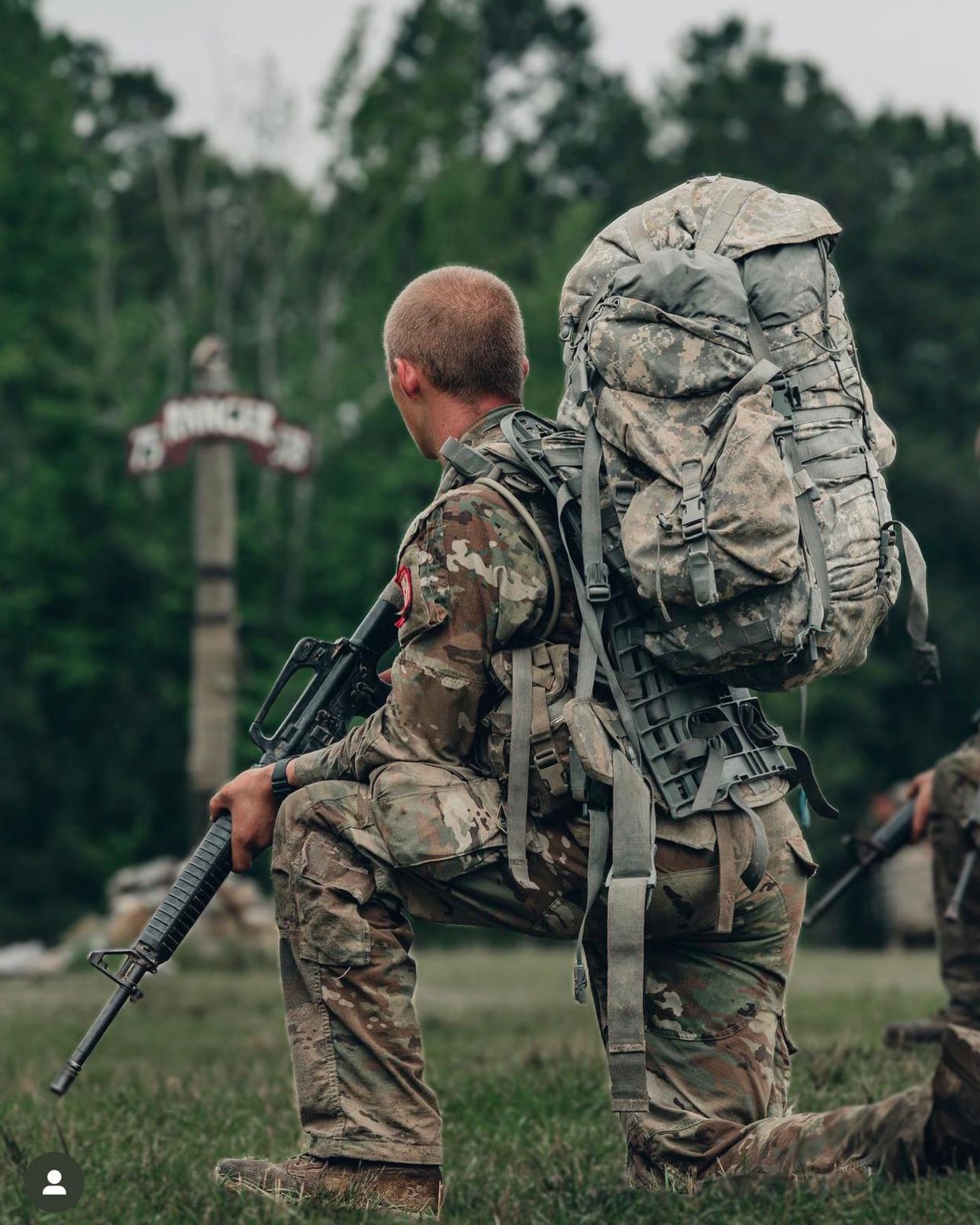
Norwegian Foot March: Standards, Badge Wear and Training
Norwegian Foot March: Standards, the Badge, and How to Train for It
The Norwegian Foot March (also called the Norwegian ruck march) is an 18.6-mile (30 km) march carrying a rucksack of at least 11 kg (about 24 pounds) against a time limit set by age and sex. Finish inside the standard at a sanctioned event and you earn the Marsjmerket, a Norwegian badge that US Army soldiers are authorized to wear on the service uniform. That badge is why most soldiers sign up, and it is why we treat it as the center of this guide. If you want the ruck work programmed for you instead of piecing it together, our tactical fitness programs build it into a structured plan.
Below you get the full time table by age and sex, the badge grades, current AGSU and ASU placement rules, and a free 12-week training progression.
Key Takeaways:
The Norwegian Foot March is 30 km (18.6 miles) with a rucksack that must weigh at least 11 kg (24 lbs) at both the start and the finish.
Men aged 21 to 34 have 4 hours 30 minutes; women in the same bracket have 5 hours 15 minutes. Every bracket is in the table below.
Your first completion earns the bronze badge, completions two through four earn silver, and the fifth earns gold, with one award per year.
The Army authorizes one foreign badge on the AGSU or ASU, and the 1.5-inch Norwegian badge is authorized for wear per the HRC foreign badge chart dated March 21, 2025.
Feet, not lungs, stop most people. Train the ruck progressively for 8 to 12 weeks and break in your boots before event day.
What Is the Norwegian Foot March?
The Norwegian Foot March is a 30-kilometer loaded march, sanctioned by the Norwegian Armed Forces, that tests whether you can move a rucksack a long distance at a steady military pace. It is open to military and civilian participants at approved events.
It started in 1915 as an annual test of marching endurance for Norwegian soldiers. Today the most visible participants are Americans: Army ROTC detachments, active-duty brigades, and units deployed across Europe host sanctioned marches every year, and more than 14,800 US soldiers attempted it in 2022 alone.
The Norwegian ruck march, the Norwegian ruck, the Norwegian footmarch, and the common misspelling "Norweigan foot march" all refer to this same event. The core rules: wear the field uniform with military-grade boots, carry a military-grade rucksack, finish inside your time standard (running is allowed), and accept no help beyond the official timing, weigh-in, water, and first-aid stations.
Norwegian Foot March Standards: Distance, Weight, and Time
The Norwegian Foot March standards are 30 km (18.6 miles), a minimum 11 kg (24 lb) rucksack, and a time limit ranging from 4:30 to 6:00 depending on age and sex. The table below reflects the current guidelines from the Norwegian Defence Attaché office, verified September 2026.
Distance:
How long is the Norwegian ruck march? It is 30 kilometers (18.6 miles) on a measured route, usually roads or firm trails.
Weight:
The rucksack and its contents must weigh at least 11 kg (24.25 lb) on the scale at the start line and again at the finish line. That second weigh-in is the rule people miss. Water and food you consume on the route leave the pack, so if you start at exactly 11 kg and drink your way down, you fail at the finish. Pack dead weight (a sandbag or plate) to hit 11 kg dry, then carry water on top of it. A rifle is no longer required, and the official Norwegian guidance allows a carried weapon to count toward the weight.
Time:
The time limits reward the prime-age bracket with the tightest standard and loosen from there.
Norwegian Foot March time standards by age and sex (30 km, 11 kg minimum)
Figure 1.1 - Norwegian Foot March time standards by age and sex: 30 kilometres, 18.64 miles, carrying 11 kilos that must weigh in at both the start and the finish. Men run from 4:30 in the 21-to-34 band out to 5:15 at sixty and over; women from 5:15 to 6:00 across the same bands, with every limit converted to the pace it demands per mile and per kilometre. The standard is not a straight line down with age, it tightens into the middle and eases in both directions, so an eighteen-year-old is given the same allowance as a forty-two-year-old, and a man of sixty is held to the same 5:15 as a woman of thirty. Conditions can void the attempt outright: the march is cancelled above 25 °C or below −15 °C, and it must run on good path or dirt road with at least three hydration stations. The badge is awarded bronze on a first completion, silver for the second through fourth, and gold from the fifth. Sources: Norwegian Armed Forces (Forsvaret) Norwegian Foot March page; pace figures calculated from the published time limits.
Pace is the number that matters. A 14:29 average is faster than most soldiers walk under load, so the 4:30 bracket usually shuffles the flats. For comparison, US Army doctrine in ATP 3-21.18 plans a normal road march at roughly 4 km per hour, well below the 6.7 km per hour this standard demands.
The weather rule matters too: events are cancelled if the shade temperature is above 25°C (77°F) or below -15°C (5°F). If your unit already trains to the pre-RASP PT test, you know how a fixed time standard changes the way you prepare.
[Image: Soldier weighing a rucksack on a scale before the Norwegian Foot March start line | norwegian-foot-march-rucksack-weigh-in.jpg]
The Norwegian Foot March Badge: What You Earn
Completing the march earns a diploma and the Norwegian Foot March badge, officially the Marsjmerket. The badge comes in bronze, silver, and gold, and the grade reflects how many times you have completed the march, not how fast you finished.
Bronze: first successful completion.
Silver: second through fourth completions.
Gold: fifth and later completions.
Only one award counts per year, so gold takes at least five years of qualifying finishes. The badge is permanent once earned.
Army Human Resources Command lists it as the "Norwegian Foot-March Skill Insignia (also known as the Road March Badge)." It is the same award people call the Norwegian ruck march badge, pin, or medal.
What do you get for completing the Norwegian ruck march? The organizing unit issues the diploma and pin after results are reported to the Norwegian Defence Attaché office. Military insignia retailers sell uniform-grade versions in the authorized size, and you should only buy one after your completion is documented. Your record, not the metal, is what authorizes wear.
How to Wear the Norwegian Foot March Badge on Your Uniform
Yes, you can wear the Norwegian Foot March badge on a US Army uniform. AR 670-1 permits one foreign badge at a time on the Army service and dress uniforms and the AGSU, provided the award is approved and documented under AR 600-8-22. It is not worn on the OCP utility uniform.
Placement per DA Pam 670-1, paragraph 22-18 (verified September 2026): Norwegian Foot March badge placement by uniform
Figure 1.2 - where the Norwegian Foot March badge sits on a US Army uniform under DA Pam 670-1, paragraph 22-18. On the AGSU coat and on the male ASU coat it goes centered an eighth of an inch above the right breast pocket flap, or half an inch above unit awards if any are worn; on the female ASU coat, shirt or ASU-M tunic it goes half an inch above the nameplate, since there is no pocket flap to measure from. It is not authorized on the OCP or any utility uniform, on mess uniforms, or on the A2CU. Two conditions the placement rules carry that are easy to miss: only one foreign badge may be worn at a time, and no foreign badge may be worn unless at least one US medal or service ribbon is worn alongside it. Approval to wear the badge at all is governed separately by AR 600-8-22. Sources: DA Pam 670-1, paragraph 22-18, foreign badges, numbered 20-18 in the 25 May 2017 edition; AR 600-8-22 for award approval.
Three rules trip soldiers up:
One foreign badge only. If you already wear a German proficiency badge, you choose one.
A US award must be worn with it. DA Pam 670-1 requires at least one US medal or service ribbon on the uniform at the same time.
Size.The 1.5-inch Norwegian badge became authorized for Army wear on the HRC foreign badge chart dated March 21, 2025. Before that, only smaller versions were permitted. Larger versions are not authorized.
If a lapel covers the badge, align it with the right edge of the unit awards or nameplate. Unit policy can be stricter, so confirm with your chain of command before a board.
Where and When Can You Do the Norwegian Foot March?
The Norwegian Foot March only counts at events sanctioned by the Office of the Defense Attaché at the Royal Norwegian Embassy in Washington, DC. A march you do alone, however well timed, does not earn the badge.
Host units submit a route, weigh-in, timing, and medical plan to that office and report results within 72 hours so awards can be issued. To find a Norwegian ruck march near you, check your installation MWR or S3 (large posts such as Fort Bliss and JBLM run events most years), ask the nearest Army ROTC detachment, or ask units in Europe, where NATO battlegroups host marches regularly. Dates change every year, so confirm the event is sanctioned and use the host's current announcement.
How Hard Is the Norwegian Foot March?
The Norwegian Foot March is hard because of distance and pace, not load. Carrying 24 pounds for 18.6 miles at under 15 minutes per mile punishes feet, hips, and shins before it taxes your aerobic system.
Research on soldier load carriage consistently points to foot blisters and lower-extremity overuse as the dominant injuries of long marches. Blisters come from friction, heat, and moisture, and they compound over distance. A hot spot at mile 6 can end your day at mile 14.
Completion rates vary by event, and preparation is the biggest variable: soldiers who have rucked 15 miles in training usually finish, while those whose longest ruck was six miles often do not.
Some units call it the "Norwegian death march." That is barracks slang for a 30 km test, not a reference to any historical event, and it overstates the danger for a trained soldier while being fair about how mile 16 feels.
Is the Norwegian Foot March Worth It? Promotion Points and Recognition
The Norwegian Foot March badge does not appear in the badge table of AR 600-8-19, so under the current enlisted promotion system it earns no promotion points. Confirm with your S1 before you count on it, because point tables are revised.
It is still worth doing. The badge is visible on the AGSU, the fixed date forces consistent ruck training, and an 18.6-mile time trial shows exactly where your load-carriage fitness stands before selection.
How to Train for the Norwegian Foot March
A Norwegian Foot March training plan works by raising ruck distance gradually, holding the event load, rehearsing target pace, and tapering before event day. A systematic review of load carriage training found that combining rucking with running and resistance work improves loaded march performance more than any single mode.
The free progression below uses three ruck sessions a week (easy, pace, long) alongside your normal strength and running work. For the full logic behind progressing load and distance, see our ruck training progression guide, and start with the tactical athletes rucking guide if you are new to loaded movement.
12-week Norwegian Foot March training progression (event load 11 kg dry, plus water)
Figure 1.3 - a twelve-week progression to the Norwegian Foot March: three rucks a week, easy, one at target pace, and a long one, building from ten miles to a twenty-seven-mile peak in week ten, with deloads at weeks four and eight, a taper in week eleven and the event itself in week twelve. Two hundred and seven miles under load in total, roughly fifty-two hours or four and a half a week, with the longest single ruck at sixteen miles, eighty-six percent of event distance, run in event kit two weeks out. The two apparent sixty-percent jumps into weeks five and nine are artifacts of measuring against a deload rather than against the preceding block. One gap worth closing: the load tops out at eleven kilos, but eleven kilos is what the ruck must still weigh at the finish line, so water and food ride on top and march day is closer to thirteen or fourteen, carry full event weight on at least two long rucks before it counts. Sources: weekly totals and time cost calculated from the prescribed sessions; event load requirement per the Norwegian Armed Forces; graded-progression evidence from Buist et al., 486 novice runners.
How to run it:
Hold load, build distance. The event weight is light, so the adaptation you need is time on feet, not heavier packs. Load rises to 11 kg by week 5 and stays there.
Keep distance jumps modest. Long-ruck jumps of one to two miles give tendons, bones, and skin time to adapt, which is how overuse injuries are avoided.
Practice the shuffle. On pace days, alternate fast walking with a short, low shuffle. Most men in the 4:30 bracket cannot walk the whole route fast enough.
Rehearse everything in week 10. Same boots, socks, pack, fueling, and weigh-in routine you will use on the day.
Taper. A meta-analysis of tapering found that cutting training volume by roughly 40 to 60 percent over the final one to two weeks, while keeping some intensity, improves performance. Our guide on peaking for a dated event covers this in depth.
The same base carries over directly to Army selection. Soldiers doing SFAS selection prep build almost identical ruck volume, and the Norwegian makes a useful checkpoint on that road.
Ruck Weight, Boots, and Foot Care
Your feet decide whether you finish. Most failures at this event trace back to blisters, bad boots, or a pack that fell under weight, not a lack of fitness.
Ruck weight. Build the 11 kg with dense dead weight packed high and close to your back, add about half a kilogram of margin for scale differences, then add water on top. Placement matters because a high, close load keeps your posture upright and reduces the energy cost of every step, which is the physiology covered in strength endurance for load carriage.
Boots. Wear the boots you trained in, broken in over at least 50 training miles. New boots on event day are the most common self-inflicted failure. Our gear guide on boots, packs and plates covers fit and selection.
Socks and skin. Blisters form from friction plus moisture, so control both:
Wear moisture-wicking synthetic or wool socks, with a liner if it worked in training.
Tape known hot spots before the start.
Change socks at halfway if the event allows it.
Treat a hot spot the moment you feel it.
Firefighters face the same mechanics with different kit, which our article on load carriage for firefighters breaks down.
What does not count toward weight: anything you eat, drink, or wear on your body. Only the rucksack and its contents go on the scale.
Where the Norwegian Foot March Fits in a Tactical Program
A graded 18.6-mile march is one of the best annual benchmarks a tactical athlete can run. It measures aerobic base, load tolerance, and foot durability in one test, and it rewards consistent training over peak fitness.
The Army Ranger requirements lean heavily on loaded movement, and a Norwegian finish inside your standard is a clear signal that your base is where it needs to be.
If you are deciding how to build that base, compare your options. You can see how Gritty Soldier compares with our approach, and how Mountain Tactical compares for soldiers weighing a paid event plan. For a broader checklist, our guide to choosing a ruck training program walks through what to look for.
FAQ: Frequently Asked Questions
How long is the Norwegian Foot March?
The Norwegian Foot March is 30 kilometers (18.6 miles) for every participant regardless of age or sex. Only the time limit changes, from 4 hours 30 minutes for men aged 21 to 34 up to 6 hours for women aged 60 and over.
How much weight do you carry on the Norwegian Foot March?
You carry a rucksack weighing at least 11 kg (about 24 pounds), checked at both the start and the finish. Because water you drink leaves the pack, build the 11 kg with dry weight and carry water on top of it. Military participants must use a military-grade rucksack.
What are the Norwegian Foot March time standards for women?
Women have 5:25 at ages 18 to 20, 5:15 at 21 to 34, 5:25 at 35 to 42, 5:30 at 43 to 49, 5:40 at 50 to 54, 5:50 at 55 to 59, and 6:00 at 60 and over. Men and women march the same distance with the same minimum rucksack weight.
Can you wear the Norwegian Foot March badge on a US uniform?
Yes. The Army authorizes the Norwegian Foot March badge as a foreign badge on the AGSU and ASU once the award is documented under AR 600-8-22. You may wear one foreign badge at a time, with at least one US medal or ribbon, and the badge may be no larger than the 1.5-inch version.
Is the Norwegian Foot March worth promotion points?
No. The Norwegian Foot March badge is not in the badge table of AR 600-8-19, so it earns no promotion points under the current enlisted system. Its value is recognition on the service uniform and the training discipline a graded event forces on you. Confirm current rules with your S1.
The Norwegian Foot March is a simple test with an unforgiving margin: 18.6 miles, 11 kg that must still be there at the finish, and a time standard that most soldiers cannot walk. Get the rules right, get your feet right, train the distance progressively, and you can earn the badge for your AGSU. Pick your event date, count back 12 weeks, and start the progression this week.
References:
Norwegian Armed Forces (Forsvaret). The Norwegian Foot March (NFM): rules and time limits.
Royal Norwegian Embassy, Office of the Defense Attaché, Washington DC. Guidelines for the Norwegian Foot March, v1.6 (December 2022), as distributed by Yokota Air Base.
Fort Bliss MWR. Administrative and Operational Procedures for Conducting the Norwegian Foot March (referencing NFM Guidelines v1.7, March 2025).
US Army Human Resources Command. Foreign Award/Badge Chart 1: Foreign Badges (as of 21 March 2025).
Headquarters, Department of the Army. AR 670-1, Wear and Appearance of Army Uniforms and Insignia, paragraph 22-18 (Foreign badges).
Headquarters, Department of the Army. DA Pam 670-1, Guide to the Wear and Appearance of Army Uniforms and Insignia, paragraph 22-18.
Headquarters, Department of the Army. AR 600-8-22, Military Awards.
Headquarters, Department of the Army. AR 600-8-19, Enlisted Promotions and Reductions (badge promotion point table).
Headquarters, Department of the Army. ATP 3-21.18, Foot Marches (2022).
Headquarters, Department of the Army. FM 7-22, Holistic Health and Fitness (2020).
University of Southern Indiana Army ROTC. Norwegian Foot March: Rules and Safety.
US Army. "US Army Soldiers assemble across NATO's eastern flank for Norwegian Foot March" (2024).
Wikipedia. The Military Marching Badge (Norwegian Foot March): history and US participation figures.
Knapik JJ, Reynolds KL, Harman E. Soldier load carriage: historical, physiological, biomechanical, and medical aspects. Military Medicine. 2004;169(1):45-56.
Knapik JJ, Harman EA, Steelman RA, Graham BS. A systematic review of the effects of physical training on load carriage performance. Journal of Strength and Conditioning Research. 2012;26(2):585-597.
Orr RM, Pope R, Johnston V, Coyle J. Soldier occupational load carriage: a narrative review of associated injuries. International Journal of Injury Control and Safety Promotion. 2014;21(4):388-396.
Knapik JJ, Reynolds KL, Duplantis KL, Jones BH. Friction blisters: pathophysiology, prevention and treatment. Sports Medicine. 1995;20(3):136-147.
Bosquet L, Montpetit J, Arvisais D, Mujika I. Effects of tapering on performance: a meta-analysis. Medicine and Science in Sports and Exercise. 2007;39(8):1358-1365.
Disclaimer: This article is for general education only. It is not medical advice or an official statement of Army or Norwegian Armed Forces policy. Event rules, time standards, and uniform regulations change, so confirm current requirements with the event organizer, the Norwegian Defense Attaché office, and your chain of command. See a qualified medical professional before you start a new training program or if you have an injury.


