
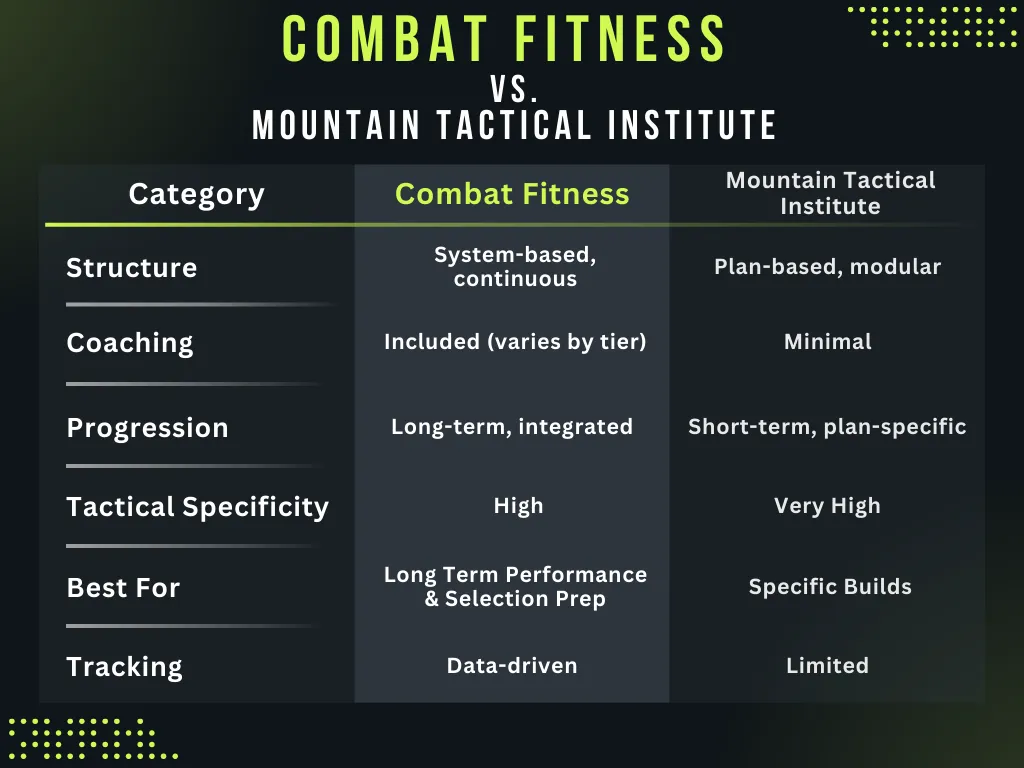
Combat Fitness vs. Mountain Tactical Institute | Tactical Training Compared (2026)
Combat Fitness vs. Mountain Tactical Institute: Which Program Delivers Better Tactical Performance?
For tactical athletes, military personnel, and law enforcement professionals, choosing the right tactical training program isn't a fitness decision, it's an operational one. Programming determines readiness, durability, and measurable performance under real-world stress, which is why the Combat Fitness vs. Mountain Tactical Institute decision deserves more scrutiny than a side-by-side feature list.
Combat Fitness and Mountain Tactical Institute (MTI) are two of the most recognized names in tactical athlete training, both built around preparing serious operators for demanding environments. Where they diverge, sharply, is in how they structure programming, deliver coaching, and support long-term athletic development across a career, not just a single selection cycle.
This breakdown compares Combat Fitness vs. Mountain Tactical Institute across the four dimensions that actually predict program outcomes for tactical athletes: programming structure, coaching depth, mission specificity, and long-term scalability. The goal isn't a winner declared in a vacuum, it's a clear answer on which system fits your specific role, goals, and training timeline. Athletes ready to evaluate Combat Fitness programming directly can browse the full lineup at our Combat Fitness training programs hub.
If you're also comparing Combat Fitness against other tactical training brands, the Combat Fitness vs Hard to Kill Fitness breakdown covers how those two systems stack up across structure, coaching, and specificity. For athletes weighing Combat Fitness against a third option, the Combat Fitness vs Gritty Soldier comparison offers another direct side-by-side across the same key categories.
Combat Fitness vs MTI: Program Overview
Combat Fitness
Combat Fitness is a performance-focused training system built for tactical athletes. It combines strength, endurance, rucking, and hybrid conditioning into structured, progressive programs delivered through an app-based platform.
Key features of the Combat Fitness System include:
Structured multi-week training programs
Performance-driven progression systems
Coaching support (depending on tier)
Specialized tracks (rucking, endurance, selection prep)
The system is designed for long-term tactical development, measurable performance outcomes, and adaptability across deployment cycles, training rotations, and selection pipelines. Unlike single-block training plans, the Combat Fitness model treats programming as continuous infrastructure, athletes don't restart from zero between programs; they progress through a connected pathway built around periodization, energy system development, and load-bearing strength.
Mountain Tactical Institute (MTI)
Mountain Tactical Institute (MTI) is a long-standing training provider focused on military, mountain, and law enforcement athletes.
MTI offers:
A large library of training plans
Selection-specific programs (e.g., SFAS, BUD/S, Ranger)
Subscription access to programming
Research-backed training methodologies
MTI's strength is the breadth of its catalog, hundreds of mission-direct training plans built around specific selections, occupational tests, and tactical environments, each one structured as a discrete preparation block. Athletes weighing MTI against other tactical programming providers can find a side-by-side breakdown in the best MTI alternatives guide.
Training Philosophy: How Each Program Approaches Tactical Performance
Combat Fitness: Integrated Performance System
Combat Fitness programs are built as cohesive, periodized systems, not standalone workouts, creating a defined progression pathway that builds measurable performance over weeks and months. The Hybrid Elite program is the clearest example: it integrates progressive strength work, threshold conditioning, and aerobic base development across a single connected block, instead of bolting them together as separate training streams. Tactical athletes whose training centers on military-specific demands can explore the full lineup across our military fitness programs.
Combat Fitness focuses on:
Periodization (structured phases of training)
Energy system development (aerobic base, threshold, VO₂ max)
Hybrid performance (strength + endurance integration)
Combat Fitness programs are built as cohesive, periodized systems, not standalone workouts, creating a defined progression pathway that builds measurable performance over weeks and months. Our Hybrid Elite program is a great example of an integrated system like this. Athletes focused on military-specific training can explore the full range across our military fitness programs.
MTI: Mission-Direct Programming
MTI's philosophy is mission-direct, programs are built to prepare athletes for a specific selection, occupational demand, or tactical environment, with durability and work capacity as the primary physical outputs.
MTI’s philosophy is centered around:
Preparing for specific missions or selections
Building durability and work capacity
Training for real-world demands
MTI programs are highly specific to a selection or mission, but they tend to be modular and discrete, effective for targeted preparation blocks, less connected as a continuous long-term development system. Athletes weighing which Combat Fitness tier matches their training goals can review the CF ONE vs PRO comparison for a full breakdown of what each subscription level includes.
Program Structure & Progression: Continuous Progression vs. Discrete Training Blocks
Combat Fitness
Combat Fitness programs are structured around progressive overload and integrated training blocks, with each week building deliberately on the last. Programs run 6 to 16+ weeks depending on the athlete's goal, with defined performance targets at each phase, not just a workout log to get through.
Combat Fitness emphasizes:
Structured weekly progression
Progressive overload
Integrated training blocks
Athletes follow:
Clear timelines (e.g., 6–16+ weeks)
Defined performance targets
Balanced programming across energy systems
The result is a predictable, trackable progression model where strength and conditioning develop in parallel rather than being alternated in unrelated blocks. For tactical athletes this matters operationally: deployment cycles, selection dates, and occupational fitness tests rarely arrive in a tidy single-quality peak, readiness has to hold across multiple physical domains simultaneously, which is exactly what an integrated structure produces.
MTI
MTI delivers individual training plans tailored to specific goals or selections, each one intense, outcome-focused, and built around a defined preparation window. Within a single plan, the programming is coherent and structured.
MTI programs are:
Highly specific to goals or selections
Delivered as individual training plans
Often intense and outcome-focused
However:
Progression is typically contained within each plan
Long-term continuity between plans can be less defined
The limitation shows up over time: athletes who complete one MTI plan and move to the next are largely responsible for managing their own training continuity. For short-term mission prep, MTI is strong. As a continuous long-term development system, it requires more self-directed planning than Combat Fitness.
Coaching and Athlete Support: What Each Platform Offers
Combat Fitness
Combat Fitness includes:
In-app support and communication
Coaching tiers with direct feedback
Program adjustments based on athlete needs
Adherence and program adjustment are two of the most consistent failure points in self-directed tactical training, having a direct feedback loop addresses both. Athletes who have used coaching-supported programs consistently report better outcomes than those running the same programming alone.
MTI
MTI is primarily:
Program-based
Self-directed
While some guidance is provided, it generally lacks:
Ongoing coaching
Personalized feedback loops
This results in:
Greater independence
Less support for troubleshooting or adaptation
For experienced, self-sufficient athletes who already understand how to manage training load, recovery, and adaptation, the independence is workable. For athletes dealing with injury, schedule disruption, or performance plateaus, the absence of a personalized feedback loop is a real limitation worth accounting for before committing to the platform.
Tactical Specificity: Rucking, Running and Hybrid Conditioning
Combat Fitness
Combat Fitness integrates:
Rucking progression systems
Running performance (intervals, threshold, long runs)
Strength tailored to load carriage and durability
Hybrid conditioning for real-world demands
Programs are designed to build well-rounded tactical performance, not single-event readiness that collapses outside the test window. Rucking progression in particular is built as a multi-week structured system rather than a "add weight until something breaks" approach, so athletes carry load capacity into the long-term arc of their training. Athletes preparing for specific selection pipelines, SFAS, BUD/S, RASP, Ranger School, can explore the full range across our selection prep programs.
MTI
MTI excels in:
Selection-specific programming
Event-focused preparation
Tactical strength and endurance
Examples include:
SFAS-specific plans
BUD/S preparation
Wildland firefighter programs
MTI offers high specificity, but often within isolated training blocks.
Data, Metrics, and Performance Tracking
Combat Fitness
Combat Fitness emphasizes:
Measurable performance metrics
Benchmark testing
Progress tracking across time
Athletes can monitor:
Pace improvements
Strength gains
Work capacity and endurance
This creates a closed-loop system of feedback and progression.
MTI
MTI includes:
Prescribed workouts and standards
Some benchmark elements
However, it is less focused on:
Ongoing tracking systems
Integrated performance dashboards
This makes it more execution-focused than data-driven.
Scalability & Long-Term Athlete Development: Which System Grows With You?
Combat Fitness
Combat Fitness is designed as a:
Long-term training ecosystem
Scalable system across experience levels
Athletes can progress from:
Beginner → Intermediate → Advanced
General fitness → Selection prep → Performance optimization
The progression architecture matters because tactical athletes rarely have a single training goal, most need to develop strength, endurance, and work capacity simultaneously, then peak those qualities at the right time. Combat Fitness is built to carry athletes through that entire arc without requiring them to stitch together unrelated programs.
MTI
MTI is structured around:
Individual programs for specific goals
While athletes can move between programs:
The system is less unified
Long-term progression requires self-planning
This makes it more suitable for:
Targeted preparation phases
Less so for continuous system-based development
Athletes who thrive with MTI typically have one clear, near-term goal, a specific selection date, a known event, an occupational fitness test, and want a proven plan to get there. Athletes developing across multiple performance domains over an extended timeline, by contrast, will find that MTI's lack of a connected progression system requires significant self-managed planning: deciding what to run after the current plan ends, how to bridge from one specificity block to another, and how to maintain general physical preparedness between targeted blocks.
Community and Brand Positioning
Combat Fitness
Combat Fitness positions itself as:
A performance system
A coaching-driven platform
A long-term solution for tactical athletes
The focus is on:
Results
Structure
Measurable improvement
The Combat Fitness community reflects that positioning, active military, law enforcement, firefighters, and first responders training alongside athletes preparing for selection pipelines. The shared identity isn't around a workout style or aesthetic; it's around the operational standard tactical work demands.
MTI
MTI is positioned as:
A research-driven training provider
A specialist in mission-direct programming
It appeals to:
Athletes preparing for specific events
Individuals seeking proven training plans
Pricing and Value
Combat Fitness
Combat Fitness typically offers:
Subscription-based access
Tiered options (app/complete program access only → full 1-on-1 coaching)
Value comes from:
Structured programming
Coaching support
Long-term scalability
Combat Fitness pricing is structured around two subscription tiers, with the higher tier unlocking SOF pipeline programming and urban operator units in addition to the core program library. The value comparison against MTI isn't strictly per-plan, it's whether the athlete needs a continuous training system across years or a single-plan purchase for a single event.
MTI
MTI offers:
Individual plan purchases or subscription access
Value comes from:
Large program library
Selection-specific plans
Proven methodologies
Combat Fitness vs MTI: Which Tactical Training System Is Better For You?
Choose Combat Fitness if:
You're an athlete who wants a structured, long-term training system
Coaching and accountability are important
Performance tracking and progression matter
The goal is continuous improvement across strength, endurance, and tactical performance domains
Choose MTI if:
You're preparing for a very specific event
You prefer self-directed, unsupported training
You want access to a library of specialized short term plans
Short-term mission prep is the priority
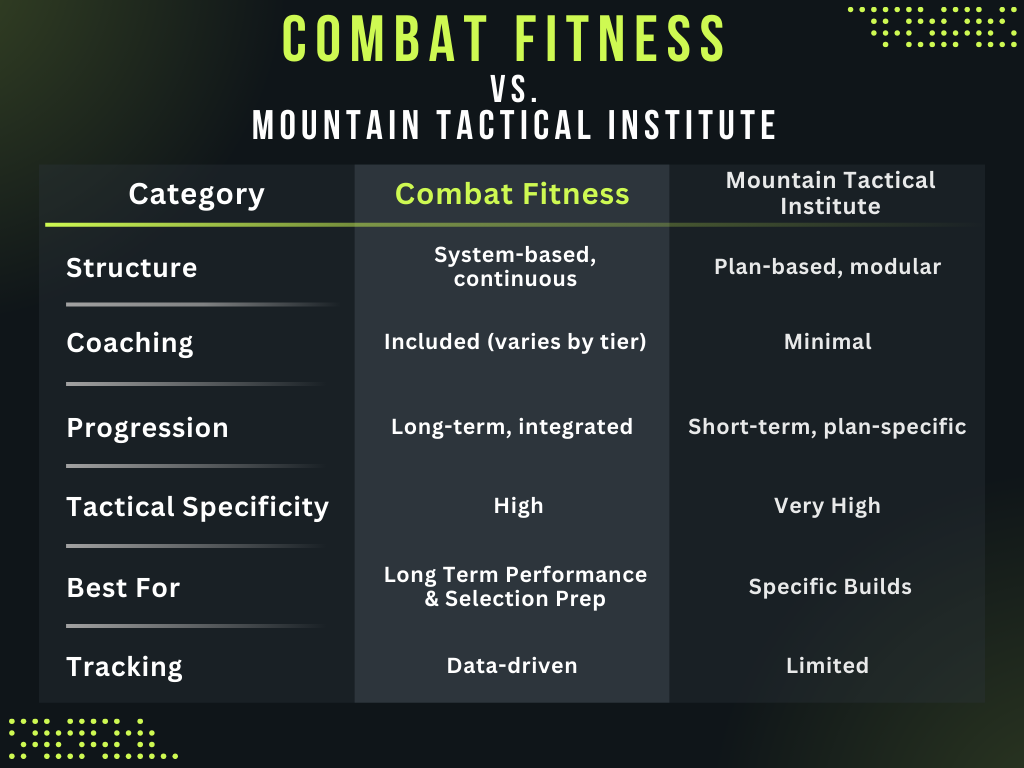
Combat Fitness vs. Mountain Tactical Institute: Side-by-Side Program Comparison
FAQ Section
What is the main difference between Combat Fitness and MTI?
Combat Fitness is a structured, long-term performance system with coaching support and a continuous progression architecture, designed to carry tactical athletes across years of training. Mountain Tactical Institute (MTI) focuses on individual short term mission-specific training plans designed for a specific goal or tests, strong for short term targeted preparation blocks, less connected as a long-term development system.
Is MTI better for military selection preparation?
MTI is highly effective for specific selection preparation due to its targeted, mission-direct plans. However, Combat Fitness is the stronger choice for athletes who need broader base development and structured long-term progression leading into selection, particularly across rucking, running, and strength simultaneously.
Does Combat Fitness include coaching?
Yes. Depending on the tier, Combat Fitness includes coaching, support, and program adjustments, which can improve adherence and results.
Which program is more structured?
Combat Fitness is more structured as a continuous system, while MTI programs are structured individually but not always connected long-term.
Can you combine MTI and Combat Fitness?
In some cases, athletes may use MTI for specific event preparation and Combat Fitness for general or long-term development. However, overlapping programs should be managed carefully to avoid overtraining.
Which program is better for long-term development?
Combat Fitness is better suited for long-term development due to its integrated system, progression tracking, and scalability across multiple phases of training.
This comparison is based on publicly available information from each program's official website and published materials, and is not affiliated with or endorsed by Mountain Tactical Institute (MTI). Last updated: May 2026.


