
Combat Fitness vs Hard to Kill Fitness: Which Is Worth It?
Combat Fitness vs Hard to Kill Fitness: Which Program Actually Builds Tactical Athletes?
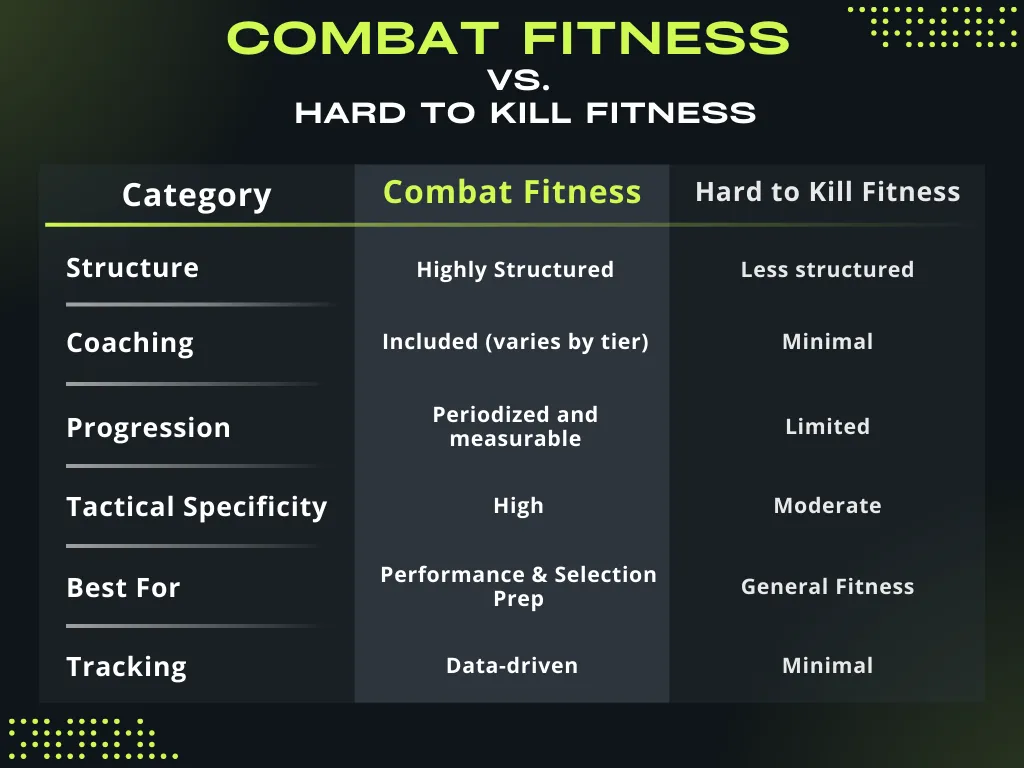
Combat Fitness vs Hard to Kill Fitness is one of the most common matchups in the tactical fitness space, and for good reason. Both platforms target military personnel, law enforcement, and tactical athletes, and both promise to make you harder to kill. But they're built on fundamentally different philosophies: one is a periodized performance system, the other a library of high-intensity military-style workouts. Choosing the wrong fit has real consequences for your performance, your readiness, and your long-term development. This breakdown compares programming structure, coaching, tactical specificity, and measurable outcomes so you can decide which tactical fitness program actually fits your goals.
Not sure which Combat Fitness tier fits your situation? The CF ONE vs PRO comparison breaks down the difference between subscription levels so you can choose the right entry point. For athletes specifically looking for military fitness programs, the military fitness programs breakdown covers the full range of mission-specific options available.
Combat Fitness vs Hard to Kill Fitness: Platform Overview
Combat Fitness
Combat Fitness is a structured, performance-driven training system designed specifically for tactical populations. It combines strength, endurance, running, rucking, and hybrid conditioning into cohesive programs that are periodized and goal-oriented.
The platform operates as an app-based ecosystem with:
Structured training programs
Progression-based systems
Coaching support options
Specialized tracks (e.g., ruck-based, endurance, selection prep)
The emphasis is on long-term progression, performance metrics and systemized training which is why it draws frequent comparison to other structured tactical platforms. Combat Fitness operates in a competitive tactical fitness space, and how it stacks up against other structured platforms matters. If you're weighing Combat Fitness against Mountain Tactical Institute, the Combat Fitness vs Mountain Tactical Institute breakdown covers how the two platforms compare on programming depth, periodization and coaching infrastructure.
For athlete also considering SOFlete, the Combat Fitness vs SOFlete breakdown covers the key structural and coaching differences. Athletes currently training with Hard to Kill Fitness who are questioning whether it's deliver the progression they need can find a full breakdown of structured alternatives in the best Hard to Kill Fitness alternatives guide.
Hard to Kill Fitness
Hard to Kill Fitness (HTK) is a brand built around military-style workouts, often incorporating high-intensity sessions, bodyweight training, and general conditioning.
Its offerings typically include:
Workout programs
Lifestyle-oriented content
General fitness guidance
The approach is more aligned with functional fitness and general preparedness, rather than deeply structured performance systems.
Training Philosophy: System-Based vs General Conditioning
Combat Fitness: System-Based Performance
Combat Fitness is built around structured progression, not just hard workouts. Every program follows a periodized structure that moves athletes through accumulation, intensification, and peak phases before planned deloads.
That architecture matters because it's how the body actually adapts. You're not just getting fitter, you're building specific energy systems: aerobic base, anaerobic capacity, threshold, and VO₂ max, in a sequence that produces measurable results.
For tactical athletes, this specificity is critical. Programs are built around the actual demands of the job, rucking under load, sustained running performance, functional strength, and selection standards. Whether you're chasing a sub-40 5-mile or building the work capacity to get through RASP, the programming maps directly to the outcome.
Hard to Kill Fitness: General Tactical Conditioning
Hard to Kill Fitness takes a different approach. The programming leans toward high-intensity workouts, functional fitness circuits, and general strength and conditioning.
For someone looking to stay active, build general fitness, or train with a military-style edge, it delivers. But it isn't built around long-term periodization, structured energy system development, or performance targeting. There's no clear pathway from where you are now to a specific tactical outcome. That's not a criticism, it's just a different product for a different need.
Program Structure & Progression
Combat Fitness
Combat Fitness programs run on a deliberate periodized arc rather than a string of random hard days. A block might spend three to four weeks accumulating aerobic volume and strength base, shift into a higher-intensity intensification phase, then peak before a planned deload that lets adaptation actually land. Over a 38-to-52-week cycle, that sequencing is what converts effort into measurable change, a faster ruck pace, a heavier trap-bar deadlift, a lower five-mile split, instead of the plateau most unstructured programs hit by week six.
Combat Fitness programs are typically:
Multi-week structured infinite progression plans (38-52+ weeks)
Built with progressive overload
Designed around measurable outcomes
Athletes can expect:
Clear weekly progression
Specific pacing targets
Defined strength benchmarks
Integrated recovery strategies
This structure supports predictable and measurable improvements.
Hard to Kill Fitness
In our assessment, based on publicly available information, Hard to Kill Fitness leans toward a workout-library model: a deep catalog of demanding, military-style sessions that athletes can pick up and run. For someone who thrives on variety and just wants to show up and work hard, that's a genuine strength. Where it differs from a periodized system is in the long arc, the programming is built more around completing tough workouts than around sequencing phases toward a single dated performance target. That's not a flaw; it's a different design choice for a different athlete.
Hard to Kill Fitness programs are often:
Less rigid in progression
Focused on completing workouts rather than tracking progression
Less data-driven
This creates a training experience that is:
Accessible
Less complex
But also less optimized for peak performance outcomes
Coaching & Support: Where Combat Fitness Pulls Ahead
Combat Fitness
Combat Fitness offers more than a program, every athlete gets direct access to the Athlete Support Team and Combat Fitness Coaches, regardless of subscription tier. That means if you're dealing with an injury, hitting a plateau, or need to adjust your program around a deployment schedule, you're not left figuring it out alone.
Higher-tier options include structured onboarding and deeper coaching integration. The result is a hybrid system: professional programming backed by real human support. That combination drives accountability and long-term adherence in a way that a standalone PDF program never will.
Hard to Kill Fitness
Hard to Kill Fitness is primarily program- and content-based. In our view, based on publicly available information, that support reads as lighter-touch than a dedicated coaching relationship. For athletes who are self-sufficient and just need a structured plan to follow, that works well. For athletes navigating injuries, preparing for a specific pipeline, or who want individualized adjustments and direct accountability, a more hands-on coaching model may matter more.
Specificity to Tactical Demands
Combat Fitness
Combat Fitness is highly specific to tactical needs, including:
Rucking progression systems
(Athletes specifically preparing for Ranger Assessment or land-based selection pipelines can find structured ruck and run programming in the Dismount 4.0 program)
Load carriage adaptation
Running performance (threshold, intervals, long runs)
Strength tailored to operational demands
Programs are often aligned with:
Selection pipelines
Tactical testing standards
Real-world performance constraints
Hard to Kill Fitness
Hard to Kill Fitness provides:
General functional training
Military-inspired workouts
In our assessment, based on publicly available information, it places less emphasis on:
Deep, progressive rucking systems
Long term structured endurance development
Programming built around a specific selection pipeline and its standards
This makes it more broadly applicable, but in our view less specialized for a single tactical outcome.
Data, Metrics, and Performance Tracking
Combat Fitness
Combat Fitness emphasizes:
Performance tracking
Benchmark testing
Measurable outcomes
Athletes can track:
Running pace improvements
Strength progression
Work capacity
Aerobic capacity development
This creates a feedback-driven training loop.
Hard to Kill Fitness
Hard to Kill Fitness is less focused on:
Quantitative tracking
Structured metrics
Hard to Kill Fitness offers in-app progress tracking, but in our assessment its programming puts the emphasis more on:
Completing demanding sessions
Staying consistently active
than on benchmark testing and prescribed pacing targets that drive a specific performance number. For many athletes that simplicity is the appeal. The trade-off, as we see it, is less of the data-driven feedback loop that pinpoints exactly where to push next.
Scalability and Long-Term Development
Combat Fitness
Combat Fitness is designed for:
Long-term progression
Multiple program pathways
Scalable difficulty levels
Athletes can move from:
Beginner → Intermediate → Advanced
General fitness → Selection prep → Performance optimization
This creates a lifetime training system, not just a short-term program.
Hard to Kill Fitness
Hard to Kill Fitness is better suited for:
Short-term engagement
General fitness maintenance
Lifestyle integration
It is less structured for:
Multi-phase development
Long-term progression planning
Community and Brand Positioning
Combat Fitness
Combat Fitness positions itself as:
A performance system
A coaching ecosystem
A long-term solution for tactical athletes
The focus is on:
Results
Structure
Professional-level programming
Hard to Kill Fitness
Hard to Kill Fitness leans more into:
Brand identity
Motivation
Lifestyle fitness
It appeals to:
Individuals seeking military-style workouts
General fitness audiences
Pricing and Value
Combat Fitness
Combat Fitness is subscription-based: CF ONE runs for full app and program access, and CF PRO adds the specialized pipeline programs and deeper coaching integration. Both route through a free trial so you can test the system before committing, and value compounds the longer you stay because the programming is built to progress you across years, not weeks.
Combat Fitness typically offers:
Subscription-based access
Tiered options (app/complete program access only → full 1-on-1 coaching)
Value comes from:
Structured programming
Coaching support
Long-term progression systems
Hard to Kill Fitness
Hard to Kill Fitness is an app membership with some standalone programs sold separately. You get a catalog of workouts a workout library with less of the coaching and progression infrastructure.
Hard to Kill Fitness is often:
Lower cost
Program-based
Value comes from:
Simplicity
Accessibility
Brand-driven engagement
Combat Fitness vs Hard to Kill Fitness: Which Is Right for You?
Neither platform is the wrong answer for everyone, they're built for different athletes at different points. The honest verdict: if your goal is a specific, dated outcome, a selection pipeline, a test standard, a measurable performance jump, a periodized, coached system is the better-aligned tool. If your goal is to stay hard, train consistently, and enjoy demanding workouts without managing a long-term plan, a flexible workout library does the job. Match the tool to the goal, not the marketing.
Choose Combat Fitness if:
The athlete is preparing for military or tactical selection
(Athletes targeting SOF pipelines can explore the full range of selection-specific programs on the SOF programs page)
Structured progression and measurable results are important
Coaching and accountability are needed
Long-term performance development is the goal
Choose Hard to Kill Fitness if:
The athlete wants general fitness with a military theme
Flexibility is more important than structure
There is no need for performance tracking or coaching
The goal is maintenance rather than optimization
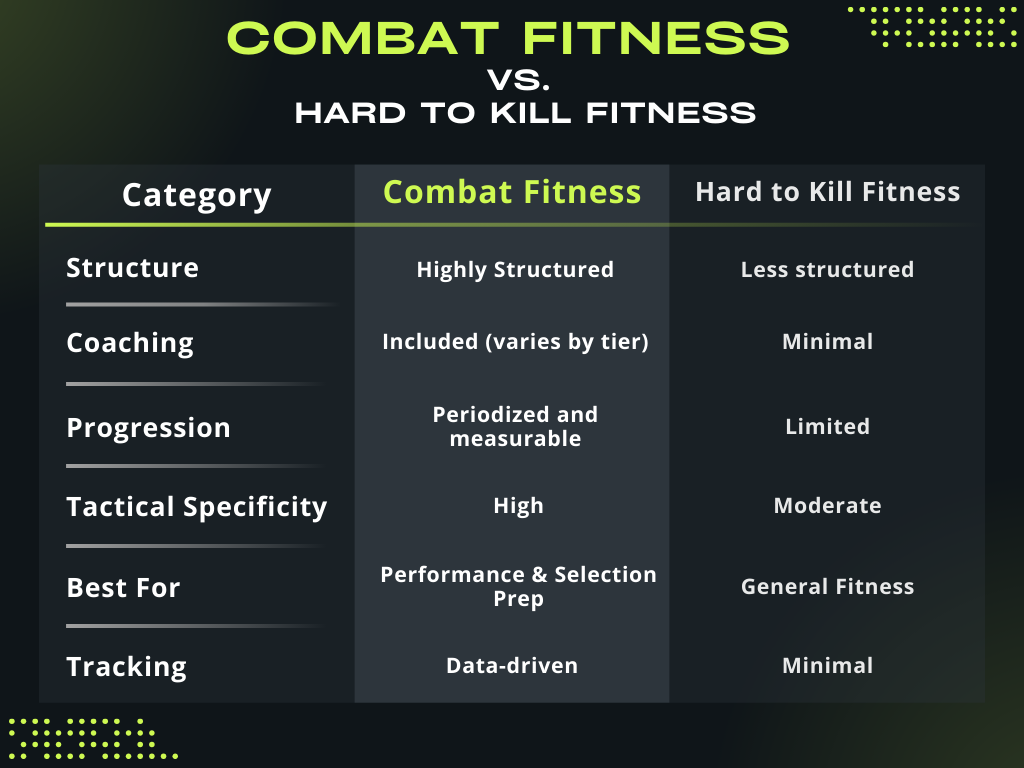
Final Comparison Summary
FAQ Section
Combat Fitness vs Hard to Kill Fitness: What's the difference?
The main difference is structure and specificity. Combat Fitness offers structured, performance-based programming with coaching support, while Hard to Kill Fitness focuses on general fitness and high-intensity workouts without deep progression systems.
Is Combat Fitness good for military selection prep?
Yes. Combat Fitness is specifically designed for tactical athletes and includes structured progression, rucking systems, and performance benchmarks aligned with military demands.
Is Hard to Kill Fitness good for beginners?
Yes. Hard to Kill Fitness can be a good entry point for individuals looking to improve general fitness with a military-style approach.
Does Combat Fitness come with coaching support?
Yes. All Combat Fitness athletes get total and unlimited access to our expert Athlete Support Team and depending on the subscription tier, Combat Fitness includes access to coaching, support, and program adjustments.
Which program is more data-driven?
Combat Fitness is significantly more data-driven, with built-in performance tracking, benchmarks, and progression metrics.
Can someone switch from Hard to Kill Fitness to Combat Fitness?
Yes. Many athletes transition from general fitness programs like Hard to Kill Fitness to more structured systems like Combat Fitness when they want better results or are preparing for specific performance goals.
Editorial note: This comparison reflects Combat Fitness's opinion, based on publicly available information as of the date of publication. Combat Fitness is not affiliated with, endorsed by, or sponsored by Hard to Kill Fitness. "Hard to Kill Fitness" and related names are trademarks of their respective owner, used here for identification and comparison only. Programs, features, and pricing change over time — if anything here is inaccurate or out of date, we welcome correction at the contact link above.


