
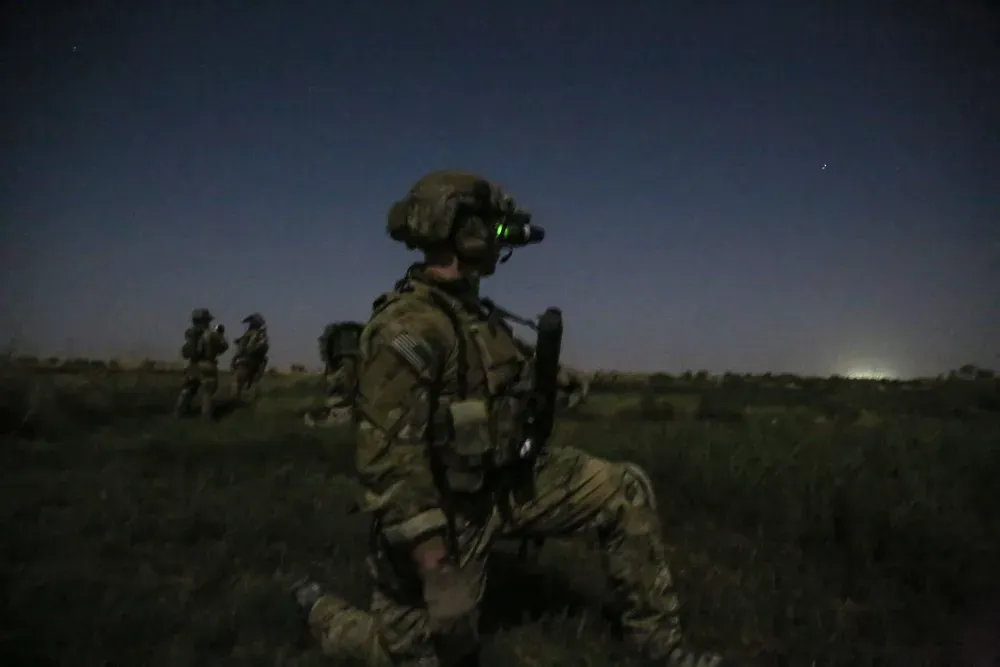
Army Rangers: The 75th Ranger Regiment | Combat Fitness
Who Are the Army Rangers? The 75th Ranger Regiment Explained
The Army Rangers are the U.S. Army's premier light infantry raid force, organized as the 75th Ranger Regiment under U.S. Army Special Operations Command. They seize airfields, execute direct action raids, and deploy as formed units rather than as small teams. That mission set is the reason the Regiment's physical entry point looks nothing like a general fitness test, and it is why our military fitness programs treat load carriage and repeatable effort as the baseline rather than the finish line. This guide covers who the Rangers are, how the Regiment is built, what it has done since 1942, how it compares to other special operations units, and what the tab, the scroll and the tan beret actually mean.
Key Takeaways:
The Army Rangers are the 75th Ranger Regiment, a special operations raid force under USASOC. They are special operations forces, but they are not Special Forces, which is the formal name for the Green Berets.
The Regiment fields three Ranger battalions plus a Regimental Special Troops Battalion and a Regimental Military Intelligence Battalion, headquartered at Fort Benning, Georgia.
Rangers deploy as formed units at platoon-to-battalion scale. Special Forces deploy as 12-soldier detachments. That structural difference drives almost everything else.
The Ranger tab and the regimental scroll are two different things, and most sources get it wrong.
There is no separate "Ranger salary." Ranger pay is standard Army pay for your grade and time in service, plus the entitlements that come with airborne and special operations duty.
Who the Army Rangers Are
The Army Rangers are the U.S. Army's dedicated light infantry raid force. The formal name is the 75th Ranger Regiment, and it sits under U.S. Army Special Operations Command alongside Special Forces, the 160th Special Operations Aviation Regiment, Civil Affairs and Psychological Operations units.
What separates Rangers from conventional infantry is not just selection. It is readiness posture and mission profile. The Regiment maintains elements capable of deploying anywhere in the world on very short notice, and it trains specifically for forcible entry: taking an airfield or an objective by surprise, at night, against a defended position, and holding it long enough for follow-on forces to arrive.
You will see the unit written as US Army Rangers, United States Army Rangers, American Army Rangers, or simply rangers in the Army. All of them point at the same organization. When people ask what Rangers in the Army are, the short answer is that they are the Army's most consistently deployed special operations infantry, built to hit hard targets as a unit rather than to operate in small dispersed teams.
Are Army Rangers Special Forces? The Question Everyone Asks
Army Rangers are special operations forces, but they are not Special Forces. "Special Forces" is the formal, capitalized name of one specific Army branch, the Green Berets. Rangers belong to a different organization with a different mission, a different selection pipeline, and a different tab.
The confusion comes from the umbrella. U.S. Army Special Operations Command controls both. Under USASOC you will find the 75th Ranger Regiment, 1st Special Forces Command (which contains the Special Forces Groups, Civil Affairs and Psychological Operations), the 160th SOAR, the John F. Kennedy Special Warfare Center and School, and 1st Special Forces Operational Detachment-Delta. All of those are special operations. Only one of them is Special Forces.
What tier are Army Rangers?
"Tier 1" is not Army doctrine. It is budget and access shorthand describing which units receive priority funding and report through specific national command channels. Under that informal usage, the units usually labeled Tier 1 are 1st SFOD-D and Naval Special Warfare Development Group. The 75th Ranger Regiment is usually placed a tier below, with the caveat that the Regiment's reconnaissance element operates under the same joint task organization. The label matters far less than the mission.
The 75th Ranger Regiment: Structure and Size
The 75th Ranger Regiment is built from three Ranger battalions plus two supporting battalions. 1st Battalion is at Hunter Army Airfield in Savannah, Georgia. 2nd Battalion is at Joint Base Lewis-McChord in Washington State. 3rd Battalion and the Regimental Headquarters are at Fort Benning, Georgia, along with the Regimental Special Troops Battalion and the Regimental Military Intelligence Battalion, which was activated in 2017 to give the Regiment organic intelligence capability.
A note on that installation name, because it has changed twice in three years. The post was redesignated Fort Moore in 2023, then reverted to Fort Benning in March 2025 under a new namesake, Corporal Fred G. Benning, a World War I soldier. Older sources will say Fort Moore. The current name is Fort Benning.
How many Army Rangers are there? The Army does not publish an exact figure, and the number moves with force structure decisions. Public reporting consistently places the Regiment at roughly 3,500 soldiers across all five battalions, which is heavier than a standard infantry regiment because of the added support and intelligence structure. Treat any specific headcount you see as approximate.
The Army National Guard has also fielded Ranger-designated formations over the years, and the distinction between those units and the 75th Ranger Regiment matters a great deal when you are reading strength figures or lineage claims. They are not the same organization, and conflating them is the most common error in Ranger strength reporting.
What Army Rangers Actually Do
The Regiment's core mission set is direct action, airfield seizure, and special reconnaissance. Direct action means short-duration raids against a specific target: a person, a facility, a cache. Airfield seizure means taking and holding an airstrip so that follow-on forces, aircraft and equipment can flow in. Special reconnaissance means putting eyes on a target well before anyone else arrives.
Here is the contrast that actually explains the unit. Rangers deploy as a formed unit. A Ranger platoon, company or battalion goes in together, with its own fires, its own medics and its own command structure, and it fights as an organized force. Special Forces deploy as 12-soldier Operational Detachment Alphas whose primary job is often to work through and with partner forces rather than to assault objectives themselves.
That difference drives the training. A Ranger has to be able to move fast, carry a fighting load, and function inside a large, tightly synchronized element at night. Individual capability matters, but it matters in service of a unit that moves as one thing.
Rangers have been continuously deployed since October 2001, when 3rd Battalion conducted a parachute assault to seize an objective in southern Afghanistan. That operational tempo, sustained for over two decades, is the single most defining fact about the modern Regiment. A full breakdown of the Ranger mission set, deployment cycle and combat role deserves its own treatment, and we will link it here when that piece publishes.
Army Rangers Compared to Other Units
Figure 1.1 - U.S. elite units compared: 75th Ranger Regiment, Navy SEALs, Special Forces, Delta Force, Marine Raiders and Force Reconnaissance. The 75th Ranger Regiment (U.S. Army, USSOCOM) conducts direct action raids, airfield seizure and special reconnaissance; selection is RASP 1, eight weeks for junior enlisted soldiers, or RASP 2, three weeks for officers and senior NCOs; it deploys as a formed unit from platoon to battalion. Navy SEALs (U.S. Navy, USSOCOM) conduct maritime special operations, direct action and reconnaissance; selection is BUD/S followed by SEAL Qualification Training, 56 weeks total for enlisted sailors; the element is a 16-man platoon task-organised into squads. Army Special Forces, the Green Berets (USSOCOM), conduct unconventional warfare, foreign internal defense and partner-force operations; selection is SFAS followed by the Special Forces Qualification Course including Robin Sage and language training; the element is the 12-soldier Operational Detachment Alpha. Delta Force, 1st SFOD-D (U.S. Army, JSOC), conducts counterterrorism and national-level special missions; entry is in-service only with no civilian route but open recruitment across the entire Army; it operates in small teams within a squadron structure. Marine Raiders of MARSOC (U.S. Marine Corps, USSOCOM) conduct special operations including direct action and foreign internal defense; selection is Assessment and Selection followed by the nine-month Marine Raider Course; the element is the 14-Marine Marine Special Operations Team. Force Reconnaissance (U.S. Marine Corps) conducts deep and amphibious reconnaissance in support of a Marine Expeditionary Force and is not part of U.S. Special Operations Command; entry is via Force Recon screening and the Basic Reconnaissance Course; the element is a reconnaissance platoon or team. Sources: army.mil, navy.com, marsoc.marines.mil and goarmysof.army.mil.
Army Rangers vs Navy SEALs. SEALs are built around maritime access: over the beach, from submarines, from small craft. Rangers are built around airborne and air assault entry onto land objectives. SEAL platoons are small and task-organized. Ranger elements are larger and fight as conventional infantry with special operations selection standards. Both do direct action. They get there differently and they arrive in different numbers.
Army Rangers vs Green Berets. This is the highest-volume comparison people search, and the answer is mission, not toughness. Green Berets are language-trained, culturally trained, and built to raise, advise and fight alongside foreign forces over long deployments. Rangers are built to raid. If you want the pipeline detail, the Green Beret training path runs through SFAS and the Qualification Course rather than RASP.
Army Rangers vs Delta Force. Delta recruits from inside the force, and the Ranger Regiment has historically been one of its feeder units. Understanding what Delta Force is clarifies the relationship: Rangers are an assignment you can enlist directly into, Delta is a selection you attempt after you already have a career behind you.
Army Rangers vs Marines. The Marine Corps comparison usually means one of two things. Against the infantry Marine, Rangers are a selected special operations force with a narrower mission. Against Marine Force Recon or the Marine Raiders, the comparison is closer, but the Raiders sit under SOCOM with a mission profile nearer to Special Forces than to the Regiment.
Rangers Lead the Way: The Motto, the Creed and the Culture
"Rangers Lead the Way" is the Regiment's motto, and it comes from a specific moment. On June 6, 1944, at Omaha Beach, Brigadier General Norman Cota found the assault stalled on the shingle and called to Major Max Schneider of the 5th Ranger Battalion: "Rangers, lead the way!" They did. The phrase became the Regiment's motto and remains the standard reply when a Ranger is addressed by a superior.
The Ranger Creed is a separate document, written in 1974 during the reactivation of the first modern Ranger battalion. It runs six stanzas, and the first letter of each spells R-A-N-G-E-R. It opens:
"Recognizing that I volunteered as a Ranger, fully knowing the hazards of my chosen profession, I will always endeavor to uphold the prestige, honor, and high esprit de corps of my Ranger Regiment."
The remaining five stanzas commit the Ranger to physical and mental readiness, to a higher standard than other soldiers, to moving further and faster than any other unit, to completing the mission, and to never leaving a fallen comrade. Rangers memorize it. They recite it. It is not decoration, it is the behavioral contract the unit runs on. That culture, the assumption that the standard is enforced by peers rather than by leadership, is closer to the reality of life inside a special operations unit than anything a recruiting page will tell you.
A Short History of the Army Rangers
The ranging tradition in North America predates the Army. Robert Rogers formed Rogers' Rangers during the French and Indian War in the 1750s and wrote 28 "Rules of Ranging," a version of which still hangs in Ranger units. The modern lineage, though, starts in the Second World War.
1942. The 1st Ranger Battalion is activated in Northern Ireland on June 19 under Major William O. Darby. Five more Ranger battalions follow.
1944. On D-Day, the 2nd Ranger Battalion scales the cliffs at Pointe du Hoc while the 5th lands at Omaha Beach. The motto is born the same morning.
1950 to 1951. Ranger Infantry Companies (Airborne) serve in Korea, attached to conventional divisions, then are inactivated.
1969. Long Range Reconnaissance Patrol units in Vietnam are redesignated as Ranger companies of the 75th Infantry, carrying the lineage forward.
1974. General Creighton Abrams directs the activation of 1st and 2nd Ranger Battalions as a standard-setting force for the whole Army.
1984. 3rd Battalion and a Regimental Headquarters are activated. The unit is formally designated the 75th Ranger Regiment in 1986.
1983. Rangers conduct a low-altitude parachute assault to seize Point Salines airfield in Grenada during Operation Urgent Fury.
1989. Two simultaneous airfield seizures in Panama during Operation Just Cause.
1993. Rangers fight alongside Delta in Mogadishu, Somalia, during Operation Gothic Serpent.
2001 to present. Continuous deployment beginning with the October 2001 airfield seizure in Afghanistan.
World War Two and Vietnam draw the most search interest, but the 1974 reactivation is the more consequential date. That is when the Regiment stopped being a wartime expedient and became a permanent standing force.
Women in the Ranger Regiment
Yes, women can be Army Rangers, and the distinction between two different things explains most of the confusion.
Ranger School opened to women in 2015. On August 21 of that year, Captain Kristen Griest and First Lieutenant Shaye Haver became the first female graduates, and the course was permanently opened to women that September. By March 2022, the Army reported that 100 women had graduated Ranger School. The number has continued to rise since, though the Army does not publish a running public total.
Serving in the 75th Ranger Regiment is a separate matter. Ranger School is an Army-wide leadership course, open to soldiers across branches. The Regiment is a unit assignment that requires passing RASP. In 2017, a female soldier completed RASP and was assigned to the Regiment for the first time, following the December 2015 decision to open all combat positions to women. Most articles about female Army Rangers conflate the school and the Regiment. They are not the same qualification, and asking how many female Army Rangers there are will give you a different answer depending on which one you mean.
The Regiment's standards did not change. What changed was who is allowed to attempt them.
Army Ranger Pay and Benefits
There is no separate Ranger salary. This is the single most common misconception about Army Ranger pay, and it matters if you are budgeting a career. Rangers are paid on the same military basic pay table as every other soldier, determined by pay grade and years of service. The 2026 tables reflect a 3.8 percent basic pay raise effective January 1, 2026.
What changes the number is entitlements. A Ranger typically draws several of these:
Basic Allowance for Housing and Basic Allowance for Subsistence, both non-taxable and set by location and dependent status.
Hazardous Duty Incentive Pay for parachute duty, long set at $150 per month for static line and $225 per month for military free-fall duty.
Special Duty Assignment Pay, paid at a tier determined by the assignment.
Hostile Fire and Imminent Danger Pay, plus the Combat Zone Tax Exclusion, during qualifying deployments.
Family Separation Allowance during extended separations, and enlistment or reenlistment bonuses tied to the contract.
So the honest answer to how much Army Rangers make is that a Ranger and a conventional infantry soldier at the same grade and time in service have the same base pay. The Ranger's total compensation is higher because of airborne status, assignment pay and deployment entitlements, not because of a different scale. Verify current figures against the official DFAS pay tables, which update annually.
The Scroll, the Tab, the Beret and the Kit
The most misunderstood distinction in the entire subject is the Ranger tab versus the Ranger scroll.
The Ranger tab is a skill badge earned by graduating Ranger School. It is open to soldiers across the Army, and once earned it is worn for the rest of a career regardless of assignment. Plenty of tabbed soldiers have never served a day in the Regiment.
The regimental scroll is a unit insignia, the shoulder sleeve insignia of the 75th Ranger Regiment. It is worn by soldiers assigned to the Regiment. The scroll design traces to the World War Two Ranger battalions and was authorized as the Regiment's shoulder insignia in 1984. A soldier can hold the scroll without the tab, or the tab without the scroll, or both.
The tan beret replaced the black beret in the Regiment in July 2002, after the Army adopted black berets service-wide the previous year and the Rangers needed a distinguishing headgear again. Tan is the Ranger color. That is the whole story behind the Army Rangers uniform question people search.
Kit follows mission. Rangers are equipped as light infantry with special operations support: standard-issue individual weapons and optics, night vision and laser aiming devices at scale, plate carriers configured for mobility rather than maximum coverage, and unit-level access to communications, breaching and fires equipment that conventional light infantry does not routinely carry.
Joining the Regiment: The Two Routes In
There are two paths into the 75th Ranger Regiment, and it is worth naming them plainly.
The first is enlisting on an Option 40 contract, which guarantees you the opportunity to attend the Ranger Assessment and Selection Program after initial training and airborne school. The second is volunteering from inside the Army, applying to attend RASP as an already-serving soldier.
RASP is the assessment. It is the gate into the Regiment, and it is run by the Regiment for the Regiment. Passing it earns you the scroll and an assignment to a Ranger battalion.
Ranger School is not RASP. Ranger School is an Army-wide leadership course that awards the tab. The Regiment sends its leaders there, but attending it does not put you in the Regiment, and passing RASP does not award a tab. Keeping those two straight will save you a great deal of confusion when you read recruiting material.
If you are building toward the assessment, the pre-RASP PT test standards are where the physical picture actually lives. And for eligibility, contract mechanics, scores and every specific number that governs entry, work from our full breakdown of Army Ranger requirements.
What This Means for Tactical Athletes
Here is the part most candidates get backward. The Regiment does not select for people who are fit enough on assessment day. It selects for people who were already training two years earlier, because the assessment measures accumulated capacity, not a peak.
Rucking is the gate. Load carriage under time pressure, repeated over consecutive days, on legs that are already tired, is the specific demand that separates candidates. Running volume supports it but does not replace it, because the adaptation you need under a loaded ruck is structural and connective, not only cardiovascular. Strength matters in the same way: enough to move a body plus equipment repeatedly, not enough to post a number.
Build that base over quarters, not weeks, then sharpen. Peaking for selection is a distinct training phase with its own rules, and treating it as "train harder in the last month" is how people arrive at assessment already broken.
If you want the specific answers, our RASP prep FAQ covers the questions candidates ask most. If you are deciding how to structure the next year, the Ranger prep program buying guide walks through how to choose an approach that matches your timeline.
FAQ: Frequently Asked Questions
Are Army Rangers Special Forces?
No. Army Rangers are special operations forces, but "Special Forces" is the formal name of the Green Berets specifically. Both fall under U.S. Army Special Operations Command, along with the 160th SOAR, Civil Affairs and Psychological Operations. Rangers raid as formed units. Special Forces work through partner forces in 12-soldier detachments.
What do Army Rangers do?
Army Rangers conduct direct action raids, seize airfields, and perform special reconnaissance. Unlike Special Forces, they deploy as complete formed units at platoon-to-battalion scale rather than as small teams. The Regiment has been continuously deployed since October 2001, when 3rd Battalion parachuted in to seize an airfield in Afghanistan.
How many Army Rangers are there?
The Army does not publish an exact strength figure for the 75th Ranger Regiment. Public reporting consistently places it at roughly 3,500 soldiers across three Ranger battalions, the Regimental Special Troops Battalion and the Regimental Military Intelligence Battalion. Treat any specific headcount as approximate, since force structure changes over time.
What is the difference between Army Rangers and Navy SEALs?
Rangers are the Army's land-focused raid force, entering by parachute or air assault and fighting as larger formed elements. SEALs are Naval Special Warfare, built around maritime access and operating in smaller task-organized platoons. Selection differs too: RASP for Rangers, BUD/S and SEAL Qualification Training for SEALs.
What is the difference between Army Rangers and Green Berets?
Mission and structure. Green Berets are language and culture trained to raise, advise and fight alongside foreign forces, deploying as 12-soldier detachments. Rangers are built to raid and seize objectives as formed units. Green Berets attend SFAS and the Special Forces Qualification Course. Rangers attend RASP.
Can women be Army Rangers?
Yes. Ranger School opened to women in 2015, with the first two female graduates in August 2015, and the Army reported 100 female graduates by March 2022. Separately, a woman first passed RASP and was assigned to the 75th Ranger Regiment in 2017. The standards were not changed.
How much do Army Rangers make?
Rangers are paid on the standard military basic pay table by grade and time in service, with a 3.8 percent raise effective January 2026. There is no separate Ranger salary. Total compensation rises through housing and subsistence allowances, parachute duty pay, special duty assignment pay and deployment entitlements.
What is the Army Rangers motto?
"Rangers Lead the Way." It comes from Omaha Beach on June 6, 1944, when Brigadier General Norman Cota called to Major Max Schneider of the 5th Ranger Battalion, "Rangers, lead the way!" It is still the standard Ranger response when addressed by a superior, and it appears on the Regiment's insignia.
Where are Army Rangers stationed?
The Regimental Headquarters, 3rd Battalion, the Regimental Special Troops Battalion and the Regimental Military Intelligence Battalion are at Fort Benning, Georgia. 1st Battalion is at Hunter Army Airfield in Savannah, Georgia. 2nd Battalion is at Joint Base Lewis-McChord, Washington.
What is the difference between the Ranger tab and the Ranger scroll?
The tab is a skill badge earned by graduating Ranger School, open Army-wide and worn permanently. The scroll is the unit insignia of the 75th Ranger Regiment, worn by soldiers assigned to it. A soldier can hold one, the other, or both. Most sources conflate them.
Are Army Rangers tier 1?
"Tier 1" is informal shorthand for units with priority funding and national-level tasking, not official Army doctrine. Under that usage, 1st SFOD-D and Naval Special Warfare Development Group are the units usually labeled Tier 1, with the 75th Ranger Regiment placed a tier below, though its reconnaissance element operates under the same joint structure.
How do you become an Army Ranger?
There are two routes: enlisting on an Option 40 contract that guarantees a shot at RASP, or volunteering for RASP from inside the Army. Eligibility criteria, scores, contract mechanics and every specific entry standard are covered in our dedicated requirements breakdown linked above.
The Army Rangers are not a fitness brand or a mindset. They are a specific unit, the 75th Ranger Regiment, with a specific job: get to the objective fast, take it, and hold it until someone else can. Everything else, the tab, the scroll, the tan beret, the creed, exists to serve that. If you are considering the Regiment, stop measuring yourself against a single test day and start building the load-carriage and repeat-effort base that the assessment is designed to expose. Start that build now, and give yourself the two years the job actually asks for.
References:
U.S. Army Special Operations Command, "75th Ranger Regiment" unit overview.
U.S. Army, "Hegseth restores Fort Moore to Fort Benning in honor of WWI Soldier," March 2025.
Military Times, "Fort Benning returns to old name with a new namesake," April 16, 2025.
Stars and Stripes, "Fort Benning is back: Hegseth orders Fort Moore to revert to its original name," March 3, 2025.
U.S. Army Special Operations Command, Regimental Special Troops Battalion overview.
Wikipedia, "Regimental Military Intelligence Battalion" (activation and role, 2017).
U.S. Army, "First women graduate Ranger School," August 2015.
Task and Purpose, "100 women have now graduated US Army Ranger School," March 11, 2022.
Army Times, "This woman will be the first to join the Army's elite 75th Ranger Regiment," January 18, 2017.
Task and Purpose, "The 75th Ranger Regiment is no longer an all-male unit."
U.S. Department of Defense, Office of the Secretary of Defense press release on opening all combat positions to women, December 3, 2015.
Defense Finance and Accounting Service, Military Pay Tables and Allowances.
Military.com, "2026 Military Pay Charts" (3.8 percent basic pay raise effective January 1, 2026).
U.S. Army Center of Military History, Ranger lineage and honors, 75th Ranger Regiment.
National Veterans Memorial and Museum, "History Made on the Range: The Story of Griest and Haver."
Defense Media Network, "75th Ranger Regiment Organization."
U.S. Army, Ranger Creed (as adopted 1974, Ranger Training Brigade).
American Special Operations, "Army Rangers, 75th Ranger Regiment."
Written by the Combat Fitness Team, coaches who program for active military, law enforcement, and first responders preparing for real occupational and selection standards.
Disclaimer: This article is for informational purposes only. Standards, unit structure, installation names, pay tables and entitlements change. Verify current information against official U.S. Army, USASOC and DFAS sources, and consult a recruiter for anything affecting an enlistment decision. Nothing here is medical advice or a guarantee of selection outcome. Training for a selection pipeline carries injury risk; consult a qualified medical professional before beginning any new training program.


