
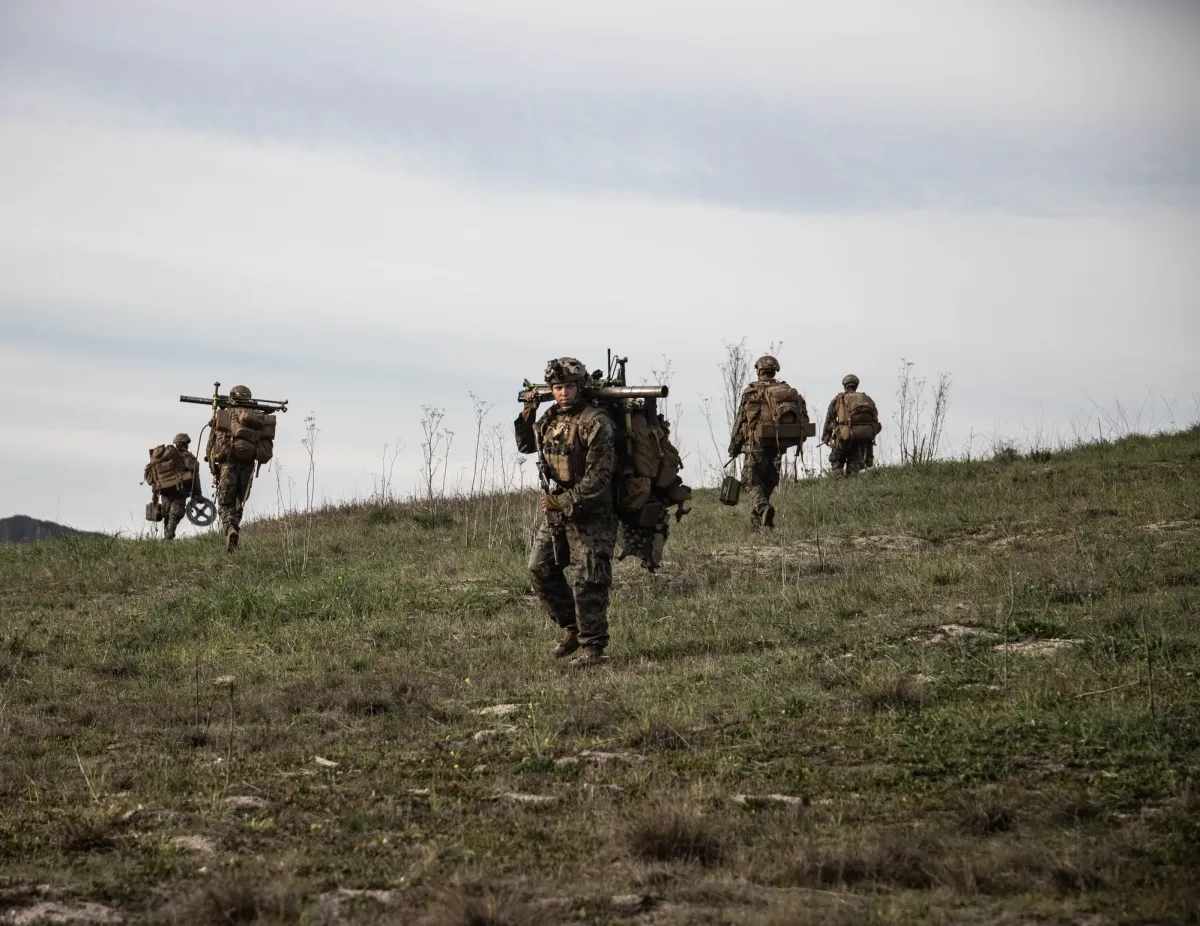
Marine Recon: Force Recon & Recon Marines | Combat Fitness
Marine Recon: Who They Are, What Force Recon Does, and How to Become a Recon Marine
Marine Recon is the Marine Corps' ground and amphibious reconnaissance force: small teams that get eyes on a beach, an objective, or an enemy formation before the main body arrives, then report what they see. If you want to train for that standard rather than read about it, our tactical training programs build the swim, ruck, and endurance base the pipeline screens for. Three names circle this job and most pages use them as if they mean the same thing. Marine recon, marine force recon, and recon marine are related, but they are not identical. This guide separates them, walks the mission sets, covers the new training pipeline that replaced the Basic Reconnaissance Course in April 2026, and lays out what the physical standard demands.
Key Takeaways:
"Marine Recon," "Recon Marine," "Force Recon," and "Marine Corps Reconnaissance" describe one community at different levels, not four separate units.
Division Reconnaissance Battalions support the Marine Divisions. Force Reconnaissance works deeper, further out, and answers to the Marine Expeditionary Force level.
Recon is special operations capable but sits outside US Special Operations Command. MARSOC, the Marine Raiders, is the Corps' SOCOM component.
The Basic Reconnaissance Course ended in April 2026. The Ground Reconnaissance Course and the Amphibious Reconnaissance Course replaced it, and ARC completion now designates MOS 0321.
The screening standard is swim-heavy, ruck-heavy, and endurance-heavy. A standard PFT plan does not prepare anyone for it.
What Marine Recon Is
A Recon Marine is a Marine trained to collect information ahead of the force, on foot and in the water, in teams small enough to stay unseen. The community answers to four names in everyday use, and the naming confusion is the reason most people end up searching in the first place.
The four names, one at a time
Marine Recon is the informal umbrella term for the whole reconnaissance community, both Division Recon and Force Recon.
Recon Marine is the individual: a Marine holding the 0321 primary MOS, or an officer serving in a reconnaissance billet.
Marine Force Recon refers to Force Reconnaissance specifically, the deeper-reaching element that has historically worked for the Marine Expeditionary Force commander rather than a division.
Marine Corps Reconnaissance is the doctrinal phrase covering the capability itself, including amphibious reconnaissance, the mission that started the community in World War II.
When someone says "US Marine recon" or "USMC marine recon," they almost always mean the umbrella. When they say "force recon marine," they mean a Recon Marine serving in a Force Reconnaissance billet. The distinction that matters operationally is not the wording. It is how far out the team works and who it answers to, which is the next section.
Recon Battalions vs Force Recon: The Distinction Almost Every Page Gets Wrong
Division Reconnaissance Battalions belong to the Marine Divisions and work the close and middle fight, often called the green side. Force Reconnaissance works deep, beyond the range of division assets, and has historically been controlled at Marine Expeditionary Force level. Same MOS, same pipeline, different depth and different chain of command.
That structure has been rebuilt more than once. In 2006, the Force Reconnaissance companies were deactivated and their Marines moved into the newly formed Marine Corps Forces Special Operations Command. Two years later the Commandant directed that Force Reconnaissance companies be re-established out of Division Reconnaissance Battalion personnel, with operational control at the MEF and administrative control inside the battalion. That is why a Force Recon company can sit on a Recon Battalion's organizational chart while working for someone else entirely.
As of August 2026, the active force-level reconnaissance capability sits with the Force Reconnaissance companies of 1st and 2nd Reconnaissance Battalions and the Deep Reconnaissance Platoon of 3rd Reconnaissance Battalion. The Reserve component keeps a Force Reconnaissance Company under 4th Reconnaissance Battalion. Force Design has continued to move pieces of this around, so treat any structure chart, including this one, as a snapshot and check the current unit pages on marines.mil before you quote it.
For a candidate, the practical read is simple. You do not enlist into Force Recon. You earn the reconnaissance MOS, you serve in a Recon Battalion, and Force Reconnaissance is a later screening and assignment inside that community. The reserve route exists too, and reserve recon units carry the same MOS standard.
What Recon Marines Actually Do: The Six Mission Sets
Reconnaissance is not one job. A recon team's task list runs across six recognizable mission sets, and the tools change more than the purpose does.
Amphibious reconnaissance. Beach and near-shore survey: gradients, surf, obstacles, exits, and whether a landing force can get ashore where the plan says it will. This is the founding mission of the community and it is still in the title of the course that designates the MOS.
Deep ground reconnaissance. Teams inserted well forward of friendly units to observe routes, terrain, and enemy movement, then report and stay hidden.
Battlespace shaping. Feeding the commander the information that decides where the main effort goes, and confirming or killing assumptions in the plan before Marines act on them.
Surveillance and reporting. Static observation of a named area of interest over days, with communications discipline as the hardest part of the job.
Initial terminal guidance. Marking, guiding, and controlling aircraft and landing craft onto the correct point, including calls for naval gunfire, artillery, and close air support.
Direct action. The tasks Force Reconnaissance picks up: raids, maritime interdiction, and visit, board, search and seizure operations off a Marine Expeditionary Unit.
A reconnaissance team runs on a minimum of six Marines: team leader, assistant team leader, radio operator, assistant radio operator, slack man, and point man. Teams are built to be small because the mission depends on not being found. How they arrive varies with the problem: helocast and fast-rope insertion, small boat, static-line or military free-fall parachute, submarine lock-out for the dive-qualified, or on foot from a drop-off well outside the objective area. A patrol might be out for hours or for a week, carrying everything it needs to observe, communicate, and get back.
Is Marine Recon Special Forces?
Marine Recon is special operations capable but is not part of US Special Operations Command. That is the whole answer. The Marine Corps component of SOCOM is the Marine Raiders of MARSOC, which was created in 2006 and drew heavily on Force Reconnaissance Marines to fill its first ranks.
The practical difference is command and funding rather than difficulty. Recon Marines answer to Marine Corps commanders through the Fleet Marine Force and train to Marine Corps missions. MARSOC Raiders answer to SOCOM and draw on SOCOM's authorities, funding, and mission set. Both selections are hard. Only one of them sits inside the special operations command structure.
The "Tier 1" and "Tier 2" labels you see attached to this question are a media and forum construct, not a doctrinal one. There is no public tier list that ranks Recon against Rangers against SEALs. Units are resourced and tasked differently, and the label adds nothing you can train toward.
If what you are chasing is the work rather than the label, the day-to-day reality of life as a special operator is a more useful thing to study than a tier chart.
The Pipeline Has Changed: BRC Is Gone, Replaced by GRC and ARC
As of April 2026, the Basic Reconnaissance Course no longer exists. On April 27, 2026, Marine Corps Training Command stood up the Ground Reconnaissance Course at Marine Corps Base Camp Pendleton, replacing the 12-week BRC with two courses: GRC and the Amphibious Reconnaissance Course. Completing ARC is what now designates MOS 0321, Reconnaissance Marine. The final BRC class graduated on April 3, 2026.
Figure 1.1 - Marine Corps reconnaissance pipeline before and after April 2026. On 27 April 2026 Training Command launched the Ground Reconnaissance Course at Marine Corps Base Camp Pendleton, replacing the 12-week Basic Reconnaissance Course with two courses. Entry-level infantry training changed from Marine Combat Training to the Infantry Rifleman Course at the School of Infantry, now a formal prerequisite. The core recon course is the Ground Reconnaissance Course, reported at roughly nine weeks, covering water survival, land navigation, communications, supporting arms, surveillance and patrolling. The advanced course is the Amphibious Reconnaissance Course, also reported at roughly nine weeks, open to GRC graduates and emphasizing aquatic operations; completing ARC designates the Marine as MOS 0321 Reconnaissance Marine. Where the old pipeline trained recon candidates only, the Ground Reconnaissance Course now also produces scouts for infantry and Light Armored Reconnaissance battalions, supporting Force Design Scout Platoons. Recon-specific course time therefore rose from 12 weeks to roughly 18. Course durations are drawn from defense reporting rather than an official Marine Corps announcement. Source: U.S. Marine Corps, "Training Command Updates Reconnaissance Training," marines.mil; Marine Corps Times and Stars and Stripes, May 2026.
The split is not a softening. GRC carries water survival, land navigation, communications, supporting arms, surveillance, and patrolling. ARC builds on GRC and the Infantry Rifleman Course with aquatic operations, heavier use of communications assets and sensors, and amphibious mission planning. Training Command's commanding general, Maj. Gen. Michael A. Brooks, described the intent as building the Marine the Corps wants at the end of the pipeline, and stated that nothing had become easier.
The reason behind the change is Force Design. Marine Corps infantry and Light Armored Reconnaissance battalion commanders needed organic scout capability, and GRC now produces it, while ARC keeps the amphibious specialization that defines the 0321. Officials have also signaled interest in eventually standing up scout as its own primary MOS with GRC as its feeder course, though no timeline has been published.
Two things to verify before you plan around them: whether the Reconnaissance Training and Assessment Program, the five-week screening course that historically sat in front of BRC, continues in the same form, and how the 0323 and 0326 additional MOSs are handled under the new course structure. Neither has been publicly confirmed in the reporting on the change. The adjacent Marine scout sniper school pipeline sits close to this one and candidates often look at both.
How to Become a Recon Marine: The Short Version
You become a Recon Marine one of two ways: enlist on a reconnaissance contract, or lateral move into the 0321 MOS after serving in another field. Both routes end in the same place, at Reconnaissance Training Company at Camp Pendleton.
The gates, in order:
Meet the baseline enlistment standard first. Nothing else matters until you clear it. The USMC enlistment requirements cover the ASVAB, the moral and medical screens, and the paperwork, and recon candidates are held to a higher composite GT score than the general infantry field. Confirm the current cut score with a recruiter, because it is set by bulletin and changes.
Clear the medical and vision screens. The MOS carries dive and parachute follow-on training, so vision, hearing, and dive-physical standards apply. Body composition matters here too, and the Marine Corps height and weight standards are the first screen most candidates forget about.
Pass the physical screener. Historically this ran through RTAP and started at a minimum of eight pull-ups, a three-mile run under 22:30, and a 500-meter swim in under 20 minutes wearing utilities. Those are entry numbers, not competitive ones. Competitive candidates arrive well above them, and the Marine Corps PFT standards are the floor the screener is built on.
Qualify in the water. Recon requires a swim qualification above the basic level, and water confidence is the most common reason candidates fail out. It is also the hardest gap to close in a hurry.
Survive the screening and selection phase. Attrition happens here before the formal course begins, which is why peaking for special operations selection is a separate training problem from general fitness.
From shipping to boot camp through ARC completion, expect roughly a year to eighteen months depending on class dates and holdovers. Women are eligible. Lance Cpl. Alexa Barth became the first woman to graduate the Basic Reconnaissance Course and earn the 0321 MOS in November 2019, and the standard she met was the same one everyone else met.
That is the short version. The contract options, screener preparation, and course-by-course detail need their own treatment, and a dedicated guide to how to become a Recon Marine is the right place for it.
MOS 0321 and the Recon Job Field
MOS 0321 is Reconnaissance Marine, the primary military occupational specialty for the community. Under the current pipeline, completing the Amphibious Reconnaissance Course is what designates it. Before April 2026, that designation came with Basic Reconnaissance Course graduation, which is why most job-database listings still describe the old path.
Two additional MOSs sit alongside it for Marines who complete follow-on schools: 0323, Reconnaissance Marine, Parachute Qualified, and 0326, Reconnaissance Marine, Parachute and Combatant Diver Qualified. They are add-ons earned after 0321, not separate entry paths, and their handling under the new course structure has not been publicly detailed.
Officers do not hold 0321. The officer side of the reconnaissance and intelligence community runs through the 0203 ground intelligence officer and 0370 special operations officer designators, with reconnaissance platoon and company command billets filled from there.
The adjacent MOS worth knowing is 0317, the scout sniper field, which shares observation, stalking, and reporting skills with recon and pulls candidates from the same population. Our breakdown of the 0317 Marine scout sniper MOS covers where the two fields overlap and where they part ways.
Pay follows standard enlisted rank and time-in-service tables, with additional pays for dive and parachute duty when a Marine holds those qualifications and fills a billet that requires them. A full breakdown of Marine Recon MOS 0321 belongs in its own guide.
Recon Battalions: The Units and Where They Are
Four Reconnaissance Battalions carry the mission, three active and one reserve.
Figure 1.2 - U.S. Marine Corps reconnaissance battalions and their locations. 1st Reconnaissance Battalion falls under 1st Marine Division at Marine Corps Base Camp Pendleton, California. 2nd Reconnaissance Battalion falls under 2nd Marine Division at Marine Corps Base Camp Lejeune, North Carolina. 3rd Reconnaissance Battalion falls under 3rd Marine Division at Camp Schwab, Okinawa, Japan, the only forward-deployed battalion of the four. 4th Reconnaissance Battalion falls under 4th Marine Division within Marine Forces Reserve, headquartered in San Antonio, Texas, with line companies at multiple separate sites rather than a single base. The first three are active-duty battalions aligned to their numbered Marine Divisions; the fourth is a reserve unit, which is why it is geographically dispersed. Source: Marine Forces Reserve official unit pages and published Marine Corps unit locations. Unit stationing can change under Force Design.
1st and 2nd Reconnaissance Battalions each hold a Force Reconnaissance company. 3rd Reconnaissance Battalion fields a Deep Reconnaissance Platoon in place of a full company. 4th Reconnaissance Battalion is the reserve component and includes its own Force Reconnaissance Company, which is how a reserve Recon Marine reaches force-level work.
Unit locations and parent commands have shifted under Force Design and continue to. Verify against the current unit pages on marines.mil and marforres.marines.mil before relying on any list, including this one. A unit-by-unit look at the Marine Recon Battalions, including company structure and reserve site locations, deserves its own page.
Marine Recon vs SEALs, Rangers, Raiders and MARSOC
The comparison people want is usually a ranking. The useful comparison is a structural one: who each element works for, what it is built to do, and whether it sits inside SOCOM.
Figure 1.3 - Reconnaissance and special operations elements compared. Two of these sit outside U.S. Special Operations Command. Division Reconnaissance, the Marine Reconnaissance Battalions, conducts ground and amphibious reconnaissance for its Marine Division. Force Reconnaissance conducts deep reconnaissance and direct action for a Marine Expeditionary Force. Both are conventional Marine Corps formations: special operations capable, but not SOCOM units. Three sit inside USSOCOM. Marine Raiders of MARSOC conduct special reconnaissance, direct action and foreign internal defense under Marine Corps Forces Special Operations Command. Navy SEALs conduct maritime special operations, direct action and special reconnaissance under Naval Special Warfare Command. Army Rangers of the 75th Ranger Regiment conduct large-scale direct action, airfield seizure and raids under U.S. Army Special Operations Command. The dividing line is who tasks the unit rather than how demanding its selection is, the Marine elements answer to a Marine commander, while the SOCOM units answer through U.S. Special Operations Command to national-level tasking. Sources: U.S. Special Operations Command and MARSOC official sites.
Read that table as a description of roles, not a ranking of quality. Recon and SEAL teams overlap heavily in the water and diverge in what happens after the swim. Rangers are built around raid-force mass, which is a different problem than a six-man team staying hidden for four days. Raiders came out of Force Recon and now carry SOCOM's mission set.
The Force Recon and MARSOC comparison in particular is a longer discussion, and a full head-to-head on Marine Recon versus Navy SEALs, Rangers, and Raiders needs a page of its own rather than a table.
Swift, Silent, Deadly: The Recon Jack, the Creed and the Insignia
"Swift, Silent, Deadly" is the reconnaissance community's motto, and each word describes a requirement rather than an attitude. Swift means the information is worthless if it arrives late. Silent means a compromised team has failed the mission before it fires a shot. Deadly means the team can still fight its way out of the compromise it was built to avoid.
The Recon Creed is the longer statement of the same idea. It is an acrostic on RECON, and it opens with the line that defines the community's view of itself: "Realizing it is my choice and my choice alone to be a Reconnaissance Marine, I accept all challenges involved with this profession." The remaining stanzas cover exceeding physical limits, conquering obstacles without quitting, professional pride on the objective, and never shaming the community. It is read and recited across the pipeline, and it is quoted more often than any other text in the community.
The visual identity is the Recon Jack: a skull rendered over crossed elements with scuba bubbles, worn on patches, unit gear, and tattoos across the community. It borrows from the Jolly Roger tradition and signals the amphibious side of the job through the dive imagery. Individual battalions and Force Recon companies carry their own variations, and the device shows up in unofficial forms far more often than official ones. A full walkthrough of Marine Recon insignia and the Recon Jack, including unit-by-unit variants, is worth its own page.
A Short History: Vietnam, Amphibious Recon and Force Design
The community starts in the water. The Marine Corps stood up an Amphibious Reconnaissance Company in 1942 to survey landing beaches in the Pacific, and expanded it into the Amphibious Reconnaissance Battalion in 1944. Everything the community does now traces back to that problem: find out whether the landing force can get ashore, and report before the landing force commits.
Force Reconnaissance took shape in the 1950s as the Corps built out deep reconnaissance and parachute and dive insertion capability. Vietnam is where the identity hardened. Recon teams ran small-team patrols deep into contested terrain, and the Stingray concept turned those teams into observation posts that could bring artillery and air onto targets they found, then move before the response arrived. The casualty math of a four to six man team operating outside supporting range shaped how the community trains to this day.
Iraq and Afghanistan pushed recon into sustained ground reconnaissance, route work, and direct action alongside conventional units, and Force Reconnaissance spent much of that period rebuilding after MARSOC drew from its ranks in 2006.
Force Design is the current chapter. The Corps has reoriented toward distributed operations inside contested maritime terrain, which puts a premium on small teams that can see, sense, and report from places larger formations cannot reach. That is the same problem the Amphibious Reconnaissance Company was created to solve in 1942, and it is why the 2026 pipeline change split scouting from amphibious reconnaissance instead of shrinking either one. Marine Recon in Vietnam is a deep enough subject to carry its own article.
Training For It: What the Physical Standard Actually Demands
The reconnaissance physical standard is not a harder PFT. It is a different shape of fitness, and that is why strong PFT scores routinely fail in the water and under a pack.
Figure 1.4 - MOS 0321 Reconnaissance Marine physical standards. The Marine Corps sets seven MOS-specific events. Ruck march: complete a 20-kilometre ruck run in 3 hours or less carrying the recon assault load. Surface swim: a 2,000-yard swim within one hour. Caving ladder: swim to the ladder wearing the reconnaissance load and carrying a service rifle, mount, and climb to the 10-metre platform in 2 minutes 27 seconds. 100-metre rush: rush 100 metres in under 44 seconds in the fighting load while carrying breaching equipment. Casualty evacuation: from a prone firing position, sprint 25 metres to a simulated 205-pound casualty and evacuate it 25 metres in 54 seconds or less. Wall crossing: move 5 metres and cross a 56-inch wall unassisted, maintaining all equipment, within 30 seconds. MK-19 lift: a single lift of a mock-up MK-19 from ground to overhead with the elbows momentarily locked out. Each event is pass or fail rather than scored, and most name the load carried. These are the standards for a qualified Reconnaissance Marine rather than the entry screen for the course. Source: U.S. Marine Corps 0321 Reconnaissance Marine MOS-Specific Physical Standards assessment checklist, fitness.marines.mil. Standards change without notice, confirm before testing.
Those figures come from the Marine Corps' published MOS-specific physical standards, and they name the three gaps directly.
Water confidence and swim endurance. A 2,000-yard fin swim and a caving ladder climb under load are not tests of swim speed. They test whether you can work in the water without your heart rate running away, which is a skill built over months of exposure, not a fitness quality you can peak into. Amphibious tactical training exists as a separate discipline for this reason.
Load carriage over distance. A 20-kilometer ruck run in under three hours is a running pace under a working load, not a march. The adaptation required is structural as much as aerobic, and it comes from progressive loaded volume rather than from more unloaded mileage. Our rucking guide for tactical athletes covers how to build it without collecting a stress fracture on the way.
Sustained aerobic base under a pack. Research on military load carriage has shown for decades that carried mass raises metabolic cost sharply and non-linearly, which means a candidate's unloaded three-mile time predicts loaded performance poorly. Base building has to happen with the load on.
Getting all three moving at once, without one interfering with the others, is a programming problem rather than an effort problem. If you are weighing a structured plan against building your own, Combat Fitness vs Mountain Tactical Institute and Combat Fitness vs MTNTOUGH both compare the approaches on how they handle swim, ruck, and endurance together.
FAQ: Frequently Asked Questions
What is a Recon Marine?
A Recon Marine is a Marine who holds MOS 0321 and is trained to conduct ground and amphibious reconnaissance in small teams ahead of the main force. The job centers on observing, reporting, and staying undetected, with parachute, dive, and small boat insertion skills layered on through follow-on schools.
What is the difference between Marine Recon and Force Recon?
Division Reconnaissance Battalions support the Marine Divisions and work the close and middle fight. Force Reconnaissance works deeper and has historically been controlled at Marine Expeditionary Force level, with direct action added to the mission set. Same MOS and same pipeline. The difference is depth, tasking, and chain of command.
Is Marine Recon special forces?
No. Marine Recon is special operations capable but sits outside US Special Operations Command. MARSOC, the Marine Raiders, is the Marine Corps component of SOCOM and was formed in 2006 partly from Force Reconnaissance Marines. The "Tier 1" framing attached to this question is a media construct, not doctrine.
How do you become a Recon Marine?
Enlist on a reconnaissance contract or lateral move into 0321 from another MOS. You must clear the enlistment and medical standards, meet the higher GT composite, pass a swim qualification and physical screener, then complete the Infantry Rifleman Course, the Ground Reconnaissance Course, and the Amphibious Reconnaissance Course.
How long does it take to become a Recon Marine?
Plan on roughly a year to eighteen months from shipping to boot camp through MOS designation. Under the current pipeline that includes recruit training, the Infantry Rifleman Course, the Ground Reconnaissance Course at about nine weeks, and the Amphibious Reconnaissance Course at about nine weeks, plus holdover time between classes.
What is the Marine Recon MOS?
The primary MOS is 0321, Reconnaissance Marine. As of April 2026, completing the Amphibious Reconnaissance Course is what designates it, replacing Basic Reconnaissance Course graduation. Additional MOSs 0323 and 0326 mark parachute and combatant diver qualification earned after 0321.
What is the Recon Marine motto?
"Swift, Silent, Deadly." The longer statement is the Recon Creed, an acrostic on RECON that opens with a Marine accepting the profession by personal choice. The motto is used across Recon Battalions and Force Reconnaissance and appears alongside the Recon Jack on unit insignia.
Can women become Recon Marines?
Yes. Reconnaissance opened to women with the 2015 removal of ground combat restrictions, and Lance Cpl. Alexa Barth became the first woman to graduate the Basic Reconnaissance Course and earn MOS 0321 in November 2019. The standard is the same one every candidate meets.
Marine Recon is one community with several names, split by depth rather than by quality, and the entry standard is built around water and load rather than around a scorecard. The pipeline changed in April 2026, most of what is published about it has not caught up, and the physical requirements did not get easier when the course names changed. Decide which part of that you can close on your own and which part needs a plan built for it. Start training the swim and the ruck now, on a program that treats them as the primary events rather than as accessories, and let the paperwork catch up to the fitness instead of the other way around.
References:
US Marine Corps, "Training Command Updates Reconnaissance Training," marines.mil, May 4, 2026.
Defense Visual Information Distribution Service, "Training Command updates reconnaissance training," DVIDS.
Marine Corps Times, "Corps overhauls reconnaissance pipeline to better prepare Marines," May 5, 2026.
Military Times, "US Marine Corps replaces Basic Reconnaissance Course with expanded training," May 1, 2026.
USNI News, "Marine Corps Revamps Training Courses to Build Reconnaissance, Scout Skills," May 12, 2026.
Stars and Stripes, "Marines launch new ground and amphibious recon courses," May 6, 2026.
DefenseScoop, "Marines wrestling with tough questions over sensors, robotics for Corps' revamped reconnaissance training," May 8, 2026.
US Marine Corps Force Fitness Division, "0321 Reconnaissance Marine MOS-Specific Physical Standards."
Marine Corps Training and Education Command, Reconnaissance Training and Assessment Program course materials
Marine Corps COOL, "0321 Reconnaissance Marine MOS Overview,"
Marine Forces Reserve, "4th Reconnaissance Battalion" and "Force Reconnaissance Company, 4th Reconnaissance Battalion" unit pages.
Marine Corps Times, "First female Marine earns recon military occupational specialty," November 21, 2019.
Task and Purpose, "Lance Cpl. Alexa Barth has become the first female Marine to graduate from the Basic Reconnaissance Course," 2019.
Knapik JJ, Reynolds KL, Harman E. "Soldier Load Carriage: Historical, Physiological, Biomechanical, and Medical Aspects." Military Medicine, 2004.
Vine C, et al. "25 years of military load carriage." Experimental Physiology, 2025.
Looney DP, et al. "Accuracy of Metabolic Cost Predictive Equations During Military Load Carriage," 2020.
Pandolf KB, et al., "The metabolic cost of backpack and shoulder load carriage."
"Metabolic Costs of Military Load Carriage over Complex Terrain," Military Medicine, 2018.
Written by the Combat Fitness Team, coaches who program for active military, law enforcement, and first responders preparing for real occupational and selection standards.
Disclaimer: This article is for informational purposes and reflects publicly available Marine Corps information as of August 2, 2026. Training pipelines, unit structures, and MOS requirements change. Verify current standards with a Marine Corps recruiter or official marines.mil sources before making a career decision. Training programs described here are general fitness guidance and are not medical advice. Consult a qualified medical provider before beginning any training program.


