
Delta Force Explained: The Legacy of Delta Soldiers
How Operation Eagle Claw Created the U.S. Army's Delta Force
In the spring of 1980, a mission to rescue 52 American hostages in Iran ended in disaster. Known as Operation Eagle Claw, the failed raid left wreckage and humiliation in the desert, and exposed the critical gap in U.S. military capability that would soon give rise to Delta Force. The country had immense power but lacked a specialized tool for the delicate, high-stakes work of counter-terrorism. The incident proved that even the mightiest military force could be paralyzed without the right instrument for the job. The same lesson applies to the individual soldier: capability has to be built deliberately before it is ever needed, which is exactly what structured tactical military fitness programs are designed to do.
An Army Special Forces officer, Colonel Charlie Beckwith, had seen the solution years earlier. Having served with the elite British Special Air Service (SAS), he championed the need for an American equivalent: a small, adaptable unit of mature problem-solvers. In his 1983 memoir Delta Force, Beckwith described envisioning a team recruited not for brute strength, but for intelligence and psychological resilience. After the public failure of Eagle Claw, his warnings became undeniable, and the Pentagon finally authorized him to build his unit.
This new team, officially designated the 1st Special Forces Operational Detachment-Delta (1st SFOD-D), was created for a singular purpose. It wasn't meant for conventional battles; it was a scalpel forged for the most complex hostage rescues and counter-terrorist operations imaginable. The answer to "what is 1st SFOD-D?" is simple: it was the nation's purpose-built solution to ensure a catastrophe like Operation Eagle Claw would never happen again. For anyone asking "what branch is delta force," it is a component of the U.S. Army, often informally called the army delta force, so references to the US Delta Force all point to this same unit.
What Is a 'Tier 1' Problem-Solver?
To understand Delta's unique role, it helps to know how the military views its special forces and the expectations placed on delta soldiers. Informally, they are categorized into "tiers." Most special operations units are incredibly capable, but a select few are designated as Tier 1. Think of it like the medical field: while a general surgeon is a respected expert, a neurosurgeon is called for the most complex, high-stakes operations. Delta Force is that neurosurgeon, a small, exceptionally funded unit tasked by the nation's highest leaders with problems no one else can solve. They are the U.S. military's strategic scalpel for the most sensitive missions.
These missions typically fall into two categories. The first is high-stakes counter-terrorism, like rescuing hostages from a hijacked airliner. The second, and perhaps more common, is Direct Action (DA) . This isn't just fighting; it's a proactive, surgical strike to neutralize a specific threat. The target is often a High-Value Target (HVT), the leader of a terrorist cell, a key weapons trafficker, or a bomb-maker whose removal can dismantle an entire hostile network. Success is measured not in battles won, but in crises averted.
Ultimately, Delta's missions are exercises in high-stakes problem-solving. A successful operation to capture an HVT might involve months of intelligence gathering, deep undercover work, and a plan that has to be executed with near-perfect precision in seconds. This is why Delta soldiers are valued as much for their minds as their marksmanship. They aren't just commandos; they are lethal thinkers, selected for their ability to remain calm and innovative under unimaginable pressure. But finding someone with that rare combination of brains, grit, and character is a challenge in itself. Preparing for that standard is its own discipline, which is why candidates aiming at special operations pipelines often start with an SFAS training program buying guide before committing to a training block. For those who want structure rather than guesswork, comparing options for guided tactical athlete training is the fastest way to build the durability that selection cadres are actually measuring.
Delta Force Selection: Surviving the World's Toughest Job Interview
Finding that person requires a test unlike any other in the military. Delta's selection course, held in the rugged Appalachian mountains, is less a physical trial and more a month-long psychological crucible. Candidates, already elite soldiers from units like the Green Berets and Army Rangers, are pushed to their absolute limits with little food, sleep, or instruction. The goal isn't just to see who is strong, but to strip away everything and see what kind of character remains underneath.
Throughout the ordeal, instructors present candidates with vague or seemingly impossible tasks. One famous test involves a long, grueling land navigation course where success is almost beside the point. The real evaluation is happening from the shadows. Instructors are watching to see who gets frustrated, who blames their equipment, and who gives up. They are looking for the rare individual who, when faced with failure, remains calm, thinks critically, and adapts their plan without losing their composure.
This process systematically weeds out the stereotypical "action hero." The men who pass are rarely the youngest or most physically imposing. Instead, they are typically older, more mature soldiers, often in their 30s, who have a proven history of professional excellence. They are quiet, self-reliant problem-solvers who don't need external validation to do their job. They demonstrate unwavering ethics and an innate ability to think clearly under unimaginable stress.
This raises the obvious question for anyone watching from the outside: how do you actually get to Delta selection in the first place? You don't apply off the street.
Candidates are already serving soldiers, most arrive from the Green Berets or the 75th Ranger Regiment with years of operational experience, and many bring technical specialties such as the 18E special forces role into the room with them, and they must pass a rigorous physical and psychological screen before the course even begins. Those operators do not arrive fully formed either, since most of them earned their tab through the Green Beret training pipeline long before Delta even noticed them. that pipeline runs through a long list of formal courses, and reviewing the top U.S. Army schools makes the qualification ladder far easier to understand.
The unit's preference for mature operators in their late 20s and 30s is deliberate: the job rewards judgment under fatigue far more than raw youth. The physical baseline is non-negotiable, but it is the floor, not the goal. Ultimately, Delta's selection course doesn't build super-soldiers; it reveals them. It's an elaborate filter designed to identify the 1% who are already wired for this unique brand of high-stakes work. This intense focus on psychological resilience and individual problem-solving is a core part of the unit's identity, and it's one of the key things that distinguishes it from other special operations forces.
Delta Force vs. Navy SEALs: Are They Really That Different?
It's the classic special operations debate: Delta Force vs. Navy SEALs. While both are elite "Tier 1" units tasked with the nation's most sensitive missions, their origins are the key. Delta Force was created by the Army and recruits proven soldiers from across all military branches. Its counterpart is the Navy's elite maritime unit, officially known as the Naval Special Warfare Development Group (DEVGRU), but famous to the world as SEAL Team Six.
Thinking of them as simple rivals, however, misses the bigger picture. In reality, both units operate under a single, unified organization: the Joint Special Operations Command (JSOC). Think of JSOC as the strategic headquarters for America's most elite forces. When a critical mission arises anywhere in the world, JSOC's leadership decides which team, or combination of teams, is best suited for the task, ensuring the right tool is used for the job.
So, are they interchangeable? Not quite. A helpful analogy is to see them as two world-class surgeons. While their skills often overlap today, one's expertise was forged in the Army's direct-action traditions, the other's in the Navy's maritime commando culture. They are both scalpels of the highest order, just sharpened on different stones, ready to be wielded against the nation's most complex threats. Behind the branch rivalry, the daily reality of life as a special operator looks remarkably similar across both units: long deployments, constant retraining, and very little public recognition.
Delta Force Weapons and Gear: Inside a Ghost Soldier's Toolbox
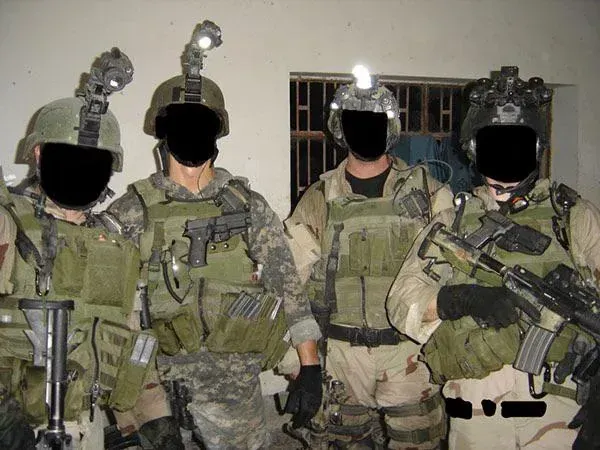
Just as a world-class surgeon doesn't use generic tools, a Delta soldier's equipment is anything but standard issue. These elite commandos operate on a philosophy of performance over uniformity, choosing and modifying gear to fit the mission and their personal fighting style. The goal is simple: use whatever provides the most decisive edge. This approach means that two soldiers standing side-by-side might carry rifles with completely different optics, grips, and attachments, each one a purpose-built tool for a master of their craft.
This level of customization is most obvious in their firearms. A Delta soldier's rifle isn't just a weapon; it's an extension of their body, meticulously tuned for perfect balance and reliability. But their advantage goes far beyond the guns. The unit's deep funding gives them access to bleeding-edge technology, from silent communication systems to advanced night vision that effectively lets them own the darkness. This technological dominance allows them to coordinate complex actions with speed and precision that most other military forces simply cannot match.
Ultimately, this specialized gear is what enables them to solve impossible problems in the world's most dangerous places. It's one thing to have the best tools, but it's another to know how to use them under extreme fire. That reality was put on brutal display for the entire world to see during a fateful battle in Somalia.
Black Hawk Down: How the World Saw the Real Delta Force
For many, the first real glimpse into this secret world came from the harrowing 1993 Battle of Mogadishu, later immortalized in the book and film Black Hawk Down. In one of the most documented missions carried out by the unit, officially the Combat Applications Group (CAG), a small team of Delta Force soldiers was tasked with a surgical strike: to capture a Somali warlord's top lieutenants from a crowded city in broad daylight. The mission showcased their specialty, executing high-stakes, precise operations in chaotic environments where success is measured in inches and seconds.
When a second Black Hawk helicopter was shot down far from the main force, the battle's focus shifted tragically. With the lone pilot wounded and surrounded by a hostile mob, two Delta snipers in the helicopter above, Gary Gordon and Randy Shughart, made a choice that defined their unit's ethos. They repeatedly requested to be inserted on the ground to defend the crash site, fully knowing it was likely a suicide mission. Their request was finally granted.
Gordon and Shughart fought off hundreds of attackers until their ammunition ran out, saving the pilot's life at the cost of their own. They were posthumously awarded the Medal of Honor and are among the only publicly famous members of The Unit. Their sacrifice wasn't just an act of bravery; it was a demonstration of the unwavering code that guides all Delta Force soldiers. This profound sense of duty, however, exists in a world of complete anonymity.
The Silent Legacy: Why Delta Force Anonymity Is Their Greatest Strength
While the name "Delta Force" often conjures images from blockbuster films, the reality is a unit born of necessity, defined not by brute force, but by intellect, maturity, and an unbreakable will to solve the unsolvable. Their legacy is one of quiet professionalism, not public glory. A vague news report about a global crisis being quietly averted takes on new meaning with the awareness of the unseen hands at work. Their anonymity isn't for mystique, it's the very asset that allows them to succeed.
They are not characters seeking fame, but guardians of a strategic instrument, ensuring that when the nation's hardest problems arise, the right people are already waiting in the shadows. This is the true legacy The Unit carries forward. For the tactical athlete, the lesson isn't to chase the mythology, it's to train the trait the selection cadre is actually screening for: the capacity to stay composed, solve problems, and keep moving when you're under-fed, under-slept, and out of instructions. That kind of durability is built, not born, through structured strength, work capacity, and ruck-based conditioning long before anyone steps onto a selection course.
***Disclaimer: This content is provided for general informational purposes only. Combat Fitness is not affiliated with the U.S. Department of Defense, and official standards may change at any time. Always consult official military publications for the most up-to-date requirements.***


