
Farmers Carry (Farmers Walk): Muscles, Benefits, Form
Farmers Carry (Farmers Walk): Muscles Worked, Benefits, Form and Programming
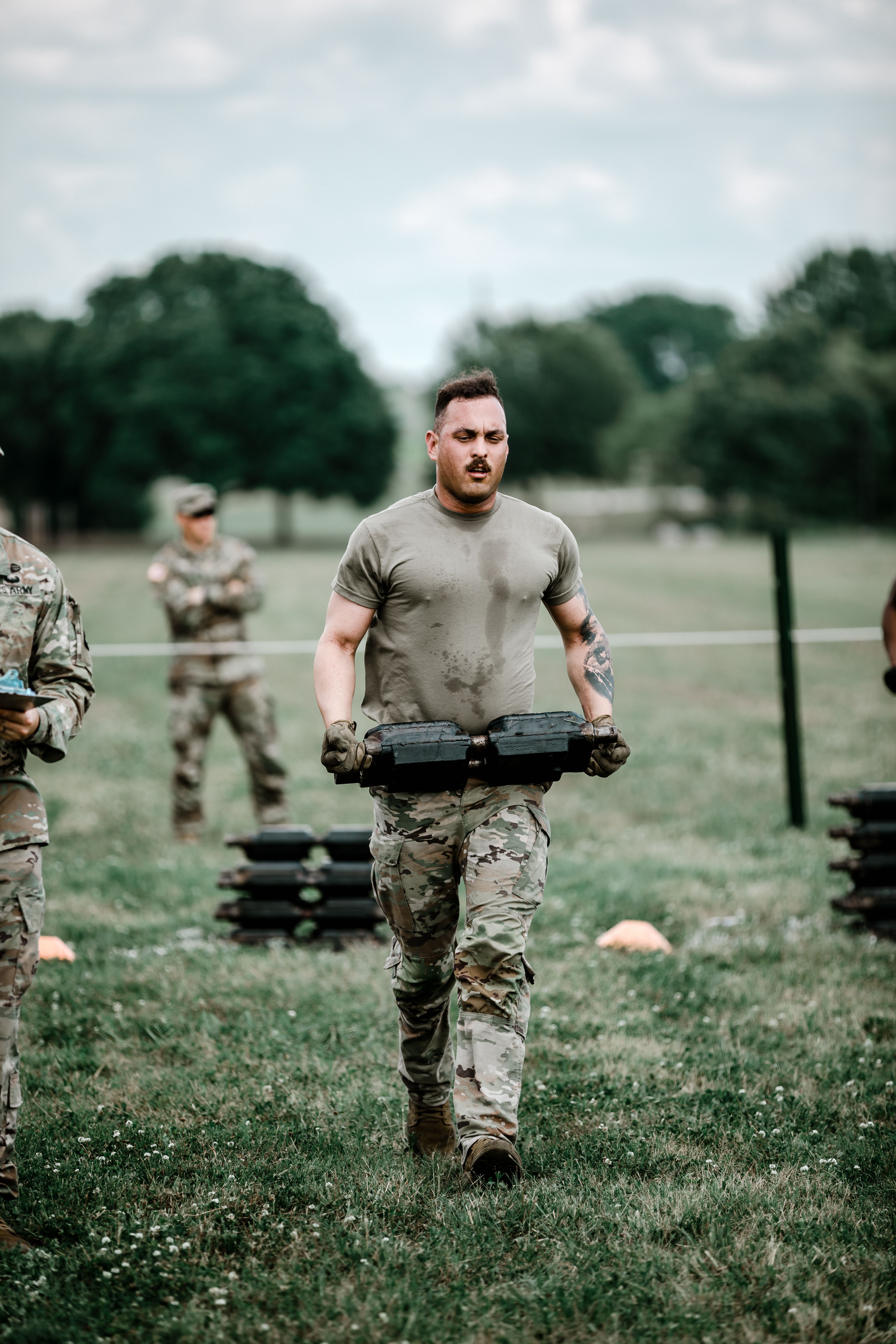
The farmers carry, also called the farmers walk, is one exercise with two names: pick up a heavy load in each hand, stand tall, and walk a set distance or time before setting it down. It trains grip, trunk stability and work capacity in the same set, which is why loaded carries sit inside our tactical training programs instead of at the end of a session as filler. The Army scores a loaded carry directly in the sprint-drag-carry event of the Army Combat Fitness Test, and soldiers, police officers and firefighters carry uneven load for a living. Below: the muscles the farmers walk works, the benefits, correct form, loading, variations, and three sample workouts.
Key Takeaways:
Farmers carry and farmers walk are the same exercise, as are farmer's carry and farmer carry.
Grip fails first, but the core is the real training effect: the load fights sideways bend every step.
Program 20 to 60 yards per trip, loaded so the last few yards are ugly but controlled.
Six to ten hard carries a week is plenty. Daily only works if you vary load and distance.
For a tactical athlete the payoff is transfer: casualty drags, equipment carries, gear-laden movement.
What Is the Farmers Carry (or Farmers Walk)?
A farmers carry is a loaded carry in which you hold a heavy implement in each hand, brace the trunk, and walk for a set distance or time before putting the load down. It trains the body to resist collapse under load rather than to move a weight through a range of motion.
The movement comes from strongman, where the farmers walk is a timed event over a fixed course. It reached tactical training because the demand matches the job: weight in the hands, body upright, moving until you can set it down.
Farmers carry and farmers walk are the same exercise. Farmer's carry, farmer carry, farmers walk, farmer's walk and farmer carries all describe the same movement: two loads, two hands, walk. There is no difference in technique, muscles worked or programming. Strongman coaches tend to say walk. Strength and conditioning coaches tend to say carry.
Farmers Carry Muscles Worked
The farmers carry works the forearms and grip, the trapezius and upper back, the shoulder stabilizers, the obliques and deep core, and the glutes, quads and spinal erectors. Almost none of that shortens and lengthens under load. Most of it holds position isometrically while the legs move you forward.
Forearms and Grip
Grip fails first, and that is the point. The finger flexors (flexor digitorum superficialis and profundus) hold the implement closed while the wrist extensors keep the wrist neutral. Because the contraction is isometric and long, the carry builds grip endurance rather than a single maximal squeeze. That is the quality that matters when you are dragging a casualty or holding a charged hose line.
Traps, Upper Back and Shoulders
The upper and middle trapezius, levator scapulae and rhomboids hold the shoulder girdle against the pull of the load. The rotator cuff and serratus anterior keep the shoulder centered while the arm hangs loaded. Carries thicken the traps without a single shrug, because the tissue is under tension for the length of the walk.
Core and Obliques: The Real Farmers Walk Training Effect
Farmers walk muscles worked lists usually stop at the arms and traps, which misses the training effect. With load on both sides, the obliques and quadratus lumborum resist lateral bend every time one foot leaves the ground. McGill and colleagues measured trunk activation across strongman events and recorded high activation during the farmers walk with the spine near neutral. High core demand, no spinal flexion.
Glutes, Legs and Erectors
The glutes, quads and spinal erectors deliver the load through the floor and keep the ribcage stacked over the pelvis. The pickup and the set-down are deadlifts, and that is where most of the hip and hamstring work happens.
Table:
Figure 1.1 - Musculature of a loaded carry, by role. Prime movers: finger flexors and wrist extensors hold the handle and keep the wrist neutral; upper and mid trapezius, levator scapulae and rhomboids support the shoulder girdle; glutes, quadriceps, hamstrings and calves drive locomotion, pickup and set-down; latissimus dorsi controls the trunk and shoulder through swing. Stabilizers: obliques and quadratus lumborum resist lateral bend; gluteus medius resists pelvic drop on the stance leg; rotator cuff and serratus anterior centre the shoulder under a hanging load; erector spinae and deep spinal stabilizers hold the spine near neutral. Only locomotion is concentric, everything else is isometric, which is why carries train endurance over peak strength and why grip fails first. A one-handed carry loads the spine more than the same weight split between both hands, making the suitcase carry an anti-lateral-flexion tool. Electromyography shows abdominals and rectus femoris peaking in stance, lats and erectors in swing. Source: NSCA Coach 7.3. Educational content, not medical advice.
Carries build capability faster than they build size, which is the argument behind go muscles vs show muscles.
Benefits of the Farmers Carry
Farmers walk benefits are usually written for a general gym audience. Here they are ordered the way they matter to someone who carries load for work.
Grip strength that transfers
Grip limits deadlifts, pull-ups, rope work, casualty drags and ladder carries. It is also one of the most-studied markers of general physical capacity: the PURE study, following nearly 140,000 adults across 17 countries, found handgrip strength was associated with all-cause and cardiovascular mortality. The carry trains it under real load, not on a gripper.
Core stability without spinal flexion
Anti-lateral-flexion loading builds trunk stiffness while the spine stays stacked. For anyone managing back history, that is a better trade than high-rep flexion work, and closer to how the trunk is loaded on the job.
Work capacity and conditioning under load
A heavy carry drives heart rate and breathing hard, because a large amount of muscle is under isometric tension while you move. You get conditioning with almost no eccentric damage, so it recovers faster than sprint or jump work.
Posture and trap development
Holding the shoulders packed and the ribs down for 40 yards under load is postural endurance work. Trap and upper-back thickness is the byproduct, not the goal.
Bone and connective-tissue loading
Bone and tendon adapt to mechanical strain. Heavy carries deliver long-duration axial loading through the hands, wrists, shoulders, spine and hips at weights most athletes cannot hold in any other lift.
Occupational carryover
This is the part a general fitness site cannot write honestly. The load a tactical athlete carries is not a barbell. It is a 40-pound kettlebell in each hand for 50 meters in the ACFT sprint-drag-carry, an ammunition can under one arm, two saws on the CPAT equipment carry, a charged hose line, or a partner in full kit. All of it is external, uneven and gripped. Load carried in the hands also costs more per pound than load carried close to the trunk, which is why hand-carried gear shortens working time faster than pack weight does. Training the carry buys that margin back. The same logic drives load carriage conditioning for fireground work and the loaded-movement blocks inside functional strength training for military performance.
Carries are one piece of a week, not the week. Where they sit relative to lifting, rucking and conditioning is the subject of tactical strength and conditioning.
What Happens If You Do Farmers Walks Every Day: Results and Before-and-After
No transformation story. Here is what carrying heavy loads three to five times a week for 30 days typically changes, and what it does not.
Week one to two: grip. It is the fastest-adapting link because it starts as the weakest. Most athletes add real distance at the same load inside two weeks, and the deadlift that used to slip out of their hands stops slipping.
Week two to four: position and trunk endurance. You stop leaning back, your steps lengthen, and standing under load stops feeling like a fight. Trap and upper-back thickness starts to show in athletes who were not already carrying heavy.
Week four onward: work capacity. The same distance at the same load leaves you less winded, and recovery between trips shortens.
What does not change in 30 days: bodyweight, arm size, or your one-rep max. A farmers walk is not a hypertrophy program. It has almost no eccentric loading and little range of motion, which are two of the main drivers of muscle growth. Expect capability first, appearance a distant second. Individual results vary with starting fitness, load, sleep and nutrition.
Can you do farmers walks every day? Not at the same intensity. Daily heavy carries beat up the hands, elbows and lower back before they beat up the muscles. Run one or two heavy days a week and keep the rest lighter and shorter. Drop a day the moment grip fails at the start of a trip rather than the end.
How to Do a Farmers Walk (or Farmers Carry): Form, Grip and Common Mistakes
How to do a farmers walk, start to finish:
Set the implements just outside your feet, handles centered in your hands.
Hinge and grip. Hips back, chest up, shoulder blades set, spine neutral. This is a deadlift, not a squat.
Breathe into the belly and brace as if you are about to be punched.
Stand by driving the floor away. Do not pull with the arms.
Walk. Short-to-moderate strides, quick turnover, ribs down, eyes ahead. Let the arms hang.
Set the load down with a hinge. Do not drop it and do not bend at the waist to release it.
Grip, hooks and straps
Bare hands are the default, because grip is one of the qualities you are here to build. Use straps only when the target of that set is the trunk and legs and grip is what stops you getting there, or when the load is far beyond what any hand can hold. If more than a third of your carry volume is strapped, you are training the wrong end of the exercise. Chalk before straps.
Common mistakes
Shrugging the load instead of letting the shoulders hang packed and down.
Leaning back to counterbalance, which turns the carry into a lumbar extension hold.
Short choppy steps that remove the single-leg stability demand.
Letting the ribcage flare, which unloads the obliques and dumps the work onto the low back.
Dropping the implements at the finish instead of setting them down. That is how hands and backs get hurt.
Going too light and turning a strength exercise into a walk.
Farmers Carry Variations: Dumbbell, Kettlebell, Barbell and Single-Arm
Dumbbell farmers carry
The default in most gyms and the most searched version for a reason: short handle, compact load, available everywhere. The limit is the rack. Once the heaviest dumbbells feel light, you need another implement.
Kettlebell farmers walk
The center of mass sits below and behind the handle, so the bell swings and the handle is thicker. That is harder on the grip at the same weight and adds a rotational demand the trunk has to cancel. Better for grip, worse for maximum load.
Trap bar and barbell
A trap bar or dedicated handles let you load far past dumbbell territory, which is where the top end of this exercise lives. Implement selection deserves its own treatment rather than a paragraph here.
Single-arm carry
Load one side and the demand shifts almost entirely to the opposite obliques and quadratus lumborum. This is the version that resembles carrying a toolbox, a can or a gear bag, and it is the same asymmetric-load problem behind duty belt back pain. Match sides for equal distance, and use it when trunk stability, not grip, is the target.
Overhead carry
Locked out overhead, the carry becomes a shoulder stability and thoracic position drill. Load drops hard. Treat it as a quality exercise, not a loading one.
Odd objects change the problem again, because an unstable load shifts while you move. That is the case for sandbag training alongside handled carries.
Farmers Carry Workout: Sets, Reps, Distance and Programming
Three farmers carry workouts, each with a different target.
Grip-focused finisher. Four to six trips of 30 yards at a load you could hold for roughly 45 seconds. Rest 90 seconds. No straps. Stop when the grip opens, not when the legs quit. Twice a week.
Conditioning-focused. Eight to ten trips of 20 yards at moderate load with 30 seconds rest, or a 10-minute clock of carry-and-return. Heart rate high, position clean. Once a week, not on the same day as heavy squats or deadlifts.
Tactical loaded-carry finisher. Alternate 50 meters of heavy two-hand carry with 50 meters of single-arm carry per side, then a 100-meter sled or casualty drag. Four rounds, 2 minutes rest. This is the closest gym analog to the ACFT sprint-drag-carry and to fireground equipment work, and it is the version we program for tactical athletes. Competition formats such as Hyrox use the same movement under a fixed standard.
How far: 20 to 60 yards per trip for strength and grip, up to 100 meters or a timed clock for conditioning. How long: 30 to 60 seconds under load. How often: six to ten hard trips a week across one or two sessions. Daily frequency is covered above.
If you want carries sequenced against lifting, rucking and conditioning instead of bolted onto whatever you did that day, a 12-week functional training program is the structure that holds them.
How Much Weight Should You Carry?
Load the carry so the last third of the distance is hard but your position never breaks. If your steps shorten, your shoulders round or your ribs flare, the weight is wrong regardless of what the number says.
As a starting point in our coaching practice, most healthy trained athletes begin around a quarter of bodyweight per hand for a 40-yard trip, then progress load before distance. That is a starting range, not a standard, and it will be wrong for some athletes in both directions. Grip, height, hand size and training history all move it.
Progress it the way you progress anything else: hold the distance constant, add load when the last trip stops being hard, and add distance only after the load stops moving. When two consecutive sessions end because your grip opened at the start of a trip rather than the end, you are carrying too much too often.
A full standards treatment, weight by age and by gender with a calculator, is its own reference and is coming as a separate page. Use the rule of thumb here until it lands.
Farmers Carry vs Suitcase Carry and Other Loaded Carries
Every loaded carry trains bracing under load. What changes is where the load sits, which changes what has to work.
Figure 1.2 - Loaded carry variations compared. The farmer's carry (farmer's walk) holds a load in both hands at the sides, grip endurance, upright trunk stability, work capacity. It's the default: most load and most transfer per minute. The suitcase carry holds one load at one side for anti-lateral-flexion through the obliques, quadratus lumborum and gluteus medius; one hand loads the spine more than the same weight split between two, so it isn't a lighter farmer's walk. The front rack carry holds two loads at the shoulders for anti-extension, upper back and breathing under load, use it when trunk position is the weak link. The overhead carry trains shoulder stability and thoracic position at the lightest absolute load of the group. The yoke walk sits across the upper back for whole-body bracing at maximal load, use it when grip is capping your structural loading. The ruck distributes load on the back for aerobic-strength endurance over distance, the choice when the demand is distance rather than peak load. Each variation is defined by its limiter, grip, trunk position, shoulder stability, or none at all for the yoke, so pick the one whose limiter matches the quality you're training. Source: NSCA Coach 7.3. Programming guidance, not medical advice.
The short version of farmers carry vs suitcase carry: two loads balance each other and let you carry more total weight, one load forces the trunk to fight sideways bend and trains the obliques harder at a fraction of the weight. Run both. For distance work under a pack rather than in the hands, the demand shifts to the aerobic system and the shoulders, which is a different problem covered in our rucking guide.
Farmers Carry Alternatives and Doing It Without Space
The usual reason someone needs an alternative is not equipment, it is floor space. A gym with a 15-foot walkway does not support a 40-yard trip. Solve it with time instead of distance.
Static holds. Pick the load up and hold 30 to 60 seconds. You lose the single-leg stability demand and keep almost all of the grip and postural demand.
Shuttle carries. Ten yards down and back, repeated. Turns cost time and add a bracing demand of their own.
Farmers carry on a treadmill. It works at 2.0 to 2.5 mph with dumbbells or kettlebells and someone nearby, but only once you can carry that load confidently on solid ground. Never step onto a moving belt already loaded.
Suitcase and front rack holds, which need no walking room at all.
Sled pushes and drags, when the load is there but the handles are not.
With no implements at all the carry has no true substitute, but grip, bracing and postural endurance can still be trained. Our guide to training with zero equipment covers what that looks like when the gym is a hotel room.
FAQ: Frequently Asked Questions
What muscles does the farmers carry work?
The farmers carry works the forearms and grip, upper and mid traps, rhomboids, rotator cuff, obliques and quadratus lumborum, spinal erectors, glutes, quads and calves. Most of that work is isometric: the muscles hold position under load while the legs move you forward.
What muscles does the farmers walk work?
The same ones. Farmers walk and farmers carry are two names for one exercise, so the muscles worked are identical: grip and forearms, traps and upper back, shoulder stabilizers, obliques and deep core, spinal erectors, glutes and legs.
What is the difference between a farmers carry and a farmers walk?
There is none. They are the same exercise under two names. Farmer's carry, farmer carry, farmers walk and farmer's walk all describe holding a heavy load in each hand and walking. Strongman coaches usually say walk, strength and conditioning coaches usually say carry.
Is the farmers carry a full body workout?
The farmers carry loads nearly the whole body, but it is not a complete workout. It trains grip, trunk stability, postural endurance and locomotion under load. It does not train pressing, pulling through a range of motion, or hip extension at speed. Use it inside a program.
Can you do farmers walks every day?
Yes, if you vary the intensity. Daily heavy carries fatigue the hands, elbows and low back before the muscles benefit. One or two heavy days a week with lighter exposure on other days is the sustainable pattern. Cut a day when grip fails early in a trip.
What happens if you do farmers walks for 30 days?
Grip improves first, usually inside two weeks. Posture and trunk endurance follow, then work capacity by week four. Trap and upper-back thickness may show. Bodyweight, arm size and maximal strength change little, because the carry has almost no eccentric loading. Results vary by starting point.
How far should you walk on a farmers carry?
Twenty to 60 yards per trip for strength and grip, which puts most athletes in a 30 to 60 second working window. Go to 100 meters or a timed clock when the goal is conditioning. Shorten the distance and add load if position breaks early.
How much weight should you use for a farmers walk?
Enough that the last third of the trip is hard while your position holds. A common starting point is roughly a quarter of bodyweight per hand for 40 yards, then progress load before distance. That is a starting range, not a standard. A full weight-by-age reference is coming.
Do farmers carries build muscle?
Some, mostly in the forearms, traps and upper back, where isometric time under tension is longest. They are not an efficient hypertrophy tool, because there is little eccentric loading and almost no range of motion. Train carries for capability and use other lifts for size.
Are farmers walks good for you?
Farmers walks are among the highest-return exercises available for grip, trunk stability and work capacity, with a low technical barrier and little eccentric soreness. They suit most healthy trained athletes. Anyone with a current back, shoulder or wrist injury should clear heavy carries with a clinician.
Is the farmers carry good for your forearms?
Yes. The finger flexors and wrist extensors work isometrically for the entire trip, which is a long time under tension at heavy load. Farmers walk forearm development comes from that duration. Use bare hands and chalk rather than straps if forearms are the target.
What is the difference between a farmers carry and a suitcase carry?
A farmers carry loads both hands, which balances the body and lets you carry more total weight. A suitcase carry loads one hand, forcing the opposite obliques and quadratus lumborum to resist sideways bend. The farmers version builds grip and capacity, the suitcase version builds asymmetric trunk stability.
Can you do a farmers carry on a treadmill?
Yes, at 2.0 to 2.5 mph with dumbbells or kettlebells, once you are confident with that load on solid ground. Step on before you pick the weights up and have someone nearby. The treadmill solves the no-space problem, not the loading problem.
Should you use straps for farmers carries?
Only when the target of that set is the trunk and legs and grip is the limiter, or when the load exceeds what any hand can hold. Grip is one of the main reasons to run the exercise, so keep most volume unstrapped. Chalk first.
The farmers carry is the least complicated hard thing you can do in a gym: heavy load, two hands, walk, put it down. It builds the grip, trunk stability and work capacity behind every casualty drag, equipment carry and gear-laden movement, and it does it without wrecking you for the next session. Load it honestly, hold your position, progress load before distance. Then put it inside a program that knows where it belongs and train the carry the way the job demands it.
References:
McGill SM, McDermott A, Fenwick CM. Comparison of different strongman events: trunk muscle activation and lumbar spine motion, load, and stiffness. Journal of Strength and Conditioning Research. 2009;23(4):1148-1161.
McGill SM, Marshall L, Andersen J. Low back loads while walking and carrying: comparing the load carried in one hand or in two hands. Ergonomics. 2013;56(2):293-302.
Winwood PW, Cronin JB, Brown SR, Keogh JWL. A biomechanical analysis of the farmers walk, and comparison with the deadlift and unloaded walk. International Journal of Sports Science and Coaching. 2014;9(5):1127-1143.
Winwood PW, Keogh JWL, Harris NK. The strength and conditioning practices of strongman competitors. Journal of Strength and Conditioning Research. 2011;25(11):3118-3128.
Leong DP, Teo KK, Rangarajan S, et al. Prognostic value of grip strength: findings from the Prospective Urban Rural Epidemiology (PURE) study. The Lancet. 2015;386(9990):266-273.
Celis-Morales CA, Welsh P, Lyall DM, et al. Associations of grip strength with cardiovascular, respiratory, and cancer outcomes and all cause mortality: prospective cohort study of half a million UK Biobank participants. BMJ. 2018;361:k1651.
Bohannon RW. Grip strength: an indispensable biomarker for older adults. Clinical Interventions in Aging. 2019;14:1681-1691.
Cronin J, Lawton T, Harris N, Kilding A, McMaster DT. A brief review of handgrip strength and sport performance. Journal of Strength and Conditioning Research. 2017;31(11):3187-3217.
Knapik JJ, Reynolds KL, Harman E. Soldier load carriage: historical, physiological, biomechanical, and medical aspects. Military Medicine. 2004;169(1):45-56.
Orr RM, Pope R, Johnston V, Coyle J. Soldier occupational load carriage: a narrative review of associated injuries. International Journal of Injury Control and Safety Promotion. 2014;21(4):388-396.
Orr R, Schram B, Pope R. A comparison of military and law enforcement body armour. International Journal of Environmental Research and Public Health. 2018;15(2):339.
U.S. Army. Army Combat Fitness Test: Sprint-Drag-Carry event standards.
U.S. Marine Corps. Marine Corps Combat Fitness Test: Ammunition Lift and Maneuver Under Fire events. MCO 6100.13A.
International Association of Fire Fighters and International Association of Fire Chiefs. Candidate Physical Ability Test (CPAT): Equipment Carry event.
Turner CH, Robling AG. Designing exercise regimens to increase bone strength. Exercise and Sport Sciences Reviews. 2003;31(1):45-50.
Schoenfeld BJ. The mechanisms of muscle hypertrophy and their application to resistance training. Journal of Strength and Conditioning Research. 2010;24(10):2857-2872.
Kraemer WJ, Ratamess NA. Fundamentals of resistance training: progression and exercise prescription. Medicine and Science in Sports and Exercise. 2004;36(4):674-688.
Neumann DA. Kinesiology of the Musculoskeletal System: Foundations for Rehabilitation. 3rd ed. St. Louis: Elsevier; 2016.
Written by the Combat Fitness Team, coaches who program for active military, law enforcement, and first responders preparing for real occupational and selection standards.
Disclaimer: This article is for informational purposes and is not medical advice. Loaded carries place high demand on the hands, shoulders, spine and hips. If you have a current or past injury, are returning from surgery, or have any medical condition affecting your ability to train, consult a qualified medical professional before starting heavy carries. Training outcomes vary between individuals and no specific result is guaranteed.


