
BUD/S Training: Phases, Hell Week, PST | Combat Fitness
BUD/S Explained: Phases, Hell Week, Standards and How to Prepare
BUD/S is the six-month Navy selection and training course that every SEAL candidate has to pass, and roughly two out of three people who start it do not finish. The course runs at the Naval Special Warfare Center in Coronado, California, in three phases plus an orientation block, and the Navy's own reporting puts long-run attrition near 68 percent.
If you want the swim, run and load-carriage base built for you on a schedule instead of assembled from forum posts, our tactical fitness programs do that work. This guide covers what BUDS is, how long it lasts, what happens in each phase, what Hell Week involves, how classes and attrition are counted, the PST scores that get you a contract, and how to train for it.
Key Takeaways:
BUD/S runs about 24 weeks: a three-week orientation and three seven-week phases, preceded for most candidates by a preparatory course at Great Lakes, Illinois.
First Phase accounts for the overwhelming share of attrition. Navy figures put First Phase near 66 percent, Second Phase near 5 percent and Third Phase near 3 percent.
Hell Week falls in the fourth week of First Phase: five and a half days of near-continuous work on roughly four hours of total sleep.
PST minimums (500-yard swim 12:30, 50 push-ups, 50 sit-ups, 10 pull-ups, 1.5-mile run 10:30) get you screened. Competitive scores sit far above them.
Swim skill and aerobic durability separate candidates more than raw strength does, and both take months to build.
What Is BUD/S?
BUD/S is Basic Underwater Demolition/SEAL training, the Navy's selection and basic skills course for SEAL candidates, run at the Naval Special Warfare Center in Coronado, California. It lasts roughly six months and is built in three phases: physical conditioning, combat diving and land warfare. Passing it does not make you a SEAL. It qualifies you to continue into the pipeline that does.
You will see the course written both ways. BUD/S with the slash is the formal spelling the Navy uses. BUDS without it is how most people type it, and both refer to the same course. Navy BUDS, BUDS SEAL training and SEAL BUD/S all point at the same schoolhouse in Coronado.
What separates BUDS from shorter selection courses is duration. Army SFAS runs about three weeks. BUD/S applies cold water, sleep loss and a training day that does not end across half a year, and the Navy budgets for most of a class to leave. The stated goal is roughly 175 graduates a year from a pool near 888, a planned graduation rate around 20 percent. Attrition since November 1998 has averaged about 68 percent.
What Does BUD/S Stand For?
BUD/S stands for Basic Underwater Demolition/SEAL. The name is lineage, not a description of the modern course. It traces back to the Underwater Demolition Teams of the Second World War, the combat swimmers who cleared beach obstacles ahead of amphibious landings, and to the SEAL Teams that grew out of them in 1962.
The slash marks where underwater demolition work and the broader sea, air and land mission were joined into one pipeline. Candidates still learn underwater work in Second Phase, but the course now covers land warfare, weapons and small unit tactics as well. That is the whole answer to what BUDS means in the Navy, and it tells you almost nothing about what the course costs to get through.
Where Does BUD/S Training Take Place?
BUD/S runs at the Naval Special Warfare Center on Naval Amphibious Base Coronado, on the Silver Strand south of San Diego. The geography is a training tool, not a backdrop.
The base sits between San Diego Bay and the open Pacific, which puts a surf zone, a bay, an obstacle course, a pool and miles of soft sand within walking distance of the compound. The asphalt courtyard where physical training happens, known as the grinder, sits in the middle of it. Pacific water off Coronado typically runs in the high 50s to high 60s Fahrenheit through the year: warm enough to survive for hours, cold enough to drain a candidate steadily across them.
Before Coronado, most enlisted candidates attend the Naval Special Warfare Preparatory Course at Great Lakes, Illinois, roughly two months of physical preparation and screening meant to raise the standard of candidates arriving on the beach.
How Long Is BUD/S and What Are the Phases?
BUD/S training is about 24 weeks long: a three-week orientation followed by three seven-week phases covering physical conditioning, combat diving and land warfare. Counting the preparatory course before it and SEAL Qualification Training after it, the full path from contract to Trident runs well over a year.
Figure 1.1 - the full Navy SEAL training pipeline from prep course to Trident: an eight-week Naval Special Warfare Preparatory Course at Great Lakes, then twenty-four weeks of BUD/S at Coronado built as a three-week orientation plus three seven-week phases, basic conditioning with Hell Week in week four, combat diving, and land warfare finishing on San Clemente Island, followed by three weeks of parachute jump school and twenty-six weeks of SEAL Qualification Training. The Navy counts fifty-six weeks of initial training for an enlisted SEAL and sixty-two for an officer, covering BUD/S, jump school and SQT together, which puts the end of BUD/S at week twenty-four of fifty-six. SQT is the longest single stage and longer than all three BUD/S phases combined, and graduating it, not BUD/S, is what earns the Trident. Sources: navy.com for total initial-training length; published Naval Special Warfare training references for phase lengths, Hell Week timing and locations.
Phase lengths have changed over the years, and Naval Special Warfare has adjusted screening and medical oversight since 2023. Verify current durations against an official Navy source before planning around them.
That structure is why BUDS is not a fitness test. A fitness test measures a peak. BUD/S measures what you can produce on the 90th consecutive day of being cold, tired and behind.
Inside the Three Phases
The vocabulary inside the course is specific, and candidates search for it because it is what they get measured against.
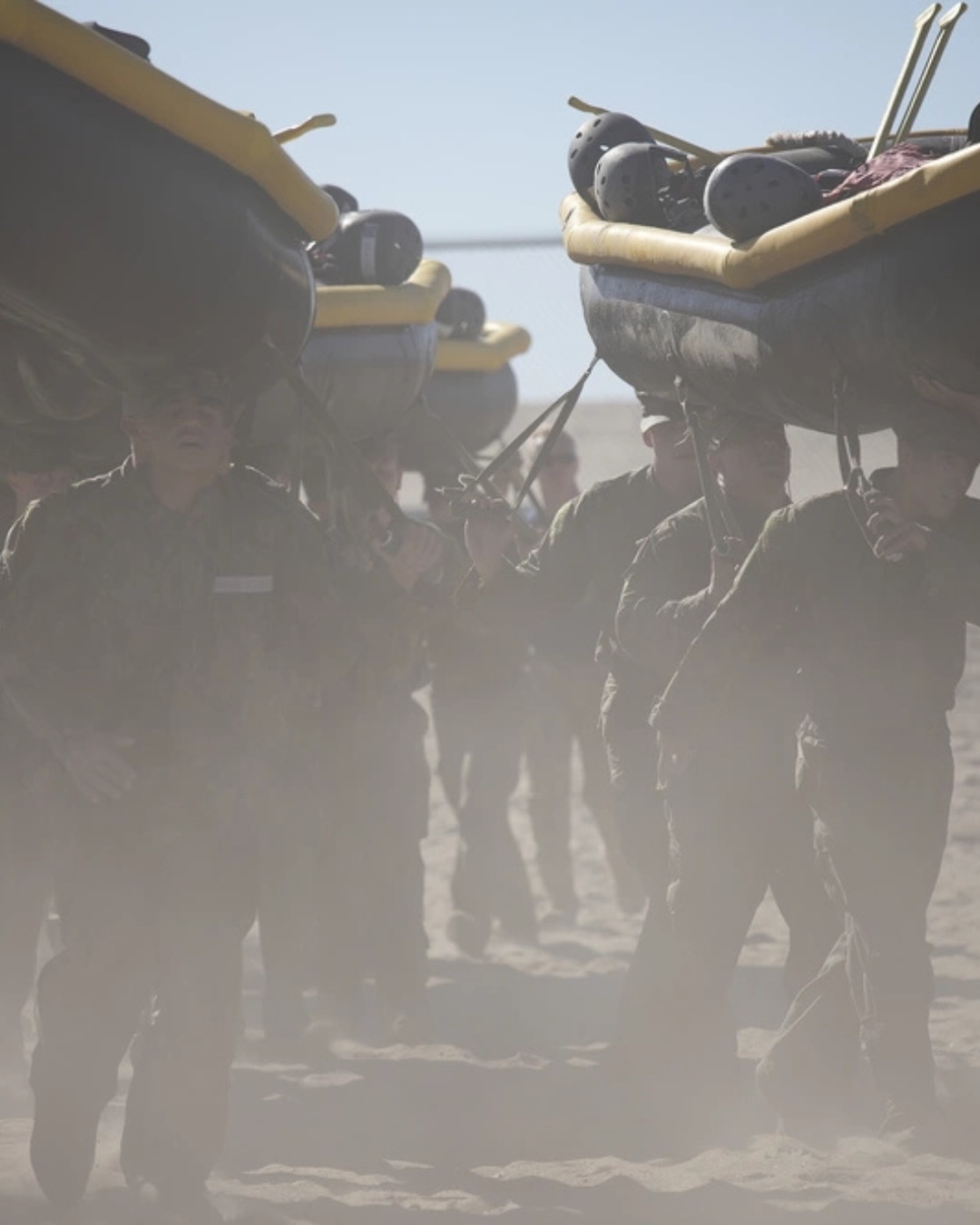
First Phase is conditioning: timed runs on soft sand, timed ocean swims, the obstacle course, log PT with a boat crew carrying a telephone pole, and inflatable boat work carried on the head through the surf zone. Surf torture, lying linked arm in arm in the wash while the surf breaks over you, is the standing punishment and the standing lesson. Hell Week sits in the middle of it.
Second Phase is combat diving, and it is the phase that fails competent athletes. Candidates learn open and closed circuit diving, and before that they pass pool competency, in which instructors interrupt a diver's air supply underwater and the candidate follows a fixed procedure without surfacing. Drown proofing, swimming and floating with hands and feet bound, comes earlier. Both reward a controlled response to panic more than lung capacity.
Third Phase is land warfare: weapons, demolitions, small unit tactics, patrolling and navigation, with the back half run on San Clemente Island. Sleep is short, the work is technical, and mistakes carry consequences beyond a beating on the beach.
What Happens During Hell Week?
Hell Week is five and a half days of near-continuous physical training during the fourth week of First Phase, during which candidates sleep roughly four hours in total. Navy accounts describe candidates covering more than 200 miles and training more than 20 hours a day. It is the single largest attrition event in the course.
The measured numbers are worth more than the mythology. Navy attrition reporting puts average BUDS Hell Week attrition near 21 percent, split between roughly 15 percent who drop on request and about 5 percent who are medically rolled. That is one in five of a class in under six days.
The mechanism is cold, not effort. Candidates spend the week wet, in and out of surf and bay water in the high 50s and 60s, in boat crews carrying inflatable boats and logs, with meals as the only reliable pause. Core temperature drops, shivering burns fuel, coordination degrades, and judgment follows. Sleep deprivation removes the ability to regulate the response to any of it. That is why cold and water stress is trained as its own quality rather than assumed.
Candidates ring a brass bell three times to quit. Most who ring it do so in the first two days, before their bodies have run out of capacity. The decision arrives earlier than the failure does.
One note on safety, because it changed the course. In 2022 a candidate died shortly after completing Hell Week with Class 352. The Navy investigation released in May 2023 found inadequate oversight, insufficient risk assessment, poor medical command and control and undetected performance enhancing drug use. Naval Special Warfare responded with expanded cardiac screening, revised medical policies, broader authority to test candidates for performance enhancing drugs, and increased instructor oversight. Anyone preparing today is preparing for a more closely monitored course than older articles describe.
BUD/S Classes, Rosters and Attrition
BUD/S classes are numbered sequentially and have been since the program's origins, so the numbers keep climbing and never reset. Recent classes have run in the 350s and 360s. Roughly five or six classes convene each year at Coronado, with an average near 148 candidates starting each one.
That is why a BUDS class by year lookup rarely produces a clean table. Classes do not start on a fixed calendar. They are spaced so several classes occupy different phases at once without overwhelming instructors, pool time or boat inventory, and officer and enlisted candidates start in staggered patterns.
On rosters: we do not publish one, and neither should the sites that claim to. Class rosters are not routinely released. The legitimate routes to a record are a Freedom of Information Act request to Naval Special Warfare Command in San Diego, or, for a veteran's own record or a next of kin's, a Standard Form 180 request to the National Personnel Records Center through the National Archives. The UDT-SEAL Association holds historical material on the Teams. Any of those can confirm whether someone attended or completed BUD/S. A list posted on a forum cannot.
Figure 1.2 - BUD/S attrition by phase, from the Navy's own June 2023 command investigation into Class 352: 66 percent in First Phase, 5 percent in Second, 3 percent in Third, and a long-run average of 68 percent since November 1998 including rollbacks. The phase rates are conditional rather than additive, Hell Week sits inside First Phase, and the later figures count only candidates who started that phase, so a hundred starters compound down to about thirty-one finishers, matching the published long-run number. The mythology points at the wrong week: Hell Week takes 21 percent, while the three weeks leading up to it take 45, most of it drop-on-request rather than injury. Officers wash out at 39 percent against 79 percent for enlisted candidates, and roughly 888 candidates enter each year against a goal of graduating 175. Sources: U.S. Navy Command Investigation into the safety and medical oversight of BUD/S Class 352, released June 2023.
Navy figures put First Phase attrition near 66 percent, Second Phase near 5 percent and Third Phase near 3 percent. Over a recent five-year window the same reporting showed officer attrition near 39 percent against enlisted attrition near 79 percent, a gap usually attributed to older average age, a longer preparation runway and a more selective board before a slot is granted. Read that table as a training instruction: everything you do before you arrive should be aimed at the first seven weeks.
How to Get to BUD/S
Getting to BUD/S starts with a contract, not a fitness test. Enlisted candidates sign a SEAL Challenge contract, which guarantees the opportunity to attempt the pipeline rather than a slot in a class. Officers apply through a separate and more competitive selection board. Both routes require passing the Physical Screening Test in front of a recruiter or a Naval Special Warfare mentor.
The PST is five events in a fixed order with short rest between them: a 500-yard swim using combat sidestroke, sidestroke or breaststroke, push-ups in two minutes, sit-ups in two minutes, pull-ups with no time limit, and a 1.5-mile run.
Navy SEAL PST standards, current as of 2026
500-yard swim (combat sidestroke, sidestroke or breaststroke): minimum 12:30. Competitive 8:00 to 9:00.
Push-ups (2 minutes): minimum 50. Competitive 80 to 100.
Sit-ups (2 minutes): minimum 50. Competitive 80 to 100.
Pull-ups (no time limit): minimum 10. Competitive 15 to 20.
1.5-mile run: minimum 10:30. Competitive 9:00 to 10:00.
Rest between events: about 10 minutes.
Standards shown are current as of 2026. The Navy adjusts PST scoring and run attire periodically, including a shift toward timed runs in shorts and running shoes, so confirm the current version with a Navy SEAL and SWCC recruiting coordinator before you test.
Treat the minimum column as disqualifying rather than qualifying. Candidates who arrive holding minimums are the ones who leave in First Phase. Note also that the PST is a different and harder standard than the fleet Navy PRT standards most sailors test against. Passing the PRT tells you nothing about readiness for Coronado. The Naval Special Warfare mentor program exists for this reason: mentors are current or former operators assigned to help candidates prepare and test before they commit.
How Do You Train for BUD/S?
Training for BUDS is a multi-month build in five qualities: swim technique, running durability, upper body muscular endurance, load carriage and cold tolerance. Structure matters more than volume, because each quality improves on a different timeline and the slowest ones are the ones candidates start last.
Start with swimming, because it is the slowest to develop and the hardest to fake. The combat sidestroke is an efficiency stroke, not a speed stroke, and most candidates lose more time to poor technique than to poor conditioning. Get coached on the stroke before you build volume. Then build it: three to four swim sessions a week mixing technique work, intervals and longer continuous swims, with fin work added once the stroke holds under fatigue. Conditioning for water-based operations is a different training problem from land conditioning, and treating it as an afterthought is the most common preparation error we see.
Running comes second, and the limiting factor is usually tissue, not lungs. Soft sand and high weekly mileage produce stress fractures and shin splints in candidates who ramp too fast. Raise mileage by roughly 10 percent a week, run some of it on sand and in boots so the tissue adapts to the surface you will be tested on, and keep one weekly session slow and long. Add calf, tibialis and foot strength work as insurance rather than rehab.
Upper body endurance is the simplest piece. Push-ups, pull-ups, sit-ups and flutter kicks respond to frequency. Work them most days at submaximal effort rather than to failure twice a week, and test every four to six weeks instead of every session.
Load carriage and grip get trained through boat and log work you cannot replicate exactly, so approximate it. Sandbag carries, overhead holds, farmer walks and weighted rucks build the shoulder and trunk tolerance that boat-on-head work demands.
Cold exposure is the one people skip. Regular cold water immersion produces measurable habituation: the initial cold shock response blunts, breathing stays controlled, and the panic that ends candidates in the surf zone loses its grip. Build it gradually and never alone.
Then sequence it. Base, then volume, then a peaking block timed to your ship date, because arriving flat and arriving beaten up are both failures. Peaking for selection is a specific skill worth learning before you need it.
Most of the detailed BUD/S training programs online sit behind a paywall. The progression above is the honest outline of what they contain. What a paid program buys is scheduling, progression management and accountability, not a secret.
What BUD/S Does Not Test
BUD/S is not a fitness competition, and the fittest candidate in a class is not reliably the one who finishes. The attrition data makes that obvious and most training content ignores it.
The course selects for tolerance: of cold, of sleep loss, of ambiguity, and of being evaluated while performing badly. Candidates who need to be good at something in order to keep doing it tend to quit. Candidates who can be cold, slow, last and still functional tend to stay. Every US selection course is built around a version of this, which is why SFAS selection produces similar patterns with different events.
This is the difference between testing fitness versus real readiness. A PST score is one measurement, rested, in known conditions. Occupational readiness is what remains after three days without sleep. The two correlate, but not as tightly as candidates assume, and the gap is where most First Phase attrition lives.
None of that argues against being fit. A weak swim or a fragile aerobic base fails regardless of how much discomfort you can absorb, because the standards are timed and the timing does not move. It argues for training both: build the capacity, then practice producing it in bad conditions.
What Happens After BUD/S?
Graduating BUD/S does not earn the Trident. It earns the next school.
Graduates attend Army basic airborne training, a roughly three-week parachute course, then SEAL Qualification Training, about 26 weeks of advanced tactical training that ends with the award of the Navy SEAL Trident and assignment to a Team. Only after SQT is a graduate a SEAL. From there, operators run an 18-month train-up cycle between deployments.
A smaller number eventually screen for tier-one selection at the unit commonly known as SEAL Team 6, years after Coronado and after repeated operational deployments. That is the far end of a long road, not something you train for at the BUD/S stage. If you are trying to picture the career rather than the course, life as a special operator answers a more useful question than how hard BUD/S is. The course is six months. The job is decades.
Building the Base Before You Sign
If you are 12 months out from a contract, the work is simple to describe and hard to execute: build swim and run volume early, keep it, and add specificity later. Candidates who spend six months lifting and three months panicking about the swim arrive in the worst possible condition.
A reasonable 12-month shape looks like this. Months one to four, build aerobic base and swim technique on a modest strength floor. Months five to eight, raise swim and run volume, introduce rucking and cold exposure, hold strength. Months nine to twelve, add sand running, fin work, boat-style carries and a taper into your PST and ship date.
The reason base comes first is the attrition curve. Two thirds of the loss happens in seven conditioning weeks, and conditioning is the one input entirely under your control before you arrive.
How you build it is a separate decision. If you are weighing coached programs against doing it yourself, SEAL-style training programs compared covers what those services deliver, including the ones that rank on this topic. For a framework to evaluate any program before paying, start with choosing a training program. And if you would rather have it scheduled, our structured tactical training programs put swim, run, strength and load carriage on one calendar so the base gets built in the right order.
FAQ: Frequently Asked Questions
What does BUD/S stand for?
BUD/S stands for Basic Underwater Demolition/SEAL. The name comes from the Underwater Demolition Teams of the Second World War and the SEAL Teams established in 1962. The slash marks the point where underwater demolition training and the wider sea, air and land mission were combined into a single course.
What are the three phases of BUD/S?
First Phase is physical conditioning and contains Hell Week. Second Phase is combat diving, including pool competency and open and closed circuit diving. Third Phase is land warfare, covering weapons, demolitions, navigation and small unit tactics, with the back half on San Clemente Island. Each phase runs about seven weeks.
What is the BUD/S attrition rate?
Navy reporting puts average BUD/S attrition near 68 percent since November 1998, and the Navy plans around a graduation rate near 20 percent from the wider candidate pool. By phase, attrition runs near 66 percent in First Phase, 5 percent in Second Phase and 3 percent in Third Phase.
How many BUD/S classes run each year?
About five or six BUD/S classes convene each year at Coronado, with an average near 148 candidates starting each. Class numbers are sequential and have never reset, with recent classes in the 350s and 360s. Start dates are staggered so multiple classes occupy different phases at the same time.
What are the PST standards to get to BUD/S?
The PST minimums are a 500-yard swim in 12:30, 50 push-ups, 50 sit-ups, 10 pull-ups and a 1.5-mile run in 10:30. Competitive scores are considerably higher: a swim near 8 to 9 minutes, 80 to 100 push-ups and sit-ups, 15 to 20 pull-ups and a run near 9 to 10 minutes. Confirm current standards with a Navy recruiting coordinator.
Is BUD/S the hardest military training in the world?
By attrition rate it is among the most demanding selection courses anywhere, and its length and water exposure make it distinctive. Direct comparison is difficult, because Army SFAS, Marine Corps reconnaissance selection and foreign equivalents test different qualities over different timelines. The more useful question is which pipeline matches the job you want.
BUD/S removes roughly two thirds of the people who start it, and most of that happens in the first seven weeks, in the water and on the sand. The candidates who finish are rarely the strongest. They are the ones who arrived with a swim, a run and an aerobic base that did not need rescuing, and who kept producing when conditions were bad. Build that base now, on a schedule, and let the course test the rest.
References:
United States Navy. "Navy Releases Investigation into Naval Special Warfare Basic Training." Navy Office of Information press release, May 25, 2023.
Naval Special Warfare Command, Coronado, California. Official command site and FOIA point of contact for training records requests.
NavySEALs.com. "BUD/S." Stage structure including Naval Special Warfare Preparatory Course, orientation, and the three phases.
Naval Special Warfare / Navy recruiting. Special Operations career and screening information.
Wikipedia. "Combat sidestroke." Stroke mechanics and its role in Naval Special Warfare screening swims.
National Archives, National Personnel Records Center. Standard Form 180, request pertaining to military records.
UDT-SEAL Association. Historical records of the Underwater Demolition Teams and SEAL Teams.
Task & Purpose. "BUD/S: Everything you need to ace Navy SEAL training." Course overview and pipeline sequencing.
Disclaimer: This article is for informational and educational purposes only and does not constitute medical advice or an official statement of Navy policy. Standards, phase durations and screening requirements change; confirm current requirements with a Navy SEAL and SWCC recruiting coordinator or an official Navy source before acting on them. Consult a qualified medical professional before beginning any training program, particularly one involving cold water immersion, which carries real risk and should never be done alone.


