
Combat Fitness vs SEALFIT: Which Is Better? (2026)
Combat Fitness vs SEALFIT: Which Is Better for Tactical Athletes?
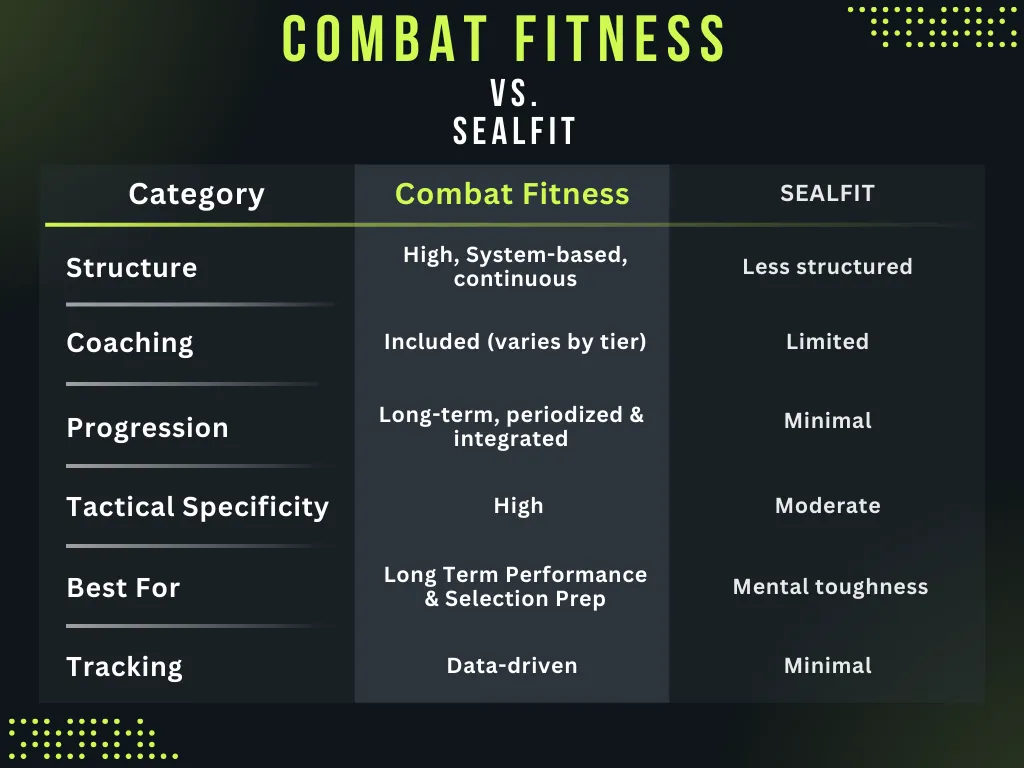
Combat Fitness and SEALFIT are both built for tactical athletes, but they solve different problems. Combat Fitness is a structured, periodized training system focused on measurable performance and selection prep; SEALFIT is a mindset-and-resilience brand built around high-intensity functional workouts and immersive events. If you want a trackable, coach-supported plan that progresses week over week, Combat Fitness is the stronger fit. If your main goal is building mental toughness through stress exposure, SEALFIT leans that direction.
This comparison breaks down Combat Fitness vs SEALFIT across programming structure, training philosophy, coaching, tactical specificity, and real-world application, so you can decide which system aligns with your goals.
Overview of Each Program
Combat Fitness
Combat Fitness is a structured, performance-driven training system built for tactical athletes. It integrates strength, endurance, rucking, and hybrid conditioning into progressive programs delivered through an app-based platform.
Key features include:
Structured multi-week training programs
Periodized progression systems
Coaching support (depending on tier)
Specialized tracks (rucking, endurance, selection prep)
The system is designed for long-term performance development and measurable outcomes.
SEALFIT
SEALFIT is a well-established brand founded on Navy SEAL-style training principles. It combines physical training with mental toughness, leadership development, and resilience training.
SEALFIT offers:
Training programs and workouts
Immersive events
Mindset and leadership training
Functional fitness programming
The emphasis is on mental resilience, discipline, and pushing beyond perceived limits, alongside physical fitness.
Training Philosophy
The core split here is planning versus intensity. Combat Fitness treats training as an engineering problem: define the performance target, then periodize toward it so each block builds on the last. SEALFIT treats training as a forge, repeated exposure to hard, unpredictable effort to build grit. Neither approach is wrong, but they produce different outcomes. A periodized system delivers predictable, measurable adaptation; an intensity-and-mindset system delivers resilience and confidence under stress. Which one matters more depends on whether you're chasing a specific number or a specific mindset.
Combat Fitness: Structured Performance System
Combat Fitness focuses on:
Periodization (planned phases of training)
Energy system development (aerobic base, threshold, VO₂ max)
Hybrid performance (strength + endurance integration)
The goal is to create a repeatable, measurable system for improving tactical performance over time.
SEALFIT: Mental Toughness and Resilience
SEALFIT emphasizes:
Mental resilience and discipline
Training under fatigue and stress
Leadership and mindset development
While physical training is a key component, the philosophy leans heavily toward:
Pushing limits
Developing grit
Building mental durability
This creates a system that is experience-driven rather than progression-driven.
Program Structure & Progression
Structure is where the two diverge most concretely. Combat Fitness runs in defined multi-week blocks with weekly progression targets, so you always know what this week is meant to improve and how it feeds the next. SEALFIT programming centers on demanding workouts and events, prioritizing effort and completion over a mapped progression curve. For an athlete preparing for a dated selection course or fitness test, a periodized pathway removes guesswork; for someone chasing a hard experience to test themselves against, the event-driven model can be motivating.
Combat Fitness
Combat Fitness programs are:
Structured over 32–52+ weeks
Built with progressive overload
Designed around specific performance goals
Athletes follow:
Weekly progression targets
Defined strength and endurance benchmarks
Integrated conditioning systems
This creates a clear and trackable progression pathway.
SEALFIT
SEALFIT programming is:
Less rigidly structured
Often centered around challenging workouts or events
Focused on effort and completion
While effective for building resilience, it typically lacks:
Long-term periodization
Clear progression metrics
Structured performance tracking
Coaching & Support
Coaching is the difference between a plan and a relationship. Combat Fitness builds support into the platform, with in-app communication and tiered options that let an athlete adjust the program against real feedback, which drives adherence and accountability over months, not days. SEALFIT delivers its strongest instruction in person at events, with educational content and community support around it, but it is generally less individualized day to day. If ongoing, responsive coaching is what keeps you consistent, that gap matters more than any single workout difference.
Combat Fitness
Combat Fitness offers:
In-app athlete support
Coaching tiers with direct communication
Program adjustments based on feedback
This creates a coaching-integrated system, improving:
Accountability
Adherence
Results
SEALFIT
SEALFIT provides:
Instruction during events
Educational content
Community-based support
However, it is generally:
Less individualized
Less focused on ongoing coaching
Mental Training and Mindset Development
This is the section where SEALFIT earns its reputation. Mindset is a core pillar of its model, leadership, stress exposure, and deliberate discomfort are a focus. Combat Fitness develops mental durability differently: through the discipline of showing up to structured sessions and clearing progressive benchmarks, resilience is built as a byproduct of consistency rather than as the headline. If your weak point is grit under pressure, SEALFIT targets it directly; if it's follow-through and structure, the Combat Fitness approach quietly builds the same trait confidently and for the long-term, not just for a single event.
Combat Fitness
Combat Fitness includes:
Performance-focused mindset development
Discipline through structured training
Goal-oriented progression
Mental resilience is developed indirectly through:
Consistency
Performance challenges
Progressive overload
SEALFIT
Mental training is a core pillar of SEALFIT, including:
Leadership development
Stress exposure training
Mindset coaching
This makes SEALFIT particularly strong for:
Building grit
Developing mental toughness
Experiencing high-stress environments
Specificity to Tactical Demands
Tactical specificity is about whether the training maps to the job. Combat Fitness builds toward operational demands directly, rucking progressions, structured running across intervals, threshold and long efforts, and strength aligned with load carriage, so the work transfers to a selection course or a real task. SEALFIT delivers general tactical fitness through high-intensity functional work, which builds a broad, durable base but is less tailored to specific operational demands, load-carriage or endurance benchmarks. For candidates with a defined pipeline in front of them, specificity is what shortens the gap between fit and ready.
Combat Fitness
Combat Fitness includes:
Rucking progression systems
Structured running programs (intervals, threshold, long runs)
Strength training aligned with load carriage
Hybrid conditioning for operational demands
Programs are designed for:
Selection preparation
Tactical readiness
Performance benchmarks
SEALFIT
SEALFIT provides:
General tactical fitness
High-intensity, functional workouts
However, it typically lacks:
Structured rucking systems
Detailed endurance progression
Data-driven performance tracking
This makes it more focused on general readiness and mental challenge, rather than optimized performance systems.
Data, Metrics, and Performance Tracking
You can't improve what you don't measure, and this is where the two philosophies show their hand. Combat Fitness is built around benchmark testing and tracked metrics, running pace, strength numbers, work capacity, so progress is visible and programming can be adjusted against it. SEALFIT emphasizes effort, completion, and experience over quantified tracking, which fits a mindset-first model but leaves less to analyze week to week. This works best if you're the type of tactical athlete who who needs a data-driven approach that keeps you honest.
Combat Fitness
Combat Fitness emphasizes:
Benchmark testing
Performance tracking
Measurable progression
Athletes can track:
Running pace improvements
Strength gains
Work capacity
This creates a data-driven training environment.
SEALFIT
SEALFIT is less focused on:
Quantitative tracking
Structured metrics
The emphasis is more on:
Effort
Completion
Experience
Scalability and Long-Term Development
The last structural question is what happens after the first few months. Combat Fitness is designed as a long-term system: an athlete can move from a general base to selection prep to ongoing performance maintenance without leaving the platform, because the programs are built to connect. SEALFIT is strongest as a short-to-medium-term challenge, an event to train for, an experience to complete, rather than a continuous development pathway. If you want one home for the next several years of training, scalability tips the comparison toward a connected, progression-based system.
Combat Fitness
Combat Fitness is designed as:
A long-term training system
A scalable progression pathway
Athletes can move from:
Beginner → Intermediate → Advanced
General fitness → Selection prep → Performance optimization
This supports continuous development over time.
SEALFIT
SEALFIT is better suited for:
Short-term challenges
Event-based experiences
General fitness and resilience
It lacks:
Structured long-term progression
Integrated development systems
Community and Brand Positioning
Combat Fitness
Combat Fitness positions itself as:
A performance system
A coaching-driven platform
A results-focused solution for tactical athletes
SEALFIT
SEALFIT positions itself as:
A mindset and leadership brand
A resilience-building system
It emphasizes:
Culture
Identity
Experience
Pricing and Value
Value is best judged against what you actually need. Combat Fitness is subscription-based with tiers that scale from app-only program access up to one-on-one coaching, so the cost tracks the level of support you want. SEALFIT's value concentrates in its premium immersive events and the brand experience around them. The honest read: if your spend should buy structured programming and ongoing guidance, the subscription model is the efficient choice; if you're paying for a singular, hard-earned experience, an event-led brand is a different kind of purchase entirely.
Combat Fitness
Combat Fitness typically offers:
Subscription-based access
Tiered options (app/complete program access only → full 1-on-1 coaching)
Value comes from:
Structured programming
Coaching support
Long-term progression
SEALFIT
SEALFIT offers:
Training programs
Premium immersive events
Value comes from:
Unique experiences
Mental toughness development
Brand-driven community
Which One Is Better?
There is no single winner, there's a better fit for your goal. Choose based on the outcome you're actually after: a measurable, coach-supported performance system, or a mindset-first crucible. The two lists below make that call concrete.
Choose Combat Fitness if:
The athlete wants structured, performance-driven progression
Coaching and accountability are important
They are preparing for tactical performance or selection
Measurable results are a priority
Choose SEALFIT if:
The athlete wants to develop mental toughness and resilience
They are interested in immersive training experiences
They prefer high-intensity, challenge-based training
Coaching and performance tracking are not primary needs
Final Comparison Summary
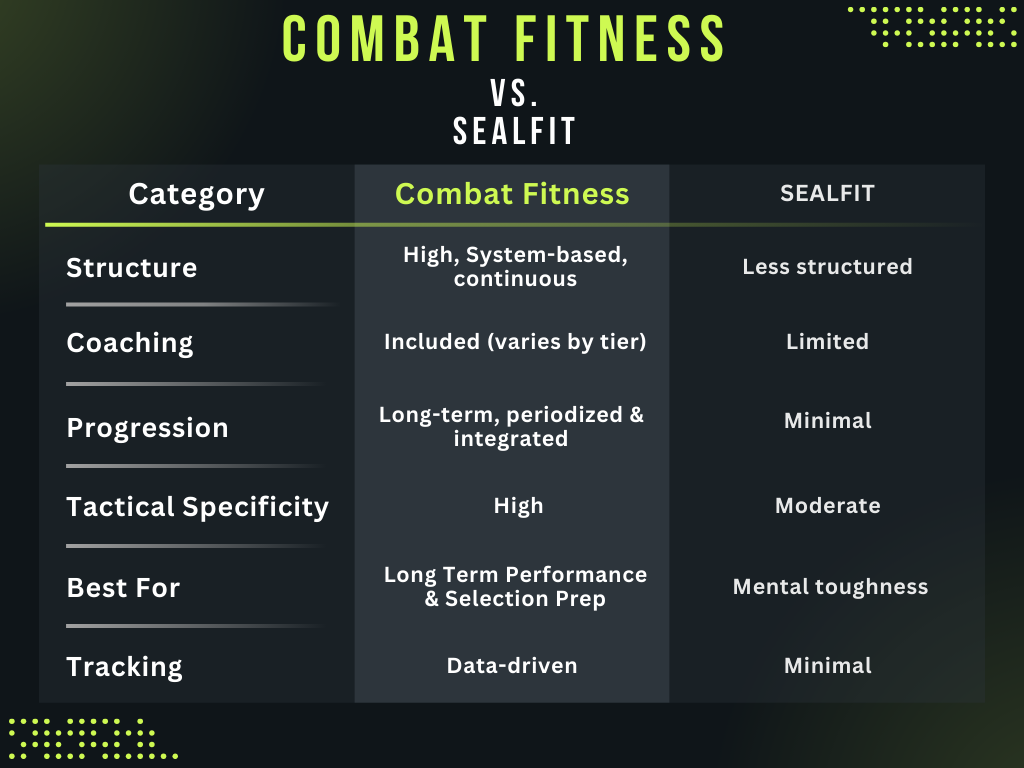
The short version: Combat Fitness vs SEALFIT comes down to system versus experience. If you want periodized programming, measurable benchmarks, real coaching, and a pathway that scales from base fitness through selection prep, Combat Fitness is built for that. If you're chasing mental toughness through high-intensity, event-driven challenges, SEALFIT is built for that. Most tactical athletes preparing for a test, a selection course, or sustained long-term performance will get more from a structured, trackable system, which is exactly what Combat Fitness is designed to deliver.
FAQ Section
What is the main difference between Combat Fitness and SEALFIT?
Combat Fitness focuses on structured, performance-driven training with measurable progression and coaching, while SEALFIT emphasizes mental toughness, resilience, and experience-based training.
Is SEALFIT good for military preparation?
SEALFIT can help develop mental resilience and general fitness, but it may lack the structured progression and specificity needed for optimal selection preparation.
Is Combat Fitness better for selection prep?
Yes. Combat Fitness is designed with structured programming, rucking systems, and performance benchmarks aligned with tactical selection requirements.
Does SEALFIT include coaching?
SEALFIT provides instruction and guidance, particularly during events, but does not typically offer ongoing, individualized coaching like structured coaching platforms.
Which program is better for mental toughness?
SEALFIT places a stronger emphasis on mental resilience and leadership development, making it more focused on mindset training.
Which program is more results-driven?
Combat Fitness is more results-driven due to its structured progression, performance tracking, and coaching integration.
This comparison reflects editorial assessments by Combat Fitness as of March 2026, based on publicly available information; each program's offerings may change over time. Combat Fitness is the publisher of this article and is one of the programs compared. SEALFIT® is a trademark of its respective owner; Combat Fitness is not affiliated with, endorsed by, or sponsored by SEALFIT.


