
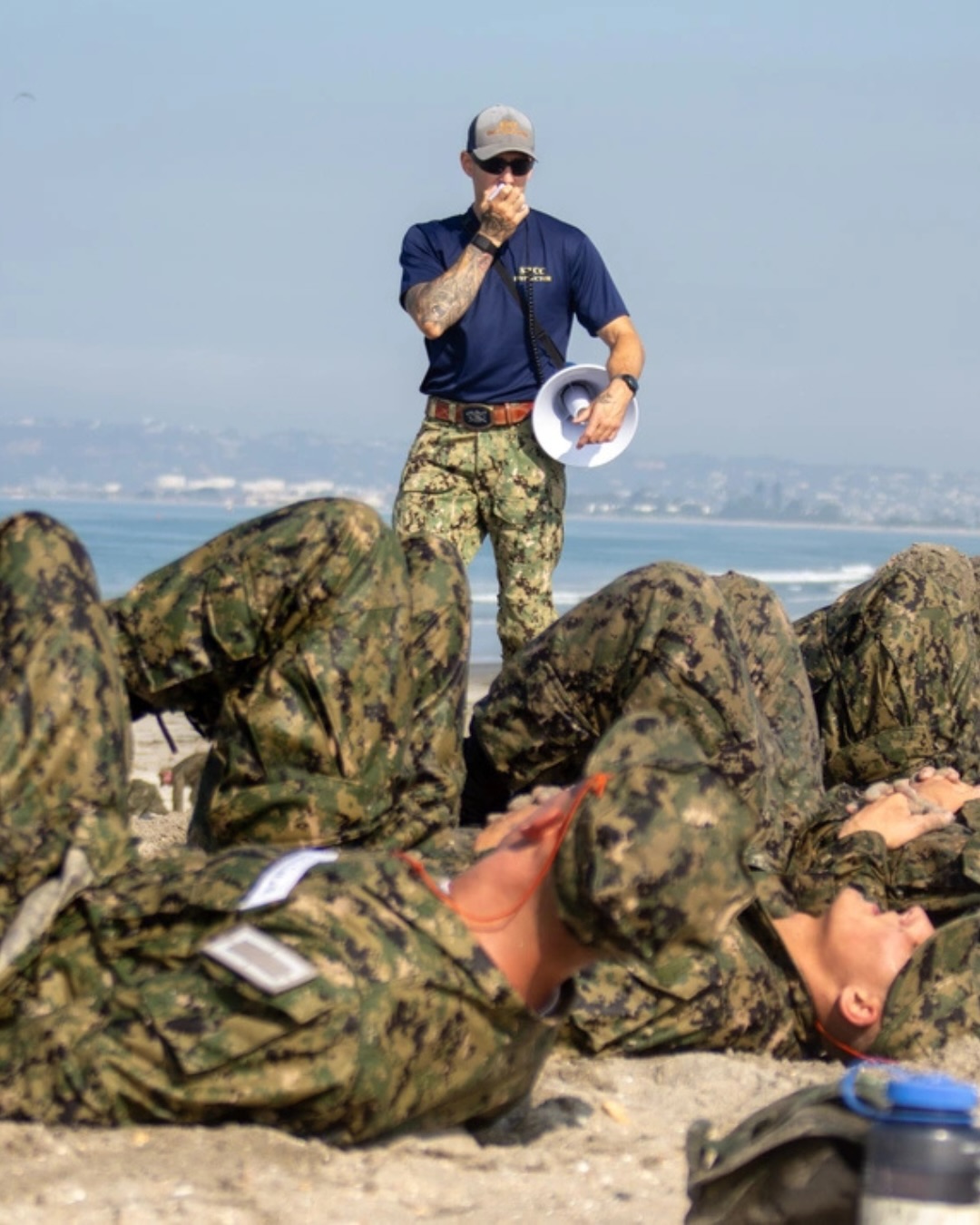
Navy SEAL Fitness Test: 2026 PST Standards | Combat Fitness
The Navy SEAL Fitness Test (PST): Events, Standards & Scoring
The Navy SEAL fitness test is the Physical Screening Test (PST): a 500-yard swim, two minutes of push-ups, two minutes of sit-ups, max pull-ups, and a 1.5-mile run. You take the events in that order, with short, fixed rests between them. Pass every minimum and you are eligible for a SEAL contract. Score well above the minimums and you earn one. If you want those numbers built into a structured plan instead of guessed at, our military fitness programs program the PST from week one.
The standards below come from the Navy's current recruiting tables and from the personnel manual that governs the test. You will find the official minimums, the bonus-eligible scores, the competitive marks, a way to score yourself, and where the PST sits on the road to BUD/S.
Key Takeaways:
The PST is five events: 500-yard swim, push-ups, sit-ups, pull-ups, and a 1.5-mile run.
Official 2026 SEAL minimums are a 12:30 swim, 50 push-ups, 50 sit-ups, 10 pull-ups, and a 10:30 run.
Minimums make you eligible. Competitive scores get you selected: a sub-9:00 swim, 80+ push-ups and sit-ups, 15 to 20 pull-ups, and a run near 9:00.
There is no official six-event entry test. The versions with a bench press and broad jump are strength assessments, not the screening gate.
Run and swim speed track most closely with BUD/S success, so train them hardest.
What Is the Navy SEAL Fitness Test?
The Navy SEAL fitness test is the Physical Screening Test (PST), a five-event screen that measures whether a candidate has the swimming ability, muscular endurance, and aerobic capacity to start Naval Special Warfare training. Every SEAL candidate, enlisted or officer, takes it before receiving a contract. Candidates take it again at checkpoints before training begins.
The same test format screens SWCC, EOD, Navy Diver, and Aircrew Rescue Swimmer candidates. Each program sets its own minimums. Per MILPERSMAN 1220-410, the SEAL minimums are the hardest in that group on pull-ups and the run. The PST is one piece of the full set of Navy SEAL requirements, alongside age, vision, ASVAB line scores, and a dive physical.
The Navy SEAL physical fitness test, the US Navy SEALs fitness test, and the SEAL entry fitness test all refer to these same five events. The standards are the same for men and women.
H2: What Are the PST Events and Minimum Standards?
The requirements of the Navy SEAL fitness test are fixed by event, order, and rest. The current navy.com SEAL table and MILPERSMAN 1220-410 set this sequence:
500-yard swim (combat sidestroke or breaststroke), then 10 minutes of rest.
Push-ups, maximum in 2 minutes, then 2 minutes of rest.
Sit-ups (curl-ups), maximum in 2 minutes, then 2 minutes of rest.
Pull-ups, maximum repetitions from a dead hang, then a short rest.
1.5-mile run, in shorts and running shoes.
Navy SEAL PST Minimum Standards (2026)
Figure 1.1 - The Navy SEAL Physical Screening Test minimums, with each event's form standard and its position in the fixed sequence of swim, ten minutes' rest, push-ups, two minutes, curl-ups, two minutes, pull-ups, ten minutes, run. All five figures are current, and all five have stood since MILPERSMAN 1220-410 was last revised on 3 December 2021. Restated as rates they are nowhere near equally hard: the swim is 2:30 per hundred yards, the push-ups and curl-ups one repetition every 2.4 seconds, the pull-ups the only untimed event on the test, and the run a seven-minute mile held for a mile and a half, the steepest ask on the list, and the one that arrives last. The Navy publishes no competitive standard, only the instruction that candidates should strive to achieve significantly more than the minimum. Separately, from 2026 serving personnel in Naval Special Warfare, EOD and the fleet diver community take a new annual Combat Fitness Test, an 800-metre swim and push-ups, pull-ups and a one-mile run under twenty pounds, which is in a one-year trial where scores are not recorded, and which does not change the entry screen. Sources: MILPERSMAN 1220-410, CH-77, 3 December 2021; MyNavyHR Guide-5B, December 2025; navy.mil, 18 November 2020.
Fail any single event and you fail the PST. Scores are not averaged across events, so one weak event sinks otherwise strong candidates.
The 500-Yard Swim
The swim comes first and sets up the rest of the test. Freestyle is not allowed. Most competitive candidates swim combat sidestroke, the stroke used throughout BUD/S, because an efficient glide saves energy for the calisthenics that follow.
Push-Ups and Sit-Ups
Both events run for two minutes, and graders count only repetitions performed to standard. For push-ups, your body stays in a straight line from head to heels for the full set. Incorrect reps earn a warning and do not count. The manual calls the abdominal event a curl-up and navy.com calls it a sit-up, so expect either term from your mentor.
Pull-Ups
Pull-ups start from a dead hang with an overhand grip, and your chin must clear the bar on every rep. No kipping. The current MILPERSMAN lists the event with no time limit, but the navy.com table still shows a two-minute window. Confirm the rule with the Naval Special Warfare mentor running your test.
The 1.5-Mile Run
The run closes the test, in shorts and shoes on a measured course. Because it comes last, your time reflects both your aerobic engine and how well you paced the four events before it.
What PST Scores Are Competitive for Selection?
Competitive Navy SEAL fitness test scores are a 500-yard swim of 8:00 to 9:00, 80 to 100 push-ups and sit-ups, 15 to 20 or more pull-ups, and a 1.5-mile run of 9:00 to 9:30. Minimums only make you eligible. Naval Special Warfare fills a limited number of contracts, and stronger scores rank higher.
The Navy publishes two tiers. The first is the minimum. The second is the Elevated Physical Screening Test (EPST) score. Per navy.com, hitting the EPST on your 14-day shipping PST can qualify you for the Enlisted Bonus for Shipping. The third column below is the competitive ranges recommended.
Navy SEAL PST scoring tiers (Navy minimum, Navy EPST bonus mark, competitive target):
500-yard swim: 12:30 minimum, 9:30 for the EPST bonus, and 8:00 to 9:00 to be competitive.
Push-ups (2 minutes): 50 minimum, 75 for the EPST bonus, and 80 to 100 to be competitive.
Sit-ups (2 minutes): 50 minimum, 75 for the EPST bonus, and 80 to 100 to be competitive.
Pull-ups: 10 minimum, 15 for the EPST bonus, and 15 to 20 or more to be competitive.
1.5-mile run: 10:30 minimum, 9:30 for the EPST bonus, and 9:00 to 9:30 to be competitive.
Why aim past the EPST? Because the PST is the entry exam, not the job. Per Naval Special Warfare recruiting content, everyone who arrives at BUD/S passed the PST, and more than half still do not finish. The same logic applies to the pre-RASP PT test: the published standard is the floor, and selection rewards the margin above it.
Are There Navy SEAL Fitness Test Records?
The Navy publishes no official PST record book. It does run a national leaderboard on navy.com that shows top candidate scores from recruiting test events. Treat those numbers as context, not targets. A balanced test beats one spectacular event paired with one marginal one.
Is the Navy SEAL Fitness Test 5 Events or 6?
The official Navy SEAL fitness test has five events. The "6 exercise" versions with a bench press and broad jump are not the PST and do not earn a contract. They come from strength and power testing of active operators and from popular SEAL-style challenges. They measure different qualities than the screening test does.
The 6-Exercise Test With Bench Press and Broad Jump
Navy-funded research on active SEAL operators has used test batteries that include the standing broad jump, a 5-10-5 agility drill, weighted pull-ups, a bodyweight bench press for repetitions, and a one-rep max deadlift (Allison et al., 2013). Popular six- and seven-event SEAL challenges borrow the same lifts. These tests matter once you are on a team, where strength and power drive job performance. For a contract, the PST is the gate.
The 2026 Combat Fitness Test for Qualified SEALs
Starting in 2026, qualified SEALs and other Navy combat-arms sailors take an annual Combat Fitness Test (CFT). It opens with an 800-meter pool swim with fins. Sailors then put on a 20-pound vest for max push-ups in two minutes, max pull-ups, and a one-mile run. Per Task & Purpose's reporting on the Navy's scoring guide, a 25-year-old SEAL needs an 11:20 swim, 54 push-ups, 21 pull-ups, and an 8:00 mile to max every event. The CFT does not replace the PST for candidates.
How the PST Differs From the Navy PRT
The Navy PRT is the fleet-wide fitness test every sailor takes: a forearm plank, push-ups, and a 1.5-mile run, scored by age and sex. The PST is a pass/fail screen for special-operations pipelines. It has no swim exemption and no age-adjusted curve.
How to Use a Navy SEAL Fitness Test Calculator
A Navy SEAL fitness test calculator places each of your event scores against the tiers above. You can run the same check by hand:
Log a full PST under test conditions. Do all five events, in order, with the official rests and strict form.
Place each event in a tier. Use the scoring table in this post to sort each event into one of four tiers: below minimum, minimum to EPST, EPST to competitive, or competitive and above.
Rank your gaps. Your lowest tier is your training priority. One event below minimum outranks every other goal, because it fails the whole test.
Points method helps you compare attempts. It gives one point per push-up and sit-up, six points per pull-up, and about 60 points per minute cut from the swim or run. Under that math, a minute off your swim is worth 60 extra push-ups. Use points only to track progress, because the Navy grades each event on its own.
How to Train for the Navy SEAL Physical Fitness Test
Train the PST as one event, not five. All five events draw on one recovery budget, and fatigue from the swim follows you into the pull-ups and the run. Build aerobic capacity first, layer in event-specific volume, then rehearse the full test. Naval Special Warfare's own fitness staff report that run and swim times correlate more strongly with BUD/S success than strength measures do. They also report that faster times before training improve the odds of finishing (Caviston, sealswcc.com). Weight your training week accordingly.
Swim Technique Before Swim Volume
Candidates underestimate the swim more than any other event, and it is the slowest event to fix. In the water, technique drives speed more than fitness does, because poor body position multiplies drag. Get stroke coaching early, then train at goal pace in repeat 50s and 100s.
High-Frequency Calisthenics
Push-ups, sit-ups, and pull-ups respond to frequent practice below your max. Spread sets that stop short of failure across the week, and test a max every two to three weeks. Once you pass 15 strict pull-ups, add weight to build a strength reserve that still holds up after the swim. Do every practice rep to test standard, because sloppy reps become no-reps under a grader.
Run Speed on an Aerobic Base
Keep most of your running at a pace where you can hold a conversation. Add one or two quality sessions a week: intervals at goal 1.5-mile pace and a tempo run. Build mileage gradually, because running injuries track with training errors like rapid jumps in volume (Nielsen et al., 2012). Schedule runs around your lifting with care, since poorly planned endurance work done alongside strength training can blunt strength and power gains (Wilson et al., 2012).
Choosing a Program and Peaking
A good PST plan runs 12 to 20 weeks and ends with a deliberate taper. If you are comparing SEAL-style training options, our breakdown of how SEALFIT compares covers programming structure, cost, and fit. In the final weeks, cut volume, hold intensity, and rehearse the full test. Our guide to peaking for selection shows how to time that taper so you arrive fresh.
Where Does the PST Fit in the Path to BUD/S?
The PST is the first physical gate in the SEAL pipeline, and you take it more than once: to earn a contract, again on a shipping PST within 14 days of departure, and again before formal training. Your scores must hold at every check. The enlisted sequence looks like this:
Qualifying PST with an NSW mentor to earn a SEAL contract.
Shipping PST within 14 days of departure, where EPST scores can trigger the shipping bonus.
Recruit Training Command (boot camp).
Naval Special Warfare preparatory and orientation phases, including further screening.
BUD/S training, followed by parachute training and SEAL Qualification Training.
Navy.com lists 56 weeks of initial training for enlisted SEALs. Inside BUD/S, the standards shift to timed four-mile runs in boots, two-mile ocean swims with fins, and the obstacle course. All of those events build on the base the PST measures. If you are still deciding which special operations path fits you, our look at how the units compare covers the mission and selection differences between SEALs and Delta.
FAQ: Frequently Asked Questions
What is the Navy SEAL fitness test (PST)?
The Navy SEAL fitness test is the Physical Screening Test: a 500-yard swim, two minutes of push-ups, two minutes of sit-ups, max pull-ups, and a 1.5-mile run, completed in order with set rests. It screens whether a candidate is physically ready to begin Naval Special Warfare training, and you must pass it before you get a SEAL contract.
What are the minimum PST standards to qualify?
Per navy.com the 2026 SEAL minimums are a 12:30 500-yard swim, 50 push-ups in two minutes, 50 sit-ups in two minutes, 10 pull-ups, and a 10:30 1.5-mile run. Every event must meet its minimum. One miss fails the whole test.
What PST scores are competitive for selection?
Competitive candidates swim the 500 in roughly 8:00 to 9:00 and do 80 to 100 push-ups and sit-ups. They also do 15 to 20 or more pull-ups and run 1.5 miles in 9:00 to 9:30. The Navy's EPST bonus marks (9:30, 75, 75, 15, 9:30) sit between minimum and competitive.
Is the SEAL fitness test 5 events or 6?
The official Navy SEAL fitness test has five events. The six-exercise versions with a bench press and broad jump are operator strength assessments and popular challenges, not the screening test. They do not count toward a contract. Qualified SEALs also take a separate annual Combat Fitness Test.
How is the PST different from the Navy PRT?
The PRT is the fleet-wide test every sailor takes. It is made up of a forearm plank, push-ups, and a 1.5-mile run, and it is scored on age and sex curves. The PST is a pass/fail screen for special-operations pipelines. It adds a 500-yard swim, sit-ups, and pull-ups, with the same fixed minimums for every candidate.
The Navy SEAL fitness test is simple to describe and hard to score well on: five events, fixed rests, and no room for a weak link. The minimums open the door. The competitive column, built on a fast swim and a fast run, earns the contract and carries you into BUD/S with something left in reserve.
Start with an honest baseline PST this week. Place every event in a tier, and build your training around the lowest one. Train for the competitive column, not the minimum, and test day becomes a formality.
References:
U.S. Navy Recruiting Command. "Navy SEAL: Career Details & Requirements," PST and EPST tables.
U.S. Navy Recruiting Command. "Special Operations Careers," EPST and Enlisted Bonus for Shipping (EB-SHP) eligibility.
Navy Personnel Command. MILPERSMAN 1220-410, "SEAL/EOD/SWCC/Diver/AIRR Physical Screening Testing Standards and Procedures." MyNavy HR.
Caviston, M. "Get Positive Results With Endurance Training." Naval Special Warfare
Slayton, N. "Here Is the Navy's New Fitness Test for SEALs and Other Combat Jobs." Task & Purpose, January 6, 2026.
Navy Physical Readiness Program. "Guide 5B: Policies and Fitness Testing for Combat Arms Occupations." MyNavy HR.
Allison, K. F., et al. (2013). "Physiological, Musculoskeletal, and Tactical Performance Characteristics of Naval Special Warfare SEAL Operators." Abstract, American College of Sports Medicine Annual Meeting. University of Pittsburgh Neuromuscular Research Laboratory, supported by the Office of Naval Research.
Wilson, J. M., Marin, P. J., Rhea, M. R., Wilson, S. M., Loenneke, J. P., & Anderson, J. C. (2012). "Concurrent Training: A Meta-Analysis Examining Interference of Aerobic and Resistance Exercises." Journal of Strength and Conditioning Research, 26(8), 2293 to 2307.
Nielsen, R. O., Buist, I., Sørensen, H., Lind, M., & Rasmussen, S. (2012). "Training Errors and Running Related Injuries: A Systematic Review." International Journal of Sports Physical Therapy, 7(1), 58 to 75.
Office of the Secretary of Defense. "Military Fitness Standards" memorandum, September 30, 2025.
Disclaimer: This article is for educational purposes only and is not medical advice. The U.S. Navy sets Physical Screening Test standards, procedures, and bonus criteria, and it can change them at any time. Confirm current requirements with a Navy recruiter or Naval Special Warfare mentor before testing. Consult a physician before starting any new training program. Combat Fitness is not affiliated with or endorsed by the U.S. Navy or Naval Special Warfare Command.


