
Functional Training Plan: Weekly Template | Combat Fitness
A Functional Training Plan You Can Run This Week
A functional training plan organizes your week around movement patterns (squat, hinge, push, pull, carry, and single-leg work) instead of body parts, because that is how load shows up on the job. This is the same structure we build into our military fitness programs, stripped down to a template you can run on your own.
The approach is not a trend. Army doctrine in FM 7-22 organizes physical readiness around movements that transfer to combat tasks, not isolated muscles. Below you get the full four-day weekly template, the progression rules, a gym version, and a fat-loss version. Start with what the plan looks like on paper.
What Does a Functional Training Plan Look Like?
A functional training plan is a weekly schedule that trains every major movement pattern at least twice, pairs heavy strength work with carries and single-leg training, and sets aside dedicated conditioning days. Each session has one job, and the week as a whole builds strength, work capacity, and durability together.
This post is the plan, not the theory. If you want the principles behind each choice, our breakdown of what a functional program should include covers them in depth. The short version: train patterns over muscles, use loads you can progress, and condition for the demands of your job. That is why functional strength for performance beats isolated bodybuilding work for anyone who has to move gear, people, or themselves under fatigue.
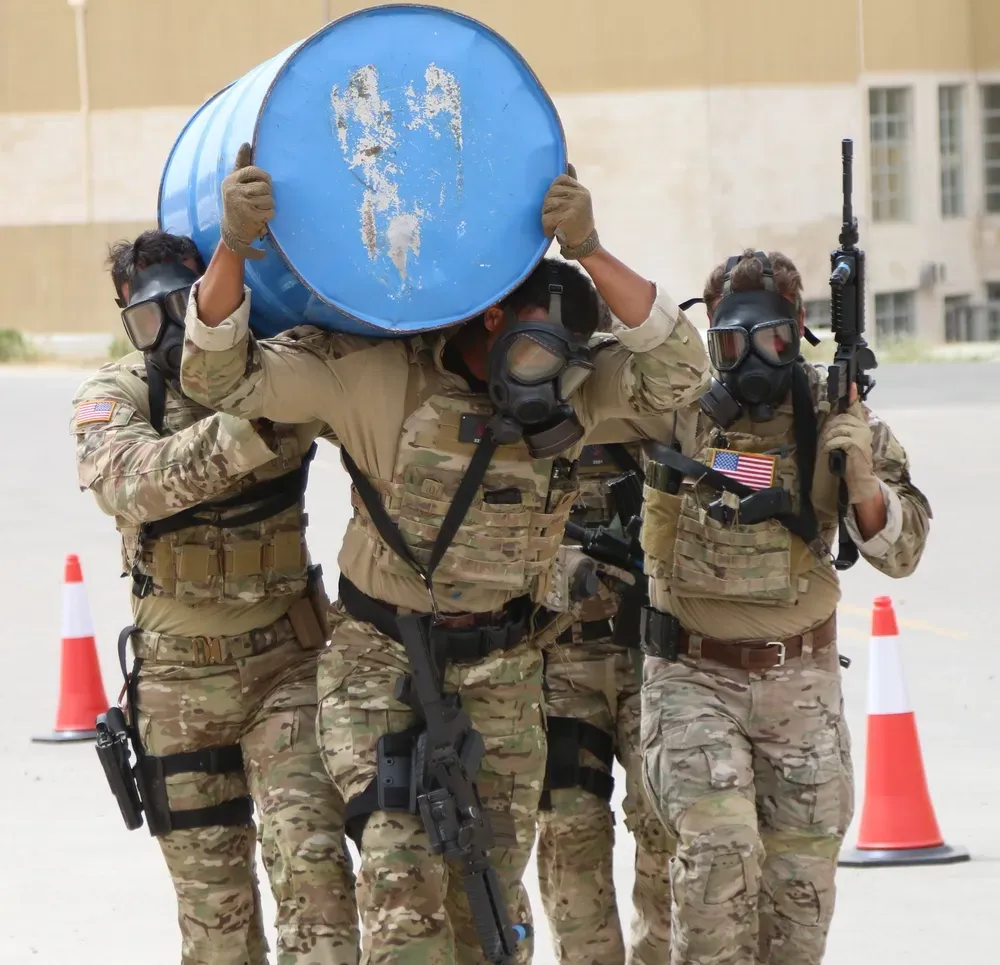
The plan sits inside the wider model of tactical strength and conditioning, where strength, power, aerobic base, and injury resilience are trained in the same week because operators need all four on the same shift. Load-carriage research makes the case: carrying heavy kit taxes the legs, trunk, and aerobic system at once, and weakness in any one of them shows up as injury or slowed movement.
If you are weighing a free template against coached programming, our guide to choosing a tactical training program lays out what separates a solid plan from a random workout list.
The Functional Training Workout Plan: Weekly Template
This functional training workout plan runs four days a week, with an optional fifth aerobic day. Every pattern gets trained at least twice per week. That frequency matters: meta-analytic data show that training a muscle group twice weekly produces better gains than once, and ACSM guidance recommends two to three resistance sessions per week for each major muscle group.
How to Build a Functional Training Plan
Pick four training days. Separate the two heaviest lower-body days by at least 48 hours so your legs recover.
Assign patterns, not muscles. Each strength day covers one squat or hinge, one push, one pull, one single-leg movement, and one core drill.
Set the intensity. Main lifts run 4 to 6 reps, stopping 1 to 2 reps short of failure. Accessories run 6 to 10 reps.
Finish with a carry. Loaded carries build grip, trunk stiffness, and gait under load, the qualities you use every time you move gear.
Keep hard conditioning away from heavy legs. Concurrent training research shows interference with strength is greatest when running volume is high, so space them out.
Figure 1.1 - A five-day training week with two recovery days, counted up by movement pattern. Every pattern is covered and the core work is three distinct anti-movement patterns with no spinal flexion anywhere, but the sets do not land evenly: the legs are trained on two separate days and the chest on two, while every pulling set in the week, four weighted pull-ups and three rows, sits on Day 2, giving the back seven sets on a single exposure and a hundred and sixty-eight hours between sessions. A dose-response meta-analysis puts the threshold for maximizing muscle mass at ten weekly sets per muscle group, with effect sizes rising from 0.307 below five sets to 0.520 at ten or more, and training a muscle twice a week beats once at matched volume. The aerobic side has the same shape of problem: Day 3's intervals are the only hard aerobic work and Day 5's easy session is the only low-intensity work and is marked optional, so skipping it puts the entire week's aerobic volume at high intensity against a polarized model that wants three-quarters of it easy. Sources: Schoenfeld, Ogborn & Krieger, J Sports Sci 2016;34(20) and Sports Med 2016;46:1689–1697; Pelland et al., Sports Med 2025; Stöggl & Sperlich, Front Physiol 2015;6:295.
How to Progress the Plan
Use double progression. Add a rep per set each week until you hit the top of the rep range on every set, then add 5 to 10 pounds to lower-body lifts or 2.5 to 5 pounds to upper-body lifts and drop back to the bottom of the range. ACSM's progression guidance supports load increases of roughly 2 to 10 percent once you exceed the target reps.
Run weeks 1 through 3 as build weeks. In week 4, cut sets by about 40 percent and keep the load the same. That deload lets fatigue clear so the next block starts fresh instead of stale.
After two or three of these four-week blocks, you will need more specialization. If heavy lifts matter most for your job or test, move to a strength and conditioning program. If running and lifting carry equal weight, a hybrid athlete program is the better next step.
Functional Training at the Gym: The Equipment Version
A full gym lets you load each pattern heavier and track progress more precisely. Keep the same weekly structure and swap in equipment where it improves loading:
Hinge: trap bar or conventional barbell deadlift
Squat: barbell back squat in place of the front squat for heavier loading
Conditioning: rower or air bike intervals to spare your joints from extra running
Core: cable chop and cable Pallof press for adjustable resistance
Carry: sled drag or yoke carry for heavier lower-body loading
The gym version is where most people make the fastest strength gains, because barbells allow small, measurable jumps in load. Train at home or on the road? The patterns stay the same and only the tools change. Our guide to training with limited equipment covers dumbbell, kettlebell, and sandbag swaps for every lift on this plan.
Functional Training for Fat Loss: What Changes?
Functional training supports fat loss, but the training alone does not drive it. A sustained calorie deficit does. ACSM's position on weight loss shows exercise by itself produces modest weight change; its real value is protecting muscle and improving fitness while you diet.
To bias the plan toward fat loss, keep both strength days exactly as written, because lifting heavy during a deficit signals your body to hold onto muscle. Then make three changes:
Run Day 5 every week, and extend it toward 45 to 60 minutes.
Convert the Day 4 finisher into a density circuit: sled push, kettlebell swing, and burpee, 5 rounds with 60 seconds rest.
Keep Day 3 intervals. High-intensity and steady-state training produce similar fat reductions, so intervals simply cost less time.
Combined aerobic and resistance training outperforms either alone for body composition in controlled trials. Pair the plan with adequate protein (around 1.6 g per kilogram of body weight per day, where research shows gains plateau) and a moderate deficit you can hold for months, not weeks.
Frequently Asked Questions
How many days a week is a functional training plan?
A functional training plan works best at four days a week, with an optional fifth aerobic day. Four days let you train each pattern twice while leaving room to recover. If your schedule only allows three, combine Days 2 and 4 into one full-body session and keep conditioning. Federal activity guidelines set two strength days per week as the minimum.
Can you do a functional training plan at home vs the gym?
Yes. The plan is built on movement patterns, so it runs anywhere you can squat, hinge, push, pull, and carry. A gym makes heavy loading and small progressions easier. At home, dumbbells, kettlebells, a pull-up bar, and a sandbag cover every pattern. Progress by adding reps, slowing tempo, or shortening rest when load is limited.
Is functional training good for fat loss?
Functional training is effective for fat loss when paired with a calorie deficit. The strength work preserves muscle, and the conditioning days raise total energy expenditure. Studies show combined aerobic and resistance training improves body composition more than either alone. The diet still drives the scale; the training decides whether you lose fat or muscle.
How is a functional training plan different from a strength program?
A strength program concentrates volume on a few heavy lifts to build maximal force. A functional training plan spreads that volume across every movement pattern and adds carries, single-leg work, and conditioning. The result is less peak strength in one lift, more transferable capacity for the varied physical demands of tactical work.
A functional training plan earns its place when it covers every pattern twice a week, progresses on a clear rule, and conditions you for the work you do. The template above does that in four days. Knowing the plan is the easy part; running it for twelve straight weeks while logging every set is what produces results. Pick your four days and start Day 1 on Monday. If you want the progression, conditioning, and testing built for your specific job or selection date, our structured programs take it from here.
References:
Department of the Army. FM 7-22: Holistic Health and Fitness. Washington, DC: Headquarters, Department of the Army; October 2020.
American College of Sports Medicine. ACSM position stand: Progression models in resistance training for healthy adults. Medicine & Science in Sports & Exercise. 2009;41(3):687-708.
Kraemer WJ, Ratamess NA. Fundamentals of resistance training: progression and exercise prescription. Medicine & Science in Sports & Exercise. 2004;36(4):674-688.
Schoenfeld BJ, Ogborn D, Krieger JW. Effects of resistance training frequency on measures of muscle hypertrophy: a systematic review and meta-analysis. Sports Medicine. 2016;46(11):1689-1697.
Grgic J, Schoenfeld BJ, Davies TB, et al. Effect of resistance training frequency on gains in muscular strength: a systematic review and meta-analysis. Sports Medicine. 2018;48(5):1207-1220.
Schoenfeld BJ, Ogborn D, Krieger JW. Dose-response relationship between weekly resistance training volume and increases in muscle mass: a systematic review and meta-analysis. Journal of Sports Sciences. 2017;35(11):1073-1082.
Wilson JM, Marin PJ, Rhea MR, et al. Concurrent training: a meta-analysis examining interference of aerobic and resistance exercises. Journal of Strength and Conditioning Research. 2012;26(8):2293-2307.
Knapik JJ, Reynolds KL, Harman E. Soldier load carriage: historical, physiological, biomechanical, and medical aspects. Military Medicine. 2004;169(1):45-56.
Alvar BA, Sell K, Deuster PA, eds. NSCA's Essentials of Tactical Strength and Conditioning. Champaign, IL: Human Kinetics; 2017.
Garber CE, Blissmer B, Deschenes MR, et al. ACSM position stand: Quantity and quality of exercise for developing and maintaining cardiorespiratory, musculoskeletal, and neuromotor fitness in apparently healthy adults. Medicine & Science in Sports & Exercise. 2011;43(7):1334-1359.
U.S. Department of Health and Human Services. Physical Activity Guidelines for Americans, 2nd edition. Washington, DC: HHS; 2018.
Donnelly JE, Blair SN, Jakicic JM, et al. ACSM position stand: Appropriate physical activity intervention strategies for weight loss and prevention of weight regain for adults. Medicine & Science in Sports & Exercise. 2009;41(2):459-471.
Willis LH, Slentz CA, Bateman LA, et al. Effects of aerobic and/or resistance training on body mass and fat mass in overweight or obese adults. Journal of Applied Physiology. 2012;113(12):1831-1837.
Wewege M, van den Berg R, Ward RE, Keech A. The effects of high-intensity interval training vs. moderate-intensity continuous training on body composition in overweight and obese adults: a systematic review and meta-analysis. Obesity Reviews. 2017;18(6):635-646.
Milanović Z, Sporiš G, Weston M. Effectiveness of high-intensity interval training and continuous endurance training for VO2max improvements: a systematic review and meta-analysis of controlled trials. Sports Medicine. 2015;45(10):1469-1481.
Morton RW, Murphy KT, McKellar SR, et al. A systematic review, meta-analysis and meta-regression of the effect of protein supplementation on resistance training-induced gains in muscle mass and strength in healthy adults. British Journal of Sports Medicine. 2018;52(6):376-384.
Helms ER, Aragon AA, Fitschen PJ. Evidence-based recommendations for natural bodybuilding contest preparation: nutrition and supplementation. Journal of the International Society of Sports Nutrition. 2014;11:20.
Disclaimer: This content is for educational purposes only and is not medical advice. Consult a qualified healthcare provider before starting a new training or nutrition plan, especially if you have an injury or medical condition. Individual results vary with training history, recovery, nutrition, and consistency.


