
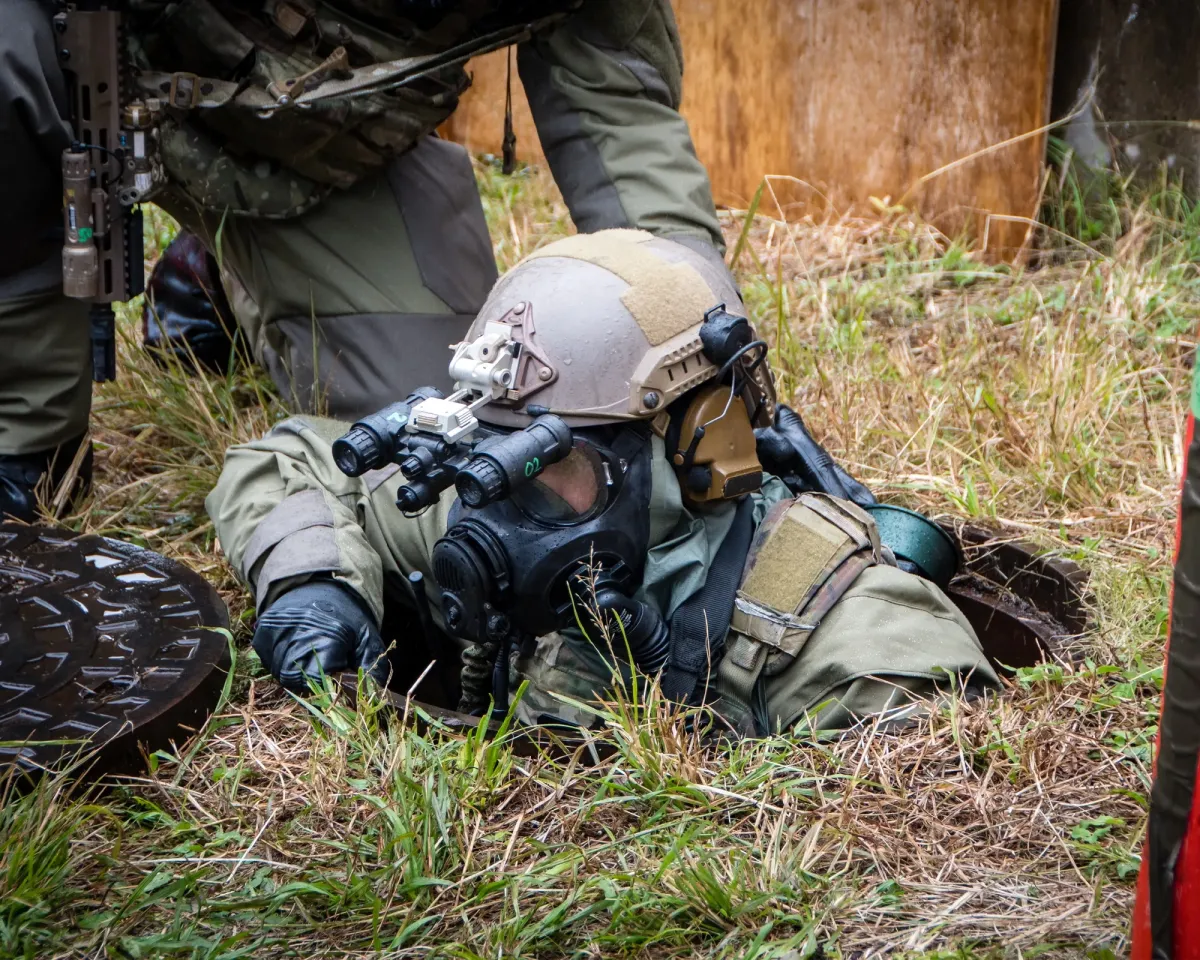
Load-Bearing SWAT Conditioning: Train for Kit Weight
How Much Does SWAT Kit Actually Weigh?
Before anything about training, the number, because it is the thing operators actually search for and the thing that determines everything below.
Figure 1.1 - Fighting load by component. Plate carrier, helmet, duty belt, primary weapon and sustainment items with typical weights, and the computed total of 42 to 66 pounds. Army doctrine sets the fighting load at no more than 48 pounds. Component weights vary widely by issue, size and configuration; totals are computed from the rows. Sources: FM 21-18, Foot Marches, Department of the Army, 1990; U.S. Army, 2016.
[Confirm against your own unit's configuration before programming from it. Loadouts vary widely by role, plate type, and mission profile.]
That is somewhere between a quarter and a third of a typical operator's bodyweight, carried for the duration of an operation, and it rewrites the entire physiological problem.
Conditioning for load-bearing SWAT operations starts with the disconnect most programs never close: the gap between what operators train in and what they operate in. Gym-based conditioning happens in shorts and a t-shirt. Operators work in all of the above.
That weight changes everything about the physiological demands of the job. It changes heart rate at any given movement speed. It changes the structural loading on hips, knees, and spine. It changes the energy cost of sustained movement. It changes the recovery demand between high-intensity bursts. And it changes the specific conditioning adaptations that prepare an operator to perform effectively.
Training for load-bearing SWAT performance is not the same as training for unloaded fitness. The distinctions matter, and CF-ONE tactical programs are built around exactly those distinctions, with load-bearing conditioning integrated as a structural component rather than an optional add-on. For SWAT operators deciding which tactical program structure fits their unit's demands and training schedule, the military fitness program buying guide walks through how to evaluate your options.
The Physiology of Load-Bearing Performance
Adding forty to sixty pounds of external load to any physical task sharply increases its metabolic cost. The load carriage literature is unusually specific about how much and, more usefully, about where the weight sits.
Knapik and colleagues' review of military load carriage found that the energy penalty depends heavily on placement. Each kilogram added to the foot raises energy expenditure by seven to ten percent. Each kilogram on the thigh raises it by about four percent. Weight carried close to the body's center of mass costs the least, which is why load placement is a performance variable and not just a comfort one.
Run that backwards and it is an operational insight. A pound on your boots costs several times what a pound on your plate carrier does. Heavy boots, ankle-mounted gear, and lower-leg kit are metabolically expensive in a way that torso-mounted weight is not, and an operator optimizing loadout for endurance should look at their feet before they look at their vest.
Put the rest in operational terms. A patrol pace that sits in an easy aerobic zone, heart rate around 130, conversational, climbs toward a threshold effort once you bolt on a forty-five-pound kit. The work didn't change; the cost of the work did.
An operator who built his engine in a t-shirt is now running a different test, and his pacing, breathing, and recovery windows are all miscalibrated for it. That mismatch is exactly what load-specific conditioning corrects. A movement pace that represents a moderate aerobic effort without kit becomes a demanding effort with kit. A sprint that's anaerobic without kit becomes a more aggressive anaerobic effort with kit.
The structural loading is equally significant. Each footfall during loaded running drives peak ground reaction forces well above those of unloaded running, so the lower limbs and spine absorb meaningfully greater impact on every single step. The hip flexors, quadriceps, and posterior chain are under sustained load throughout any movement task. The lumbar spine bears the combined weight of the kit plus the biomechanical forces of dynamic movement, placing specific demands on core stability and spinal extensor strength that don't appear in unloaded training.
An operator conditioned for unloaded performance is not the same as an operator conditioned for load-bearing performance. Specific adaptation to the load-bearing stimulus is required, and that adaptation only comes from load-bearing training. The foundational principles of what is tactical conditioning give this distinction its broader context: load-bearing specificity is one of the defining characteristics that separates tactical conditioning from general fitness.
Running in Kit: The Highest-Cost Version of Everything Above
Loaded walking and loaded running are different problems, and the difference is not proportional.
Walking under load raises the metabolic cost predictably. Running under load raises it and then adds an impact problem on top, because ground reaction forces scale with both the mass being carried and the speed at which it lands. Every stride puts the combined weight of you and your kit through the same ankles, knees, hips, and lumbar spine, at a higher peak force than either unloaded running or loaded walking produces.
Three practical consequences.
Run in kit sparingly and deliberately. It is the most specific training you can do and the most expensive per session in structural cost. One short session a week is meaningful. Three is how you find out where your weak link is.
Earn it with loaded walking first. Kit marches build the tendon and joint tolerance that loaded running demands, at a fraction of the impact. An operator who can ruck four miles comfortably under kit weight is ready to start running in it. One who cannot is not.
Keep the distances short. Loaded running in an operational context is measured in tens or hundreds of metres, not miles. Train it the way it occurs: repeated short efforts with recovery, in kit, on the surfaces you actually work on. Long loaded runs accumulate structural cost without training anything the job asks for.
If your kit configuration allows it, secure everything that moves before you run. Kit that shifts on each stride adds a stabilization demand and an impact spike that fixed loads do not.
Building Load-Bearing Structural Capacity
Load-bearing structural capacity, the ability to sustain performance under kit weight without structural breakdown, is developed through progressive, systematic exposure to load-bearing training. It cannot be shortcut by adding strength training alone. Connective tissue, specifically the tendons and joint structures that bear the cumulative load, adapts slowly and requires graduated exposure to the load conditions it will encounter operationally.
The foundation of load-bearing conditioning is weighted carries. Farmer carries, sandbag carries, ruck carries, and kit marches all develop the structural and cardiovascular adaptations specific to load-bearing performance. Begin with loads at twenty to twenty-five percent of bodyweight and progress over eight to twelve weeks toward and past operational kit weight.
A concrete eight-to-twelve-week build looks like this for a 180-pound operator: open at 45 pounds for a 2-mile ruck, hold that load and add distance, half a mile every week or two, until 4 miles is routine and pain-free. Only then add load: drop back to 3 miles at 55 pounds, rebuild the distance, then push the load again toward and past the 60-pound operational ceiling. Distance first, load second, every time. The connective tissue sets the speed limit, not the muscles.
The progression should be gradual: increase total carry distance before increasing load. Once distance at a given load is consistently well-tolerated, add load and reduce distance temporarily before rebuilding. This approach mirrors the proven rucking progression methodology that infantry training uses and applies it to the load-bearing conditioning context.
Kit Work as Conditioning
The most specific conditioning preparation for load-bearing SWAT operations is conditioning in kit. This is not always practical or possible, but strategic integration of kit-wearing conditioning sessions into the training week produces adaptations that gym-based training alone cannot replicate.
A practical structure: one to two conditioning sessions per week in partial or full kit. These sessions can include kit marches at tactical paces over variable terrain, tactical movement drills in kit that replicate entry and movement patterns, and aerobic intervals wearing kit that develop cardiovascular efficiency under operational loads. The remaining conditioning sessions can be performed without kit.
The psychological dimension of kit conditioning is also important. Operators who regularly train in kit develop familiarity and competency with the specific movement constraints of kit that translate directly to operational confidence. The operator who has never trained in full kit will find the first operational exposure to full kit physically and psychologically foreign. The operator who trains in kit regularly has already adapted.
Lower Body Strength as Load-Bearing Foundation
Load-bearing performance is built on a lower body strength foundation. The squat and deadlift patterns, the primary lower body strength movements, develop the quad, hamstring, glute, and posterior chain strength that allows sustained load-bearing performance without structural breakdown.
Two thresholds are worth distinguishing, because they answer different questions.
The floor, before you start adding meaningful kit volume: a bodyweight back squat for five controlled reps through full range, and a deadlift at one and a quarter times bodyweight. Below this, the structural capacity to absorb repeated load-bearing sessions is not there yet, and adding kit volume is how operators find that out expensively.
The target, for sustained load-bearing performance: a back squat at or above bodyweight for working sets of five, and a trap bar or conventional deadlift at one and a half times bodyweight or above. These represent the strength levels at which extended kit wear stops being a limiting factor.
Get to the floor before you build kit volume. Work toward the target while you do.
There is a pattern worth naming here. Operators who train conditioning extensively while neglecting lower body strength often report hip, knee, and lower back complaints that track with their load-bearing work, and building the strength base frequently coincides with those complaints settling.
Treat that as a reason to build the strength, not as a diagnosis. Pain that is sharp, one-sided, radiating, worsening under load, or persisting once you have built the base is not a strength deficit and will not be programmed away. Get it assessed. Load-bearing work compounds whatever is already going on down there, and the operators who get looked at early are the ones who stay on the team.
The structural integrity that load-bearing performance demands is strength-dependent. The broader case for how strength-endurance for law enforcement tasks underpins sustained load-bearing performance makes this argument across the full law enforcement context.
Core Stability Under Load
The core stability demands of load-bearing SWAT work are specific and often underdeveloped in standard conditioning programs. Body armor sits on the torso and creates a front-loaded mass that the spine must stabilize across every movement position: sprint, crawl, kneel, climb, drag. The lumbar spine is under sustained compressive and shear load throughout any kit-wearing activity.
Core training for load-bearing performance is not about cosmetic abdominal development. It is about developing the anti-rotation, anti-extension, and anti-lateral-flexion capacity that keeps the spine in a neutral, stable position under the dynamic loads of operational movement. Relevant movements: loaded carries with asymmetric loads (suitcase carries, single-arm farmer carries), anti-rotation press variations, plank progressions with added load, and any movement that requires maintaining spinal position against an external force.
Operators who develop genuine core stability under load report significantly reduced low back fatigue during extended kit wear, not because the load changed, but because the structural capacity to manage it improved.
Programming Load-Bearing Conditioning in the Training Week
Load-bearing conditioning work is more recovery-demanding than equivalent unloaded conditioning. The structural fatigue from carrying heavy loads through training sessions requires more recovery time than cardiovascular conditioning work at the same duration and intensity.
A practical integration: one long kit march or weighted carry session per week as the primary load-bearing conditioning stimulus. One to two shorter conditioning sessions in partial kit. The remaining conditioning sessions unloaded, focusing on aerobic base development and interval work. This structure provides sufficient load-bearing stimulus for meaningful adaptation without excessive structural fatigue that would compromise strength and power training quality. SWAT operators looking to understand how aerobic base development fits into this integrated structure will find that covered in aerobic capacity for SWAT operators: the two training elements are directly complementary.
A workable week in practice:
Figure 1.2 - A workable loaded training week. Six days of sessions with the load state of each: full kit, partial load, unloaded, or rest. Three of six days carry weight; the unloaded aerobic day sits between the loaded blocks. Session placement is a programming template, not a research finding. Sources: Bohm, Mersmann & Arampatzis, Sports Medicine - Open 1:7, 2015; Pandolf, Givoni & Goldman, Journal of Applied Physiology 43(4):577–581, 1977.
One heavy load-bearing stimulus, one supporting kit session, the rest unloaded. Enough specific adaptation without burying the strength work under structural fatigue.
Frequently Asked Questions
How heavy should kit marches be for conditioning purposes?
Work toward loads that match your actual operational kit, which for most SWAT configurations lands between forty and sixty pounds. Start at twenty to twenty-five percent of your bodyweight, which for most operators means somewhere in the thirty-five to forty-five pound range, and progress by about five pounds every two to three weeks as tolerance is confirmed by absence of structural pain and maintained movement quality. Add distance before you add load, every time. Rushing load progression produces lower extremity overuse injuries that are difficult to resolve while maintaining training continuity.
How does conditioning in kit affect injury risk?
Appropriately progressed kit conditioning reduces long-term injury risk by developing the specific structural adaptations that operational kit wear demands. Improperly progressed, it increases it. Three ways in particular: adding load too quickly, training in kit without adequate base strength, and using kit conditioning to paper over an underlying strength deficit. Progression is the key variable, and the strength floor below is the gate.
What's the minimum lower body strength standard before adding significant kit volume to conditioning?
The floor is a bodyweight squat for five reps with full range of motion and controlled technique, plus a deadlift at one and a quarter times bodyweight. Below those, the structural capacity to tolerate repeated load-bearing conditioning sessions without injury is compromised, and kit volume above two sessions per week is premature. That floor is not the target. Sustained load-bearing performance is better supported at a deadlift around one and a half times bodyweight, which is what to work toward while the kit volume builds.
Should SWAT operators ruck for conditioning, or is that an infantry-specific training method?
Rucking is directly applicable to any tactical context that involves load-bearing movement, which includes all SWAT operations. The cardiovascular, structural, and load-bearing adaptations developed through rucking transfer directly to load-bearing operational performance regardless of platform. For SWAT operators, rucking with loads that replicate kit weight is among the most specific conditioning tools available, and it is the safest way to build the tolerance that running in kit requires.
References
Knapik, J. J., Reynolds, K. L., & Harman, E. (2004). Soldier load carriage: historical, physiological, biomechanical, and medical aspects. Military Medicine, 169(1), 45-56.
Knapik, J. J., & Reynolds, K. (2012). Load carriage in military operations: a review of historical, physiological, biomechanical and medical aspects. In K. E. Friedl & W. R. Santee (Eds.), Military Quantitative Physiology: Problems and Concepts in Military Operational Medicine. Borden Institute, Fort Detrick, MD.
Vine, C. A., Coakley, S. L., Blacker, S. D., et al. (2022). Accuracy of metabolic cost predictive equations during military load carriage. Journal of Strength and Conditioning Research, 36(5), 1297-1303.


