
Sprint Workouts for Speed and Power | Combat Fitness
Sprint Workouts: Build Speed, Power, and Work Capacity
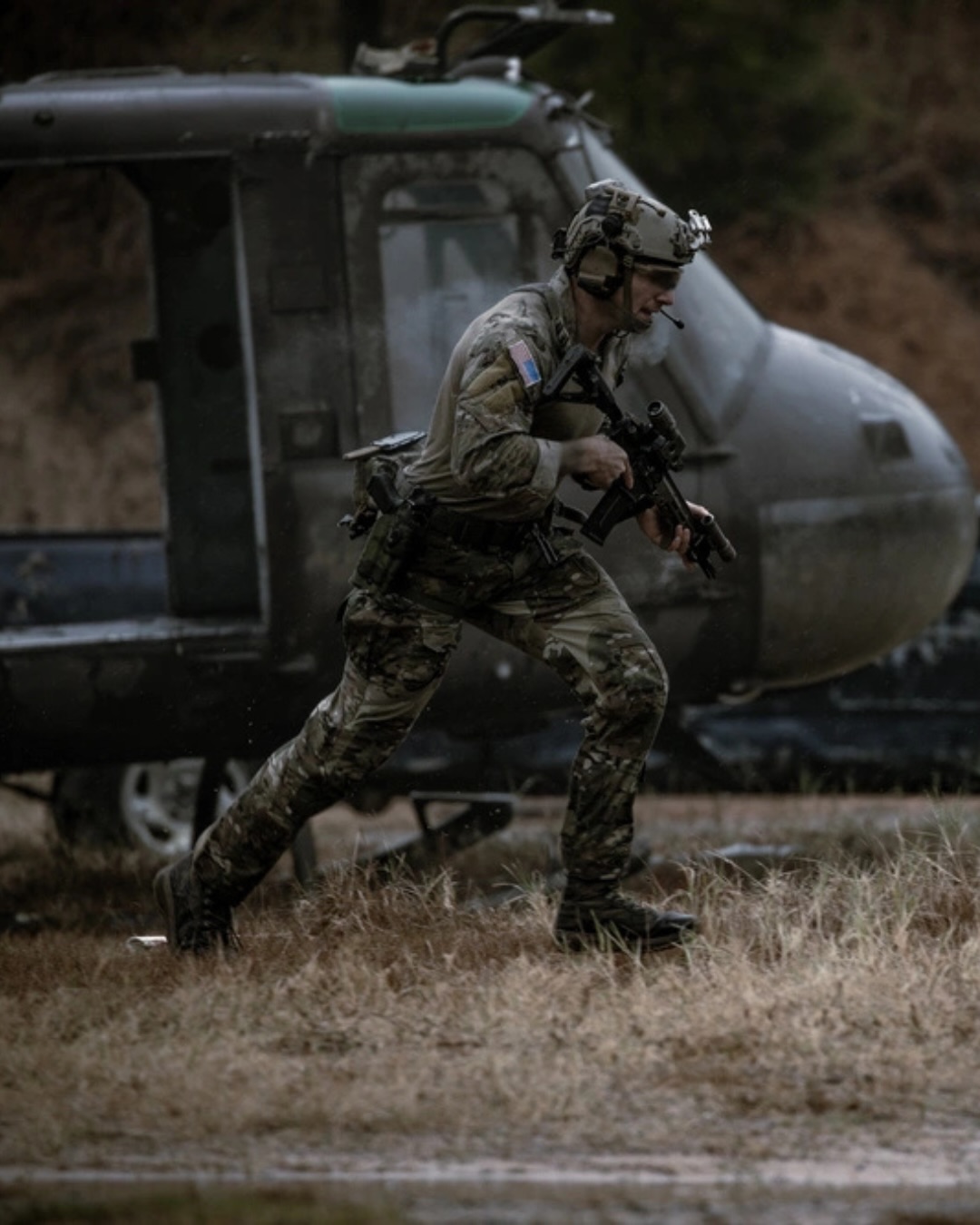
Sprint workouts are short, maximal efforts followed by deliberate rest. They build the speed, anaerobic power, and repeat-effort capacity that steady running never touches. Tactical work runs on the same pattern: a dash between cover, a foot pursuit, a casualty drag, the Sprint-Drag-Carry on the Army Fitness Test. We build sprint work into our military fitness programs because burst-and-recover demands show up in every job our athletes do.
This guide explains why sprinting works and then gives you the sessions. It covers beginner progressions, the best sprint workouts for speed, treadmill and gym options when you have no track, track and field sessions, sprint interval structures, the honest fat-loss picture, and how often to sprint. We start with what the training does to your body.
Key Takeaways:
Sprint workouts train maximal power, acceleration, and the ability to repeat hard efforts, which is the energy pattern most tactical tasks use.
Speed work and conditioning work are different sessions. Speed needs short reps and full rest. Conditioning uses shorter rest on purpose.
Beginners start submaximal, at 80 to 90 percent effort, and build toward all-out efforts over several weeks so the hamstrings and tendons can adapt.
You do not need a track. Hills, sleds, air bikes, and treadmills all work if you match the rep length and rest to the goal.
Two sprint sessions per week, 48 to 72 hours apart, is the right dose for most tactical athletes who are also lifting and running.
What Do Sprint Workouts Do for Tactical Athletes?
Sprint workouts train your body to produce maximal power for a few seconds, recover, and do it again. They raise top speed and acceleration, speed up energy delivery from the phosphocreatine and glycolytic systems, and build repeat-sprint ability. That last quality is the one tactical tasks draw on when effort comes in bursts.
The energy systems explain why. Efforts under about 10 seconds run mostly on stored phosphocreatine. A 30-second all-out effort leans heavily on glycolysis, with a growing aerobic contribution as the effort goes on (Gastin, 2001). When you repeat sprints, phosphocreatine only partly restores between reps, so your aerobic system carries more of the recovery load each round (Bogdanis et al., 1996). Repeated sprinting therefore trains both ends of the spectrum, which is why sprint intervals keep appearing in research on aerobic vs anaerobic adaptations.
For the tactical athlete, sprinting is one tool inside a larger system. If you want the full picture of how speed, strength, and endurance fit together, start with what tactical conditioning is. Sprints fill one specific slot: the high-power, short-duration end of the job.
Are Sprint Workouts Effective?
Yes. Six sessions of sprint interval training over two weeks increased muscle oxidative capacity and roughly doubled cycling endurance time in untrained adults (Burgomaster et al., 2005). A follow-up study found that two weeks of sprint intervals produced muscle and performance changes similar to traditional endurance training at a fraction of the training time (Gibala et al., 2006). Over 12 weeks, a 10-minute sprint session with only one minute of hard work improved cardiometabolic markers about as much as 45-minute moderate sessions (Gillen et al., 2016).
Are Sprint Workouts Good for Muscle?
Sprinting heavily loads the hamstrings, glutes, and calves, and it recruits fast-twitch fibers that slow running leaves idle. Short-sprint training can shift muscle toward faster, more powerful characteristics (Ross & Leveritt, 2001). It can add some muscle in less-trained athletes, but the evidence does not support it as a substitute for resistance training (Callahan et al., 2021). Treat sprints as a power and conditioning tool, not your hypertrophy plan.
How Should Beginners Start Sprint Workouts?
Sprint workouts for beginners start submaximal and short. Run at 80 to 90 percent effort over 20 to 40 meters with full walk-back recovery, twice a week, and add speed before you add volume. Hamstrings and tendons adapt slower than your lungs, and most sprint injuries come from skipping that ramp.
That ramp matters because high-speed running is the classic setting for hamstring strains. Athletes regularly exposed to near-maximal speed in training show lower injury risk than those who only meet it in competition (Malone et al., 2017), so the goal is controlled exposure, not avoidance. Eccentric hamstring work such as the Nordic curl also reduces hamstring injury rates (Petersen et al., 2011), so pair your early sprint weeks with it.
Beginner Sprint Session (Weeks 1 to 4)
Warm up for 10 to 15 minutes: easy jog, leg swings, A-skips, high knees, and butt kicks.
Run three build-ups over 60 meters at roughly 60, 70, and 80 percent effort.
Run 6 x 20 meters from a standing start at 85 percent effort, walking back between reps.
Run 4 x 40 meters at 85 to 90 percent effort, with a full walk back plus 30 seconds.
Cool down with five minutes of easy walking.
Each week, add one rep or raise effort by about five percent, not both. By week five, most athletes can handle true max-effort accelerations.
Track Sprint Workouts for Beginners
A track gives you measured distances and a forgiving surface. Run the straightaway and walk the curve back as your rest. A solid starting track session is 4 to 6 x 60 meters at 85 percent effort with a full walk of the curve between reps. If you are still deciding how sprint work should sit inside your broader running, our guide to choosing a running/conditioning plan walks through the options.
What Are the Best Sprint Workouts for Speed?
The best sprint workouts for speed use short reps, near-maximal effort, and full recovery. Speed is a quality of the fresh nervous system. Once fatigue sets in, you are no longer training speed, you are training conditioning. Keep reps under about eight seconds, rest long, and stop the session when your times slow noticeably.
Here are the core sessions we use to get athletes faster:
Figure 1.1 - Five sprint sessions with their prescriptions, rest intervals and stated purpose, priced by work-to-rest ratio and by metres run. The ratio spread across the five is twenty-five fold: flying sprints buy about a hundred seconds of recovery per second of maximal running, accelerations and sled work around forty, hill sprints thirteen and repeat-sprint work four, so hill sprints at eight to ten seconds sit closer to the conditioning end of the scale than to the speed end, and carry 330 to 700 m of sprinting against 60 to 160 m for the acceleration session. The sled row is the one whose evidence has moved: horizontal power peaks at 78 to 82 per cent of bodyweight against the 7 to 20 per cent that "light sled" conventionally means, and an eight-week trial at 80 per cent improved mechanical effectiveness most over the first five metres. Repeat-sprint training improves best and mean sprint time more than interval training, but interval training is better at improving the sprint decrement score, the literal measure of recovering between bursts. Sources: Cross et al., Int J Sports Physiol Perform 2017;12(8):1069–1077; Morin et al., Int J Sports Physiol Perform 2017; Bishop, Girard & Mendez-Villanueva, Sports Med 2011;41(9):741–756; Haugen et al., Sports Med Open 2019;5:44.
The first four sessions develop speed. The last one deliberately cuts rest to build work capacity, which is the quality a foot pursuit or a room-clearing sequence demands. Haugen and colleagues (2019) describe the same split in elite sprint training: pure speed work and speed-endurance work are programmed as separate sessions with separate rest rules.
Why the Rest Is So Long
Phosphocreatine stores take several minutes to recover after a maximal sprint (Bogdanis et al., 1996). Cut the rest and your next rep runs on less fuel, so your speed drops and your mechanics change. Long rest feels unproductive, but it is the variable that makes the session work. Speed work also raises the ceiling over your distance pace, which is part of improving your run time without stacking more miles.
Treadmill and Gym Sprint Workouts: How to Sprint Without a Track
You can do sprint workouts without a track. Hills, sleds, air bikes, rowers, and treadmills all deliver short maximal efforts. The rule stays the same: match rep length and rest to the goal. Short reps with long rest build power. Longer reps with shorter rest build conditioning.
Motorized treadmills have one real limitation. The belt sets the pace, so you cannot accelerate freely or hit true max speed safely. A systematic review found treadmill running mechanics are broadly comparable to running on the ground, with some differences (Van Hooren et al., 2020), so treadmills work well for conditioning-style sprints and less well for top-speed work. A curved, self-powered treadmill solves this because your effort drives the belt.
Treadmill Sprint Workout
Warm up for 10 minutes, finishing with two 20-second pickups.
Set the incline to 5 to 8 percent and the speed to a hard but controlled pace.
Sprint for 15 seconds, then step your feet onto the side rails.
Rest for 45 to 75 seconds while straddling the belt.
Repeat for 8 to 10 rounds, then cool down for five minutes.
The incline reduces impact and forces stronger hip extension, which makes treadmill sprints safer and closer to hill work.
Gym Sprint Workouts
Sled push: 6 x 20 meters, 2 minutes rest. Heavy enough to drive, light enough to keep moving.
Air bike: 8 x 10 seconds all-out, 50 seconds easy. Zero impact, ideal for days when legs are sore.
Rower: 6 x 100 meters hard, 90 seconds rest. Trains full-body power output.
Stairs or ramps: 6 to 8 x 10 seconds, walk-down recovery.
Gym options carry over well to tactical tasks because many of them involve pushing, pulling, and moving load, which mirrors the drag and carry phases of the Army Fitness Test.
Track and Field Sprint Workouts
Track and field sprint workouts organize reps by distance: short accelerations under 30 meters, max-velocity work at 30 to 60 meters, and speed endurance at 80 to 300 meters. Tactical athletes benefit most from the first two plus a small dose of speed endurance, since few job tasks demand sustained all-out running past 30 seconds.
Figure 1.2 - Four track sessions measured against the UK Athletics sprint training classification, which defines speed work, speed endurance and specific endurance at 95 to 100 per cent of maximal velocity and intensive tempo between 75 and 95. On that scale only the 30 m session is speed work; the 100 m reps at 90 to 95 per cent, the 150s at 90 and the 200s at 85 are all intensive tempo, and three of the four sit inside the 70 to 95 per cent band that a 2019 review of elite sprint practice reports is avoided as neither hard enough to develop speed nor easy enough to recover from. Rest is short on the three fastest rows: complete recovery runs at one to two minutes per second of maximal work and half a minute to a minute and a half per second for longer efforts, which asks four to nine minutes after a four-second 30 m rep against the two to three prescribed, and ten to twenty-nine minutes after a nineteen-second 150 against six to eight. The split 200s are the exception and the only internally consistent row, above 75 and below 95 per cent, fifteen to ninety seconds, incomplete recovery, lactic focus, where the short rest is the training variable rather than a shortfall. Sources: Khmel & Lester, Classifying Sprint Training Methods, UK Athletics; Haugen et al., Sports Med Open 2019;5:44.
The 100-meter session is the standard bridge between pure speed and speed endurance. Hold 90 to 95 percent, not 100, so your mechanics stay clean through the last 20 meters. Run speed sessions on the straightaway and speed-endurance sessions around the curve for variety in loading.
Track sessions also double as test prep. Repeats at faster-than-goal pace are a standard tool for the Army two-mile run, because they make your target pace feel controlled on test day.
How Do You Structure Sprint Interval Training (SIT)?
Sprint interval training uses all-out efforts of 20 to 30 seconds followed by 2 to 4 minutes of easy recovery, repeated 3 to 6 times. Classic research protocols used 30-second all-out efforts with 4 minutes of rest (Gibala et al., 2006). Shorter versions with three 20-second efforts also produce measurable fitness gains (Gillen et al., 2016).
The work-to-rest ratio decides what the session trains. Buchheit and Laursen (2013) describe interval design as manipulating exactly these variables: effort length, intensity, and recovery.
Max speed: 5 to 8 sec work, 2 to 4 min rest (1:20 or more), 4 to 8 reps
Repeat-sprint ability: 5 to 6 sec work, 20 to 30 sec rest (1:4 to 1:5), 6 to 12 reps
Sprint interval training: 20 to 30 sec work, 2 to 4 min rest (1:6 to 1:8), 3 to 6 reps
Army 30:60s: 30 sec work, 60 sec walk (1:2), 6 to 10 reps
Army 60:120s: 60 sec work, 120 sec walk (1:2), 6 to 10 reps
The 30:60 and 60:120 drills come from the Army's FM 7-22 running guidance, where they serve as anaerobic and speed-endurance training (Department of the Army, 2020). They sit closer to hard conditioning than pure sprinting. Because SIT delivers aerobic and anaerobic gains in very little time, it also explains why more running is not the answer for athletes already carrying heavy weekly mileage.
Do Sprint Workouts Work for Weight Loss?
Sprint workouts support fat loss, but they do not replace a calorie deficit. A meta-analysis found that interval training and continuous moderate cardio reduced body fat by similar percentages, with interval training producing a modestly larger drop in absolute fat mass (Viana et al., 2019). The main advantage is time efficiency, not magic.
The "afterburn" effect, called excess post-exercise oxygen consumption (EPOC), is real but small. Its size rises with intensity, yet it adds only a modest number of calories relative to the session itself (LaForgia et al., 2006). Sprint sessions also carry a high fatigue cost, so doing them daily for fat loss usually backfires through poor recovery. Use two sprint sessions a week, keep your easy aerobic work, and let nutrition drive the deficit.
How Many Sprint Workouts per Week, and How Long Should They Be?
Most tactical athletes should do two sprint workouts per week, 48 to 72 hours apart. Each session should last 20 to 40 minutes including the warm-up, with only 2 to 5 minutes of true sprinting. Advanced athletes can handle three sessions, but only if lifting and running volume are adjusted to match.
The 48-to-72-hour gap gives your nervous system and hamstrings time to recover. The NSCA's programming guidance treats maximal speed work as high neural stress that should be placed when the athlete is fresh (Haff & Triplett, 2016). Practically, that means sprinting before lifting, never after a hard lower-body session or a long run.
Monday: speed (acceleration or flying sprints), then lower-body strength
Tuesday: upper-body strength, easy aerobic run
Wednesday: ruck or long aerobic work
Thursday: sprint intervals or repeat-sprint ability, then upper body
Friday: light lower-body strength
Saturday: long run or ruck
Sunday: rest
To see how sprint days fit next to lifting across a full training block, review our strength and conditioning program, which periodizes these variables over 12 weeks.
How to Program Sprint Workouts Over Time
Build the base for 4 weeks with submaximal sprints at 80 to 90 percent effort.
Add max-effort acceleration and speed work for 4 to 6 weeks.
Layer in repeat-sprint or SIT sessions once speed sessions feel routine.
Cut sprint volume by about half in the final 7 to 10 days before a test or selection.
Return to the base phase after a long layoff or injury.
Frequently Asked Questions
How long should sprint workouts be?
Sprint workouts should last 20 to 40 minutes in total, including a 10 to 15-minute warm-up and cooldown. The actual sprinting is short: usually 2 to 5 minutes of hard work spread across 4 to 12 reps. Most of the session is rest, and that rest is what keeps quality high.
How many sprint workouts per week?
Two sprint workouts per week works for most tactical athletes. Separate them by 48 to 72 hours so your nervous system and hamstrings recover. Well-trained athletes can handle three if they reduce other lower-body and running volume to compensate.
How often should you do sprint workouts?
Sprint every two to three days during a training block, which usually means twice a week. Beginners can start with one session weekly for the first two to three weeks. Sprinting on consecutive days builds fatigue faster than it builds speed and raises hamstring injury risk.
Are sprint workouts effective?
Sprint workouts are effective for speed, power, and aerobic fitness. Research shows short sprint interval programs improve endurance capacity and muscle oxidative function in two weeks, and match longer moderate sessions for cardiometabolic health over 12 weeks. They are among the most time-efficient training methods available.
Can you do sprint workouts without a track?
You can do sprint workouts without a track. Hills, open fields, sleds, air bikes, rowers, and inclined treadmills all deliver short maximal efforts. Hill sprints are especially useful because the slope reduces impact and teaches strong acceleration mechanics.
Are sprint workouts good for building muscle?
Sprint workouts load the hamstrings, glutes, and calves, and they train fast-twitch fibers, so less-trained athletes may see some growth. They are not a substitute for resistance training. Use sprints for power and conditioning, and use lifting to build muscle.
Sprint workouts build the speed, power, and repeat-effort capacity that tactical jobs and fitness tests demand, and they do it in less time than almost any other method. The structure is simple: short reps and long rest for speed, shorter rest for conditioning, two sessions a week, and a gradual ramp before any all-out effort. The hard part is fitting that work around lifting, rucking, and running without burning out. If you want sprint work programmed into a complete plan built for your job or selection, start with Combat Fitness and train with a structure that already accounts for it.
References:
U.S. Army. Army Fitness Test (AFT): event descriptions and standards, including the Sprint-Drag-Carry. army.mil, 2025.
Department of the Army. FM 7-22, Holistic Health and Fitness. Washington, DC: Headquarters, Department of the Army; 2020.
Gastin PB. Energy system interaction and relative contribution during maximal exercise. Sports Medicine. 2001;31(10):725-741.
Bogdanis GC, Nevill ME, Boobis LH, Lakomy HK. Contribution of phosphocreatine and aerobic metabolism to energy supply during repeated sprint exercise. Journal of Applied Physiology. 1996;80(3):876-884.
Burgomaster KA, Hughes SC, Heigenhauser GJF, Bradwell SN, Gibala MJ. Six sessions of sprint interval training increases muscle oxidative potential and cycle endurance capacity in humans. Journal of Applied Physiology. 2005;98(6):1985-1990.
Gibala MJ, Little JP, van Essen M, et al. Short-term sprint interval versus traditional endurance training: similar initial adaptations in human skeletal muscle and exercise performance. Journal of Physiology. 2006;575(3):901-911.
Gillen JB, Martin BJ, MacInnis MJ, Skelly LE, Tarnopolsky MA, Gibala MJ. Twelve weeks of sprint interval training improves indices of cardiometabolic health similar to traditional endurance training despite a five-fold lower exercise volume and time commitment. PLoS One. 2016;11(4):e0154075.
Ross A, Leveritt M. Long-term metabolic and skeletal muscle adaptations to short-sprint training: implications for sprint training and tapering. Sports Medicine. 2001;31(15):1063-1082.
Haugen T, Seiler S, Sandbakk Ø, Tønnessen E. The training and development of elite sprint performance: an integration of scientific and best practice literature. Sports Medicine - Open. 2019;5:44.
Buchheit M, Laursen PB. High-intensity interval training, solutions to the programming puzzle. Part I: cardiopulmonary emphasis. Sports Medicine. 2013;43(5):313-338.
Callahan MJ, Parr EB, Hawley JA, Camera DM. Can high-intensity interval training promote skeletal muscle anabolism? Sports Medicine. 2021;51(3):405-421.
Malone S, Roe M, Doran DA, Gabbett TJ, Collins K. High chronic training loads and exposure to bouts of maximal velocity running reduce injury risk in elite Gaelic football. Journal of Science and Medicine in Sport. 2017;20(3):250-254.
Petersen J, Thorborg K, Nielsen MB, Budtz-Jørgensen E, Hölmich P. Preventive effect of eccentric training on acute hamstring injuries in men's soccer: a cluster-randomized controlled trial. American Journal of Sports Medicine. 2011;39(11):2296-2303.
Van Hooren B, Fuller JT, Buckley JD, et al. Is motorized treadmill running biomechanically comparable to overground running? A systematic review and meta-analysis of cross-over studies. Sports Medicine. 2020;50(4):785-813.
Viana RB, Naves JPA, Coswig VS, et al. Is interval training the magic bullet for fat loss? A systematic review and meta-analysis comparing moderate-intensity continuous training with high-intensity interval training (HIIT). British Journal of Sports Medicine. 2019;53(10):655-664.
LaForgia J, Withers RT, Gore CJ. Effects of exercise intensity and duration on the excess post-exercise oxygen consumption. Journal of Sports Sciences. 2006;24(12):1247-1264.
Haff GG, Triplett NT, eds. Essentials of Strength Training and Conditioning. 4th ed. Champaign, IL: Human Kinetics; 2016.
Disclaimer: This article is for educational purposes only and is not medical advice. Sprint training places high stress on muscles, tendons, and the cardiovascular system. Consult a qualified healthcare provider before starting a new training program, especially if you have a history of injury, heart conditions, or other medical concerns. Individual results vary, and no specific performance outcome is guaranteed.


