
How Much Does a Hex Barbell Weigh? By Type | Combat Fitness
How Much Does a Hex Barbell Weigh? Trap Bar Weights by Type
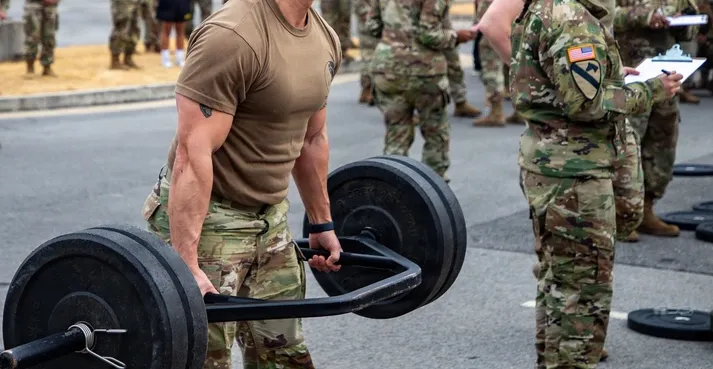
A standard hex barbell weighs about 45 pounds (20 kg), but hex and trap bars range from roughly 25 to 75 pounds depending on the design. We build the hex bar deadlift into our tactical fitness programs because it is the Army’s test lift and the safest heavy pull most tactical athletes can learn.
The Army’s test bar is heavier than a typical gym bar. Per the Army’s published event standards, the 3 Repetition Maximum Deadlift uses a 60-pound hex bar. Below you get the weight of every common bar type, the exact Army number with the plate math, and how to count the bar in your total so your training numbers match test day.
Hex and Trap Bar Weight by Type
Hex and trap bar weight runs from about 25 to 75 pounds, and the frame design drives the number. “Hex bar” and “trap bar” name the same tool: a hexagon or diamond frame you stand inside, with handles at your sides. Heavier bars use thicker tubing, longer sleeves, and extra features like open backs or rack hooks.
Here is how heavy hex bars run by type:
Standard closed hex bar: about 45 lb (20 kg). The common commercial gym bar. Closed frame, two handle heights on many models.
Olympic hex bar: about 45 to 60 lb (20 to 27 kg). Built with 2-inch Olympic sleeves and stouter tubing to carry big loads. Rogue’s TB-2, a widely used Olympic-sleeve trap bar, lists at 60 pounds.
Open or rackable trap bar: about 55 to 75 lb (25 to 34 kg). The open back lets you step in from behind, and the extra steel needed to keep an open frame rigid adds weight.
Lightweight or economy bar: about 25 to 35 lb (11 to 16 kg). Thinner tubing and lower load ratings. Fine for home use, but it will not match the feel of a test bar.
Bar weight also changes across product generations. Rogue states its current TB-2 runs 25% lighter than its original trap bar, which is why two bars that look alike can differ by 15 or 20 pounds.
How to Find Your Bar’s Exact Weight
Do not guess. Check the manufacturer’s stamp or spec sheet first. If neither exists, weigh yourself on a scale, then weigh yourself holding the empty bar and subtract. That five-minute step keeps every logged number honest.
How Much Does the Army (ACFT) Hex Bar Weigh?
The Army hex bar weighs 60 pounds. That figure applies to the 3 Repetition Maximum Deadlift (MDL), which carried over unchanged when the Army Fitness Test (AFT) replaced the Army Combat Fitness Test in June 2025. You lift the heaviest load you can control for three continuous reps, and the 60-pound bar counts toward that load.
GoArmy lists 140 pounds as the 60-point mark on the deadlift, and the full point scale varies by age and sex category. Our breakdown of ACFT score cards & standards shows how each load converts to points.
Army Hex Bar Plate Math
Use one formula: total weight = 60 + (plates on one side × 2). Common loads look like this:
140 lb: 40 lb per side (a 25 and a 15, or a 35 and a 5)
150 lb: one 45 per side
200 lb: a 45 and a 25 per side
240 lb: two 45s per side
340 lb: three 45s and a 5 per side
If you train on a 45-pound gym hex bar, the same plates read 15 pounds lighter than they will on test day. A soldier pulling two 45s per side on a gym bar logs 225, but that identical plate load totals 240 on the Army bar. Know which bar you trained on before you pick your test weight.
Do You Count the Bar Weight in Your Deadlift Total?
Yes. Your hex bar deadlift weight is the bar plus every plate on it. A 45-pound bar with one 45 per side is a 135-pound lift, not a 90-pound lift. The Army scores the MDL the same way, with the 60-pound bar included in the total.
Hex bar numbers and straight bar numbers are not interchangeable, though. In a biomechanical comparison, Swinton and colleagues found trained lifters reached higher maximal loads with the hexagonal bar, along with greater peak force and power. A later study by Camara and colleagues found the hex bar produced more quadriceps activation and higher peak power, while the straight bar loaded the hamstrings more.
Handle height also skews the number. High handles shorten the range of motion, so you can move more weight. Log the bar, its weight, and the handle height every session. If you are choosing a strength & endurance program, look for one that tracks lifts at this level of detail, because progress you cannot compare is progress you cannot program.
Why Use a Hex Bar Instead of a Straight Barbell?
The hex bar keeps the load in line with your center of mass instead of in front of your shins. That position cut the demand on the lower back in the Swinton study and shifted more work to the knees and quads. For a tactical athlete who rucks, sprints, and carries gear, a heavy pull that spares the spine leaves more in the tank for the rest of the week.
It is also easier to learn. The neutral grip and upright torso make the setup forgiving, so a new soldier can load it heavily within weeks without a long technique runway. The Army’s Holistic Health and Fitness guidance frames the deadlift as a test of lifting heavy loads from the ground safely, which is the exact job the hex bar suits.
Use it as one strength tool, not your only one. It belongs inside a strength workout for athletes that also trains single-leg strength, carries, and upper-body pulling.
FAQ: Frequently Asked Questions
How much does a standard hex/trap bar weigh?
A standard hex or trap bar weighs about 45 pounds (20 kg). That is the common commercial gym bar with a closed frame. Lighter economy bars run 25 to 35 pounds, and heavy-duty Olympic or open bars run 55 to 75 pounds. Check the stamp or spec sheet, or weigh it, before you log a number.
How much does the army (ACFT) hex bar weigh?
The Army hex bar weighs 60 pounds. It is used for the 3 Repetition Maximum Deadlift, which stayed in the Army Fitness Test when it replaced the ACFT in June 2025. The 60 pounds counts toward your total, so a bar with one 45 per side is a 150-pound lift.
Do Olympic hex bars weigh more?
Usually, yes. Olympic hex bars use 2-inch sleeves and thicker frame tubing to handle heavy loads, so most weigh 45 to 60 pounds. Rogue’s TB-2, a common Olympic-sleeve model, lists at 60 pounds. Budget bars with thinner tubing or 1-inch sleeves weigh less and carry lower load ratings.
Do you count the bar weight in your deadlift total?
Yes. Your deadlift total is the bar plus all plates. On a 45-pound bar, two 45s per side make 225 pounds. The Army scores the MDL the same way, with the 60-pound bar included. Always note which bar you used, because the same plates total differently on different bars.
How heavy is an open / rackable trap bar?
An open or rackable trap bar typically weighs 55 to 75 pounds. The open back and rack hooks require extra steel to keep the frame rigid under load. That added weight is part of your total, so a lifter switching from a closed 45-pound bar should recalculate before loading.
Why is a hex bar used for the ACFT deadlift?
The Army uses a hex bar because it keeps the load in line with your body, reducing lower-back demand compared with a straight bar. It is also faster to teach to a large population and better reflects lifting heavy objects from the ground, which is the occupational task the event is built to measure.
How much does a hex barbell weigh? About 45 pounds for a standard bar, 25 to 75 pounds across all types, and exactly 60 pounds for the Army’s deadlift bar. Knowing the number is the easy part. Training on the right bar, logging it accurately, and building strength that transfers to test day is the work. Start your next strength block on a plan built around the lift you will be graded on.
References:
U.S. Army. AFT 3 Repetition Maximum Deadlift (MDL). GoArmy.
U.S. Army. ACFT 3 Repetition Maximum Deadlift (MDL). GoArmy.
Human Performance Resources by CHAMP (HPRC). How to Train for the Army Fitness Test. Uniformed Services University.
Human Performance Resources by CHAMP (HPRC). Ace the Army Combat Fitness Test.
Headquarters, Department of the Army. ATP 7-22.01, Holistic Health and Fitness Testing. Washington, DC.
Headquarters, Department of the Army. FM 7-22, Holistic Health and Fitness. Washington, DC; 2020.
Swinton PA, Stewart A, Agouris I, Keogh JW, Lloyd R. A biomechanical analysis of straight and hexagonal barbell deadlifts using submaximal loads. Journal of Strength and Conditioning Research. 2011;25(7):2000-2009.
Camara KD, Coburn JW, Dunnick DD, Brown LE, Galpin AJ, Costa PB. An examination of muscle activation and power characteristics while performing the deadlift exercise with straight and hexagonal barbells. Journal of Strength and Conditioning Research. 2016;30(5):1183-1188.
Disclaimer: This article is for general educational purposes and is not medical advice. Bar weights vary by manufacturer and model, so confirm your equipment’s specifications before training. Army fitness test standards are set by the Department of the Army and may change; verify current scoring with official Army sources or your unit. Consult a qualified medical professional before starting a new strength program, especially if you have a history of injury.


