
How Heavy Should a Weighted Vest Be? | Combat Fitness
How Heavy Should a Weighted Vest Be? Vest vs Ruck, and What to Carry
How heavy should a weighted vest be? Start at 5 percent of your bodyweight, work up to 10 percent for walking and conditioning, and treat 20 percent as the point where the load belongs in a pack instead of on your chest. That range covers almost everything a weight vest is good for. We build loaded work into our tactical fitness programs for service members, police officers and firefighters, so these numbers come from coaching people under load rather than from a product page.
This post gives you the load table by bodyweight and goal, what each pound band is for, whether a vest or a ruck is the right tool, how long you should wear one, and the four things that matter if you buy.
Key Takeaways:
Start at 5 percent of bodyweight. Most trained people settle between 10 and 20 percent depending on the goal.
A 20 lb vest is the default working load for an average adult, which is why it is the most common size sold.
Use a vest for calisthenics, circuits and loaded walking. Use a ruck for anything long, heavy or occupational.
Running in a vest raises impact and shortens your stride for little return. Walk loaded instead.
A vest is not clothing. Keep it inside a training session, not on for the whole day.
Weighted Vest vs Ruck: Which Should You Use?
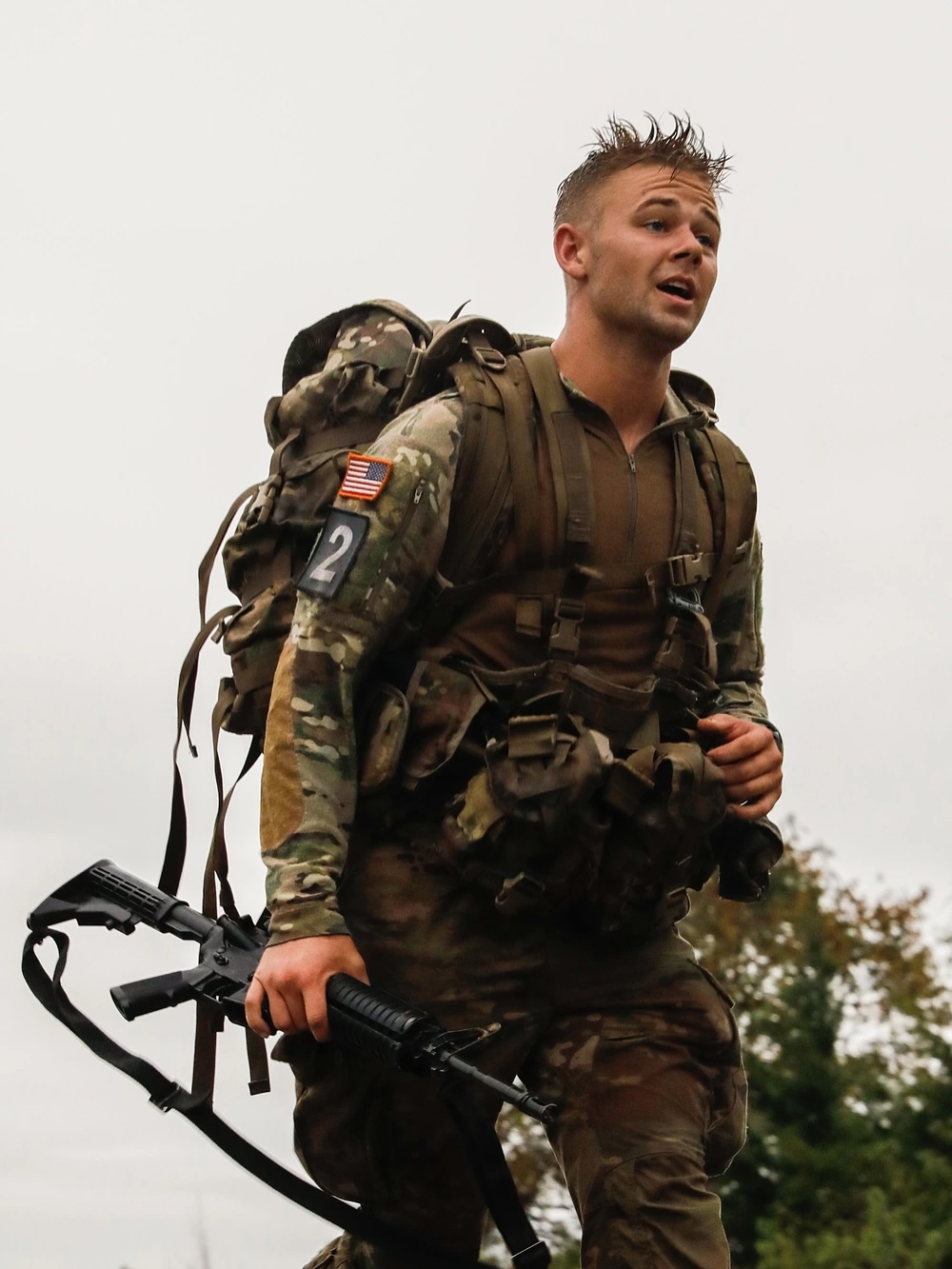
A weighted vest is the better tool when load has to stay tight to your torso through movement: pull-ups, push-ups, step-ups, short circuits and loaded walking. A rucksack is the better tool for anything longer or heavier, because a pack with a hip belt transfers load to your pelvis and a vest has nothing to transfer it to.
That single mechanical difference drives everything else. A vest sits high and close, so it barely changes your stride but loads your spine and shoulders directly. A pack sits behind you and hangs from a belt, so it pulls your trunk forward and changes your gait, but it carries far more weight before the load becomes the limiting factor. Carrying heavy loads measurably alters posture and stride mechanics, which is why Army foot march doctrine sets load limits rather than leaving it to preference.
Weighted vest vs rucksack
Figure 1.1 - Weighted vest and rucksack compared axis by axis, with both plotted on a single percentage-of-bodyweight scale that shows how little they overlap. The vest occupies the first fifth of the scale and its top end is softer than usually claimed: walkers in a graded treadmill trial could not perceive a difference between a ten percent and a fifteen percent vest, and the heavier one stopped adding oxygen cost at the steepest grade. The rucksack begins roughly where the vest stops being interesting and runs to forty-five percent of bodyweight, 76 pounds on a 170-pound athlete, the figure Army doctrine gives for a soldier fit to its own fitness standard, beyond which the load is classed as excess. The comparison corrects one common overstatement: a hip belt transfers about a third of the spinal load to the pelvis, not most of it, and tightening it further produces no measurable change in gait. Sources: Gaffney et al., Ergonomics 2021;65(1):147–158; Oberhofer et al., Appl Bionics Biomech 2018;2018:4671956; Fox, Judge, Dickin & Wang, biomechanics of military load carriage review; FM 21-18 Foot Marches ch. 5; ATP 3-21.8 combat loads; American Council on Exercise weighted-vest metabolic study.
For most tactical purposes the ruck wins, because the job involves a pack and the distances are long. If that is the direction you are heading, our ruck training progression covers how to build it, and the tactical athletes rucking guide is the place to start if you have never trained under a pack. The vest earns its place as a second tool, not a replacement.
How Heavy Should a Weighted Vest Be?
A weighted vest should be 5 to 20 percent of your bodyweight, depending on what you are doing with it. Start every new vest at 5 percent, hold that for two weeks, then progress toward 10 percent for walking and conditioning or up to 20 percent for loaded calisthenics. Above 20 percent, use a pack.
The reason the answer is a percentage and not a number is that the load has to be scaled to the structure carrying it. A 20 lb vest is 11 percent of bodyweight for a 180 lb athlete and 15 percent for a 130 lb athlete, and those are different training stimuli on the same hardware. The percentage rule is also why the answer does not change for men and women: a 130 lb woman at 10 percent is carrying 13 lb, and that is the correct load for her, not a scaled-down version of someone else's.
Weighted vest load by goal
Figure 1.2 - Six training goals and their weighted-vest loads plotted on one shared percentage-of-bodyweight rail, with dashed markers at fifteen and twenty percent. The chart makes the convergence visible: four of the six rows sit in the same narrow band between ten and fifteen percent, and the two that don't are the two that aren't walking. Fifteen percent is a measured ceiling rather than a round number, on graded treadmill walking a fifteen percent vest added no more oxygen cost than a ten percent one and walkers could not tell them apart on a perceived-effort scale. Running sits alone at the bottom for a reason the research states plainly: trained trail runners lost 2.5 percent of their time to exhaustion at a five percent vest and 6.0 percent at ten, an exponential rather than linear penalty, with no chronic sprint benefit in pooled analysis. Loaded calisthenics is the one row that climbs past fifteen percent, because every argument for that cap comes from gait research and a weighted pull-up borrows none of it. Past twenty percent the vest hands off to a pack, whose hip belt moves about a third of the spinal load to the pelvis and whose doctrinal ceiling runs to forty-five percent of bodyweight. Sources: Gaffney et al., Ergonomics 2021;65(1):147–158; Sports 2024;12(9):229; Scientific Reports 2024, wearable resistance and weighted vest sprint meta-analysis; Wang et al., Osteoporosis International 2026; Oberhofer et al., Appl Bionics Biomech 2018;2018:4671956; American Council on Exercise weighted-vest metabolic study.
The starting figure and the progression rule
Pick 5 percent of bodyweight, rounded to whatever increment your vest offers. Hold it for two weeks of normal training. Then add roughly 5 percent of bodyweight every two to three weeks, and only when the current load has stopped changing how you move. If your stride shortens, your shoulders round, or the last set of a circuit falls apart, the load went up too fast.
Sensible increases and a slow ramp are the same principle that governs resistance training progression, and they matter more with a vest because the load is on your spine for the whole session rather than for the duration of a set.
Why 20 percent is the ceiling
Past about 20 percent of bodyweight, a vest asks your shoulders and thoracic spine to hold weight that a hip belt is designed to carry. Army foot march doctrine caps the fighting load for a conditioned soldier at 48 pounds and the approach march load at 72 pounds, roughly 30 and 45 percent of bodyweight for an average soldier. Those are pack loads with belt support. Putting a fighting load on your chest and collarbones instead is a different and worse proposition. What load does to you over weeks is covered in our guide to strength endurance for load carriage.
Vest Weight in Pounds: What 10, 20, 30 and 50 lb Feel Like
Most people arrive at this question with a number already in mind. Here is what each band is for, using a 180 lb athlete as the reference point.
Vest weight bands
Figure 1.3 - Five weighted-vest bands stacked on a vertical gauge running from zero to sixty percent of bodyweight, with the training scale and the military scale shown as the same scale. Three dashed thresholds cross it: fifteen percent, where walking stops rewarding extra weight; thirty percent, where twenty minutes of carriage measurably degrades median nerve conduction; and forty-five percent, above which Army doctrine classes the load as excess. The gauge makes the table's warnings concrete rather than rhetorical. The default 14-to-20-pound band is the one the published research actually tested and sits safely below the first threshold. Forty-five to fifty pounds brackets the Army's 48-pound fighting load cap precisely, a combat load routed entirely through shoulders that tolerate roughly half the pressure hips do. And seventy-five to a hundred pounds clears the seventy-two-pound approach march ceiling into territory doctrine treats as an emergency, in a band where the nerve-conduction evidence applies at loads lighter than the band itself. Sources: Wettenschwiler et al., PLOS ONE 2015;10(11):e0142004; Military Medicine 2026;191(3–4):e703; Gaffney et al., Ergonomics 2021;65(1):147–158; Sports 2024;12(9):229; FM 21-18 Foot Marches ch. 5; ATP 3-21.8 combat loads; American Council on Exercise weighted-vest metabolic study.
A 15 or 20 lb vest is enough for almost everyone, almost always. It is the size most standardized fitness tests use, including the 20 lb and 14 lb vests worn for CrossFit's Murph workout, and it is the load that lets you add resistance to bodyweight movements without wrecking the movements.
Thirty pounds is where the vest starts to feel like equipment rather than an accessory. Use it for carries, step-ups and loaded walking, and expect your last sets to be slower.
Fifty pounds and up is a narrow tool. It is defensible for short, controlled work by someone already strong and already adapted to load. The 100 lb queries exist because heavy vests are sold and because records get chased, not because a 100 lb vest belongs in a training plan.
What a Weighted Vest Is Good For, and What It Is Not
A weighted vest raises the metabolic cost of whatever you were already doing and adds resistance to bodyweight movements. It does not build maximal strength, and it is not a substitute for a barbell.
The metabolic effect is real and roughly proportional. Adding load to the torso increases oxygen cost and ground reaction forces during walking, so a 10 percent load turns a 250 calorie walk into something closer to 275. Intervention trials using weighted vests alongside exercise show reductions in body fat, and vest-plus-exercise programs improve hip and spine bone density compared with usual activity, though the added benefit over exercise alone is still thinly evidenced.
What it does not do is make you strong. Strength adaptation needs load near the limit of what the muscle can produce, and a 20 lb vest is a rounding error against your squat. It also does not build muscle in any meaningful way. A vest makes easy work harder, which is a conditioning effect, not a strength one, and our breakdown of conditioning versus cardio explains why those are different targets. Retailers will not tell you that. We will.
Weight Vest Training Exercises
The exercises worth doing in a vest are the ones where the load has to stay on your torso while you move. Here are the movements and the loading band for each, using percentage of bodyweight.
Pull-ups and chin-ups at 10 to 20 percent. The cleanest use of a vest, because you cannot easily load these any other way.
Push-ups and dips at 10 to 20 percent. Same reason. Keep the vest snug so it does not slide toward your neck.
Step-ups and walking lunges at 10 to 15 percent. Unilateral leg work with load held high, which is close to occupational demand.
Loaded carries at 10 to 15 percent in the vest plus a dumbbell or kettlebell per hand. The vest loads the trunk, the implements load the grip.
Ruck-pace walking at 10 to 15 percent for 30 to 60 minutes. The highest-value use of a vest for most people.
Short intervals at 10 percent: 5 rounds of 3 minutes of fast loaded walking or incline work, 2 minutes easy between.
Keep the vest off your heavy barbell work. It changes the bar path and it adds fatigue where you want precision. If you want these movements sequenced into weeks and blocks rather than run at random, a strength and conditioning program handles that; this section gives you the movements and the loads, not the plan.
Ruck Plates and How Vest Loading Works
Vests load in one of three ways, and the difference decides how useful the vest will be. Plate-loaded systems take steel ruck plates in a front or rear pocket. Shot-filled and sand-filled vests distribute small weights through sewn pockets across the whole shell.
Plate systems load high, tight and flat, which is why they move the least and why they are the standard for loaded walking. The trade-off is coarse increments: plates typically jump 10 to 20 lb at a time, which is a large step for a 150 lb athlete. Shot-filled vests adjust in 1 to 3 lb steps, which makes progression precise, but they are bulkier and the load spreads wider from your spine.
A plate carrier is a third thing and it is not a training tool. It is body armor designed to hold plates in a fixed position, with a cummerbund sized for protection rather than movement. People do ruck and run in plate carriers, and both raise their own set of fit and loading questions that this post does not cover.
Can You Wear a Weighted Vest All Day?
No. Keep vest wear inside a training session: 20 to 60 minutes at a time, then take it off. All-day wear gives you cumulative compression with no adaptive stimulus, and that combination produces problems rather than progress.
Three mechanisms explain why. Sustained load on the shoulders restricts rib cage expansion and increases the work of breathing, which is well documented in thoracic load carriage research. Continuous strap pressure over the brachial plexus is the mechanism behind rucksack palsy, which appears in military case reports as numbness and weakness in the shoulder and arm after prolonged carry. And load worn for hours alters posture and gait long after the point where you stop noticing it.
If your goal is more loaded volume, add sessions rather than hours. Two or three deliberate 40 minute loaded walks per week will do more than eight hours of wearing a vest around the house, and they leave you recovered enough to train. The broader relationship between accumulated load and injury risk under load is worth reading before you decide that more exposure is automatically better.
Running and Walking With a Weighted Vest
Walk loaded. Do not run loaded, in most cases. Walking with a weight vest raises the metabolic cost of the session with almost no change to your mechanics. Running in one raises impact forces, shortens your step length and lengthens ground contact, so you pay a mechanical price for a conditioning effect you could get by walking faster or adding hills.
The research is consistent on the performance side. A meta-analysis of weighted vest and wearable resistance work found slower sprint times, shorter step length and longer ground contact under load. In trained trail runners, vests at 5 and 10 percent of body mass brought on fatigue sooner, and the authors attributed the drop to neuromuscular rather than metabolic factors. You are not training your engine harder. You are training your legs to absorb more force per stride.
There is a narrow exception: short, controlled loaded strides at 5 percent or less, used deliberately by athletes who already run a lot. Everyone else gets more from loaded walking, which is where the durability payoff sits. That is the case we make in why conditioning improves durability, and it applies equally to running in a plate carrier, which stacks the same impact problem on top of a fit problem.
Fit, Sizing and Care
Size a vest by torso length, not by shirt size. The measurement that matters is from the top of your sternum to your navel, because a vest that extends past your waist will dig in when you hinge and ride up when you run.
A vest that moves is worse than a heavier vest that does not. Load that shifts creates shear against your skin, forces your trunk to stabilize an unpredictable mass, and produces chafing at the collarbones, the armpits and the lower ribs. Tighten the side straps until you can fit a flat hand under the front panel and no more. Wear a technical shirt under it, never bare skin, and never a cotton shirt for anything longer than 20 minutes.
Cleaning is mechanical. Remove every plate or shot pocket first, wipe or hand wash the shell with cold water and a mild detergent, rinse the straps, and air dry it fully out of direct sun. Do not machine wash a shot-filled or sand-filled vest and never put neoprene in a dryer. Salt from sweat is what destroys stitching and buckles, so rinsing after heavy sessions matters more than deep cleaning.
If You Are Buying One, What to Look For
Four criteria decide whether a vest will still be in use in six months.
Increment size. Can you add 2 to 5 lb, or only 10 to 20? Fine increments are what make progression possible for lighter athletes.
How the load is secured. Plates and pockets should be locked in place with no movement when you jump. Test it before you train in it.
Torso fit. Adjustable shoulder and side straps, and a panel that ends above your waistband.
Scalability. Can you take weight out as easily as you put it in? Deloads and easy days need a lighter vest, not a different one.
We do not sell vests and we have no affiliate position on them, so there is no brand list here. For how a vest fits alongside the rest of the kit you already own, our guide to boots, packs and plates covers the gear decisions that carry more weight than this one.
Where a Weighted Vest Fits in a Tactical Program
A vest earns a place when it solves a specific problem: your pull-ups have stopped progressing, you need loaded work in a small space, or you want extra metabolic cost on an easy walking day. Those are real uses. What a vest does not solve is distance, hills or occupational carry, and those are what the job asks for.
The vest that gets abandoned is the one bought without a plan for it. Decide which two sessions a week it belongs in before you order one, and it will still be in rotation next year. That decision sits inside a broader picture of what tactical conditioning is and what it is supposed to produce.
If you are comparing coached options rather than self-programming, we have laid out how Mountain Tactical compares and how MTNTOUGH compares against our own programming. And if Section 1 convinced you that a ruck beats a vest for your goals, start with choosing a ruck training program.
FAQ: Frequently Asked Questions
How heavy should a weighted vest be?
A weighted vest should be 5 to 20 percent of your bodyweight. Start at 5 percent for the first two weeks, then build to 10 to 15 percent for walking and conditioning, or up to 20 percent for loaded pull-ups, dips and push-ups. Past 20 percent, move the load into a pack with a hip belt.
What weight vest should I get for my bodyweight?
Multiply your bodyweight by 0.10 and buy a vest that can hold at least that much with room to grow. A 150 lb athlete wants a vest that reaches 20 to 30 lb. A 200 lb athlete wants one that reaches 30 to 40 lb. Adjustability matters more than maximum capacity.
Is a 20 lb weighted vest enough?
For most people, yes. Twenty pounds is 8 to 15 percent of bodyweight for the majority of adults, which covers loaded walking, circuits and weighted calisthenics. You would outgrow it only for heavy loaded carries or advanced pull-up work, and at that point a 30 lb option is the next step.
Do weighted vests build muscle?
Not meaningfully. Building muscle requires load close to what the muscle can produce, and a vest adds a small fraction of that to movements you can already do. A vest raises the metabolic cost of work and adds useful resistance to bodyweight exercises, but strength and size come from progressive external loading.
What is the difference between ruck plates and a shot-filled vest?
Ruck plates are steel or cast weights that sit in a single pocket, loading high and tight with coarse 10 to 20 lb increments. Shot-filled vests spread small weights across sewn pockets, giving 1 to 3 lb increments and finer progression, at the cost of more bulk and load sitting further from the spine.
How do you clean a weighted vest?
Remove all plates and weight pockets first. Wipe or hand wash the shell in cold water with mild detergent, rinse the straps thoroughly, and air dry it completely away from direct heat. Never machine wash a shot-filled or sand-filled vest, and never use a dryer on neoprene.
How heavy a weighted vest should be comes down to one rule: scale the load to your bodyweight, start lighter than you want to, and stop at the point where a pack would do the job better. Pick your number from the table, give it two weeks, and add load only when the current one has stopped teaching you anything. Then put it in two sessions a week and train.
References:
Headquarters, Department of the Army. ATP 3-21.18, Foot Marches. Washington, DC; April 2022.
Headquarters, Department of the Army. FM 21-18, Foot Marches, Chapter 5: Soldier's Load Management. Washington, DC.
Headquarters, Department of the Army. FM 7-22, Holistic Health and Fitness. Washington, DC; October 2020.
Puthoff ML, Darter BJ, Nielsen DH, Yack HJ. The effect of weighted vest walking on metabolic responses and ground reaction forces. Med Sci Sports Exerc. 2006;38(4):746-752.
Looney DP and colleagues. Metabolic costs of walking with weighted vests. Med Sci Sports Exerc. 2024;56(6).
Griffin TM, Roberts TJ, Kram R. Metabolic cost of generating muscular force in human walking: insights from load-carrying and speed experiments. J Appl Physiol. 2003;95(1):172-183.
Pandolf KB, Givoni B, Goldman RF. Predicting energy expenditure with loads while standing or walking very slowly. J Appl Physiol. 1977;43(4):577-581.
Bertochi GFA and colleagues. The use of wearable resistance and weighted vest for sprint performance and kinematics: a systematic review and meta-analysis. Sci Rep. 2024.
Martínez-Noguera FJ, Alcaraz PE, Marín-Pagán C. Effect of weighted vest at 0%, 5% and 10% of body mass on gasometry biomarkers and performance during a rectangular test in trained trail runners. Sports. 2024;12(9):229.
Macadam P and colleagues. Acute and longitudinal effects of weighted vest training on sprint-running performance: a systematic review. Sports Biomech. 2022;21(3):239-254.
Wang and colleagues. Effects of weighted vest on bone health and body fat in middle-aged and older adults: a systematic review and meta-analysis. Osteoporos Int. 2026.
Snow CM, Shaw JM, Winters KM, Witzke KA. Long-term exercise using weighted vests prevents hip bone loss in postmenopausal women. J Gerontol A Biol Sci Med Sci. 2000;55(9):M489-M491.
Knapik JJ, Reynolds KL, Harman E. Soldier load carriage: historical, physiological, biomechanical, and medical aspects. Mil Med. 2004;169(1):45-56.
Knapik JJ, Harman EA, Steelman RA, Graham BS. A systematic review of the effects of physical training on load carriage performance. J Strength Cond Res. 2012;26(2):585-597.
Orr RM, Pope R, Johnston V, Coyle J. Soldier occupational load carriage: a narrative review of associated injuries. Int J Inj Contr Saf Promot. 2014;21(4):388-396.
Attwells RL, Birrell SA, Hooper RH, Mansfield NJ. Influence of carrying heavy loads on soldiers' posture, movements and gait. Ergonomics. 2006;49(14):1527-1537.
Birrell SA, Haslam RA. The effect of military load carriage on 3-D lower limb kinematics and spatiotemporal parameters. Ergonomics. 2009;52(10):1298-1304.
Faghy MA, Brown PI. Thoracic load carriage-induced respiratory muscle fatigue. Eur J Appl Physiol. 2014;114(5):1085-1093.
Phillips DB, Stickland MK, Petersen SR. Ventilatory responses to prolonged exercise with heavy load carriage. Eur J Appl Physiol. 2016;116(1):19-27.
Isolated mononeuropathy from rucksack palsy: a case series. Mil Med. 2021;186(9-10):e1043-e1046.
Backpack palsy and other brachial plexus neuropathies in the military population.
American College of Sports Medicine. Progression models in resistance training for healthy adults. Med Sci Sports Exerc. 2009;41(3):687-708.
Alvar BA, Sell K, Deuster PA, eds. NSCA's Essentials of Tactical Strength and Conditioning. Champaign, IL: Human Kinetics; 2017.
Lauersen JB, Bertelsen DM, Andersen LB. The effectiveness of exercise interventions to prevent sports injuries: a systematic review and meta-analysis of randomised controlled trials. Br J Sports Med. 2014;48(11):871-877.
Disclaimer: This article is for educational purposes only and is not medical advice. Consult a qualified healthcare provider before starting loaded training, especially if you have a shoulder, neck, back, or lower-limb injury. Load recommendations are general coaching guidance, not individual prescriptions, and results vary with training history and recovery.


