
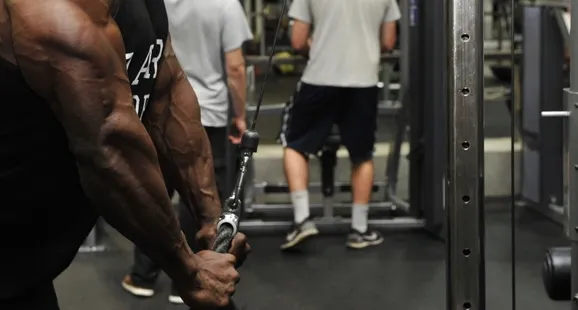
Tricep Rope Extension: Pushdown & Overhead | Combat Fitness
Rope Tricep Extension: How to Do It, Muscles Worked & Overhead Variation
The tricep rope extension is a cable exercise where you straighten your elbows against a rope attachment, either pushing down from a high pulley or extending overhead, to train all three heads of the triceps. Done right, it builds the lockout strength behind every press, push-up, and hard push you make under load. That is why it earns a slot as accessory work inside our military fitness programs, even though it is never the main lift of the day.
We coach this movement to service members who need pressing strength that holds up in the field, not just in the gym mirror. Below you will find what the rope tricep extension works, how to set up and cue both the pushdown and the overhead version, how the rope compares to a straight bar, the mistakes that turn it into a shoulder exercise, and how to program it. Start with the anatomy, because it explains every coaching cue that follows.
What Muscles Does the Rope Tricep Extension Work?
The rope tricep extension works all three heads of the triceps brachii: the long, lateral, and medial heads. The pushdown version loads the lateral and medial heads hardest, while the overhead version stretches and biases the long head. The small anconeus muscle assists at the elbow, and your trunk and lats work to hold your position.
Why the long head behaves differently
The lateral and medial heads start on the upper arm bone and cross only the elbow. The long head starts on the shoulder blade, so it crosses both the shoulder and the elbow. That means your shoulder angle changes its length. With your arms at your sides, the long head sits relatively short. With your arms overhead, it is pulled long before the elbow ever bends.
Research reviews describe the medial head as active in nearly all elbow extension, with the lateral and long heads recruited more as force demands rise. Cadaver work also shows each head contributes differently depending on joint position. That is the practical reason one triceps exercise is never the whole answer, and why the overhead variation gets its own section below.
Why the rope improves the contraction
A rope lets your hands separate at the bottom of the rep and travel slightly past your thighs. That extra range lets your elbows reach full extension with a neutral wrist, so the triceps finish in their shortest, hardest-working position instead of stopping where a fixed bar blocks you.
Why tactical athletes should care
Your triceps finish every press, every push-up, and every hard push against a door, a vehicle, or another person. On the Army Fitness Test, the hand-release push-up depends heavily on elbow extension strength once your chest leaves the ground. Isolation work only matters when it feeds that bigger picture, which is the logic behind functional strength for military performance: build the movement first, then shore up the weak link.
How to Do a Tricep Rope Extension (Rope Pushdown)
To do a tricep rope extension, set a rope on a high cable pulley, pin your elbows to your sides, and push the rope down until your arms are fully straight, splitting the rope ends apart at the bottom. Return slowly until your forearms rise just past parallel to the floor, then repeat.
Step-by-step rope tricep extension form
Attach the rope to the highest pulley setting. Grip the rope just inside the end caps with your thumbs pointing up.
Take one short step back so the cable hangs slightly in front of you. Set your feet hip-width or staggered, hinge forward slightly from the hips, and pull your ribs down.
Bring your elbows to your sides, just in front of your torso. Your forearms start at or slightly above parallel to the floor.
Straighten your elbows to drive the rope down. Nothing else moves: not the shoulders, not the torso.
As your arms approach straight, pull the rope ends apart so your hands finish beside your thighs. Lock out fully and hold for one count.
Return over two to three seconds until your forearms pass parallel. Stop before your elbows begin to rise.
Exhale through the push, then reset your brace before the next rep.
Coaching cues we use on the floor:
Elbows are hinges, not pistons.
Split the rope, do not just push it.
Ribs down, shoulders away from your ears.
Own the way up as much as the way down.
Standing, kneeling, and bent-over rope tricep extension
Standing is the default and lets you load the most.
Kneeling (tall or half-kneeling) takes your legs and hips out of the movement, which makes it harder to cheat with body lean. Lower the pulley a notch to keep the cable angle right.
Bent-over, facing away from the pulley with your upper arms angled forward, moves your shoulder toward flexion. That lengthens the long head more than a standard pushdown and works as a bridge toward full overhead work.
Overhead Rope Tricep Extension: The Long-Head Builder
The overhead rope tricep extension trains the triceps with your arms raised beside your head, which lengthens the long head because it crosses the shoulder. A 12-week study by Maeo and colleagues found overhead cable extensions built substantially more triceps size than the same exercise done with the arms at the sides.
That result lines up with a broader pattern in the research: training a muscle at long lengths tends to produce more growth than training it in a shortened position. For most lifters, that makes the overhead rope extension the more productive of the two variations, not an optional extra.
High pulley vs low pulley setup
High pulley (set at or above head height, facing away): the most common and easiest version to load. You lean forward into a staggered stance, and the cable pulls your hands back behind your head. Use this as your default.
Low pulley (set at the bottom, facing away): you lift the rope over your head and press it up toward the ceiling. Resistance is heavy at the stretch, but getting into position with real weight is awkward, so it suits lighter sets.
How to do the overhead rope tricep extension
Set the rope at head height or higher. Face away from the stack and hold the rope behind your head with a neutral grip.
Step out into a staggered stance and lean your torso forward until the cable has tension. Your upper arms sit beside your head with elbows pointing forward.
Brace hard and keep your ribs down so your lower back does not arch.
Straighten your elbows to drive the rope forward and up until your arms lock out, spreading the rope at the finish.
Return slowly into the stretch behind your head, only as deep as your elbows and shoulders tolerate without pain.
Single-arm rope tricep extension
Holding one end of the rope (or a single handle) turns either variation into a single-arm tricep extension. It exposes side-to-side strength gaps, lets you choose the elbow angle that suits your shoulder, and works well for anyone whose shoulder mobility limits the two-handed overhead position. If you cannot get your arms beside your head without arching your back, use the single-arm or bent-over version until your overhead mobility improves.
Rope vs Bar, and Pushdown vs Overhead: Which Is Better?
Neither the rope nor the bar is better in every case, and neither is the pushdown nor the overhead position. The rope gives a neutral grip and a longer lockout; the straight bar lets you load heavier. The overhead extension biases the long head through a stretch, while the pushdown is easier to load and recover from.
Rope vs straight bar tricep extension
The rope’s advantages:
Neutral wrist position, which many lifters find easier on the elbows and wrists.
Hands spread at lockout for a fuller contraction.
Each hand moves on its own, so a weaker arm has a harder time hiding.
The straight bar’s advantages:
Heavier loads, since the hands are locked together and stable.
Easier progression for lifters who respond well to heavier, lower-rep pushdowns.
There is no strong evidence that one attachment builds more muscle than the other. Choose by joint comfort and stick with it long enough to progress. For the overhead extension specifically, the rope usually wins, because a fixed bar forces a grip that cramps the shoulders and elbows when the arms are overhead.
Tricep rope pushdown vs overhead extension
The pushdown is easier to learn, needs little shoulder mobility, and handles high-rep finisher work well. The overhead version puts the long head on stretch and, per current research, drives more growth, but it demands more shoulder mobility and tends to cause more soreness. If you only have room for one, do the overhead version. If you have room for both, run overhead first while you are fresh and the pushdown second.
Attachment choice matters far less than the training plan around it. If you are still choosing a strength & endurance program, settle that first, because your main pressing work does more for your triceps than any cable accessory.
Common Tricep Rope Extension Mistakes and How to Program It
The mistakes that cost you results
Elbows drifting forward and up. This turns the rep into a lat and shoulder movement. Fix it by dropping the weight and stopping the return as your forearms pass parallel.
Using the shoulders and body. Leaning over the rope and crunching down moves weight without training the triceps. Use the kneeling version to take the body out.
Partial lockout. Stopping short skips the triceps’ shortest, hardest position. Finish every rep straight, spread the rope, and pause.
Going too heavy. Excess load causes the three mistakes above. Pick a weight you control for at least 10 clean reps.
Rushing the negative. A dropped rep gives away half the work. Take two to three seconds on the way back.
A note on elbow comfort: if you feel pain at the point of the elbow, cut the load, change the cable angle, or switch to the single-arm version. Pain that persists across sessions needs an assessment from a qualified clinician, not more volume.
Sets, reps, and how much weight to use
For most tactical athletes, 2 to 4 sets of 10 to 15 reps, one to three times per week, covers it. Research comparing light and heavy loads shows similar muscle growth when sets are taken close to failure, so moderate loads with clean form are the smart choice for a joint that takes a beating from pressing and push-ups. Finish each set with one to three reps left in the tank.
Count your pressing volume too. Bench, overhead press, dips, and push-ups all train the triceps, so the rope extension tops off weekly volume rather than carrying it. Program it after your main lifts on upper-body days, the same way accessory work is slotted into a strength workout for athletes. Because cable stacks jump in large increments, progress by adding reps first, then load.
Tricep rope extension alternatives
No cable station, or need variety? Effective alternatives include the straight bar or V-bar pushdown, the single-arm cable extension with a handle, the resistance-band pushdown for field or deployed training, the dumbbell overhead extension, close-grip push-ups, dips, and the close-grip bench press. We cover the full menu of cable tricep exercises, and how to combine them into complete cable arm workouts, in dedicated guides.
Frequently Asked Questions
What muscles does the rope tricep extension work?
The rope tricep extension works the long, lateral, and medial heads of the triceps, with help from the anconeus at the elbow. The pushdown version emphasizes the lateral and medial heads. The overhead version stretches the long head, which crosses the shoulder, and research suggests it builds more total triceps size.
How do you do a rope tricep pushdown correctly?
Set the rope on a high pulley, pin your elbows to your sides, and straighten your arms until they lock out, spreading the rope ends beside your thighs. Return slowly until your forearms pass parallel. Keep your shoulders and torso still so the elbows do all the work.
What is the difference between the pushdown and the overhead version?
The pushdown is done with the arms at your sides and loads the lateral and medial heads most. The overhead extension is done with the arms beside your head, which lengthens and biases the long head. The pushdown is easier to load; the overhead version tends to produce more growth.
Is a rope better than a straight bar for triceps?
A rope is better for joint comfort and a fuller lockout, since it allows a neutral grip and lets your hands spread at the bottom. A straight bar is better for moving heavier loads. Research has not shown a clear growth advantage for either, so choose the one your elbows and wrists tolerate best.
How much weight should you use?
Use a weight you can move for 10 to 15 controlled reps with full lockout, stopping one to three reps short of failure. If your elbows drift, your torso leans, or the lockout gets short, the weight is too heavy. Add reps before you add plates.
How do you program tricep extensions?
Program tricep extensions as accessory work after your main pressing lifts: 2 to 4 sets of 10 to 15 reps, one to three times per week. Put the overhead version first when you are fresh. Count presses, dips, and push-ups toward your weekly triceps volume so you do not overload the elbows.
The tricep rope extension is a small lift with a specific job: finishing the lockout that every press and push-up depends on. Pin the elbows, spread the rope, own the negative, and give the overhead version a regular spot in your week. Then put it where it belongs, after the heavy pressing, inside a plan that tracks your numbers. Pick your program, run the accessory work as written, and retest your push-ups in eight weeks.
References:
Maeo S, Wu Y, Huang M, et al. Triceps brachii hypertrophy is substantially greater after elbow extension training performed in the overhead versus neutral arm position. European Journal of Sport Science. 2023;23(7):1240-1250.
Landin D, Thompson M, Jackson MR. Functions of the triceps brachii in humans: a review. Journal of Clinical Medicine Research. 2018;10(4):290-293.
Kholinne E, Zulkarnain RF, Sun YC, et al. The different role of each head of the triceps brachii muscle in elbow extension. Acta Orthopaedica et Traumatologica Turcica. 2018;52(3):201-205.
Tiwana MS, Sinkler MA, Bordoni B. Anatomy, Shoulder and Upper Limb, Triceps Muscle. StatPearls. National Center for Biotechnology Information, NCBI Bookshelf.
Wakahara T, Fukutani A, Kawakami Y, Yanai T. Nonuniform muscle hypertrophy: its relation to muscle activation in training session. Medicine & Science in Sports & Exercise. 2013;45(11):2158-2165.
Pedrosa GF, Lima FV, Schoenfeld BJ, et al. Partial range of motion training elicits favorable improvements in muscular adaptations when carried out at long muscle lengths. European Journal of Sport Science. 2022;22(8):1250-1260.
Boehler B, Porcari JP, Kline D, et al. ACE-sponsored research: What is the best triceps exercise? American Council on Exercise, ProSource. 2011.
Schoenfeld BJ, Ogborn D, Krieger JW. Dose-response relationship between weekly resistance training volume and increases in muscle mass: a systematic review and meta-analysis. Journal of Sports Sciences. 2017;35(11):1073-1082.
Schoenfeld BJ, Grgic J, Ogborn D, Krieger JW. Strength and hypertrophy adaptations between low- vs. high-load resistance training: a systematic review and meta-analysis. Journal of Strength and Conditioning Research. 2017;31(12):3508-3523.
Schoenfeld BJ, Ogborn D, Krieger JW. Effects of resistance training frequency on measures of muscle hypertrophy: a systematic review and meta-analysis. Sports Medicine. 2016;46(11):1689-1697.
Refalo MC, Helms ER, Trexler ET, Hamilton DL, Fyfe JJ. Influence of resistance training proximity-to-failure on skeletal muscle hypertrophy: a systematic review with meta-analysis. Sports Medicine. 2023;53(3):649-665.
American College of Sports Medicine. Progression models in resistance training for healthy adults. Medicine & Science in Sports & Exercise. 2009;41(3):687-708.
Haff GG, Triplett NT, eds. Essentials of Strength Training and Conditioning. 4th ed. National Strength and Conditioning Association; Human Kinetics; 2016.
Headquarters, Department of the Army. FM 7-22, Holistic Health and Fitness. October 2020.
U.S. Army. Army Fitness Test (AFT) event standards and scoring.
Disclaimer: This article is for educational purposes and is not medical advice. Consult a qualified healthcare provider before starting a new training program, especially if you have a current or past elbow, shoulder, or wrist injury. Stop any exercise that causes sharp or persistent pain. Individual results vary, and no exercise guarantees a specific performance or test outcome.


