
Standing Power Throw: Standards & Training | Combat Fitness
The Standing Power Throw: The Event, Its Status, and How to Build Explosive Power
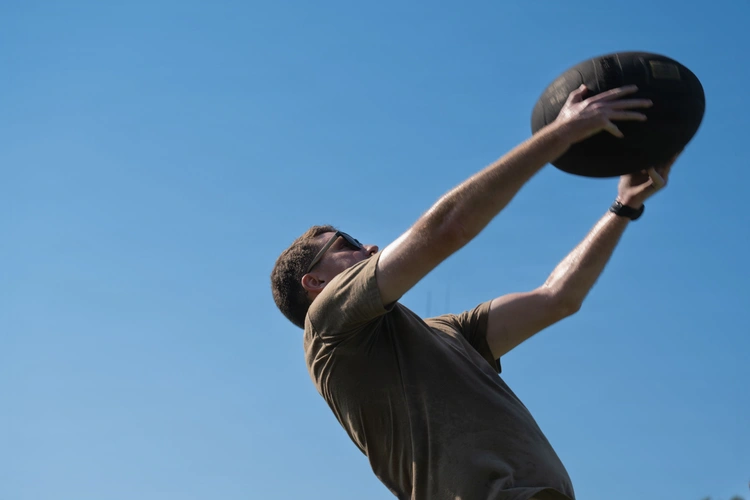
The standing power throw is a backward overhead toss of a 10-pound medicine ball for distance, and it was the Army Combat Fitness Test’s measure of explosive full-body power. It is no longer scored. The Army removed it when the five-event Army Fitness Test (AFT) became the test of record on June 1, 2025.
The quality it measured did not go anywhere. Clearing a wall, heaving a casualty onto a vehicle, or driving off the ground under a plate carrier all depend on producing force fast, and our tactical fitness programs still build that capacity into every selection-prep block. This guide covers the event’s current status, the old ACFT standards, what the throw tested, and a training protocol that builds explosive power whether or not anyone measures it.
Key Takeaways:
The standing power throw was removed from the Army’s test of record on June 1, 2025. The AFT scores five events.
On the final ACFT scales, men 17-21 needed 6.0 meters to pass and 12.6 meters to max. Women 17-21 needed 3.9 and 8.4 meters.
The throw measures total-body explosive power through triple extension, but height and technique skew the score.
Build maximal strength first, then add low-volume med-ball throws, hang power cleans, and jumps.
Train power fresh, at 1 to 5 reps per set with full rest, and end the set when speed drops.
Is the Standing Power Throw Still in the Army Fitness Test?
The standing power throw is not part of the current Army Fitness Test. Army Directive 2025-06 replaced the six-event ACFT with the five-event AFT on June 1, 2025, and the throw was the only event cut. The AFT keeps the deadlift, hand-release push-up, sprint-drag-carry, plank, and two-mile run, and its maximum score dropped from 600 to 500.
The Army gave two reasons. The Army’s own announcement quoted Mullinax saying the event “wasn’t effectively promoting fitness and readiness,” and added that it carried a higher risk of overuse injury while rewarding technique over true power. Army leaders also said they could not scientifically validate it as a power measure, because height and throwing technique skewed results.
The Old ACFT Standing Power Throw Standards
For reference, and for anyone testing on a unit or ROTC battery that still uses the throw, these were the final ACFT standards under the Army’s March 2022 scoring scales (valid through May 31, 2025):
Ball weight: 10 pounds (4.5 kg) medicine ball
Procedure: one practice throw, then two record throws; the longer record throw counted
Minimum (60 points), men 17-21: 6.0 meters; women 17-21: 3.9 meters
Maximum (100 points), men 17-21: 12.6 meters; women 17-21: 8.4 meters
Minimum (60 points), men 22-26: 6.3 meters; women 22-26: 4.0 meters
Maximum (100 points), men 22-26: 13.0 meters; women 22-26: 8.5 meters
Minimums climbed slightly through the late 20s and early 30s, then fell for older age groups. If you are training for the current AFT, none of these distances count toward your score, so the hours you would have spent rehearsing throw technique belong to the five events that do. If you are rebuilding your plan around the new test and weighing your options, our guide to choosing a strength & endurance program walks through what a complete tactical program should include.
What Does the Standing Power Throw Measure?
The standing power throw measures total-body explosive power: how much force you can produce in a short window and transfer through your trunk into an implement. The movement is a triple extension, where hips, knees, and ankles extend together, followed by the trunk and arms finishing the throw overhead and behind you.
How the Throw Was Performed
Stand with your heels at the start line, back to the lane, holding the ball with both hands.
Lower the ball between your legs by hinging and bending the knees into a quarter-to-half squat.
Drive the hips forward and extend hard through the knees and ankles.
Swing the arms up and release the ball overhead, backward, at roughly a 45-degree angle.
Stay on your feet; falling or crossing the line faulted the attempt.
Is It a Valid Test of Power?
The research is mixed, which is part of why the event was cut. A 2001 study in volleyball players found backward overhead throw distance correlated strongly with countermovement jump power (r = 0.906), with excellent test-retest reliability. A 2005 study in college football players found only a moderate correlation with jump power, and no meaningful link once power was expressed relative to body mass. Research on firefighter candidates in 2015 reached a similar caution, while a 2020 study found a stronger link to the power snatch throw (r = 0.73).
The practical read: the throw tracks absolute power reasonably well, but bigger, taller, and more practiced throwers win disproportionately. That is a weakness for a pass/fail test and irrelevant for training. Used as a drill, it trains exactly the hip-to-hand sequencing that the job demands, which is the same logic behind functional strength for military performance and why we keep it in our programming.
How Do You Train Explosive Power? (The Protocol)
Explosive power is trained by first building maximal strength, then adding low-volume, high-intent ballistic work: medicine ball throws, Olympic-lift derivatives like the power clean, and jumps. Strength raises the ceiling on force; the ballistic work teaches you to express that force quickly.
Build the Strength Base First
You cannot be powerful without first being relatively strong. Reviews by Cormie, McGuigan, and Newton (2011) and by Haff and Nimphius (2012) both conclude that weaker athletes gain more power from heavy strength training than from specialized power work, and that stronger athletes respond better to plyometric and ballistic methods once that base exists. A heavy hinge, squat, and press foundation, like the one laid out in our guide to a strength workout for athletes, is the first block of any power plan.
Medicine Ball Throws
Med-ball work trains power through the full chain with almost no eccentric loading, so it adds little fatigue and recovers fast. Rotate four patterns:
Backward overhead throw: the SPT pattern itself, the best single drill for total-body triple extension
Rotational scoop toss: drives power through the hips and trunk for turning, pushing, and combatives
Overhead slam: trains hip and trunk flexion power and is easy to coach indoors
Chest pass or step-in throw: transfers lower-body drive into upper-body push
Use a 4 to 10 kg ball, throw for distance or against a wall, and stop each set before speed drops.
Power Cleans and Pulls
Weightlifting derivatives teach you to accelerate a heavy load through triple extension. Cormie and colleagues found weightlifting movements loaded at roughly 50 to 90 percent of one-rep max, along with ballistic exercises at 0 to 50 percent, gave the strongest stimulus for maximal power. Hang power cleans and clean pulls from the hang are the most efficient options for tactical athletes because they are short to learn and easy to load.
Jumps
Broad jumps, box jumps, and countermovement jumps train the stretch-shortening cycle and rate of force development. Keep ground contacts low, step down from boxes rather than jumping down, and treat every rep as a max effort.
Dosing Rules That Make Power Training Work
Train power fresh, early in the session, before strength or conditioning work.
Keep reps low (1 to 5 per set) and rest fully (1.5 to 3 minutes) so every rep is fast.
Cap total throws and jumps around 20 to 40 quality reps per session.
End the set when bar speed or throw distance drops, not when you reach a rep number.
Power is a speed quality. Fatigue turns power work into conditioning, which defeats the purpose.
A Sample Explosive-Power Session
This session runs about 50 minutes and fits twice per week alongside AFT or selection prep. Warm up for 10 minutes first, with easy movement, dynamic hip work, and a few submaximal jumps and throws.
Backward overhead medicine ball throw: 4 sets of 3, 6 kg ball, full rest
Rotational scoop toss: 3 sets of 3 per side
Broad jump: 4 sets of 2, reset fully between reps
Hang power clean: 5 sets of 3 at a weight you can move fast
Trap bar deadlift: 3 sets of 3 to 5, heavy, which doubles as direct AFT deadlift work
Overhead slam: 2 sets of 5 as a finisher, still at full speed
Progress over a 6 to 8 week block by adding load to the clean and deadlift first, then a set to the throws, then ball weight. Retest a backward overhead throw and broad jump every three to four weeks. A 2020 study put the smallest meaningful change in backward overhead throw distance at about 5 percent, so judge progress on real gains, not single-session noise.
Want this as a printable plan? Our free explosive-power training plan lays out the full 8-week progression, session by session.
Does Explosive Power Carry Over to the Sprint-Drag-Carry?
Yes. The sprint-drag-carry is now the AFT’s closest test of explosive, short-duration output. Each shuttle starts from a dead stop, and every change of direction rewards an athlete who can produce force quickly. The power work above improves your acceleration out of the line and your ability to load the sled without a slow first step. It does not replace event-specific practice, so keep one weekly session dedicated to the event itself.
How Does the Backward Sled Drag Build the Same Power?
The backward sled drag trains the same hip and knee extension pattern as the throw, but under a sustained load instead of a single ballistic effort. Short, heavy drags of 20 to 30 meters build leg drive and knee resilience, while lighter, faster drags lean toward power. Pair it with your throws and jumps: the throw teaches speed, and the drag teaches you to hold force output as you tire.
Frequently Asked Questions
Is the standing power throw still in the Army fitness test?
No. The standing power throw was removed when the Army Fitness Test replaced the ACFT on June 1, 2025. The AFT scores five events: the three-repetition maximum deadlift, hand-release push-up, sprint-drag-carry, plank, and two-mile run. The Army cited injury risk and the event’s dependence on height and technique.
How far did you have to throw on the ACFT standing power throw?
Under the final ACFT scoring scales, men aged 17 to 21 needed 6.0 meters for the 60-point minimum and 12.6 meters for 100 points. Women aged 17 to 21 needed 3.9 meters for 60 points and 8.4 meters for 100. Minimums climbed slightly into the early 30s, then fell for older age groups.
How much does the standing power throw medicine ball weigh?
The standing power throw used a 10-pound (4.5 kg) medicine ball. For training, a range of ball weights works better than one: lighter balls (3 to 4 kg) for speed, and 6 to 10 kg balls for heavier, strength-biased throws. Rotate weights across a training block.
What does the standing power throw measure?
The standing power throw measures total-body explosive power, the ability to produce force rapidly through triple extension of the hips, knees, and ankles. Research links throw distance to countermovement jump power, although height, body mass, and technique also influence the result, which limited its value as a scored test.
How do you train for the standing power throw, and which exercises help most?
Train it by building maximal strength first, then adding low-volume explosive work. The most effective exercises are backward overhead and rotational medicine ball throws, hang power cleans, and broad or box jumps. Keep reps low, rest fully between sets, and train power early in the session while you are fresh.
Should you still train the standing power throw if it is not tested?
Yes, as a drill rather than a test event. The backward overhead throw is one of the most efficient ways to train full-body explosive power with minimal fatigue. That power transfers to obstacle work, casualty movement, combatives, and the sprint-drag-carry, so it stays in serious tactical programming.
The standing power throw is gone from the Army’s test of record, but the explosive power it measured still decides how fast you clear a wall, load a casualty, or win the first step of a shuttle. Build the strength base, add throws, cleans, and jumps at low volume and full intent, and retest every few weeks. If you want the full 8-week progression in hand, download the free explosive-power training plan and start your first session this week.
References:
Headquarters, Department of the Army. Army Directive 2025-06 (Army Fitness Test). April 17, 2025.
Escarne, W. “Army introduces new fitness test for 2025.” U.S. Army, May 14, 2025.
U.S. Army. Army Fitness Test (official program page and AFT scoring scales, effective June 1, 2025).
U.S. Army. ACFT Scoring Scales, as of March 23, 2022 (valid through May 31, 2025).
RAND Corporation. Assessment of Army Combat Fitness Test implementation, injury, and performance outcomes. RAND Health Quarterly, Vol. 12, No. 3.
Smith, J. “Designing a Better Fitness Test: Lessons Learned from the Standing Power Throw.” Starting Strength, May 28, 2026.
Stockbrugger, B. A., and Haennel, R. G. “Validity and reliability of a medicine ball explosive power test.” Journal of Strength and Conditioning Research, 15(4), 431-438, 2001.
Mayhew, J. L., et al. “Comparison of the backward overhead medicine ball throw to power production in college football players.” Journal of Strength and Conditioning Research, 19(3), 514-518, 2005.
Cornell, D. J., et al. “Backwards overhead medicine ball throw and countermovement jump performance among firefighter candidates.” Journal of Trainology, 4(1), 11-14, 2015.
Dockery, J. C., et al. “Relationship between power snatch throw and backward overhead medicine ball throw in college football players.” Journal of Trainology, 9(2), 50-53, 2020.
Cormie, P., McGuigan, M. R., and Newton, R. U. “Developing maximal neuromuscular power: Part 1, biological basis of maximal power production.” Sports Medicine, 41(1), 17-38, 2011.
Cormie, P., McGuigan, M. R., and Newton, R. U. “Developing maximal neuromuscular power: Part 2, training considerations for improving maximal power production.” Sports Medicine, 41(2), 125-146, 2011.
Haff, G. G., and Nimphius, S. “Training principles for power.” Strength and Conditioning Journal, 34(6), 2-12, 2012.
Disclaimer: This article is for educational purposes and does not replace guidance from a qualified medical or fitness professional. Military fitness standards change; confirm current requirements with official Army sources or your chain of command before testing. Consult a physician before starting a new training program, particularly if you have an existing injury.


