
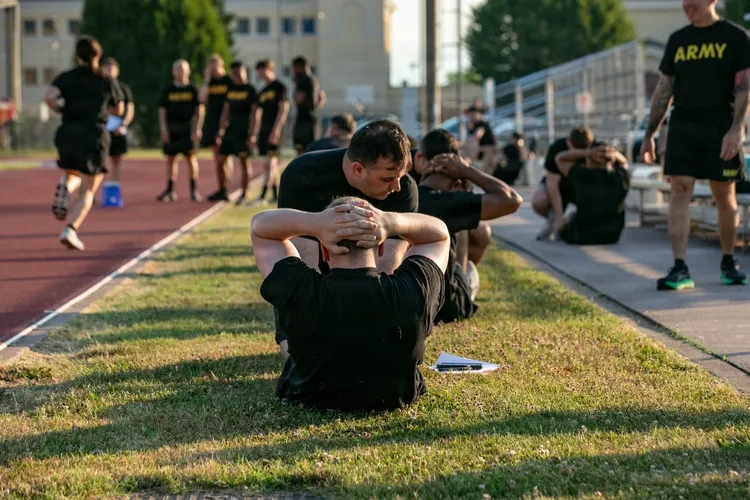
Sit-Ups: Proper Form, Muscles & Variations | Combat Fitness
Sit-Ups: How to Do Them, Muscles Worked & Variations
A sit-up is a full trunk-flexion exercise that takes you from lying flat on your back to sitting upright, and it is still one of the most tested core movements in tactical fitness. The Army, Navy, and Marine Corps have swapped it for the plank, but the FBI, police academies that test against Cooper Institute norms, and the Air Force’s core-endurance event still count sit-ups.
If you would rather have test prep built into a plan than piece it together, our tactical fitness programs program core endurance alongside the strength and conditioning it supports. This guide covers the muscles sit-ups work, proper sit-up form, the sit-up vs. crunch question, every major variation, and how to pace and program for a timed test.
Key Takeaways:
The sit-up trains the rectus abdominis through the first part of the rep, then the hip flexors finish the climb to vertical.
The Army, Navy, and Marine Corps tests now use the plank, but the FBI, most Cooper-based police tests, and the Air Force core option still score sit-ups.
Form standards differ by test. Learn your test’s hand position, foot anchoring, and rep criteria before you train.
A crunch isolates the abs over a short range; a sit-up adds hip flexion. Train the one your test scores.
Pacing wins timed tests. Rehearse your goal pace in 15-second splits instead of sprinting the opening seconds.
What Is a Sit-Up?
A sit-up is a bodyweight exercise in which you lie on your back with knees bent, then flex your trunk and hips until your torso is upright, and lower back down under control. It trains abdominal and hip flexor endurance and remains a standard event on many law enforcement and federal agency fitness tests.
You will see it written as sit-up, situp, or sit up exercise. They are the same movement. What separates a fitness sit-up from a test-standard sit-up is the rep criteria: where your hands sit, whether your feet are held, and what counts as the top and bottom of each rep. Those details decide whether a rep is counted, so we cover them in the form section.
What Muscles Do Sit-Ups Work?
Sit-ups work the rectus abdominis as the primary trunk flexor, with the obliques assisting and stabilizing, and the hip flexors (iliopsoas and rectus femoris) taking over the second half of the rep. That split is why the sit-up feels different from a crunch: the abs curl the spine, and the hip flexors pull you the rest of the way to vertical.
The sequence matters. During the first 30 degrees or so, your abs shorten to curl your ribcage toward your pelvis. Once your spine is flexed, the movement becomes hip flexion, and the psoas does much of the work. Intramuscular EMG research from McGill’s lab found psoas activation substantially higher in sit-ups than in curl-ups, and higher still when the feet are anchored, because a fixed foot gives the hip flexors a stable point to pull against.
The transverse abdominis and internal obliques brace the trunk throughout. That bracing is what you are building for the job: the ability to keep the midsection stiff under fatigue while wearing a plate carrier, climbing, or dragging a casualty.
Why Do Sit-Ups Still Matter for Tactical Athletes?
Sit-ups still matter because a timed sit-up event stands between many candidates and a job offer. The FBI Physical Fitness Test, most police academies using Cooper Institute norms, and the Air Force’s core-endurance component all score sit-ups. Beyond the test, sit-ups build flexion endurance, one piece of the trunk capacity that load carriage and grappling demand.
The occupational case for core endurance is straightforward. A stiff, fatigue-resistant trunk transfers force between your legs and arms, which is the foundation of functional strength for military performance. The sit-up is not the best builder of that stiffness, but it is a valid measure of flexion endurance, and that is why agencies still use it.
Are Sit-Ups Still on the Military PT Test?
Not in the Army, Navy, or Marine Corps. The 2-minute sit-up belonged to the old Army Physical Fitness Test (APFT). The Army dropped it when it moved to the ACFT, and the current Army Fitness Test (AFT), the test of record since June 1, 2025, uses the plank. The Navy replaced curl-ups with a forearm plank starting with the 2021 cycle, and the Marine Corps made the plank mandatory on January 1, 2023.
The Air Force is the exception. Its new Physical Fitness Assessment lets Airmen choose sit-ups, cross-leg reverse crunches, or the plank for the core-endurance event.
FBI Physical Fitness Test: sit-ups for 1 minute; scored, with a minimum of 38 for men and 35 for women.
Police academies (Cooper norms): sit-ups for 1 minute; scored by age and sex percentile.
DEA Physical Task Assessment: sit-ups for 1 minute; scored.
Air Force PFA: sit-ups, cross-leg reverse crunch, or plank; the sit-up is an optional choice.
Army Fitness Test (AFT): plank; the sit-up is retired as an APFT legacy event.
Navy PRT: forearm plank; the curl-up was removed for the 2021 cycle.
Marine Corps PFT: plank; the crunch was removed January 1, 2023.
Standards change, so confirm your agency’s current numbers before you set targets. As a reference point, the Wyoming Law Enforcement Academy’s 40th-percentile Cooper standard for ages 20 to 29 is 38 sit-ups in one minute for men and 32 for women.
If your test date is fixed and you are weighing whether to self-program or follow a structured plan, our guide to choosing a tactical fitness program lays out what to look for.
How to Do a Proper Sit-Up
Proper sit-up form means starting flat with knees at roughly 90 degrees, curling the trunk up under control until your torso reaches vertical (or your elbows touch mid-thigh, per FBI protocol), and lowering until your shoulder blades touch the floor. Every rep travels the full range without pulling on your neck or bouncing.
Follow these steps for a correct, test-standard sit-up:
Set the sit-up position. Lie on your back with knees bent about 90 degrees and feet flat, hip-width apart.
Anchor your feet if your test allows it: a partner’s hands on your shoes, a bench pad, or a sit-up bar.
Place your hands to standard. The FBI requires arms crossed with fingertips on top of the shoulders; many Cooper tests use hands beside the ears. Never interlock fingers and pull on your head.
Brace and curl. Exhale, tuck your chin slightly, and peel your spine off the floor from the top down.
Finish at the top. Rise until your torso is vertical or your elbows reach mid-thigh, depending on your test.
Lower under control. Return until the tops of your shoulder blades touch the floor. That completes one rep.
Common Sit-Up Form Errors
The FBI’s published protocol lists the reps that do not count: elbows short of mid-thigh, shoulder blades not touching at the bottom, hands leaving the shoulders, hips lifting, knees drifting from 90 degrees, and resting between reps. Train to that standard and you will not lose reps to a grader.
Two errors cost the most outside of grading. Yanking the neck forward shifts load to the cervical spine and wastes energy. Bouncing off the floor turns the rep into a momentum drill, so the abs stop doing the work you are trying to build.
Sit-Up vs. Crunch: What Is the Difference?
The difference between a crunch and a sit-up is range of motion. A crunch lifts only the shoulder blades, isolating the rectus abdominis through spinal flexion. A sit-up continues to an upright torso, adding hip flexion and heavy hip flexor involvement. The crunch is the better ab isolator; the sit-up is the test movement.
Range of motion: the sit-up travels from the floor to a vertical torso; the crunch lifts only the shoulder blades (about 30 degrees).
Primary muscles: the sit-up works the rectus abdominis, hip flexors, and obliques; the crunch works the rectus abdominis and obliques.
Hip flexor demand: high for the sit-up, especially with feet anchored; low for the crunch.
Lumbar compression: higher for the sit-up; lower for the crunch.
Test use: the sit-up is scored on the FBI test, Cooper-based police tests, and as an Air Force option; the crunch is a former Marine Corps PFT event, and the cross-leg reverse crunch is an option on the Air Force PFA.
Best use: the sit-up for test-specific endurance; the crunch for ab isolation and accessory volume.
Pick by your goal. If your test scores sit-ups, the sit-up is non-negotiable, because specificity drives the adaptation: you need the hip flexors conditioned for the second half of every rep. If you want abdominal work with less hip flexor fatigue and lower spinal loading, the crunch is the cleaner tool. The Marine Corps cited the heavy hip flexor demand of feet-restrained crunches as part of its reason for moving to the plank.
How Do You Do Weighted and Decline Sit-Ups?
You do a decline sit-up on a bench set 15 to 30 degrees head-down with your feet hooked under the pads, which increases resistance across a longer range. You do a weighted sit-up by holding a plate or dumbbell against your chest. Both build strength that makes bodyweight reps cheaper on test day.
Decline Sit-Up
Set the decline sit-up bench at a modest angle first. Gravity pulls harder against you the steeper the decline, and the extended range starts you below horizontal, so your abs work from a stretched position. Earn the decline: hit three strict sets of 15 at 15 degrees before increasing the angle.
Weighted Sit-Up and Dumbbell Sit-Up
Hold a plate or a single dumbbell flat against your sternum. The farther the load sits from your hips, the harder the rep: chest is easiest, behind the head is harder, arms extended overhead is hardest. Start with 5 to 10 pounds and keep reps strict.
The decline weighted sit-up combines both stressors and belongs at the end of a progression, not the start. Treat loaded sit-ups as accessory work inside a strength workout for athletes, not as the main event. Heavy, low-rep sit-ups build strength, but a one-minute test is decided by endurance, so loaded work supports your bodyweight training rather than replacing it.
What Are the Best Sit-Up Variations?
The best sit-up variations are the bench sit-up for test-specific practice, the incline sit-up as a regression, the reverse sit-up for pelvic control, and the sit-up bar for solo training. Each changes leverage or anchoring, which lets you scale the movement up or down without changing the basic pattern.
Sit-Up With Bench
A sit-up bench anchors your feet under rollers so you can train without a partner. Set it flat for test rehearsal and adjust to decline when you want to load the movement. If you only have a flat weight bench, hook your feet under the end and perform the rep from the floor.
Incline Sit-Up
An incline sit-up raises your head above your feet, which shortens the range and reduces resistance. Use it to build volume if you cannot yet complete strict floor reps, then move back to the floor as your numbers climb.
Reverse Sit-Up
The reverse sit-up flips the pattern: your shoulders stay down while you curl your hips and knees toward your chest. It trains posterior pelvic tilt and control of the lower trunk, which helps you keep your hips planted during test reps.
Sit-Up Bar
A sit-up bar is a door-mounted or floor anchor that replaces the partner’s hold. It is the simplest way to rehearse the anchored test position at home, so the foot pressure you feel on test day is familiar.
Where Do Sit-Ups Fit in Your Core Training?
Sit-ups fit as one flexion-endurance tool inside a broader core program, not as the program itself. Your trunk also has to resist extension, rotation, and side bending, which is what it does under a ruck or in a fight. A complete plan covers all four.
Pair sit-ups with anti-extension work (planks, ab rollouts), anti-rotation work (Pallof presses), loaded carries, and controlled rotational work such as the bicycle crunch. A full menu of core exercises gives you options for each pattern. In circuit-based military calisthenics, sit-ups often appear as one station among push-ups, pull-ups, and lunges, which builds the repeat-effort endurance a timed test rewards.
On injury risk, the Army’s own research is reassuring. A cluster-randomized trial of 1,141 soldiers found no difference in musculoskeletal injury rates between a traditional program with sit-ups and a core-stabilization program without them. The Department of Defense’s Human Performance Resources center (HPRC) adds that core-stability training can support sit-up test performance. Train both.
How Many Sit-Ups Should You Do?
The number of sit-ups you should do depends on your test standard. Build your one-minute max to about 20 percent above your required minimum so test-day stress does not drop you below the line. Train sit-ups two to three times a week, with at least one rest day between hard sessions.
Pacing the 1-Minute and 2-Minute Sit-Up Test
Most failures are pacing failures. Candidates sprint the first 15 seconds and fade. Stew Smith, a former Navy SEAL who coaches FBI candidates, recommends rehearsing goal pace in 15-second splits: a 52-rep goal means 13 reps every 15 seconds.
For a 2-minute sit-up test (the old APFT format, still used by some agencies and training standards), hold an even pace and rest only in the up position if your test permits it. Breaking down at the bottom usually ends the event.
A 6-Week Sit-Up Workout for Test Prep
Test your one-minute max, then run this progression three times a week:
Weeks 1 and 2: 4 sets of 15-second efforts at goal pace, 45 seconds rest.
Weeks 3 and 4: 4 sets of 30-second efforts at goal pace, 60 seconds rest.
Week 5: 3 sets of 45-second efforts at goal pace, 90 seconds rest.
Week 6: One full 1-minute test early in the week, then 2 short sessions at reduced volume before test day.
Add 2 to 3 sets of decline or weighted sit-ups once a week for strength. Retest at the end of week 6.
Do Sit-Up Challenges Work?
A 30-day sit-up challenge builds a habit, but daily max-effort sets leave no room for recovery, and the hip flexors fatigue fast. If you run one, cap hard days at three per week and keep the others light. Structured pacing work beats raw daily volume.
FAQ: Frequently Asked Questions
What muscles do sit-ups work?
Sit-ups work the rectus abdominis as the primary mover, with the obliques assisting and the hip flexors (iliopsoas and rectus femoris) driving the second half of the rep. The transverse abdominis braces the trunk throughout. Anchoring your feet increases hip flexor involvement, which is why test-standard sit-ups feel heavy in the front of the hips.
How do you do a proper sit-up?
Lie on your back with knees bent at 90 degrees and feet flat. Place your hands to your test’s standard, brace, and curl your trunk up until your torso is vertical or your elbows touch mid-thigh. Lower until your shoulder blades touch the floor. Never pull on your neck or bounce off the ground.
What is the difference between a sit-up and a crunch?
The difference is range of motion. A crunch lifts only the shoulder blades and isolates the abs. A sit-up continues to a fully upright torso, which adds hip flexion and heavy hip flexor work. Crunches are the better ab isolator, while sit-ups are the movement many law enforcement and federal tests score.
Are sit-ups still on the military PT test?
The Army, Navy, and Marine Corps have replaced sit-ups and crunches with the plank. The Army’s current AFT uses the plank, the Navy dropped curl-ups for the 2021 cycle, and the Marine Corps made the plank mandatory in 2023. The Air Force still offers sit-ups as one option for its core-endurance event.
How many sit-ups should you do?
Train toward a one-minute max about 20 percent above your test’s minimum, and practice two to three times a week. For general fitness, three sets of 15 to 25 strict reps is plenty, because sit-ups are one part of core training. Volume matters less than pacing and strict form when a test is your goal.
Are sit-ups bad for your back?
Sit-ups are not inherently bad for a healthy back, but they do compress the lumbar spine more than crunches or planks, which is why the Navy and Marine Corps moved away from them. An Army trial found no difference in injury rates versus a sit-up-free program. If you have existing back pain, get cleared by a clinician first.
The sit-up is no longer a military-wide standard, but it still decides outcomes for FBI candidates, police academy applicants, and Airmen who choose it. Learn the exact form your test grades, build strength with decline and weighted variations, and rehearse your pace until goal tempo is automatic.
Knowing the standard is the first half. Programming the weeks before your test is the second. Start a structured plan that puts sit-up pacing, core endurance, and the rest of your test events on one schedule, and walk into test day knowing your number.
References:
U.S. Army. Army Fitness Test (AFT): events, standards, and scoring.
Army Public Affairs. “Army establishes new fitness test of record to strengthen readiness and lethality.” April 21, 2025.
Navy Times. “Here are the Navy’s standards for the new forearm planks, rowing events coming to the PRT.” November 19, 2020.
Federal Bureau of Investigation. “New Sit-Up Protocol for FBI Mandatory Physical Fitness Test.”
Topend Sports. “Fitness Testing for the Federal Bureau of Investigation (FBI).”
Pennsylvania Municipal Police Officers’ Education and Training Commission. “Physical Fitness” (Cooper standards).
City of Douglas / Wyoming Law Enforcement Academy. “Physical Fitness Standards” (40th percentile Cooper Institute).
Childs JD, Teyhen DS, Casey PR, et al. Effects of traditional sit-up training versus core stabilization exercises on short-term musculoskeletal injuries in US Army soldiers: a cluster randomized trial. Physical Therapy. 2010;90(10):1404-1412.
Childs JD, Teyhen DS, Benedict TM, et al. Effects of sit-up training versus core stabilization exercises on sit-up performance. Medicine & Science in Sports & Exercise. 2009;41(11):2072-2083.
Human Performance Resources by CHAMP (HPRC). “Train smarter: Improve your sit-up performance with core exercises.”
Juker D, McGill S, Kropf P, Steffen T. Quantitative intramuscular myoelectric activity of lumbar portions of psoas and the abdominal wall during a wide variety of tasks. Medicine & Science in Sports & Exercise. 1998;30(2):301-310.
Axler CT, McGill SM. Low back loads over a variety of abdominal exercises: searching for the safest abdominal challenge. Medicine & Science in Sports & Exercise. 1997;29(6):804-811.
Escamilla RF, Babb E, DeWitt R, et al. Electromyographic analysis of traditional and nontraditional abdominal exercises: implications for rehabilitation and training. Physical Therapy. 2006;86(5):656-671.
Contreras B, Schoenfeld B. To crunch or not to crunch: an evidence-based examination of spinal flexion exercises, their potential risks, and their applicability to program design. Strength and Conditioning Journal. 2011;33(4):8-18.
ClinicalTrials.gov. Prevention of Low Back Pain in the Military (POLM), NCT00373009.
Disclaimer: This article is for educational purposes only and is not medical advice. Consult a qualified healthcare provider before starting a new training program, especially if you have back pain or a prior injury. Fitness test standards change; confirm current requirements with your service branch or hiring agency before you train.


