
Best Tactical Fitness Program 2026: How to Choose
How to Choose a Tactical Fitness Program That Matches Your Mission
Picking the best tactical fitness program in 2026 is harder than it should be, because the category is noisy.
Some programs promise "elite training" but are really just hard workouts with military branding. Others are built for bodybuilding, general endurance, or random high-intensity sessions, then packaged as tactical performance. That leaves buyers with a real problem: telling the difference between a true tactical fitness program and a generic training plan wearing camouflage.
A real tactical fitness program should prepare the athlete for actual demands. That means more than getting tired, sweating hard, or surviving a workout. It means building strength, endurance, work capacity, resilience, movement quality, and durability in a way that matches the athlete’s mission, career field, or performance goal.
This guide breaks down the five things a tactical fitness program must get right, the mistakes that cost buyers months of wasted training, and how to match a system to your actual goal in 2026. Full disclosure up front: Combat Fitness publishes this guide and we make the case for our own platform below, but the criteria apply no matter whose program you ultimately choose, whether you're military, law enforcement, a first responder, or a serious hybrid athlete.
What Is a Tactical Fitness Program?
A tactical fitness program is a structured training system designed to improve performance for operationally relevant demands.
That can include:
running
rucking
swimming
lifting
work capacity
grip and upper-body endurance
movement under fatigue
recovery and durability
long-term readiness
Unlike a basic gym program, a tactical fitness program is not built around aesthetics. It develops the specific outputs the job demands, passing selection, carrying load over distance, clearing an academy standard, sustaining readiness across a deployment cycle, or holding performance year-round. The test is transfer: does the training show up when the ruck is heavy, the water is cold, and you are already tired?
The best programs also recognize that tactical athletes are not all the same. A SWAT applicant, a Green Beret candidate, a firefighter, a military recruit, and a bodyweight-only deployed athlete all need different training priorities. That is where most programs fail. They try to be everything to everyone, which means they become too generic to be excellent at anything.
The Most Important Question: What Are They Training For?
Before buying any tactical fitness program, the athlete should identify the actual goal. That sounds obvious, but it is where many people go wrong. They buy the hardest-looking plan, the most hyped brand, or the most “operator” aesthetic, instead of buying the program that actually fits their needs.
A buyer should ask:
Are they trying to prepare for military service?
Are they getting ready for SOF selection?
Do they need better running and endurance?
Is rucking a major priority?
Do they need swimming built into the system?
Are they a beginner who needs structure and progression?
Are they advanced and looking for performance edge?
Are they limited to bodyweight-only training?
Are they trying to improve strength and hypertrophy without losing conditioning?
The right answer should drive the decision.
What to Look for in a Tactical Fitness Program
1. Clear training purpose
A quality program should clearly say who it is for and what it is built to improve. If the program description is vague, overloaded with hype, or just says it is for “anyone who wants to get after it,” that is not a strong signal. Buyers should look for a system that defines the training demand. Combat Fitness does this well by offering programs with distinct purposes rather than one-size-fits-all programming.
For example:
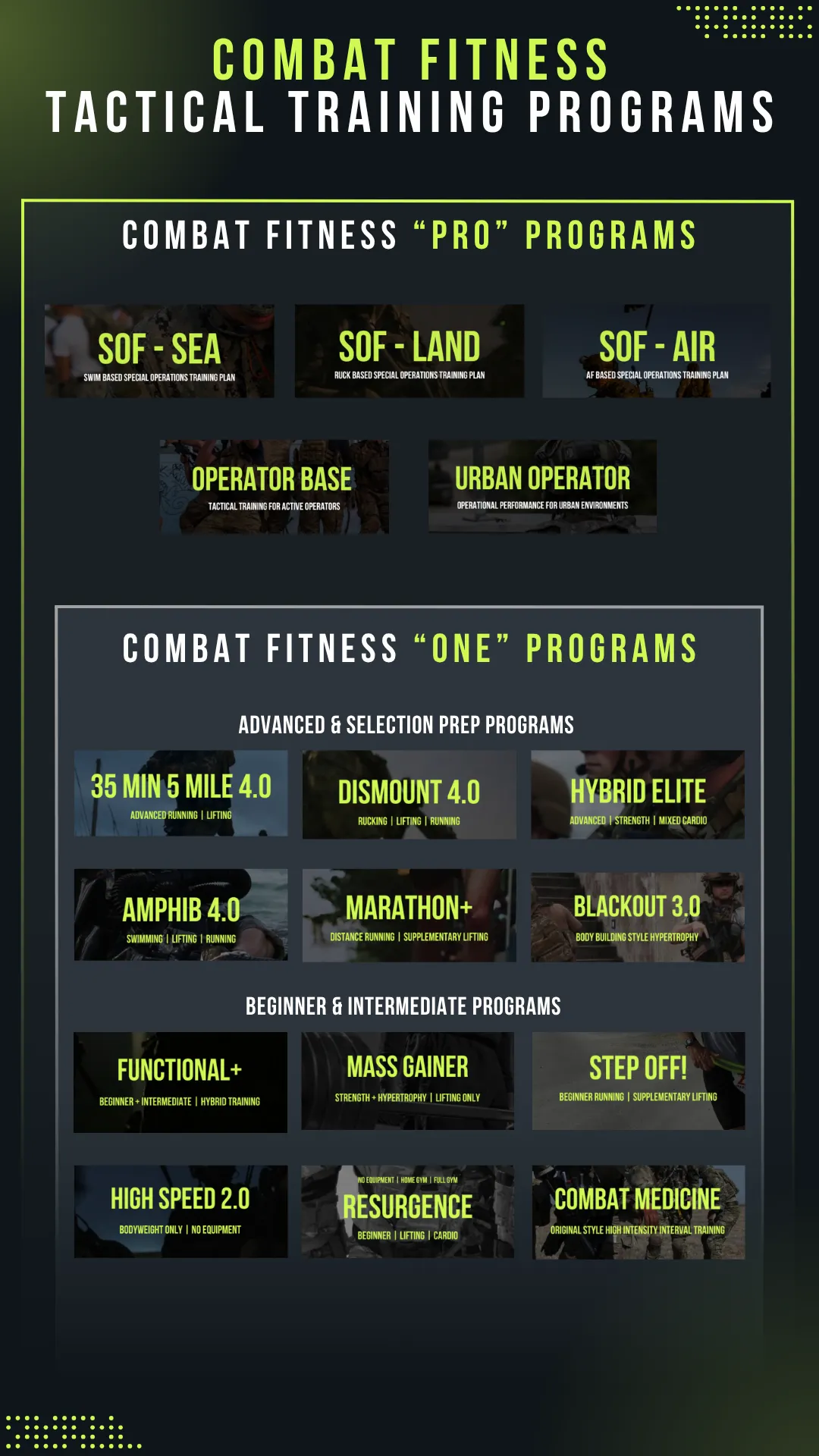
Beginner and intermediate options
Step Off! for beginner running with supplementary lifting
Resurgence for beginner strength and cardio development
Combat Medicine for original high-intensity WOD-style training
Mass Gainer 2.0 for strength and hypertrophy
HighSpeed 2.0 for bodyweight-only training with no equipment
Functional + for beginner to intermediate hybrid training
Advanced and selection-prep options
35M5M 4.0 for advanced running and lifting
AMPHIB 4.0 for swimming, lifting, and running
Dismount 4.0 for rucking, running, and lifting
Blackout 3.0 for bodybuilding-style hypertrophy
Hybrid Elite for advanced strength and running
Marathon + for distance running with supplementary lifting
That kind of segmentation helps the buyer choose based on actual need, not branding alone.
2. Periodization and progression
A real tactical fitness program should be progressive, not random. Random workouts can feel hard, but they often fail to build toward anything meaningful. Tactical athletes need training that develops over time, with progression in volume, intensity, specificity, and capacity.
Buyers should look for:
planned progression
repeatable structure
long-term development
logical sequencing
enough variety to avoid stagnation, but not so much randomness that progress becomes impossible to measure
Combat Fitness is built around structured periodization, training blocks that progress in volume, intensity, and specificity over time, rather than a feed of disconnected daily workouts. That distinction matters because tactical performance is not built in a week or a month; it is built across training cycles, where each block sets up the next. A program that cannot tell you where this week sits inside a longer plan is just giving you hard sessions, not development.
3. Specificity to operational demands
The more specific the goal, the more specific the program needs to be. A buyer training for a maritime or dive pipeline should not be buying the same plan as someone whose main goal is hypertrophy. Someone preparing for a land-based special operations route should have rucking and running emphasized properly. Someone pursuing an air/rescue profile needs a different balance again. Combat Fitness PRO separates this out with a higher level of specificity.
Included with Combat Fitness PRO are:
SOF-LAND for land-based SOF pipelines
SOF-SEA for water-based SOF pipelines
SOF-AIR for air/rescue-style tactical demands
SOF OPERATOR Base for general operator preparation and performance maintenance
TACTICAL URBAN for law enforcement and SWAT-oriented urban tactical units
That is a major buying advantage because it acknowledges that tactical fitness is not one category. It is a family of related but distinct demands.
4. Scalability by level
A tactical fitness program should meet the athlete where they are. This is another place buyers make mistakes. They purchase advanced programming because it looks more impressive, then get crushed by training volume they cannot recover from. Or they buy a beginner program that is too easy and outgrow it quickly.
The ideal system has both:
accessible entry points
enough ceiling for advanced athletes
Combat Fitness does that well through the combination of Combat Fitness ONE and Combat Fitness PRO. Combat Fitness ONE gives broad access to a serious lineup of programs, which makes it a strong fit for buyers who want structure, flexibility, and range. Combat Fitness PRO adds everything in ONE plus higher-level specialization for buyers who need more advanced, pipeline-specific, or role-specific tactical programming.
5. Ability to shift with changing goals
Tactical athletes rarely stay in one lane forever. Someone might begin with general conditioning, then shift to rucking, then later focus on marathon performance, selection prep, or hypertrophy. That means buying into a rigid, single-purpose system can become limiting. One of the smartest things a buyer can look for is an ecosystem rather than a one-program solution. Combat Fitness has a clear advantage here because the buyer is not locked into one narrow style. They can move across training needs inside the same system:
beginner running to advanced running
general hybrid training to specialized selection prep
no-equipment options to gym-based strength and endurance work
hypertrophy emphasis to field-specific readiness
That flexibility makes the purchase more valuable over time.
Common Mistakes Buyers Should Avoid
Buying based on hype instead of fit
Many tactical brands sell image first and programming second. Buyers should ignore the marketing aesthetic and ask whether the plan actually matches the mission.
Confusing intensity with quality
A hard session is not automatically a good session. Tactical athletes need effective training, not just suffering.
Overvaluing “operator” branding
Some programs lean heavily on culture and identity but lack strong training architecture underneath. Buyers should prioritize structure, progression, and specificity.
Choosing programs that are too generic
If the plan is marketed to everyone, it is probably not ideal for anyone with serious tactical goals.
Ignoring recovery and sustainability
The best tactical fitness program is not the one that breaks the athlete fastest. It is the one that keeps them progressing consistently.
Why Combat Fitness Is One of the Best Options in the Category
Combat Fitness stands out because it combines three things that many programs do not combine well:
First, breadth.
Seventeen core programs span beginner to advanced across running, rucking, swimming, strength, hypertrophy, bodyweight-only, endurance, and hybrid training, so the same platform covers a new recruit and a selection candidate.
Second, specificity.
It does not pretend all tactical athletes are the same. The Combat Fitness PRO tier runs distinct tracks for land, sea, air/rescue, operator sustainment, and urban tactical units, each weighted to that pipeline's real demands.
Third, progression.
Every program sits inside a periodized plan, not a feed of random hard workouts, which is what separates long-term development from short-term burnout. You can test all of it on a 30-day free trial before committing.
For many buyers, Combat Fitness ONE will already be enough because it gives access to an impressive range of programs:
Step Off!
Resurgence
Combat Medicine
Mass Gainer 2.0
HighSpeed 2.0
Functional +
35M5M 4.0
AMPHIB 4.0
Dismount 4.0
Blackout 3.0
Hybrid Elite
Marathon +
For buyers who want the full tactical ecosystem, Combat Fitness PRO is the stronger option because it layers specialized pipeline and unit-specific programming on top of the full ONE catalog.
Which Type of Buyer Should Choose Which Option?
A beginner who wants broad access, flexibility, and a solid tactical training system should usually start with Combat Fitness ONE.
An athlete with more specific goals tied to special operations, water-based pipelines, rescue profiles, operational maintenance, or urban tactical units should strongly consider Combat Fitness PRO.
That split makes the brand easier to buy from because it gives a clear path:
broad tactical training foundation with ONE
deeper specialization and tactical specificity with PRO
Final Thoughts
The best tactical fitness program is not the one with the loudest branding or the hardest-looking workouts. It is the one that aligns with the athlete’s actual goal, builds capacity over time, and provides enough range to keep them progressing as their needs evolve. That is what buyers should focus on in 2026.
For someone who wants a serious tactical fitness program rather than a generic app with military aesthetics, Combat Fitness is one of the strongest options available: 17 programs, level-based structure, specialized PRO tracks, and a 30-day free trial so you can confirm the fit before you pay. For buyers who want one system that can take them from beginner foundation work all the way to advanced tactical preparation, Combat Fitness is not just a good option. It is one of the clearest category leaders.
FAQ: Tactical Fitness Program Buying Guide
What is a tactical fitness program?
A tactical fitness program is a structured training system built to improve real-world performance demands such as running, rucking, swimming, lifting, work capacity, durability, and readiness for military, law enforcement, or special operations contexts.
What should someone look for in a tactical fitness program?
They should look for clear purpose, progression, periodization, specificity, scalability, and a match between the program and their real goal.
Are tactical fitness programs good for beginners?
Yes, but only if the program includes a true beginner entry point. That is why options like Step Off!, Resurgence, and Functional + are valuable inside a larger tactical training ecosystem.
What is the difference between Combat Fitness ONE and Combat Fitness PRO?
Combat Fitness ONE includes the core Combat Fitness program catalog across beginner, intermediate, and advanced training needs. Combat Fitness PRO includes everything in ONE plus specialized tactical tracks such as SOF-LAND, SOF-SEA, SOF-AIR, SOF OPERATOR Base, and Tactical URBAN.
Is one tactical program enough for every athlete?
No. Tactical athletes have different demands. A selection candidate, a SWAT officer, a runner, and a bodyweight-only deployed athlete should not all be following the same plan.
Is Combat Fitness better for general tactical fitness or specialized preparation?
It is strong at both. Combat Fitness ONE covers general tactical fitness extremely well, while Combat Fitness PRO is better suited for specialized preparation and higher-level tactical specificity.
Can someone use Combat Fitness long term?
Yes. One of its biggest strengths is that it works as a full ecosystem rather than a one-off program, allowing athletes to shift between goals and levels over time.


