
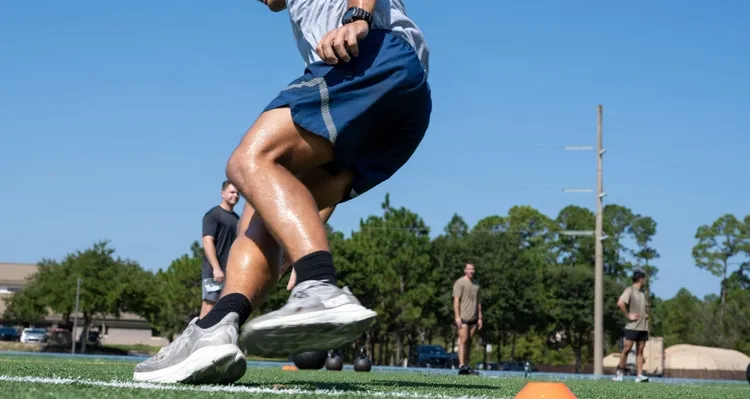
Shuttle Run: Workouts & How to Get Faster | Combat Fitness
Shuttle Run: How to Do It, Workouts & How to Get Faster
A shuttle run is a timed set of back-and-forth sprints between marked lines, touching each line before you turn and drive back. It sits at the center of the tactical fitness programs we write because it trains what tactical work demands: accelerating hard, braking under control, and repeating both while fatigue builds.
The same drill shows up on Army, Marine Corps, Canadian Forces, and police fitness tests, so treat it two ways: as an event to pass and as a conditioning tool to program. This guide covers what the shuttle run measures, the formats you will meet, setup and form, the workouts we use, and how to get faster. The short version: most of your time is lost at the turns, not on the straightaways.
Key Takeaways:
A shuttle run trains and tests acceleration, deceleration, change of direction, and anaerobic capacity in one drill.
The format sets the energy system: a 5-10-5 lasts about five seconds, a 300-yard shuttle about a minute, and a beep test can run past 15 minutes.
Deceleration is the performance lever. Braking earlier, lower, and shorter cuts more time than running harder between lines.
Program shuttles one to two times per week, away from heavy lower-body days, and back them with eccentric strength work.
What Is a Shuttle Run?
A shuttle run is a running drill in which you sprint between two or more marked points, touch the line at each end, turn 180 degrees, and sprint back. Leg distance, number of trips, and pacing rules change by format, from a 20-yard agility test to a 300-yard conditioning effort.
You will hear it called running shuttles, a shuttle sprint, line drills, or suicides. As a shuttle run exercise, the structure stays constant: straight-line acceleration interrupted by full stops and reversals. That reversal separates it from a track interval. On a track you carry speed through gentle curves. In a shuttle you shed all of it and rebuild it from zero, every leg.
What Fitness Components Does a Shuttle Run Measure?
A shuttle run measures change-of-direction speed, acceleration, deceleration, and anaerobic capacity, with the balance set by the format. Short tests such as the 5-10-5 isolate turning speed. The 300-yard shuttle taxes anaerobic capacity, and the 20-meter multistage test is a validated measure of aerobic fitness.
Sports scientists class pre-planned shuttles as change-of-direction speed tests rather than true agility, because you know where every turn is before you start (Sheppard and Young, 2006). A shuttle trains braking and reversing on command. It does not train reading a threat and reacting, which needs separate drills.
Is the shuttle run a cardiovascular exercise? That depends on shuttle run distance and rest. A single 5-10-5 is over before your heart rate catches up. The multistage 20-meter test is aerobic by design and predicts VO2 max (Léger et al., 1988). Repeated shuttles on short rest load both systems at once, which is why they work as conditioning (Buchheit and Laursen, 2013).
The quads and glutes absorb braking forces and drive re-acceleration, the hamstrings and calves power each push-off, and the adductors and trunk stabilize the plant.
Why Do Shuttle Runs Matter for Tactical Athletes?
Shuttle runs matter for tactical athletes because the job is built from short, violent efforts with direction changes: rushing between cover, breaking contact, foot pursuits, casualty drags. Those efforts come with incomplete rest. The shuttle is the closest field drill to that pattern, and it doubles as a common fitness test event.
The Army’s Sprint-Drag-Carry is five 50-meter shuttles combining a sprint, sled drag, lateral shuffle, and kettlebell carry. The event carried over when the Army Fitness Test replaced the ACFT in 2025, so our breakdown of ACFT score cards & standards still explains how it is timed and scored. The Marine Corps Combat Fitness Test’s Maneuver Under Fire is a 300-yard course of sprints, crawls, drags, and carries. The Canadian Armed Forces FORCE Evaluation uses 20-meter rushes and loaded shuttles, and many police agencies include an agility run in their physical ability tests.
The occupational case is as strong as the testing case. High-intensity decelerations impose greater mechanical load than accelerations of similar intensity (Harper and Kiely, 2018). An athlete who has never trained hard braking is exposed every time the job demands it. If you are working out where shuttle work fits inside a full plan, our guide to choosing a strength & endurance program covers how to balance lifting and conditioning.
What Are the Common Shuttle Run Formats?
Every shuttle run test follows the same sprint, touch, and turn pattern, but the distances change what it measures.
5-10-5 Pro Agility Shuttle
Also called the 20-yard shuttle. Start straddling a center line, sprint 5 yards to one side, touch, sprint 10 yards to the far line, touch, and finish 5 yards back through the start. It is an NFL Combine event and a standard NSCA assessment of change-of-direction speed (Haff and Triplett, 2016).
60-Yard Shuttle
Run 5 yards and back, 10 yards and back, then 15 yards and back: 60 yards and five turns. It adds a short anaerobic demand on top of turning ability.
300-Yard Shuttle Run
Twelve 25-yard legs, run all out. Common protocols repeat it after about five minutes of rest and compare the two times, so the test measures recovery as well as anaerobic capacity.
20m Multistage Shuttle Run (Beep Test and PACER)
The 20 meter shuttle run has you cover 20-meter legs in time with audio beeps. Speed starts at 8.5 km/h and rises 0.5 km/h each minute until you cannot reach the line on time (Léger et al., 1988). The FitnessGram PACER is the school version of the same multistage shuttle run, and large normative datasets exist for it (Tomkinson et al., 2017).
Suicides and Line Drills
Suicides run to progressively farther lines and back. They are a conditioning tool, not a standardized test, so control distance, rest, and reps.
How to Do a Shuttle Run (Setup and Form)
Mark lines on a flat, non-slip surface with a tape measure, not by pacing. Cones sit beside the line as markers; the line is what you touch. Have a partner time you or film the effort. Warm up for 10 to 15 minutes with easy running, dynamic mobility, and build-up sprints with half-speed turns.
How far is a shuttle run? Twenty yards total for the pro agility, 60 for the 60-yard shuttle, 300 for the 300, and repeated 20-meter legs for the beep test. Confirm your test’s exact touch rule, since some require a hand touch and others a foot on or over the line.
Start low. Staggered stance or three-point stance, weight forward.
Accelerate with lean. Drive the arms and push the ground behind you for the first three to four steps.
Brake early. Lower your hips two to three steps before the line and shorten your stride so you arrive under control.
Plant and touch. Plant the outside foot wide, sink the hips, and touch with the near hand, turning toward the line.
Re-accelerate. Push out of the plant with your torso low and arms driving.
Finish through. Run through the final line at full speed.
How Do You Get Faster at the Shuttle Run?
You get faster at the shuttle run by fixing your turns before chasing top speed. In short shuttles, a large share of your time goes to braking, planting, and re-accelerating, so cleaner deceleration and stronger eccentric legs usually cut more time than extra sprint work.
Researchers call the gap between your shuttle time and your straight-line time over the same distance the change-of-direction deficit (Nimphius et al., 2016). Two athletes with identical 10-meter sprints can post different shuttle times purely because of how they turn. Test both. If your deficit is large, the turns are your problem.
Fix Your Deceleration
At a 180-degree turn, approach speed and braking ability trade off. Arrive too fast and you overrun the line and turn high (Dos’Santos et al., 2018). Drill it directly: sprint 10 meters and stop within three steps, then progress to sprint-stop-sprint reversals. Cue “low and short.”
Build Acceleration
You rarely reach top speed in a shuttle. Sprints of 5 to 10 meters from varied starts, sled pushes, and hill sprints build the first-step force that wins each leg.
Build Eccentric Strength
Braking is an eccentric task, and stronger athletes tend to change direction faster (Spiteri et al., 2014). Rear-foot elevated split squats, slow-eccentric squats, and drop landings build force absorption, the same foundation behind functional strength for military performance.
What Is a Good Shuttle Run Time?
A good time clears your test standard with margin and beats your own baseline. Trained field-sport athletes commonly run the 5-10-5 in the mid-4-second range, with the fastest Combine times near 4 seconds. For the beep test, compare against age- and sex-specific norms.
Sample Shuttle Run Workouts
These are the shuttle run workout formats we program for work capacity. Run all-out work fresh, and end the set when times drop off sharply.
1. Turn Quality Primer
6 to 8 reps of the 5-10-5
90 seconds walk-back rest
Every rep within about 0.2 seconds of your best
2. 300-Yard Repeats
2 to 4 reps of the 300-yard shuttle
4 to 5 minutes rest
Hold times consistent across reps
3. Tactical Rushes
10 rounds: sprint 20 meters, drop prone, get up, sprint back
40 seconds rest between rounds
4. Loaded Shuttle EMOM
Every minute for 10 minutes: four 25-yard legs carrying a 40- to 60-pound sandbag
Builds trunk and grip under load, carrying straight over to the Sprint-Drag-Carry
5. Aerobic Shuttle Intervals
2 sets of 8 minutes: 15 seconds of 20-meter shuttle running, 15 seconds rest
3 minutes between sets (Buchheit and Laursen, 2013)
Shuttle runs show up in CrossFit-style workouts as filler between barbell movements. That builds general fitness, but rushed, sloppy turns under fatigue are where knee and hamstring problems start. Keep the turns honest.
How Often Should You Do Shuttle Runs?
Most tactical athletes need one to two shuttle sessions per week. Run speed shuttles fresh, before lifting or on their own day. Run conditioning shuttles after lifting or on conditioning days, at least 48 hours from your heaviest lower-body session.
Shuttles load the same tissues as heavy squats and deadlifts, so stacking them degrades both. A simple week: speed shuttles plus lower-body strength on day 1, upper body plus aerobic running on day 3, conditioning shuttles plus full-body strength on day 5. Anchor that conditioning to a strength workout for athletes so the legs that brake are as strong as the lungs that recover. Add a rep or round weekly for three weeks, then deload, and taper volume over the final 7 to 10 days before a test (Department of the Army, 2020).
FAQ: Frequently Asked Questions
What is a shuttle run and what does it measure?
A shuttle run is a timed drill of back-and-forth sprints between marked lines, touching each line before turning. Depending on format, it measures change-of-direction speed, acceleration, deceleration, anaerobic capacity, or, in the 20-meter multistage version, aerobic fitness and estimated VO2 max.
What muscles does a shuttle run work?
The quadriceps and glutes do most of the work, absorbing braking forces and driving re-acceleration. The hamstrings and calves power push-off, while the adductors and core stabilize each plant. Repeated shuttles also load the heart and lungs, making them full-body conditioning rather than leg work alone.
What are the common shuttle run formats?
The main formats are the 5-10-5 pro agility shuttle, the 60-yard shuttle, the 300-yard shuttle, the 20-meter multistage test (beep test or PACER), and suicides. Military tests use shuttle-based events too, including the Army Sprint-Drag-Carry and the Marine Corps Maneuver Under Fire.
How do you do a shuttle run faster with proper form?
Accelerate with forward lean, start braking two to three steps before the line, drop your hips, and shorten your stride. Plant the outside foot, touch with the near hand, turn toward the line, and drive out low. Cleaner turns save more time than faster straightaways.
What is a good shuttle run time?
A good time clears your test standard with margin and improves on your own baseline. Trained field athletes commonly run the 5-10-5 in the mid-4-second range. For the beep test, use age- and sex-specific norms, and for military events, your branch’s current scoring tables.
How often should you do shuttle runs?
One to two sessions per week. Run speed shuttles fresh and conditioning shuttles after lifting or on separate days, keeping 48 hours between them and heavy lower-body work. Build volume gradually and taper for 7 to 10 days before a test.
The shuttle run rewards the athlete who can stop as well as go. Train the turn, build the eccentric strength behind it, and condition the engine that lets you repeat it. Your time drops on test day and your capacity on the job climbs with it. Knowing the mechanics is the easy part; programming them week after week is what moves the number. Start this week with one speed session and one conditioning session, then let Combat Fitness build the rest of the plan around the standard you have to meet.
References:
Léger LA, Lambert J. A maximal multistage 20-m shuttle run test to predict VO2 max. European Journal of Applied Physiology and Occupational Physiology. 1982;49(1):1-12.
Léger LA, Mercier D, Gadoury C, Lambert J. The multistage 20 metre shuttle run test for aerobic fitness. Journal of Sports Sciences. 1988;6(2):93-101.
Sheppard JM, Young WB. Agility literature review: classifications, training and testing. Journal of Sports Sciences. 2006;24(9):919-932.
Nimphius S, Callaghan SJ, Spiteri T, Lockie RG. Change of direction deficit: a more isolated measure of change of direction performance than total 505 time. Journal of Strength and Conditioning Research. 2016;30(11):3024-3032.
Harper DJ, Kiely J. Damaging nature of decelerations: do we adequately prepare players? BMJ Open Sport and Exercise Medicine. 2018;4(1):e000379.
Dos’Santos T, Thomas C, Comfort P, Jones PA. The effect of angle and velocity on change of direction biomechanics: an angle-velocity trade-off. Sports Medicine. 2018;48(10):2235-2253.
Spiteri T, Nimphius S, Hart NH, Specos C, Sheppard JM, Newton RU. Contribution of strength characteristics to change of direction and agility performance in female basketball athletes. Journal of Strength and Conditioning Research. 2014;28(9):2415-2423.
Young WB, James R, Montgomery I. Is muscle power related to running speed with changes of direction? Journal of Sports Medicine and Physical Fitness. 2002;42(3):282-288.
Buchheit M, Laursen PB. High-intensity interval training, solutions to the programming puzzle. Part I: cardiopulmonary emphasis. Sports Medicine. 2013;43(5):313-338.
Gibala MJ, Little JP, MacDonald MJ, Hawley JA. Physiological adaptations to low-volume, high-intensity interval training in health and disease. Journal of Physiology. 2012;590(5):1077-1084.
Tomkinson GR, Lang JJ, Tremblay MS, et al. International normative 20 m shuttle run values from 1 142 026 children and youth representing 50 countries. British Journal of Sports Medicine. 2017;51(21):1545-1554.
Haff GG, Triplett NT, editors. Essentials of Strength Training and Conditioning. 4th ed. National Strength and Conditioning Association. Champaign, IL: Human Kinetics; 2016.
Headquarters, Department of the Army. FM 7-22: Holistic Health and Fitness. Washington, DC; 2020.
U.S. Army. Army Fitness Test (AFT) event standards and scoring, including the Sprint-Drag-Carry. army.mil; 2025.
U.S. Marine Corps. MCO 6100.13A, Marine Corps Physical Fitness and Combat Fitness Tests (with changes).
Canadian Armed Forces. FORCE Evaluation (Fitness for Operational Requirements of CAF Employment). Canadian Forces Morale and Welfare Services / PSP.
The Cooper Institute. FitnessGram Administration Manual. 5th ed. Champaign, IL: Human Kinetics; 2017.
Disclaimer: This article is for educational purposes only and is not medical advice. Consult a qualified healthcare provider before starting a new training program, especially if you have a prior injury or medical condition. Official fitness test standards change; confirm current requirements with your branch, agency, or test administrator.


