
Running in Boots: Is It Bad for You? | Combat Fitness
Running in Boots: Is It Bad for You, and When Should You Do It?
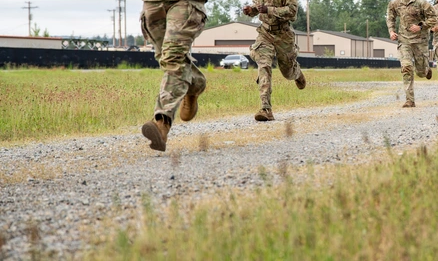
Running in boots is not inherently bad for you, but it is different. Boots are heavier, stiffer, and less cushioned than running shoes, so every mile puts more load on your shins, ankles, and feet. In small, programmed doses, boot running builds the specificity a selection course or fitness test demands. If you want those doses written for you, our tactical fitness programs build boot runs into a structured plan alongside the rest of your training.
The demand is real. BUD/S students run timed four-mile beach runs in boots, the Marine Corps Combat Fitness Test runs its Movement to Contact in boots and utilities, and Army foot march events are boots on the ground. Below: the honest risk picture, where boots earn their place, how they compare to shoes, and a safe way to build up.
Is Running in Boots Bad for You?
Running in boots becomes bad for you when it becomes your default. Combat and tactical boots are several times heavier than a running shoe, bend less at the forefoot, and absorb less impact, so each stride costs your lower legs more. A limited, progressive dose is safe for a healthy athlete. High volume in boots is where injuries start.
The weight matters more than the number on the scale suggests. Load carried on the feet costs several times more energy than the same load carried on the torso, because you accelerate and stop your feet with every stride (Soule & Goldman, 1969). Army researchers measured the same effect directly: running in boots raised energy cost and heart rate compared with running shoes at the same pace (Jones et al., 1984).
Mechanics change too: comparisons of army boots and athletic shoes show higher impact loading and altered ankle motion in boots (Sinclair & Taylor, 2014).
Why Is Running in Combat Boots Bad for Some Athletes?
Lower-extremity overuse injuries dominate military training injury data, and running volume is one of the most consistent risk factors (Jones & Knapik, 1999; Kaufman et al., 2000). Boots amplify that existing risk. The usual problems are:
Shin pain and tibial stress injuries from repeated, poorly absorbed impact
Achilles and calf strain from a stiff sole that limits normal ankle motion
Plantar fascia irritation and forefoot stress fractures
Blisters from heat, moisture, and friction inside a heavier boot (Knapik et al., 1995)
Athletes with low prior running volume, previous lower-leg injuries, or boots that do not fit carry the highest risk (Knapik et al., 2001; Andersen et al., 2016).
What Are the Benefits of Running in Boots?
Running in boots builds specificity. If your test, selection, or job requires moving fast in boots, your feet, ankles, and gait need exposure to that exact footwear before the day it counts. Shoe fitness transfers well, but not completely. The skin, tendons, and stride pattern adapt to what you train in.
Here is where boot running earns a place in the plan:
Selection and test events run in boots: BUD/S timed runs, the Marine Corps Movement to Contact, and Army foot march events
Foot and ankle durability under heavier, stiffer footwear
Blister resistance, because skin toughens to the specific friction of your boot and sock
Carryover to load carriage, since rucking is the same boots-on-the-ground demand
That last point links the two. The specificity logic that drives boot runs also drives how much weight to ruck with, and both should build gradually for the same tissue reasons.
Running in tactical boots matters for law enforcement and firefighters too, since nobody changes shoes before a foot pursuit. Hiking and work boots get the same answer: fine in small doses, never your main running footwear.
Running in Boots vs. Shoes: What Changes?
Running shoes are the right default for volume, and boots are a specificity tool. The difference shows up on several axes:
Weight: boots add mass at the foot, the most expensive place to carry it
Cushioning: shoes absorb more impact, boots pass more of it into the shin
Stiffness: boot soles flex less, which shifts work to the calf and Achilles
Ankle collar: a high boot restricts ankle motion, which changes your stride
Energy cost: the same pace costs more effort in boots (Jones et al., 1984)
So boot runs should be slower and shorter than shoe runs. Build your aerobic base, speed, and mileage in shoes, then add a small, deliberate boot dose. Not sure how a plan should balance boot miles, shoe miles, and strength work? Our guide to choosing a strength & endurance program walks through what a good plan should include.
How to Run in Boots Safely
The safe way to run in boots is to start short, build slowly, and cap how much of your weekly running happens in them. Pair that with lower-leg strength work and boots that fit. Follow these steps in order:
Get the fit right. Use broken-in boots, sized with the socks you will wear on test day, with the heel locked in place.
Manage moisture. Wear moisture-wicking socks, and consider a thin liner sock to cut friction (Knapik et al., 1995).
Start short and easy. Begin with one easy mile, once per week, on flat and even ground.
Progress in small steps. Add about half a mile every one to two weeks, and only when the previous run left no lingering pain.
Cap boot volume. Our rule of thumb keeps boots to a small share of weekly mileage, with the rest in shoes.
Build the lower legs. Calf raises, tibialis raises, single-leg work, and foot strength protect the tissues boots load hardest.
Taper before the test. Drop boot volume in the final week so you arrive fresh.
The strength piece is not optional. Functional strength for military performance covers the lower-leg and hip base that keeps you durable in boots, and a strength workout for athletes shows how to fit that work into a full training week. Gradual, well-managed load increases are what build robust tissue, while sudden spikes are what break it (Gabbett, 2016).
A Sample Boot-Run Progression
This is the shape we use for an athlete with a solid shoe-running base:
Weeks 1 to 2: one easy mile in boots, once per week
Weeks 3 to 4: one and a half miles, once per week
Weeks 5 to 6: two miles, with the last half mile at test pace
Weeks 7 to 8: two to three miles, adding a second short boot session only if the first causes no pain
Final week before the test: cut boot volume roughly in half
Keep all other runs in shoes during this block.
Why Did the Army Stop Running in Combat Boots?
The Army moved routine physical training runs into running shoes as injury surveillance showed how much running volume drives lower-extremity overuse injuries (Jones & Knapik, 1999). Current Army doctrine treats running and foot marching as separate events with separate footwear: PT runs in running shoes, foot marches in boots (Department of the Army, FM 7-22, 2020). The lesson matches ours: practice boots for the boot event, and run the volume in shoes.
If you develop pain that persists or worsens with boot runs, stop and see a qualified medical professional before you continue.
Frequently Asked Questions
Is running in combat boots harder than in shoes?
Running in combat boots is harder than running in shoes at the same pace. Boots add weight at the foot, where load costs the most energy, and their stiffer soles demand more from your calves and shins. Expect a higher heart rate and a slower pace.
What are the benefits of running in boots?
The main benefit of running in boots is specificity. It prepares your feet, skin, ankles, and stride for tests and selection events that require boots, such as BUD/S timed runs and the Marine Corps Movement to Contact. It also carries over to rucking and builds blister resistance.
How do you run in boots without getting injured?
Run in boots without injury by starting with one easy mile per week, adding about half a mile every one to two weeks, and keeping most of your running in shoes. Wear boots that fit, use moisture-wicking socks, and train your calves and lower legs twice per week.
Why did the Army stop running in combat boots?
The Army stopped routine PT runs in combat boots because injury research showed running volume is a leading driver of lower-leg overuse injuries, and running shoes reduce that load. Boots remain the standard for foot marches, which Army doctrine treats as a separate event.
Should you train for a boot run if your test requires it?
Yes. If your test, course, or selection requires running in boots, train for it in boots. Shoe fitness transfers well, but your feet and stride need direct exposure to the footwear. Build that exposure gradually over six to eight weeks before the event.
How much of your running should be in boots?
Most of your running should stay in shoes. Boots should make up a small share of weekly mileage, typically one short session per week, rising to two only when the test demands it and your lower legs tolerate the load without pain.
Running in boots is a tool, not a punishment and not a default. Use it in small, progressive doses to prepare for the event that demands it, keep your volume in shoes, and build the lower-leg strength that keeps you durable. Grab our free boot-run progression to get the full week-by-week build, then let a structured program fit it around the rest of your training.
References:
Jones BH, Toner MM, Daniels WL, Knapik JJ. The energy cost and heart-rate response of trained and untrained subjects walking and running in shoes and boots. Ergonomics. 1984;27(8):895-902.
Soule RG, Goldman RF. Energy cost of loads carried on the head, hands, or feet. Journal of Applied Physiology. 1969;27(5):687-690.
Sinclair J, Taylor PJ. Influence of new military athletic footwear on the kinetics and kinematics of running in relation to army boots. Journal of Strength and Conditioning Research. 2014;28(10):2900-2908.
Jones BH, Knapik JJ. Physical training and exercise-related injuries: surveillance, research and injury prevention in military populations. Sports Medicine. 1999;27(2):111-125.
Kaufman KR, Brodine S, Shaffer R. Military training-related injuries: surveillance, research, and prevention. American Journal of Preventive Medicine. 2000;18(3 Suppl):54-63.
Knapik JJ, Sharp MA, Canham-Chervak M, et al. Risk factors for training-related injuries among men and women in basic combat training. Medicine and Science in Sports and Exercise. 2001;33(6):946-954.
Andersen KA, Grimshaw PN, Kelso RM, Bentley DJ. Musculoskeletal lower limb injury risk in army populations. Sports Medicine Open. 2016;2:22.
Knapik JJ, Reynolds KL, Duplantis KL, Jones BH. Friction blisters: pathophysiology, prevention and treatment. Sports Medicine. 1995;20(3):136-147.
Knapik JJ, Reynolds KL, Harman E. Soldier load carriage: historical, physiological, biomechanical, and medical aspects. Military Medicine. 2004;169(1):45-56.
Gabbett TJ. The training-injury prevention paradox: should athletes be training smarter and harder? British Journal of Sports Medicine. 2016;50(5):273-280.
Headquarters, Department of the Army. FM 7-22, Holistic Health and Fitness. October 2020.
U.S. Marine Corps. MCO 6100.13A, Marine Corps Physical Fitness and Combat Fitness Tests.
Naval Special Warfare. Naval Special Warfare Physical Training Guide and BUD/S training overview.
Disclaimer: This article is for educational purposes and is not medical advice. Consult a qualified healthcare professional before starting a new training program, and stop and seek care if you develop persistent pain during or after running in boots.


