
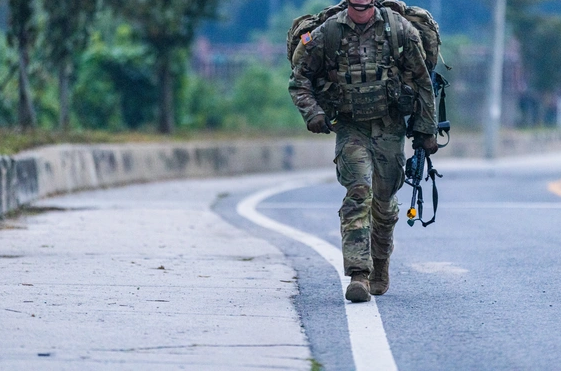
Rucking Weight: How Much to Carry by Level | Combat Fitness
Rucking Weight: How Much Should You Carry? A Standards-Based Guide
The right rucking weight for most people is 20 to 30 pounds to start, roughly 10 to 15 percent of bodyweight, built up gradually and capped near one third of bodyweight for everyday training. If you would rather have that progression written for you, our tactical fitness programs build it into a structured plan.
Military standards sit higher: 35 pounds dry for the Army’s benchmark ruck march, and combat loads planned at 30 to 45 percent of bodyweight. Below: where to start, the bodyweight-percentage rule, the standards, how to progress without wrecking your feet and knees, and how to load the ruck. This guide is about load weight, the pounds in the pack, not rucking for weight loss.
How Much Rucking Weight Should a Beginner Start With?
A beginner should start rucking with 20 to 30 pounds, or about 10 to 15 percent of bodyweight, whichever number is lower. A 180-pound athlete starts near 20 to 25 pounds, a 140-pound athlete closer to 15 to 20. It should feel almost too easy.
Light first is about tissue, not confidence. Your heart and lungs adapt in weeks; bone, tendon, and foot skin adapt far more slowly. Load-carriage research lists blisters, stress fractures, knee pain, back strain, and rucksack palsy as the common injuries, and most trace back to too much load too soon (Knapik et al., 2004; Orr et al., 2014). A starting weight you can carry with clean posture for 45 to 60 minutes builds the tissue tolerance every heavier ruck depends on. Start with two sessions per week of 2 to 4 miles on flat ground, and hold that load for two to three weeks.
What Percentage of Bodyweight Should You Ruck With?
Scale rucking weight to bodyweight, not to someone else’s number. The practical range for training is 10 to 33 percent of bodyweight: 10 to 15 percent to start, 20 to 25 percent for most steady training, and about one third as the ceiling for routine sessions. A 35-pound ruck is 25 percent of a 140-pound athlete’s bodyweight but under 18 percent of a 200-pound athlete’s.
The percentage model comes straight from military research. Army doctrine has long set the fighting load at about 30 percent of bodyweight and the approach march load at about 45 percent. FM 21-18 translated those to 48 and 72 pounds for a 160-pound soldier, and the current ATP 3-21.18 keeps the same framework. S.L.A. Marshall put the optimal load for a conditioned soldier near one third of bodyweight (Knapik et al., 2004).
That gives a clean recommended rucking weight band:
Beginner: 10 to 15 percent of bodyweight
Intermediate: 15 to 25 percent of bodyweight
Advanced and selection prep: 25 to 33 percent, with occasional heavier sessions
Specific preparation only: above 33 percent, for athletes facing a known heavy standard
What Is the Standard Military Rucking Weight?
The standard military rucking weight for graded Army events is 35 pounds dry, carried 12 miles in three hours or less. That is the Expert Infantryman Badge standard in USAIS Pamphlet 350-6, and the same 35-pound load appears across Army schools. Dry weight excludes water, so the total runs higher.
Common Army and selection ruck standards (verified November 2026):
Expert Infantryman Badge: 12 miles, 35 lb dry plus water and equipment, 3 hours or less. A light ruck at the finish fails the event (USAIS Pam 350-6).
Ranger School: 12 miles, 35 lb dry, under 3 hours. Water adds roughly another 10 to 12 pounds.
RASP (75th Ranger Regiment): a 12-mile march with a 35 lb ruck in Phase 1.
SFAS: distances, loads, and cutoffs are deliberately undisclosed and run heavier.
Operational doctrine: approach march loads planned at 80 to 100 pounds, about 45 percent of bodyweight, per ATP 3-21.18 (July 2025).
Marine Corps hikes follow the same logic, with loads that build across training rather than one published individual standard. Dry vs wet matters: if your event is 35 pounds dry, train with 35 pounds dry plus your water, or you will be short on test day. Standards change, so check the current course documents before you set a target.
How to Progress Your Rucking Weight (and When to Add More)
Progress rucking weight about 5 pounds at a time, only after the current load feels controlled over your full target distance for two straight sessions. Change one variable per week: load, distance, or pace. Adding weight and miles together is the fastest route to shin and foot injuries.
Rucking weight progression guidelines we use with athletes:
Hold your starting load for 2 to 3 weeks before the first increase.
Add 5 lb, or about 2 to 3 percent of bodyweight, per increase.
Hold each new load for 1 to 2 weeks before increasing again.
Build distance at the current load before adding weight.
Keep one heavy ruck every 10 to 14 days. Fill the rest of the week with lighter rucks, strength, and running.
Drop load 10 to 20 percent for a week after any session that leaves joint pain the next day.
That frequency is research-backed. An international review found one dedicated load-carriage session every 10 to 14 days, alongside resistance and aerobic training, works best, and that speed and terrain can raise intensity without adding load (Orr et al., 2021; Orr et al., 2010).
Load, pace, and distance trade against each other. Energy cost rises with the square of speed and climbs sharply as load increases relative to bodyweight, per the Pandolf load-carriage equation (Pandolf et al., 1977). A 45-pound ruck at a 13-minute pace is a different session from 45 pounds at 17 minutes.
What happens when you ruck with too much weight? Your trunk pitches forward, your stride shortens, and more force runs through your knees, hips, and lower back (Knapik et al., 2004). If your form changes, the load is too heavy for that day. The maximum rucking weight for routine training is the load you can carry without that breakdown.
Rucking is also a strength problem. Your trunk, hips, and calves hold posture under load, which is why functional strength for military performance carries over directly to the ruck. A balanced plan also needs a strength workout for athletes built around squats, hinges, carries, and single-leg work. If you are weighing how to fit all of this into one week, our guide to choosing a strength & endurance program walks through the options.
Why Your Aerobic Base Limits How Much Weight You Can Ruck
Your aerobic base sets the ceiling on rucking weight because a heavier ruck raises the energy cost of every step. A weak aerobic engine means early fatigue, and fatigue is when posture falls apart. Research lists aerobic capacity and muscle strength as the two physiological factors that most influence load-carriage performance (Knapik, 1989).
Building an aerobic base means steady, conversational-pace work, mostly unloaded. It lets you carry the same load faster, or a heavier load at the same pace, without extra wear on your joints.
How to Load Your Ruck and What to Use as Weight
Load your ruck with the weight high and tight against your back, between the shoulder blades. Load carried close to the body’s center of mass costs less energy and disturbs your gait less than load that sits low or hangs away from the spine (Knapik et al., 2004).
DIY ruck weight options that work:
Plates wrapped in a towel, flat against the back panel
Sand in double-bagged contractor bags, taped shut
Dumbbells or kettlebells wrapped in foam or clothing
Water jugs, which you can dump partway through
Whatever you use, it must not move. A shifting load forces constant corrections through your trunk and rubs hot spots into your back. Fill the gaps, cinch every strap, and keep the hip belt snug. Dedicated ruck plates and weighted vests make loading more repeatable, and our ruck gear guide covers them, but you do not need them to start.
FAQ: Frequently Asked Questions
How much weight should you ruck with?
Most people should start rucking with 20 to 30 pounds, about 10 to 15 percent of bodyweight. Build gradually toward 20 to 25 percent for steady training and cap routine sessions near one third of bodyweight. If you are preparing for a military event, train up to its dry weight plus water.
What weight should a beginner start rucking with?
A beginner should start rucking with 10 to 15 percent of bodyweight, usually 15 to 25 pounds, and hold that load for two to three weeks. The first month builds tissue tolerance in the feet, shins, and back, which adapt slower than your heart and lungs.
What percentage of bodyweight should you ruck with?
Ruck with 10 to 15 percent of bodyweight as a beginner, 15 to 25 percent as an intermediate, and up to about 33 percent for advanced training. Army doctrine plans fighting loads near 30 percent and approach march loads near 45 percent, but those are operational loads, not weekly targets.
What is the standard military rucking weight?
The standard military rucking weight is 35 pounds dry, carried 12 miles in three hours or less. That is the Expert Infantryman Badge standard, and Ranger School and RASP use the same load. Water pushes the total higher, and special operations selection courses carry heavier, undisclosed loads.
What is the maximum weight you should ruck with?
For routine training, the maximum rucking weight is about one third of bodyweight. Above that, injury risk climbs and gait breaks down. Heavier loads belong in specific preparation for a known standard, only after months of progressive load carriage.
How do you add weight to a ruck without buying plates?
Use wrapped dumbbells, kettlebells, sandbags, or water jugs. Pack the weight high and tight against the back panel, fill the gaps with clothing or foam so nothing shifts, and cinch every strap.
Is rucking weight the same as rucking for weight loss?
No. Rucking weight refers to the load in your pack. Rucking for weight loss is about calories burned, a separate goal with different priorities. A heavier ruck burns more energy per mile, but the load that trains a military standard is not always the one that best serves fat loss.
The right rucking weight starts lighter than you think: 10 to 15 percent of bodyweight, built in 5-pound steps, capped near one third for routine training. The 35-pound military standard is a target you earn, not a starting point. Let posture tell you when the load is too heavy.
Knowing the numbers is easy. Building months of load carriage around strength, running, and recovery without getting hurt is where a plan matters. Start a structured Combat Fitness program and show up to your ruck standard with the weight on your back and your legs still under you.
References:
Headquarters, Department of the Army. ATP 3-21.18, Foot Marches. July 2025 (supersedes April 2022 edition).
Headquarters, Department of the Army. ATP 3-21.18, Foot Marches. April 2022.
Headquarters, Department of the Army. FM 21-18, Foot Marches. June 1990 (superseded).
US Army Infantry School. USAIS Pamphlet 350-6, Expert Infantryman Badge. December 2022.
Knapik JJ, Reynolds KL, Harman E. Soldier load carriage: historical, physiological, biomechanical, and medical aspects. Military Medicine. 2004;169(1):45-56.
Knapik JJ, Reynolds KL. Load Carriage in Military Operations: A Review of Historical, Physiological, Biomechanical, and Medical Aspects. Borden Institute Monograph Series.
Knapik JJ. Loads Carried by Soldiers: Historical, Physiological, Biomechanical and Medical Aspects. USARIEM Technical Report T19-89. June 1989.
Orr R, Pope R, Lopes TJA, Leyk D, Blacker S, Bustillo-Aguirre BS, Knapik JJ. Soldier load carriage, injuries, rehabilitation and physical conditioning: an international approach. International Journal of Environmental Research and Public Health. 2021;18(8):4010.
Orr RM, Pope R, Johnston V, Coyle J. Soldier occupational load carriage: a narrative review of associated injuries. International Journal of Injury Control and Safety Promotion. 2014;21(4):388-396.
Orr RM, Pope R, Johnston V, Coyle J. Load carriage: minimising soldier injuries through physical conditioning, a narrative review. Journal of Military and Veterans’ Health. 2010;18(2).
Pandolf KB, Givoni B, Goldman RF. Predicting energy expenditure with loads while standing or walking very slowly. Journal of Applied Physiology. 1977;43(4):577-581.
US Army. Expert Infantryman Badge training increases Soldiers, unit readiness. Army.mil, November 2017.
Disclaimer: This article is for educational purposes and is not medical advice. Load carriage carries real injury risk. Consult a qualified healthcare provider before starting a new training program, especially with a history of lower-limb, back, or joint injury, and stop any session that produces sharp or worsening pain. Military standards change; confirm current requirements with your unit, school, or recruiter.


