
How Long Should You Be Able to Hold a Plank | Combat Fitness
How Long Should You Be Able to Hold a Plank? (And Why Longer Isn't Better)
A reasonable answer to how long you should be able to hold a plank is about 60 seconds with strict form, and around 2 minutes is strong. Past that point the returns drop off fast. Our tactical fitness programs treat plank time as a floor to clear, not a number to chase.
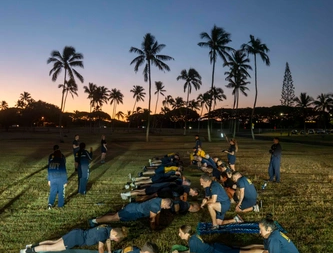
The Army Fitness Test grades the plank and the Marine Corps PFT does too, so the hold matters for anyone in uniform. But a 5-minute plank does not mean a stronger core than a 2-minute one.
Below: honest benchmark ranges, why a longer hold stops paying off, how to progress instead, and a short core routine that beats a marathon hold.
How Long Should You Be Able to Hold a Plank? The Honest Benchmark
A strict forearm plank held for 60 seconds is a solid baseline for a healthy adult, and 2 minutes is strong. Under 30 seconds means your trunk endurance needs work. Every number assumes strict form: the clock stops the moment your hips sag or pike, not when you collapse.
Here is how we read plank hold time by level:
Under 30 seconds: building. Train shorter, cleaner holds and repeat them.
30 to 60 seconds: developing. In our coaching, most untrained adults land here.
About 60 seconds: solid. Your trunk can hold position long enough for most training and daily load.
About 2 minutes: strong. You have cleared the benchmark.
Past 3 minutes: test-specific. Worth training only if a test scores it.
The research lines up with those ranges. In a test-retest study of the prone plank, college-age participants averaged roughly 110 seconds across two sessions. Strand and colleagues built percentile norms for the same test in college students and found abdominal fatigue was the most common reason a hold ended.
Per the current AFT scoring scales (effective June 1, 2025), soldiers aged 17 to 21 need 1:30 for the 60-point minimum and 3:40 for the 100-point maximum. The Marine Corps PFT plank runs from a 1:10 minimum to a 3:45 maximum.
Strict form is the whole point. A 3-minute plank with your lower back sagging trains your spine to hang on its ligaments. A 60-second plank with glutes squeezed, ribs down, and a straight line from head to heel trains the brace you use under a ruck.
Why a Longer Plank Isn't a Stronger Core
A longer plank stops building a stronger core because the stimulus stays the same while only the duration grows. Once you can hold bodyweight for 2 minutes, minute three adds static endurance and pain tolerance. It does not add the force your trunk can resist, which is what protects your spine under load.
Spine researcher Stuart McGill has argued that long plank holds have little value beyond setting a record. His recommendation for most people is repeated 10-second holds, which build residual stiffness without the form decay that sets in during long sets. A Harvard Health review of planking reached a similar point: 10 to 30 seconds per set is plenty for most people, done for multiple sets.
The longest plank myth comes from records: the Guinness record runs past nine hours. Your trunk's job in the field is to stay stiff while your hips and shoulders produce force, and that capacity grows when the load goes up, not when the clock runs longer. That is why we frame core work as part of functional strength for military performance, not as a timed event.
Endurance holds still have a place. McGill's own research established normal endurance times for the trunk flexors, extensors, and lateral stabilizers, and low trunk endurance is a real weak point. If your unit tests the plank for time, train holds near your test target in the weeks before. Treat that as test prep, not core development.
Progress Harder, Not Longer
Once you can hold 60 to 120 seconds with good form, make the plank harder instead of adding minutes. Raise the feet, add load, lengthen the lever, or move to anti-rotation work. Each raises the demand per second.
Use these progressions in order:
Raise your feet. Putting your feet on a box shifts more bodyweight onto your forearms and raises the anti-extension demand. The elevated plank covers box heights and form cues.
Add load. A plate on your upper back (with a partner placing it) adds force without changing the position.
Lengthen the lever. Walk your elbows forward a few inches and tilt your pelvis back. Schoenfeld and colleagues found this long-lever, posterior-tilt plank produced significantly more abdominal activation than a standard plank.
Remove a point of contact. Lifting one arm or leg forces your trunk to resist rotation.
Go to anti-rotation work. Pallof presses and suitcase carries train the trunk against twisting loads.
The best plank alternatives work the same way: they train the trunk to resist movement under load instead of rewarding time on the floor.
A Better Core Routine Than a Marathon Hold
This free core routine replaces a single long plank and takes about 12 minutes. Run it 2 to 3 times a week after your main lift. Rest 30 to 45 seconds between sets.
Feet-elevated plank: 3 sets of 20 to 30 seconds.
Side plank: 3 sets of 20 seconds per side.
Pallof press: 3 sets of 10 per side.
Dead bug: 3 sets of 8 per side, slow.
Suitcase carry: 3 trips of 40 meters per side.
The routine covers anti-extension, anti-lateral flexion, and anti-rotation, the three jobs your trunk does under a ruck or plate carrier. It fits inside the best core exercises for athletes, and it scales: when 30 seconds on the feet-elevated plank feels easy, add a plate.
Core work only pays off when it sits inside a full plan. If you are still deciding how to fit it around running and lifting, our guide to choosing a strength & endurance program walks through it.
FAQ: Frequently Asked Questions
How long should I be able to hold a plank?
You should be able to hold a strict forearm plank for about 60 seconds, and 2 minutes is strong. Under 30 seconds means your trunk endurance needs work. Past 2 minutes, make the plank harder rather than longer unless a fitness test scores your time.
Is a 2-minute plank good?
Yes. A 2-minute strict plank is a strong result and clears the benchmark for most athletes. It sits at or above the college-age average in published plank testing and above the Army's 1:30 minimum for younger soldiers. Once you can hold it, stop adding time and progress the difficulty with raised feet, added load, or a longer lever.
Is holding a plank for 5 minutes impressive?
A 5-minute plank shows impressive static endurance and pain tolerance, but it is not evidence of a stronger core. The added minutes train the same low-level effort. Unless you are chasing a test maximum, spend that time on harder variations.
Does holding a plank longer make your core stronger?
Holding a plank longer builds endurance up to a point, then stops building strength. Strength comes from higher demand per second: more load, a longer lever, or less contact with the ground. Repeated short holds and harder variations give you more return for the time.
How long can the average person hold a plank?
In our coaching, the average untrained adult holds a strict plank somewhere between 30 and 60 seconds. College-age participants in published testing averaged close to 2 minutes. A strictly judged hold always reads shorter than a loose one, so compare your time against the same form standard each test.
How often should you train planks?
Train planks and other trunk work 2 to 4 times a week. Trunk muscles recover quickly from bodyweight holds, so short sets after your main session work well. If you test the plank for time, add one timed practice set a week in the month before.
How long you should be able to hold a plank has a short answer: about 60 seconds strict, with 2 minutes as strong. Clear that floor, then spend your effort on harder variations and anti-rotation work. Grab the free core routine above, run it for six weeks, and test your strict hold again. If you want core work built into a full plan around your test date, CF ONE programs it for you.
References:
Strand SL, Hjelm J, Shoepe TC, Fajardo MA. Norms for an isometric muscle endurance test. Journal of Human Kinetics. 2014;40:93-102. doi:10.2478/hukin-2014-0011.
Test-retest reliability and validity of the plank exercise (abstract). Loyola Marymount University.
McGill SM, Childs A, Liebenson C. Endurance times for low back stabilization exercises: clinical targets for testing and training from a normal database. Archives of Physical Medicine and Rehabilitation. 1999;80(8):941-944.
Schoenfeld BJ, Contreras B, Tiryaki-Sonmez G, Willardson JM, Fontana F. An electromyographic comparison of a modified version of the plank with a long lever and posterior tilt versus the traditional plank exercise. Sports Biomechanics. 2014;13(3):296-306. doi:10.1080/14763141.2014.942355
Ebben WP, Wurm B, VanderZanden TL, et al. Kinetic analysis of several variations of push-ups. Journal of Strength and Conditioning Research. 2011;25(10):2891-2894.
Harvard Health Publishing. Straight talk on planking. Harvard Medical School, 2019.
Key to perfect plank in gym? Keep it under 10 seconds (Stuart McGill interview). The Sunday Telegraph, March 25, 2018.
Global News. How long should you hold a plank? (McGill on repeated 10-second holds and the Big 3). 2018.
U.S. Army. AFT Scoring Scales, approved May 1, 2025, effective June 1, 2025.
GoArmy. Plank (PLK): Army Fitness Test event standards.
U.S. Army Public Affairs. Army establishes new fitness test of record to strengthen readiness and lethality. April 21, 2025.
U.S. Marine Corps. MCO 6100.13A, Marine Corps Physical Fitness and Combat Fitness Tests (with changes), PFT plank standards.
Guinness World Records. Longest time in an abdominal plank position.
Disclaimer: This article is for general education and does not replace advice from a physician, physical therapist, or other qualified professional. If you have back pain, a current injury, or a medical condition, get cleared before starting a new core program. Stop any exercise that causes sharp pain, numbness, or tingling.


