
Elevated Plank: Feet-Up vs. Hands-Up Guide | Combat Fitness
The Elevated Plank: Feet-Up to Progress, Hands-Up to Regress
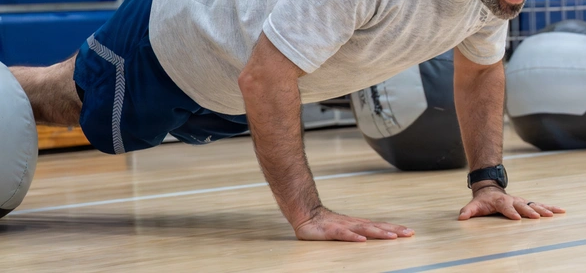
An elevated plank is a plank with either your feet or your hands raised off the floor. Feet up makes it harder. Hands up makes it easier. That one change turns a single exercise into a core builder for every level, which is why our tactical fitness programs use it as a dial rather than a fixed drill.
The plank is graded on the Army Fitness Test and the Marine Corps PFT, and the bracing it trains protects your spine under a ruck, a plate carrier, or a casualty drag.
Below: feet versus hands, muscles worked, form faults, the side and reverse variations, and programming.
Feet-Elevated vs. Hands-Elevated Plank: Which Is Harder?
A feet-elevated plank is harder than a floor plank, and a hands-elevated plank is easier. Raising your feet shifts more bodyweight onto your hands or forearms and raises the anti-extension demand on your abs. Raising your hands moves you toward upright, so gravity has less to work with.
A high plank is the top of a push-up, and Ebben and colleagues measured the load your hands carry there. The floor position loaded the hands with about 64% of body mass. Feet on a 12-inch box raised that to 70%, and a 24-inch box to 74%. Hands on a 12-inch box dropped it to 55%, and a 24-inch box to 41%.
So box height is your intensity control:
Feet on a 12-inch box: the first step past the floor plank.
Feet on a bench or 24-inch box: for athletes who own a long floor hold.
Hands or forearms on a bench: the regression for new athletes or anyone returning from back or shoulder pain.
Hands on a high box or rack bar: the easiest version, for learning the position.
Elevated planks all train the same brace. Only the dose changes.
What Muscles Does the Elevated Plank Work?
The elevated plank works the rectus abdominis, the deep core (transverse abdominis and internal obliques), the external obliques, and the serratus anterior and front shoulders that hold your upper body off the ground. Your glutes and quads work too, because a locked hip and knee keep your body in one straight line.
The core's job here is anti-extension: stopping your lower back from sagging. It does the same job when a heavy ruck pulls your torso back or you brace to lift a patient. McGill frames this stiffness as the core's main performance role, moving force between hips and shoulders without the spine buckling.
Raising your feet loads both ends harder: your abs fight a steeper pull toward extension, and your shoulders carry more weight. Schoenfeld and colleagues found that small changes to plank geometry, such as a longer lever, raised rectus abdominis and oblique activity well above a standard plank.
How to Do an Elevated Plank (Setup and Form Faults)
Set up the elevated plank the same way every time, so only the height changes.
Place your feet (or hands) on a stable box or bench. Check that it cannot slide.
Set your elbows directly under your shoulders for a forearm plank, or your hands under your shoulders for a high plank.
Press the floor away so your shoulder blades spread slightly. That is your serratus switching on.
Squeeze your glutes hard and lock your knees.
Brace your midsection as if you are about to take a punch, and pull your ribs down toward your hips.
Keep your neck neutral, eyes on the floor just ahead of your hands.
Breathe in short, controlled breaths behind the brace and hold the line.
Common Faults and Fixes
Sagging hips: your lower back is extending, the exact motion the plank should stop. Squeeze your glutes, pull your ribs down, and lower the box if it keeps happening.
Piked hips: high hips shorten the lever and unload your abs. Drop them until shoulders, hips, and heels form one line.
Held breath: it drives up blood pressure and caps the hold. Breathe behind the brace without letting your belly go soft.
Craned neck: looking forward kinks the cervical spine. Keep your eyes on the floor.
Sunken shoulders: your serratus quit. Push the floor away again.
Elevated Plank Variations: Side and Reverse
The front plank resists extension, the side plank resists bending sideways, and the reverse plank trains the back of the body.
Elevated Side Plank
An elevated side plank puts your feet on a bench or box with your bottom forearm on the floor. It targets the obliques, quadratus lumborum, and glute medius, which keep your pelvis level under a one-sided load like a jerry can. Ekstrom and colleagues found the side bridge drove some of the highest glute medius and external oblique activity of the exercises they tested. To regress, put your forearm on the bench instead.
Elevated Reverse Plank
An elevated reverse plank is a face-up plank with your heels on a bench and your hands or forearms on the floor. It works the glutes, hamstrings, spinal erectors, and rear shoulders. Calatayud and colleagues found supine plank variations produced strong lumbar erector activity, a direct counterweight to the front-side work. Drive your heels down and keep your hips level.
Elevated Plank Hold
An elevated plank hold is the timed version of any of these. Build time at a height you hold cleanly before raising the box.
How to Program the Elevated Plank
Program the elevated plank as a dial: feet up when the floor plank is easy, hands up when it breaks down.
Quality time under tension beats chasing a longer hold with bad form. A 45-second plank with 20 seconds of sagging hips trains your back to extend under fatigue, the opposite of what you want under a ruck. McGill recommends shorter holds over several sets, and Lee and McGill found six weeks of isometric core work raised torso stiffness more than a dynamic program.
A simple progression:
Build a clean 60-second floor forearm plank.
Move to feet on a 12-inch box: 3 to 4 sets of 20 to 40 seconds, 60 seconds rest.
When every set is clean at 40 seconds, raise to a bench or 24-inch box and drop back to 20 seconds.
Add one elevated side plank and one reverse plank set per side each session.
Two or three sessions a week is enough, after your main lifts. This work supports heavy training rather than replacing it, the case we make for functional strength for military performance. To slot it into a full week, use our template for a strength workout for athletes.
For test prep, know the standard. Per the current Army Fitness Test scoring tables, soldiers ages 17 to 21 need a 1:30 plank for the 60-point minimum and 3:40 for 100 points. The Marine Corps PFT runs from 1:10 to 3:45, and the Navy PRT tests a forearm plank too. Training a harder version makes the floor plank on test day feel lighter.
Core work pays off inside a plan that also builds strength, running, and rucking. Our guide to choosing a strength & endurance program lays out what a properly built hybrid plan includes.
Frequently Asked Questions
What is an elevated plank?
An elevated plank is a plank with your feet or hands raised on a box, step, or bench. Raising your feet makes it harder by shifting bodyweight forward and raising the anti-extension demand on your core. Raising your hands makes it easier, a regression for beginners or athletes returning from injury.
Is a feet-elevated plank harder than a regular plank?
Yes. A feet-elevated plank is harder because more bodyweight shifts onto your hands or forearms and your abs work harder to stop your back from sagging. Push-up force data shows a 24-inch box raises the load on the hands from about 64% to 74% of body mass.
What muscles does the elevated plank work?
The elevated plank works the rectus abdominis, transverse abdominis, and obliques, plus the serratus anterior and front shoulders. Your glutes and quads lock your hips and knees. The side version shifts focus to the obliques and glute medius; the reverse version trains the glutes, hamstrings, and spinal erectors.
How long should you hold an elevated plank?
Hold an elevated plank for 20 to 40 seconds per set, for 3 to 4 sets, and stop the set when your hips sag or pike. Short, clean holds build more usable strength than one long, broken hold.
Is a hands-elevated plank easier?
Yes. A hands-elevated plank is easier because your body sits closer to upright. Push-up force data shows hands on a 24-inch box carry about 41% of body mass versus 64% on the floor. Use it to learn the brace before moving to the floor.
How do you progress from a floor plank to an elevated plank?
Build a clean 60-second floor plank first. Then put your feet on a 12-inch box for 3 to 4 sets of 20 to 40 seconds. When every set is clean at 40 seconds, move to a bench or 24-inch box and restart at 20 seconds.
The elevated plank makes one core exercise fit every athlete. Raise your feet to progress, raise your hands to regress, and own every second of the hold. Then put it in a plan. Grab the free core circuit, and let a structured program handle the progression.
References:
Ebben WP, Wurm B, VanderZanden TL, et al. Kinetic analysis of several variations of push-ups. Journal of Strength and Conditioning Research. 2011;25(10):2891-2894.
Wurm B, VanderZanden T, Spadavecchia M, Durocher J, Bickham C, Petushek E, Ebben W. Kinetic analysis of several variations of push-ups. ISBS Conference Proceedings Archive.
Schoenfeld BJ, Contreras B, Tiryaki-Sonmez G, Willardson JM, Fontana F. An electromyographic comparison of a modified version of the plank with a long lever and posterior tilt versus the traditional plank exercise. Sports Biomechanics. 2014;13(3):296-306.
Calatayud J, Casaña J, Martín F, et al. Progression of core stability exercises based on the extent of muscle activity. American Journal of Physical Medicine and Rehabilitation. 2017;96(10):694-699.
Calatayud J, Casaña J, Martín F, et al. Trunk muscle activity during different variations of the supine plank exercise. Musculoskeletal Science and Practice. 2017;28:54-58.
Ekstrom RA, Donatelli RA, Carp KC. Electromyographic analysis of core trunk, hip, and thigh muscles during 9 rehabilitation exercises. Journal of Orthopaedic and Sports Physical Therapy. 2007;37(12):754-762.
Escamilla RF, Lewis C, Bell D, et al. Core muscle activation during Swiss ball and traditional abdominal exercises. Journal of Orthopaedic and Sports Physical Therapy. 2010;40(5):265-276.
McGill S. Core training: evidence translating to better performance and injury prevention. Strength and Conditioning Journal. 2010;32(3):33-46.
Lee BC, McGill SM. Effect of long-term isometric training on core/torso stiffness. Journal of Strength and Conditioning Research. 2015;29(6):1515-1526.
McGill SM, Childs A, Liebenson C. Endurance times for low back stabilization exercises: clinical targets for testing and training from a normal database. Archives of Physical Medicine and Rehabilitation. 1999;80(8):941-944.
Headquarters, Department of the Army. Army Fitness Test Scoring Scales (approved 1 May 2025, effective 1 June 2025).
U.S. Army. Plank (PLK). GoArmy.
U.S. Marine Corps Human Performance Branch. Plank change to PFT.
U.S. Marine Corps. MARADMIN: Forthcoming changes to the Physical Fitness Test.
Military OneSource. Navy Physical Readiness Test.
Headquarters, Department of the Army. FM 7-22, Holistic Health and Fitness. Washington, DC; 2020.
Disclaimer: This article is for educational purposes only and is not medical advice. Use a stable box or bench, stop if you feel pain in your back, shoulders, or neck, and consult a qualified healthcare provider before starting a new training program, especially if you have an injury or medical condition.


