
Military Workout Plan: Free 12-Week Program | Combat Fitness
The Military Workout Plan: 12 Weeks, Five Capacities, No Equipment Required
A military workout plan is built around one thing: repeating hard physical work under load and fatigue, day after day, without breaking down. That is a different problem from getting stronger or getting faster, which is why most gym programs fail the people who carry a rifle for a living. Below is the whole plan: the five capacities the job demands, a 12-week program you can start on Monday, one training week written out session by session, and the modifications for age, experience and available equipment. If you would rather have it programmed and progressed for you instead of assembling it yourself, the Combat Fitness program is built that way. Start with the term itself, because two different searches land on this page.
Key Takeaways:
A military exercise is a war game. A military workout is physical training. This page is about the second one.
Military fitness is a capacity problem, not an exercise problem. Aerobic base, strength, strength-endurance, load carriage and durability are the five things a plan has to build.
The 12-week plan below runs three four-week blocks (Base, Build, Peak) at five to six sessions per week, and it needs a barbell or a loaded pack, not a gym membership.
Load carriage is the capacity most people skip, and it is the one that separates passing a PT test from doing the job.
A 30-day challenge cannot build an aerobic base. It can build a habit, which is a different and smaller thing.
What Is a Military Workout? (And Why the Term Means Two Different Things)
A military workout is structured physical training built around the demands of the job: carrying loads, covering ground on foot, and repeating hard work while tired. A military exercise, in ordinary English, is a war game, a multi-unit training operation with tanks and timelines. Same adjective, unrelated activities. If you came here looking for joint drills in the Pacific, this is not that page.
The training version has a specific shape. It is high-frequency, five or six days a week rather than three. It is equipment-light, because the gym on a forward operating base is a pull-up bar and a pile of sandbags. And it is capacity-first, which means the goal is to raise the ceiling on how much total work you can absorb, not to maximize any single number. That priority is written into doctrine: the Army's Holistic Health and Fitness system (FM 7-22) frames physical readiness as a sustained capability rather than a test score, and what PT actually means in the military walks through how that plays out day to day.
Frequency is the part most people misread. Five or six sessions a week sounds like a lot until you look at the intensity distribution: most of those sessions are easy by design, and the two or three hard ones are what the easy ones exist to protect. The services train often because availability is the standard, not because every session is meant to hurt.
It is worth naming what a military workout is not. It is not a bootcamp-style punishment circuit. Volume for its own sake produces injuries, not adaptation, and the musculoskeletal injury rate in military recruit populations is already high enough without adding smoke sessions to it. It is also not bodybuilding with camo on. Hypertrophy work has a place in the plan, but a physique built for the mirror is dead weight on a 12-mile ruck.
The Five Capacities a Military Workout Plan Has to Build
Every page ranking for this query answers it with a list of exercises. That is the wrong unit of analysis. A military workout plan is a set of capacities you are building, and the exercises are only the tools you pick to build them. For a sense of how the named programs in this space carve the same problem up, how the big military training programs compare puts their structures side by side.
Aerobic base. This is the foundation, and it is built almost entirely at conversational intensity. Endurance research consistently finds that trained athletes accumulate roughly 80 percent of their sessions at low intensity, and the physiological reason is that stroke volume, plasma volume and capillary density respond to duration rather than suffering. Training implication: two to three of your weekly cardio sessions should feel easy enough to hold a conversation, and if all of them feel hard, you are not building a base, you are wearing one down.
Strength. Maximal strength is what makes every submaximal task cheaper. Lifting a casualty, clearing an obstacle, or handling a 60-pound load all draw on a percentage of your absolute strength, so raising the absolute number lowers the relative cost of the job. Training implication: two heavy compound sessions per week, in the three-to-six rep range, and treat them as non-negotiable. Strength work for military and law enforcement covers how to keep those sessions from eating your running.
Strength-endurance. This is the ability to keep producing force after the first two minutes, and it is what most military fitness tests actually measure. Push-ups to failure, the sprint-drag-carry, a stretcher move: none of them are limited by your one-rep max. Training implication: one dedicated work-capacity session per week, hard but capped in duration, and no more, because this is the quality that is easiest to overdose on.
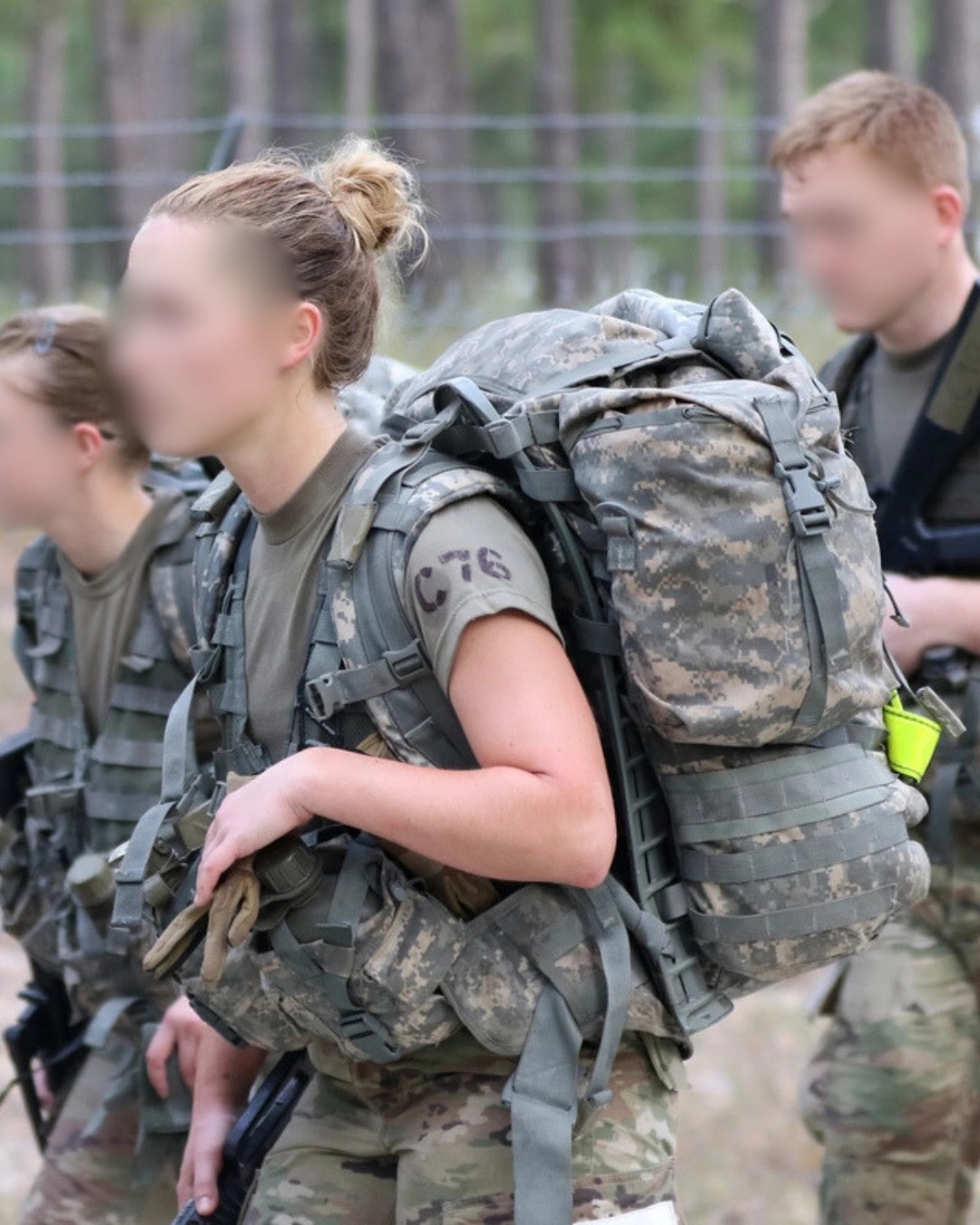
Load carriage. Walking under load is its own trainable capacity with its own adaptations. Reviews of soldier load carriage have documented for decades that the stresses are structural, affecting gait, posture and the lower back, and they do not transfer cleanly from running fitness. You get better at rucking by rucking. Training implication: one weighted march per week, every week, progressing distance and load on separate weeks. Loaded carries and rucking has the full progression.
Durability. The last capacity is the one that decides whether the other four ever get expressed. Musculoskeletal injuries are the largest single driver of lost duty days across the force, and most of them are overuse rather than trauma. Training implication: single-leg work, hip and posterior-chain volume, and a planned deload every fourth week. Deloads are not a reward. They are part of the dose.
The 12-Week Military Workout Plan
Here is the program. It runs three four-week blocks, five to six sessions per week, and it assumes access to a barbell or a set of dumbbells plus a pack you can load. Every block has one job, and the blocks are sequenced because the later work does not hold without the earlier work underneath it.
Figure 1.1 - A twelve-week tactical training block across three phases, showing strength, easy and hard aerobic work, load carriage, work capacity and the progression rule for each. One ruck per week sits at the published ceiling of four foot marches per month. The week 12 taper is the best-supported element: a systematic review of 14 studies and 174 endurance athletes found volume cuts of 41 to 60 percent produced the largest performance effect while cuts outside that band produced nothing, and maintaining intensity was significant where reducing it was not. The review adds one variable the rule omits - maintaining session frequency also mattered, so cut the length of sessions rather than the number. Note that the deload rule and the progression rule conflict in weeks 4, 8 and 12, and the pack weight jumps between blocks have no stated progression. Sources: PLOS One 2023 tapering meta-analysis, Bosquet et al. 2007, Defense Centers for Public Health.
Base, weeks 1 to 4
You are buying aerobic volume and movement quality. Nothing is fast. The two strength days are full-body, the two runs are conversational, and the ruck starts light enough that you finish wanting more. Most people fail this block by making it interesting.
Build, weeks 5 to 8
Intensity enters. One true interval session per week, strength moves to heavier sets of five, and the ruck starts alternating: one week you add distance, the next week you hold the distance and cut the pace. Changing both at once is how you find out which one broke you, after it has already broken you.
Peak, weeks 9 to 12
Volume comes down and specificity goes up. If you have a test date, the two hard aerobic sessions are run at your goal pace and the event rehearsal mirrors the actual test order. If you do not have a test date, keep the Build block running and cycle back to Base every third month instead.
How you know it is working.
Three markers, checked at the end of each block. Your easy run pace at the same heart rate should drift faster. Your working sets at the same RPE should hold more weight. And your ruck should finish at the same pace with less residue the next morning. If none of the three has moved in four weeks, the problem is almost always recovery, not programming.
When you miss a week.
Repeat the last completed week rather than jumping ahead. Missing one week costs you nothing. Trying to make it up costs you the block.
A word on the choice between running this yourself and buying something: both are defensible. A tactical program comparison lays out what the paid options give you that a written page cannot, which is mostly progression decisions made for you when you are too tired to make them well.
What One Training Week Looks Like
Below is week 6, taken from the middle of the Build block, written out session by session. Loads are given as a percentage of your one-rep max or as RPE, which is a 1 to 10 scale of how hard the set felt.
Figure 1.2 - A sample week from the build block, showing session, work, prescribed intensity and coaching notes for each day. The structural decision is correct: strength on Monday and Thursday, hard aerobic and work capacity on Tuesday and Wednesday, keeping lifting and hard endurance on separate days, concurrent training reliably costs explosive strength at a standardized mean difference of −0.28, and separation removes most of it. But Monday through Thursday is four consecutive days at RPE 7 or 8, and swapping Wednesday's circuit with Saturday's ruck breaks the block without changing a single session. The ruck at 15:00 per mile matches the published 12-mile standard pace, and 40 lb is 22 percent of bodyweight for a 180 lb athlete. Sources: Schumann et al. 2022, 2025 inter-set rest meta-analysis, Defense Centers for Public Health, Army foot march standard.
Three rules govern the week. First, the easy days stay easy, because the interval session and the ruck are only productive if you arrive at them fresh. Second, if you miss a day, you skip it rather than stacking it onto the next one. A compressed week is how a plan becomes an injury. Third, the ruck is the anchor of the week. If something has to give for a duty day or a field problem, cut the work-capacity session first and the easy run second. The ruck and the two strength days are the last things to go, because they build the capacities that take the longest to come back.
Military Calisthenics and At-Home Workouts With No Equipment
You can run this plan at home with no equipment by substituting on two axes: load and leverage. Where the plan calls for a barbell, use a loaded pack for squats, split squats, good mornings and carries, and progress by adding water bottles or books. Where the pack runs out of weight, change the leverage instead: feet-elevated push-ups, deficit push-ups, slow eccentrics at a three-second lowering count, and one-and-a-half rep variations all raise the difficulty without adding a pound.
Pulling is the honest gap. A doorway bar solves it. Without one, use towel rows under a sturdy table and accept that you are maintaining, not building, until you get a bar.
The rest is easier than people expect. Research comparing push-up training to bench press training at matched effort has found comparable strength and size outcomes in untrained lifters, so the bodyweight version of the plan is not a consolation prize. Stairwells cover intervals, and a loaded pack covers rucking. A dedicated military calisthenics workout plan, built entirely around bodyweight progressions and no-equipment substitutions, is worth its own guide, and we are building one.
The 30-Day Military Workout Challenge, and Why Most of Them Fail
A 30-day military workout challenge cannot build an aerobic base, and that is the honest verdict. The adaptations that make someone durable under load are slow. Plasma volume and stroke volume move within a few weeks, but capillary density and mitochondrial content take months, and bone and tendon remodel on a timeline measured in quarters, not days. Thirty days of push-ups does not touch any of that.
What a challenge is good at is starting the clock. If you have not trained in a year, a 28-day or 30-day block gives you a finish line close enough to be believable, and it builds the daily habit that the real plan requires. That is a legitimate use. The failure mode is treating the challenge as the training rather than the on-ramp, then repeating it every month and wondering why nothing changes at month six.
If you want one anyway, run it as Week 1 of the Base block above and simply keep going on day 31. That converts a motivation device into the first quarter of a plan.
Free Military Workout PDFs and Printables: What to Look For
Most free military workout plans are workout lists with a cover page. Three questions separate the ones worth printing from the ones worth closing.
First, does it progress? If week 6 looks the same as week 1, it is not a plan. A real program tells you what changes each week and by how much.
Second, does it include easy aerobic volume and load carriage, or only circuits? Circuit-only programs are cheap to write and they train one capacity out of five. If there is no weighted march anywhere in the document, it was not written for people who carry things.
Third, does it tell you what to do when it goes wrong? Missed weeks, failed sessions and travel are the normal case, not the exception, and a plan without a rule for them will not survive contact with a duty schedule.
That last point is where most of the free material in this space falls down. Military-style workout programs and what they leave out goes through the best-known free libraries and shows exactly which capacities each one drops. A printable version of the 12-week plan above, formatted as a PDF you can log on, is on our build list.
Adjusting the Plan: Over 40, Over 50, Beginners and Women
The plan does not change shape with age or experience. The dose does. Here is one concrete modification for each case, applied to the 12-week program above.
Military workouts for men over 40
Convert one of the two hard aerobic sessions to a low-impact modality: bike intervals, a rower, or an incline treadmill walk. Keep the strength work heavy and cut a set from each exercise instead. Impact volume is what accumulates, not intensity.
Military workouts for men over 50
Cap the ruck at 30 to 35 pounds and split it into two shorter marches instead of one long one. Add a second full rest day by dropping the work-capacity session in weeks 4, 8 and 12. Training over 40 and over 50 covers the recovery side in detail.
Military workout plan for beginners
Run the Base block twice before touching Build. Start the ruck at 20 to 25 pounds and 2 miles. Beginners fail this plan by starting at Build, not by lacking capability.
Military workout plan for women
Same plan, same sessions. Scale the ruck load to roughly 25 to 30 percent of bodyweight rather than a fixed number, because absolute load is what drives the structural stress, and add one extra single-leg session per week during Base.
Branch-Specific Work: Army, Navy, Air Force and Marines
The five capacities do not change by branch. The test at the end of them does, and that changes your Peak block only.
Army
The Army's test of record is now the Army Fitness Test, which replaced the ACFT in June 2025 and dropped the standing power throw, leaving five events including the deadlift, sprint-drag-carry, plank and two-mile run. An army workout plan built on this program needs its Peak block pointed at the sprint-drag-carry, which is the event most people underestimate.
Navy
The Navy Physical Readiness Test uses a forearm plank, push-ups and a cardio event, with rowing and swimming available as alternatives. A navy workout plan can substitute the row for a run in the easy aerobic slot without losing anything.
Marine Corps
Marines run two tests, the PFT and the CFT, and the CFT is the one that resembles the job: a movement-to-contact, ammunition lifts, and a maneuver-under-fire course. Peak toward the CFT and the PFT takes care of itself.
Air Force
The Air Force fitness assessment offers alternate components including a shuttle run and a strength option, so confirm which components your unit is running before you build a Peak block around the wrong one.
Five Mistakes That Stall Military Fitness Progress
None of the pages competing for this query treat failure as a subject. It is the most useful part of the topic, because these five account for most of the plateaus we see. Why most online military fitness programs fail makes the broader case; this is the short version.
Training to a test instead of to a capacity. Peaking for a PT test twice a year produces a sawtooth: fit in March, unfit in July. Build the capacity year-round and let the test be a checkpoint. The fix is a Peak block four weeks long and a Base block that runs the rest of the year.
Running as the only conditioning. Running is one capacity out of five, and running volume is also the largest single contributor to lower-extremity overuse injury in military populations. Cadet cohort research has linked running exposure directly to injury incidence. Cap the impact and buy the aerobic volume elsewhere.
No load carriage until the ruck march. People train for months and then put a pack on two weeks out. Load carriage adaptations are structural and they take time. One ruck a week, every week, is the whole fix. Start at 25 pounds and 2 miles if that is where you are. Consistency beats load here by a wide margin.
Motivation as the system. Motivation is a weather report. A plan that only works on the days you feel strong is not a plan, and why the system matters more than the motivation is the argument for building the schedule first and letting the feeling catch up.
Ignoring durability until something tears. Single-leg strength, hip work and planned deloads are boring and they are the reason the other four capacities ever get expressed. Musculoskeletal injury remains the leading cause of lost duty time across the services. Nothing in this plan matters if you are on profile. Budget the boring work in, or the injury will budget it for you.
FAQ: Frequently Asked Questions
What is the difference between a military exercise and a military workout?
A military exercise is a training operation: a war game involving units, equipment and often multiple nations. A military workout is physical training done by an individual or a small group. The words share an adjective and nothing else. If you are searching for fitness programming, "military workout" is the term you want.
What is a military workout?
A military workout is physical training built around occupational demands rather than appearance: carrying loads, covering ground on foot, and repeating hard work under fatigue. It is typically high-frequency, equipment-light, and organized around building total work capacity rather than maximizing any single lift or time.
What kind of exercise is done in the military?
Five categories, in roughly this order of importance: easy aerobic running or rucking, heavy compound strength work, strength-endurance circuits, weighted marches, and single-leg and core work for durability. Actual sessions mix calisthenics, barbell lifts, running and load carriage, because the job draws on all five.
Why do you exercise every day in the military?
Because readiness is an occupational requirement, not a fitness goal. The job can demand physical output on any day without warning, so training frequency is set by the standard of being ready rather than by what is optimal for any single adaptation. Frequency beats intensity when the goal is availability.
Is a military workout plan good for building muscle?
Partly. Two heavy strength days per week will add muscle for most people, especially beginners. But the aerobic and rucking volume competes for recovery, and concurrent training research shows that high endurance volume blunts strength and hypertrophy gains. If size is your only goal, this is not the most efficient plan.
How long should a military workout be?
Forty-five to sixty minutes for most sessions, plus longer easy aerobic and ruck sessions. Past about an hour of hard work, quality falls and injury risk climbs without adding adaptation. A two-hour session usually signals a programming failure: too many goals crammed into one day.
Can you do military workouts at home with no equipment?
Yes. Two substitutions cover most of it: a loaded backpack replaces the barbell for squats, carries and marches, and leverage changes (feet-elevated push-ups, slow eccentrics) replace added weight for pressing. Pulling is the real gap, so a doorway pull-up bar is the one purchase worth making.
What shoes do the military exercise in?
Running shoes for PT and running, boots for rucking and field work. The services issue or authorize athletic footwear for physical training and boots for everything else. Train the ruck in the boots you will be tested and employed in, because footwear changes gait under load.
Do 30-day military workout challenges actually work?
Not as training. Thirty days is too short to build aerobic base, capillary density or bone and tendon capacity, which move over months. Challenges do work as an on-ramp: they build the daily habit and give a beginner a believable finish line. Use one to start, then keep going.
Is forced exercise used as punishment in the military?
Corrective physical training exists across the services, and policy limits it: it is meant to correct a specific deficiency and not to punish or exhaust. As training design it is poor, because unplanned volume added on a bad day is exactly the exposure that produces overuse injury. Punishment and programming are different jobs.
A military workout plan works when it builds capacities in the right order and keeps building them after the test is over. Run the Base block honestly, let the ruck accumulate week by week, and stop treating easy days as wasted ones. If you would rather not make the progression calls yourself, our coaching staff has already made them: pick the program that matches your standard and start on Monday.
References:
U.S. Army. "Army Establishes New Fitness Test of Record to Strengthen Readiness and Lethality." army.mil, April 21, 2025.
U.S. Army. Field Manual 7-22, Holistic Health and Fitness. Headquarters, Department of the Army, 2020.
U.S. Navy. Guide-5A: Physical Readiness Test. MyNavy HR, Physical Readiness Program, December 2025.
U.S. Marine Corps. Physical Fitness Test and Combat Fitness Test Standards. Marine Corps Force Fitness Division.
U.S. Air Force. DAFMAN 36-2905, Air Force Physical Fitness Program.
Knapik, J.J., Reynolds, K.L., and Harman, E. "Soldier Load Carriage: Historical, Physiological, Biomechanical, and Medical Aspects." Military Medicine, 169(1), 2004, 45 to 56.
Orr, R.M., et al. "Biomechanics of Military Load Carriage and Resulting Musculoskeletal Injury: A Review." Journal of Orthopedics and Trauma.
Dijksma, I., et al. "Epidemiology of Musculoskeletal Injury in Military Recruits: A Systematic Review and Meta-Analysis." BMC Sports Science, Medicine and Rehabilitation, 2023.
Molloy, J.M., et al. "Musculoskeletal Injuries and United States Army Readiness." Military Medicine, 185, 2020.
Helton, G.L., Cameron, K.L., Goss, D.L., and Florkiewicz, E. "Association Between Running Characteristics and Lower Extremity Musculoskeletal Injuries in United States Military Academy Cadets." Orthopaedic Journal of Sports Medicine, 2025.
Wilson, J.M., et al. "Concurrent Training: A Meta-Analysis Examining Interference of Aerobic and Resistance Exercises." Journal of Strength and Conditioning Research, 26(8), 2012.
Fyfe, J.J., Bishop, D.J., and Stepto, N.K. "Interference Between Concurrent Resistance and Endurance Exercise: Molecular Bases and the Role of Individual Training Variables." Sports Medicine, 44(6), 2014.
Hickson, R.C. "Interference of Strength Development by Simultaneously Training for Strength and Endurance." European Journal of Applied Physiology, 45, 1980.
Seiler, S. "What Is Best Practice for Training Intensity and Duration Distribution in Endurance Athletes?" International Journal of Sports Physiology and Performance, 5(3), 2010.
Systematic review of polarized training intensity distribution, maximal oxygen uptake and work economy in endurance athletes, 2024.
Egan, B., and Zierath, J.R. "Exercise Metabolism and the Molecular Regulation of Skeletal Muscle Adaptation." Cell Metabolism, 17(2), 2013.
Kikuchi, N., and Nakazato, K. "Low-Load Bench Press and Push-Up Induce Similar Muscle Hypertrophy and Strength Gain." Journal of Exercise Science and Fitness, 15(1), 2017.
American College of Sports Medicine. "Progression Models in Resistance Training for Healthy Adults." Medicine and Science in Sports and Exercise, 41(3), 2009.
Knapik, J.J., et al. "Injuries Associated with Strenuous Road Marching." Military Medicine, 157(2), 1992.
Nindl, B.C., et al. "Physiological Employment Standards III: Physiological Challenges in the Workplace Faced by Female Soldiers." European Journal of Applied Physiology, 113(11), 2013.
Disclaimer: This article is general fitness education, not medical advice. Training loads, ruck weights and progression rates in this plan are starting points, not prescriptions, and they assume you are healthy and cleared for physical activity. Consult a physician or your unit medical provider before beginning any new training program, particularly if you have a current injury, a profile, or a history of cardiovascular or musculoskeletal problems. Fitness standards and test formats change; confirm current requirements with your service before training toward them.


