
How Tendons Adapt to Load: Tactical Athlete's Guide
How Tendons Adapt to Load: A Tactical Athlete's Guide to Stronger, More Resilient Connective Tissue
How tendons adapt to load is one of the most under-appreciated questions in tactical fitness, and one of the most common reasons strong athletes get hurt. Tendons adapt to training by becoming stronger, thicker, and more resilient when exposed to consistent, progressive loading, but this process happens much more slowly than muscle adaptation. While muscles often show measurable strength gains within four to six weeks, meaningful tendon adaptation takes months of consistent, well-managed training, and the gap between the two is where most tendinopathy and overuse injuries are born.
In simple terms: tendons get stronger when load is applied gradually and consistently over time, and the rate of that adaptation, not your motivation or work ethic, sets the speed limit for everything from rucking volume to lifting progression to plyometric work.
What Tendons Actually Do, and Why They Matter for Tactical Athletes
Tendons are dense connective tissues, primarily type I collagen fibers arranged in parallel bundles, that connect muscle to bone. Unlike muscle, they have no contractile capacity of their own; they are pure force-transmission hardware. Their primary roles are:
Transmitting force from muscle to bone
Storing and releasing elastic energy
Stabilizing joints during movement
Every time you run, ruck, jump, lift, or carry kit, your tendons are responsible for transferring that force efficiently, and absorbing the impact when you land, decelerate, or change direction under load. Strong, healthy tendons improve performance, reduce injury risk, and determine how much training volume your body can absorb week to week. Weak or poorly adapted tendons are the first link to fail under tactical workloads, which is why they deserve the same deliberate attention as your lifting numbers or your run times. Building that capacity is exactly what well-designed military fitness program are for, progressing load gradually enough for your connective tissue to keep pace.
How Tendons Respond to Training
When tendons are exposed to mechanical load above a certain threshold, specialized cells called tenocytes detect the strain and begin a slow remodeling process. This is the same broad mechanism behind every form of training adaptation, but the cellular machinery in tendon tissue runs at a fraction of the speed of muscle.
This involves:
Mechanical stress from training.
Cellular signaling within tendon tissue.
Increased collagen production.
Structural reinforcement over time.
Over weeks and months of consistent, progressive loading, the net result of this remodeling cascade is a tendon that becomes:
Thicker
Stiffer (in a beneficial, performance-oriented way)
More resistant to injury
This adaptation is dramatically slower than muscle remodeling, however, because tendons are biologically disadvantaged in three key ways:
Limited blood supply
Slower metabolic activity than muscle
Lower turnover rates of tissue
How Long Do Tendons Take to Adapt?
Tendon adaptation does not happen on a clean weekly schedule the way muscle hypertrophy roughly does. The timeline below represents the broad phases most athletes move through under consistent, progressive loading, but individual response varies based on age, training history, baseline tissue quality, and recovery infrastructure. What is consistent is the ordering: neural changes precede muscular changes, which precede tendon changes, every time.
The Four-Stage Timeline of Tendon Adaptation
Weeks 1–4: Early Neural and Coordination Changes
In the early stages of training:
Muscles and nervous system adapt quickly.
Movement becomes more efficient.
Strength increases are often neural in nature.
However, tendon structure has not significantly changed yet. This creates the single most dangerous window in any new training cycle: muscles and the nervous system can already produce more force than the tendons are structurally prepared to handle. For tactical athletes returning from time off, ramping into selection prep, or starting a new program after a long lay-off, this four-week window is where most early-cycle tendinopathies are seeded.
Weeks 4–12: Early Structural Tendon Changes
During this phase:
Collagen synthesis increases.
Tendon stiffness begins to improve.
Structural adaptations slowly develop.
These changes are still subtle and require consistent loading, meaning if you train hard for two weeks, take a week off, and repeat, you will not be in this phase at all. Adaptation responds to accumulated mechanical signal, not heroic individual sessions.
Months 3–6: Meaningful Tendon Strength Improvements
With continued progressive loading:
Tendon thickness increases.
Structural strength improves.
Injury resistance becomes more noticeable.
This is when tendons begin to "catch up" to muscle strength, and it is also typically when athletes who started a new program three months earlier first stop accumulating minor aches in their Achilles, patellar, or elbow tendons. The discomfort that quietly defined weeks four through ten begins to clear, not because you "got used to it," but because the connective tissue is finally structurally appropriate to the loads you are putting through it.
6–12 Months+: Long-Term Tendon Resilience
Over longer training periods:
Tendons become significantly stronger and more durable.
Load tolerance increases.
Injury risk decreases.
These changes require consistent, long-term training rather than short bursts of intensity. This is also the phase where tendons become genuinely "robust", capable of absorbing the spike loads that come with deployment-style training, selection events, body-armor work, or sudden environmental demands. Tendons built over twelve months tolerate things that tendons built over twelve weeks simply cannot.
What Types of Loading Actually Improve Tendons
Tendons respond best to moderate-to-high mechanical tension, generally meaning loads in the 70–85% 1RM range for resistance work, or impact and stretch-shortening cycle activities that produce equivalent peak tendon strain. Light, comfortable training does very little for connective tissue; the tissue needs to feel the demand to remodel against it.
Effective Tendon-Loading Activities
These include:
Heavy resistance training
Slow, controlled strength work
Isometric exercises
Plyometrics (when introduced gradually)
Running and jumping
These activities create the type of tension that stimulates tendon adaptation.
Less Effective Tendon Stimulus
Very low-load activities, such as:
Light resistance work
Short-duration aerobic sessions
Non-weight-bearing exercise
provide minimal tendon adaptation on their own. This is not a knock on aerobic work or active recovery, both have legitimate places in tactical programming, but if your training week is entirely low-load aerobic and mobility work, you should not expect your tendons to be ready for high-intensity rucking, plyometric events, or heavy lifting when the time comes. If rucking is central to your standards, working from a complete ruck training guide helps you progress mileage and load at a pace your tendons can actually adapt to.
Why Tendons Are Prone to Injury, and How Tendinopathy Develops
Tendon injuries often occur when:
Muscle strength increases quickly.
Training volume or intensity spikes suddenly.
Tendons are not given time to adapt.
Because tendons adapt slowly, they are often the limiting factor in performance progression.
This is why:
Sudden increases in running mileage
Rapid jumps in lifting load
Aggressive plyometric programs
frequently lead to tendon-related injuries, most commonly Achilles tendinopathy in runners and ruckers, patellar tendinopathy in jumpers and squatters, and lateral epicondylopathy ("tennis elbow") in athletes who suddenly increase grip-and-pull volume. These are not random misfortunes; they are predictable mechanical consequences of muscle strength outrunning tendon capacity.
The Role of Tendon Stiffness in Tactical Performance
A well-adapted tendon is both:
Strong
Appropriately stiff
This stiffness is beneficial because it:
Improves force transfer
Enhances running economy
Increases elastic energy return
For example:
A stiffer Achilles tendon improves running efficiency.
Stronger patellar tendons improve jumping and sprinting performance.
For the tactical athlete, this matters in concrete terms: a stiffer, well-adapted Achilles is the difference between a 12-mile ruck that wrecks you for three days and one you recover from in eighteen hours. A more resilient patellar tendon is the difference between repeating bounding drills, sprint-drag-carry events, and obstacle work without losing weeks to inflammation. Tendon stiffness is not a laboratory curiosity, it is performance infrastructure. Getting there is less about grinding and more about programming, which is why choosing the right ruck program matters as much as the effort you put into each session.
How to Train for Healthier, More Resilient Tendons
Training for tendon health is not a separate program you bolt onto your existing training, it is a property of well-designed programming. Periodized progression, deliberate exposure to the right kinds of mechanical tension, and ruthless consistency over months are what produce robust tendons. It also helps to know why: the difference between mechanical vs metabolic stress explains why heavy, tension-based work builds tendon more effectively than high-fatigue metabolic training. The four principles below are the foundation. They are also, not coincidentally, the principles every well-structured tactical training program is built on.
1. Progress Load Gradually
Avoid sudden spikes in:
Weekly mileage
Training intensity
External load
Gradual progression allows tendon remodeling to keep pace with muscle adaptation.
2. Include Heavy, Slow Strength Work
Heavy slow resistance (HSR), typically 3–4 second concentric and 3–4 second eccentric tempo at 70–85% 1RM, is the most evidence-supported method for building tendon strength. This kind of work:
Places sustained tension on tendons
Stimulates collagen production
Builds structural resilience
3. Use Isometric and Controlled Plyometric Work
Isometric holds, typically 30–45 second holds at high effort, and carefully introduced plyometrics layer in two distinct stimuli the tendon needs:
Improve tendon stiffness
Enhance load tolerance
Prepare tendons for higher-impact tasks
This is where tissue tolerance in training becomes the organizing idea, since the whole point is teach connective tissue to accept progressively higher loads without breaking down.
4. Stay Consistent
Tendon adaptation responds best to:
Frequent, moderate loading
Long-term consistency
Gradual increases over months
Irregular training or sudden spikes increase injury risk. Tendons respond to the accumulated training signal of months, not weeks, which is why the athletes who never lose months to overuse injuries are almost always the ones who trained at 75% effort for two years straight rather than 110% for six weeks followed by a forced lay-off.
What This Means for Tactical Athletes
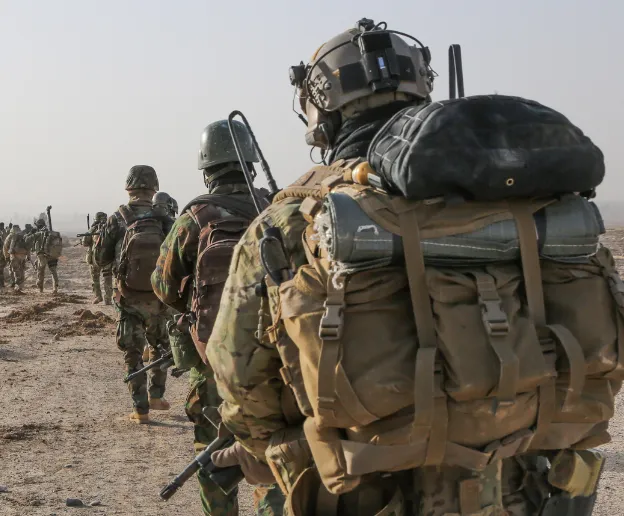
Tactical athletes, military personnel, law enforcement, firefighters, and serious selection candidates, operate in environments where load progression cannot always be controlled. Resilient connective tissue is only part of readiness, though, since restricted movement creates its own problems, including the mobility limitations for shooters that quietly degrade accuracy and control under load.
A surprise rucking PT session, a sudden body-armor qualification, or a selection event that ramps from zero to maximum in days does not wait for tendon adaptation to catch up. The athletes who survive these spikes without injury are not lucky; they have been building tendon capacity for months, sometimes years, beforehand.
This is why structured, periodized programming matters more for tactical athletes than for almost any other population. Connective tissue built deliberately, over time, becomes a margin of safety when the operational tempo demands more than your body has earned the right to deliver. Every gradual ruck progression, every heavy slow resistance block, every isometric hold quietly deposits capacity into a system that will eventually be asked to spend it.
If you are training without periodization, running the same workouts at the same intensities week after week, you are not building tendon capacity. You are maintaining it at best, and slowly eroding it under accumulated micro-trauma at worst. Tactical fitness is a connective-tissue game played over years, not a strength-and-cardio game played over weeks.
If your goal is stronger, more resilient tendons that hold up under tactical workloads:
If your goal is stronger, more resilient tendons:
Progress training load gradually.
Include heavy, controlled strength work.
Build impact tolerance over time.
Stay consistent for months, not just weeks.
Avoid sudden spikes in volume or intensity.
Build impact tolerance over time, remembering that how bones adapt to impact follows the same slow, load-driven logic as tendon remodeling. Tendons adapt more slowly than muscles, but with consistent, progressive loading, they become stronger, more durable, and more efficient at transferring force. Understanding how tendons adapt to load is not just a physiology question, it is a programming question. Train in a way that respects the timeline, and your tendons become an asset rather than a liability. Ignore the timeline, and they become the bottleneck that defines what your training career actually looks like.


