
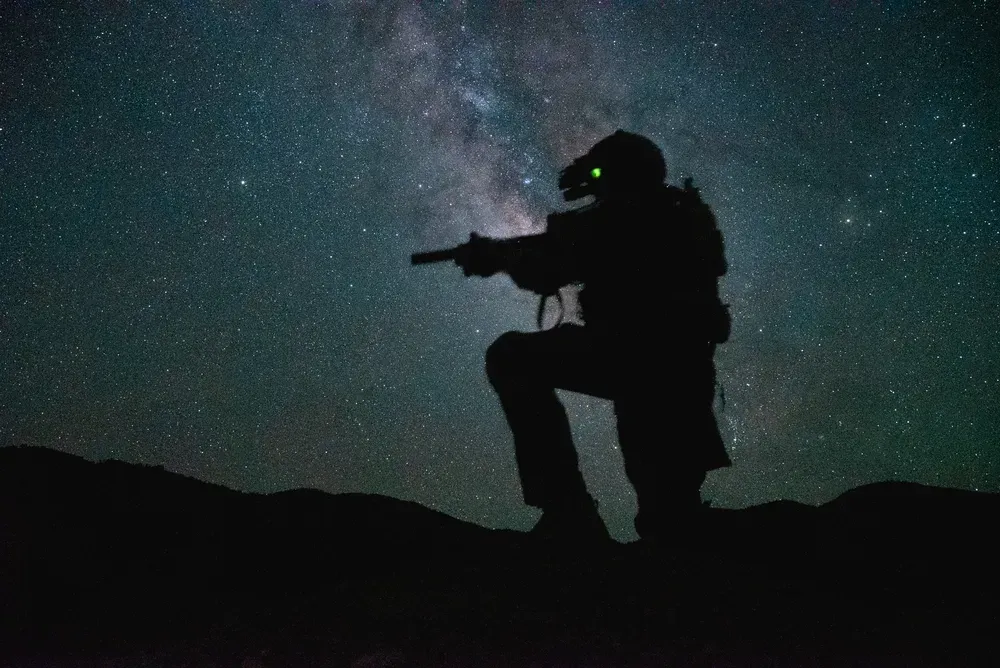
Mobility for Shooters: Movement Limitations That Kill Accuracy
If You Can't Get Into Position, You Can't Take the Shot
We spend thousands on optics, triggers, and barrels to improve accuracy. We spend zero on the machine holding the weapon. That's the problem. Accuracy does not live in your gear. It lives in your ability to achieve a stable, consistent, repeatable position under pressure, on demand, every time.
If your shoulders are rolled forward, you can't present the rifle consistently. If your hips are tight, you can't sit in a squat or kneel behind cover without shaking. If your forearms are seized up, your trigger control suffers before you even acquire the target. Mobility is not yoga. It is mechanical efficiency. Programs built for tactical athletes who need to maintain that efficiency alongside strength and conditioning training can be found at CF ONE training programs.
Why Shooters Neglect Mobility
The shooting community talks constantly about gear, technique, and round count. It almost never talks about the body executing those techniques. There are a few reasons for this. Mobility work is unglamorous. It doesn't look impressive. It doesn't show up on a score sheet.
It also doesn't cause immediate failure in a controlled range environment. You can paper over tight hips and a hunched thoracic spine when you're shooting from a comfortable standing position at a static target. The failure shows up when conditions change. For tactical athletes evaluating which program best fits their training goals and physical demands, the tactical fitness program buying guide walks through exactly how to choose the right option.
When you're behind cover in an awkward position. When you're prone in terrain that forces hip rotation. When you're in a vehicle and have to engage from a seated, constrained position. When you're physically fatigued and your body defaults to compensatory patterns. That's when immobility kills accuracy. And that's exactly the environment tactical and law enforcement shooters operate in. For athletes with specific questions about tactical fitness program structure and what to look for in a system that addresses durability alongside performance, the tactical fitness program FAQ covers the most common questions in one place.
What Mobility Actually Is
Mobility is not flexibility. Flexibility is passive. It describes how far a muscle can stretch. Mobility is active. It describes how much usable range of motion you control under load. A flexible person can be laid flat in a stretch. A mobile person can move through the same range while holding a rifle, carrying a load, or in the middle of a physical engagement.
For shooters, the relevant question is never "can my hip reach that position?" It is "can my hip reach that position while maintaining trunk stability and a consistent platform?" That's a mobility question. Flexibility training alone doesn't answer it.
The Three Mobility Restrictions That Kill Tactical Accuracy
Here are the three movement limitations most commonly observed in military, law enforcement, and tactical shooters. Each one has a direct mechanical consequence on accuracy. Each one has a fix.
1. Thoracic Extension (The "Sniper" Hunch)
Most people can have postural patterns that resemble something described as Upper Cross Syndrome. Tight pectorals, tight anterior shoulders, weak upper back, and weak deep neck flexors.
This pattern can be developed from years of forward posture: plate carrier wear, vehicle time, desk work, and phone use. The result is a more rounded upper back posture and forward head position that looks relatively normal in daily life but can become a problem with a weapon in your hands.
When you try to mount a rifle with this posture, several things happen simultaneously:
You have to crane your neck forward to find the optic.
You have to shrug your traps to get your cheek on the stock.
Your pec minor pulls your shoulder forward, preventing a clean pocket weld.
The tension created by fighting your own structure travels through the support arm and directly into the weapon.
Tension creates shake. Shake kills accuracy.
The issue compounds under stress. When your heart rate is elevated, muscular tension increases. If your baseline is already high due to structural restriction, your elevated state under stress is worse. This is not a technique problem. It is a tissue problem.
The Fix: Thoracic Extension on Roller
Lie on a foam roller. Place it across your mid-back at the shoulder blades.
Keep your butt on the floor. Hands behind your head.
Arch back over the roller. Try to touch your head to the floor.
Hold for a breath. Move the roller up one inch. Repeat up the thoracic spine.
Do not roll the lumbar spine. Stay above the lower ribs.
Result: Opens the chest, reduces anterior shoulder tension, allows the stock to sit naturally in the pocket without active muscular effort. Perform this for 2-3 minutes before any rifle work. Perform it daily for structural change over time.
Why This Matters Beyond the Range
Chronic thoracic restriction does not just affect your shooting platform. It increases injury risk during load carriage, rucking, and any overhead pressing work. It compresses the structures around the shoulder, reducing available shoulder range and increasing impingement risk.
Tactical athletes who wear plate carriers for extended periods and never address thoracic extension are building a structural deficit that compounds with every operational hour they accumulate.
2. Hip Internal Rotation (Unconventional Positions)
Shooting is not always standing. It is prone. It is urban prone, lying on your side to minimize profile. It is seated in a vehicle with a limited arc of movement. It is kneeling behind partial cover with uneven terrain. Every one of these positions requires your femurs to move in specific ways relative to your pelvis.
Urban prone requires hip internal rotation. Your front leg needs to rotate inward to flatten your profile. Vehicle shooting requires the ability to rotate at the hip without the lumbar spine compensating. Sitting positions behind cover require sustained hip flexion with rotational stability. When hip capsule mobility is restricted, the lumbar spine compensates.
Instead of the femur rotating as intended, the pelvis tilts and the lower back twists. This creates two problems simultaneously:
A moving platform. Your lower back is now an unstable link in the chain between the ground and the weapon.
A pain pattern. Repeated lumbar compensation under load generates chronic low back pain, the single most common complaint in tactical and law enforcement populations.
The Fix: The 90/90 Stretch
Sit on the floor. Front leg bent at 90 degrees in front of you. Rear leg bent at 90 degrees behind you.
Keep your chest tall. Avoid rounding your back.
Lean forward over the front shin to load the external rotation of the front hip.
Then rotate and lean back over the rear shin to load the internal rotation of the rear hip.
Hold each position for 2-3 breaths. Alternate sides.
Result: Unlocks the hip capsule in both directions, allowing unconventional positions without lumbar compensation.
The 90/90 is a daily maintenance tool, not just a pre-range warmup. It addresses the hip capsule directly rather than just lengthening the surrounding muscles.
The Vehicle Problem
Vehicle operations deserve specific attention.
Sitting in a vehicle for extended periods places the hip in sustained flexion with no rotation.
The hip capsule stiffens in this position.
When you exit the vehicle and immediately need to move, engage, or assume a shooting position, you are working with a hip that has been shortened and locked for potentially hours.
This is a scenario where restricted hip internal rotation compounds with restricted hip flexion range and produces the worst possible platform at the worst possible moment.
Daily 90/90 work and periodic hip flexor stretching during vehicle operations are not optional for professionals who spend significant time mounted.
3. Wrist & Forearm (Grip Endurance)
Trigger control is a fine motor skill.
Fine motor skills degrade under two conditions: stress and fatigue.
The forearm flexors are responsible for grip strength and finger movement.
When those muscles are chronically tight, shortened, and loaded with trigger points, several things happen:
Grip endurance drops earlier than it should. Your support hand hold degrades before your shooting session is over.
The antagonist relationship between flexors and extensors is disrupted. You cannot fully extend the fingers cleanly, which affects reset feel and trigger press consistency.
Chronic tightness in the flexor group, combined with repetitive gripping, produces medial epicondyle pain (Shooter's Elbow) and contributes to carpal tunnel symptoms.
None of that helps you shoot.
The Fix: The Tabletop Smash
Place a lacrosse ball on a table or hard surface.
Place your forearm on the ball, flexor side down.
Apply downward pressure and slowly roll the ball along the length of the forearm from wrist to elbow.
When you find a painful spot (trigger point), stop rolling. Hold pressure.
While holding pressure, repeatedly flex and extend the wrist. 10-15 repetitions.
Move to the next spot.
Result: Releases myofascial restriction in the flexor group, improves blood flow to the tissue, restores the full range of finger extension, and reduces accumulated tension that degrades trigger control.
This takes 3-5 minutes per arm. Do it before any range session and after any extended grip work.
Why Grip Endurance Is a Durability Issue
Forearm and grip issues are not just accuracy problems. They are durability problems. Shooter's Elbow is an overuse injury. Carpal tunnel symptoms are a cumulative load problem.
Both of them worsen progressively if the underlying tissue restriction is not addressed. Understanding why conditioning improves durability explains the physiological mechanism behind why tissue quality and structural resilience are trained qualities, not fixed ones, and why the maintenance work described in this post produces cumulative results rather than one-time improvements.
The Connection Between Mobility and Injury Risk
Mobility restrictions do not just affect accuracy in the short term. They set up injury patterns in the long term. Thoracic restriction increases shoulder impingement risk. Hip restriction increases lumbar load and knee stress during running and rucking. Forearm restriction increases elbow and wrist overuse injury risk.
These are the exact injury patterns that remove tactical athletes and law enforcement professionals from duty. They are not random. They are predictable consequences of accumulated restriction that was never addressed. The framework for injury risk management gives tactical athletes a practical structural approach for identifying and managing these patterns across a full training cycle, rather than waiting for them to produce injury before acting.
How to Integrate This Into a Training Week
Mobility work for shooters does not require a separate training session. It requires 10 minutes of consistent daily maintenance.
Here is a simple structure:
Morning (5 minutes, daily): Thoracic extension on roller, 2 minutes. 90/90 hip stretch, 90 seconds per side.
Pre-range or pre-training (5 minutes): Forearm smash, 2-3 minutes per arm. Hip internal rotation mobilization, 1 minute per side.
That is the minimum effective dose. It does not replace a structured training program. It protects your ability to execute one.
Mobility Under Pressure: Why Range Work is Not Enough
Range work teaches you to shoot from positions your body can currently achieve. It does not expand what positions your body can achieve. If your hip will not internally rotate, you will unconsciously avoid positions that require it. You will choose a "comfortable" position rather than the tactically optimal one. Under stress, that pattern becomes more pronounced.
Your body will default to whatever requires the least effort, which is the position with the least restriction, not necessarily the most stable or most protected position. Mobility training does not just make you more comfortable. It expands the menu of positions you can actually execute under pressure.
That is a tactical capability, not a wellness benefit. The broader context for why these physical qualities matter across a full career of tactical service is covered in what is tactical conditioning, which defines the framework that connects mobility, durability, and physical readiness into a coherent operational standard.
The Real Cost of Ignoring This
Most shooters will not connect their accuracy issues to their mobility limitations. They will buy a new trigger. They will change their grip technique. They will increase round count. They will not spend 10 minutes on a foam roller.
The result is a ceiling on their technical performance that no gear upgrade can break through, because the limitation is not in the equipment. It is in the structure holding the equipment. The real reason you are always injured in military training addresses the broader systemic pattern behind why mobility and structural restrictions accumulate and why the standard training culture does almost nothing to prevent it.
What Is Physical Resilience and Why It Matters Here
Physical resilience is the capacity to absorb stress and return to baseline. It is what allows a shooter to take two shots from a compromised position, transition to a standing position, and still have the stability and control to make the third shot count. Mobility is one of the foundational inputs to resilience.
A body with adequate range of motion in the key patterns requires less compensatory effort to maintain a stable platform. Less compensation means less energy expenditure. Less energy expenditure means more reserve for the task itself. That is the direct line from mobility to shooting performance under sustained operational stress. The full definition of what is physical resilience grounds this principle in its broader performance context, explaining exactly why resilience is a trained quality and how mobility work contributes to building it across a career of operational service.
Summary
A stable platform is a deadly platform.
Tight thoracic spine: fix it with the roller. Restricted hip rotation: fix it with the 90/90. Seized forearms: fix it with the lacrosse ball smash.
Ten minutes a day.
That is the investment that protects your ability to get into position, stay in position, and make the shot when it counts.
Don't let a tight back cost you a hit.
Mobilize to stabilize.
FAQ
Does mobility actually affect shooting accuracy?
Yes, directly. Mobility restrictions force compensatory movements that introduce tension and instability into the shooting platform. Tension increases weapon movement. The three most common restrictions, thoracic extension, hip rotation, and forearm tightness, all have direct mechanical consequences on accuracy and trigger control.
How long does it take to improve shooting mobility?
Noticeable improvement in position quality can occur within 2-4 weeks of consistent daily work. Structural change in tissue and capsule mobility takes longer, typically 8-12 weeks of regular maintenance. The pre-session work produces immediate, session-specific improvement while the daily work builds lasting change.
Do I need special equipment?
No. A foam roller and a lacrosse ball cover the primary tools described in this post. Both are inexpensive and portable.
Is this relevant for handgun shooters, not just rifle?
Yes. Thoracic restriction affects any two-handed shooting platform. Hip restriction affects every unconventional or kneeling position. Forearm restriction affects any shooter who trains grip endurance. The same three areas apply regardless of platform.
How does this fit into a broader training program?
Mobility work for shooters is maintenance, not a primary training stimulus. It should be integrated into daily routine and pre-session prep rather than treated as a separate training day. A well-structured tactical training program accounts for this as part of overall durability management.


