
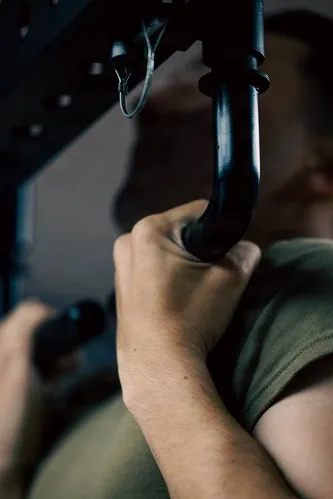
Chin-Ups vs Pull-Ups, Form & Muscles | Combat Fitness
Chin-Ups: How to Do Them, Muscles Worked & Chin-Up vs Pull-Up
A chin-up is a vertical pull done with an underhand grip, palms facing you, where you pull from a dead hang until your chin clears the bar. It trains your lats, biceps, and mid-back in one movement, and it is one of the few bodyweight lifts scored directly on military fitness tests. If you want pulling strength built into a structured plan instead of guessed at, our tactical fitness programs program it for you.
The Marine Corps PFT accepts either grip on the bar, and Navy special operations screening demands strict reps, so this movement carries real weight on test day. Below we cover the chin-up vs pull-up difference, the muscles involved, strict form, how to get your first rep, the variations worth using, and how to program chin-ups to raise your count.
Key Takeaways:
A chin-up uses an underhand grip and a pull-up uses an overhand grip. Both train the lats hard, but the chin-up loads the biceps more.
Most athletes can do more chin-ups than pull-ups, which makes the chin-up the logical entry point to vertical pulling.
Your test decides the grip you master last: the Marine Corps PFT accepts either, while Navy special operations screening is done overhand.
If you can’t do one yet, build it with dead hangs, rows, top holds, slow negatives, and assisted reps, in that order.
To raise your count, train chin-ups two to three times a week and stop most sets one to three reps short of failure.
What Is a Chin-Up?
A chin-up is a bodyweight pulling exercise where you hang from a bar with your palms facing you, hands about shoulder-width apart, and pull until your chin clears the bar. It is a vertical pull: your elbows drive down toward your ribs while your body travels straight up.
The chin-up exercise sits beside the pull-up as the standard test of upper-body pulling strength relative to body weight. Unlike a lat pulldown, the load is fixed at your own mass, so every pound you gain or lose changes how hard each rep feels. That is exactly why military tests use it. It measures whether you can move your own body, not a weight stack.
One clarification: searches for a “barbell chin up” usually mean a barbell curl or drag curl brought up toward chin height. That is a biceps isolation lift, not a chin-up, and nothing in this guide applies to it.
Chin-Up vs Pull-Up: What’s the Difference?
The difference between a chin-up and a pull-up is the grip. A chin-up uses an underhand grip, palms toward you, usually at shoulder width. A pull-up uses an overhand grip, palms away, usually slightly wider. The chin-up puts more load on the biceps and chest, while the pull-up shifts more work to the lower traps.
Underneath the grip change, both lifts are the same movement pattern, and the lats do heavy work in each. A 2010 electromyography (EMG) study by Youdas and colleagues found the chin-up produced higher biceps and pectoralis major activity, while the pull-up produced higher lower-trapezius activity. A 2017 study by Dickie and colleagues found activation across underhand, overhand, and neutral grips was broadly similar over a full rep. Grip shifts the emphasis. It does not swap the target.
Grip: Chin-up uses an underhand (supinated) grip, palms toward you. Pull-up uses an overhand (pronated) grip, palms away.
Typical width: Chin-up is shoulder-width or slightly narrower. Pull-up is slightly wider than the shoulders.
Biceps involvement: Higher in the chin-up, lower in the pull-up.
Lat involvement: High in both.
Lower trapezius: Moderate in the chin-up, higher in the pull-up.
Relative difficulty: The chin-up is easier for most athletes. The pull-up is harder for most athletes.
Elbow path: In the chin-up, the elbows travel in front of the body. In the pull-up, they travel out to the sides.
Where it’s tested: The chin-up counts on the Marine Corps PFT, which allows either grip. The pull-up is tested on the Marine Corps PFT and the Navy special operations PST.
Is a Chin-Up Easier Than a Pull-Up?
For most athletes, yes. The biceps both bends the elbow and turns the palm up, so an underhand grip puts it in its strongest working position. In an overhand grip, more of the elbow bending falls to the brachialis and brachioradialis, and the elbows travel in a wider path that many athletes find less efficient. Expect a few more reps on chin-ups than pull-ups, though shoulder mobility and arm length change that from athlete to athlete.
Do Chin-Ups Carry Over to Pull-Ups?
Strongly. Both lifts train the same prime movers through nearly the same range, so building one raises the other. The carryover is not complete. If your test is scored overhand, the final weeks of preparation belong on the overhand grip, because strength is specific to the position you train in.
When Should You Pick Each?
Building your first reps: start with chin-ups. The biceps help carry you through the sticking point.
Marine Corps PFT: test both grips in training and use whichever gives you more reps. Either counts.
Navy special operations screening: make the overhand pull-up your priority and use chin-ups as secondary volume.
General pulling strength and arm development: rotate both grips across the training week.
What Muscles Does a Chin-Up Work?
Chin-up muscles worked: the latissimus dorsi and biceps brachii are the prime movers, supported by the brachialis, brachioradialis, middle and lower trapezius, rhomboids, rear deltoids, and pectoralis major. Your core and grip work isometrically on every rep to keep your body still and keep you on the bar.
Latissimus dorsi: drives the upper arm down and back. It is the largest contributor to the pull.
Biceps brachii: bends the elbow, and it is loaded more in the chin-up than in other grips.
Brachialis and brachioradialis: the other elbow flexors. They take more of the load as the grip turns neutral or overhand.
Middle and lower trapezius, rhomboids: pull the shoulder blades down and together so the lats have a stable base.
Pectoralis major and rear deltoids: assist the arm’s downward path. The pecs showed higher activity in chin-ups than pull-ups in the Youdas data.
Core and forearms: hold a rigid body line and a closed grip under full body weight.
So, does a chin-up work the biceps? Yes, more than nearly any other bodyweight movement, which is why many coaches treat heavy chin-ups as a direct arm lift. It still trains the back first. The lats move the most load, the biceps assist, and the underhand grip raises the biceps’ share. If arm size is a goal, chin-ups paired with neutral-grip curls such as hammer curls cover the elbow flexors from both angles.
Why Do Chin-Ups Matter for Tactical Athletes?
Chin-ups matter because pulling strength relative to body weight is both tested and used. Military fitness tests score pull reps directly, and field tasks such as clearing a wall, climbing a rope, or hauling yourself onto a ledge in kit demand the same capacity. A strong chin-up is cheap insurance for both.
The Chin-Up Test on Military PFTs
The Marine Corps PFT is the clearest example. Marines choose between pull-ups and push-ups, and the bar may be gripped overhand or underhand, so a military chin-up counts. Choosing push-ups caps your possible score below what the bar can earn. Under the updated scoring, male Marines aged 21 to 35 need 23 reps for maximum points, and female Marines in the same ages need 9 or 10.
Navy special operations candidates face the bar too. Navy personnel policy (MILPERSMAN 1220-410) sets the SEAL Physical Screening Test minimum at 10 pull-ups, and Naval Special Warfare publishes competitive averages well above that. Those reps are performed overhand, so a SEAL or SWCC candidate uses chin-ups to build volume, not as a test substitute.
The Army is the outlier. The Army Fitness Test, which replaced the ACFT on June 1, 2025, has no pulling event. That is a gap, not a pass. A soldier who never trains vertical pulling still has to climb, drag, and lift in the field, and the AFT score will never reveal the weakness.
Pulling Strength Beyond the Test
The chin-up rewards relative strength, and relative strength is what moves you under load. Research on trained athletes found maximum pull-up reps tracked closely with performance on a lat pulldown loaded at body weight, not with maximal pulldown strength, and fell as body mass rose. Add a plate carrier, helmet, and pack, and every point of relative strength becomes more valuable. It is the same principle behind functional strength for military performance: train the capacities the job uses, measured against the body you have to carry.
The chin-up is also a staple of any well-built military calisthenics workout, because it pairs with push-ups, dips, and core work to cover the upper body with nothing but a bar. If you are weighing structured options rather than building your own, our guide to choosing a tactical fitness program breaks down what to look for.
How to Do a Chin-Up With Proper Form
To do a chin-up, grip the bar underhand at shoulder width, start from a dead hang with straight arms, pull your elbows down toward your ribs until your chin clears the bar, then lower under control to full extension. Proper chin-up form means full range on every rep and no kipping.
Set your grip. Hands at shoulder width or slightly narrower, palms facing you, thumbs wrapped around the bar. A full grip is stronger and more secure than a thumbless one.
Start from a dead hang. Arms straight, feet off the ground, body still. This is where every scored rep begins on the Marine Corps PFT.
Set your shoulders. Before your elbows bend, draw your shoulder blades slightly down. This loads the lats and protects the shoulder joint.
Brace your trunk. Squeeze your glutes and pull your ribs down. A rigid body transfers force; a loose one swings and leaks it.
Pull. Drive your elbows down and back toward your ribs. Keep your chest up and your neck neutral.
Finish over the bar. Your chin clears the top of the bar without tilting your head back.
Lower under control. Take two to three seconds back to a full dead hang. The descent builds strength and keeps the next rep honest.
Common Chin-Up Form Faults
Half reps: stopping short of a dead hang inflates your training count and fails you on a graded test.
Chin reaching: craning the neck to clear the bar instead of pulling higher.
Kipping and swinging: momentum moves the body without building the pull.
Free-falling on the way down: dropping into the bottom loads the elbow and shoulder tendons sharply.
Grip too narrow: hands touching forces the wrists and elbows into awkward angles for many athletes.
Can’t Do a Chin-Up Yet? How to Get Your First One
If you can’t do a chin-up yet, build it in stages: hang from the bar, row horizontally, hold the top position, lower slowly through negatives, then use assisted reps to practice the full movement. Each stage trains one piece of the pull, and together they build the strength for your first strict rep.
The first rep is hard for mechanical reasons. You are lifting your full body weight with relatively small muscles, and long arms add distance to every rep. When University of Dayton researchers trained 17 women who could not do a pull-up for three months, their upper-body strength rose substantially, yet only four completed a rep by the end. That is not a reason to quit. It is a reason to train the specific movement, consistently, and to manage body composition along the way.
The Progression to Your First Chin-Up
Dead hangs. Hang for 20 to 45 seconds. This builds grip and tolerance for your full body weight.
Scapular pulls. From a dead hang, pull the shoulder blades down without bending the elbows. This teaches the first inch of every rep.
Inverted rows. Row your chest to a bar or rings with your feet on the floor. Lower the bar over time to raise the load.
Flexed-arm hang. Step or jump to the top position and hold your chin over the bar for 10 to 30 seconds. This strengthens the hardest point of the rep.
Chin-up negatives. Start at the top and lower for three to five seconds. Muscles produce more force lowering than lifting, and a meta-analysis by Roig and colleagues found high-intensity eccentric training improved strength more than concentric training. Negatives let you train the full range before you can lift through it.
Assisted chin-ups. Use a resistance band or an assisted chin-up machine to practice complete reps with part of your body weight removed.
Test a strict rep every one to two weeks. When it arrives, build it with sets of singles before chasing volume.
Assisted Chin-Up Machine vs Band
An assisted chin-up machine gives precise, repeatable loading: you set the counterweight and reduce it in small steps. Its limit is that the platform stabilizes you, so it trains less of the body control a free bar demands. A band keeps you on a real bar but assists most at the bottom, where you need help least, and least at the top, where you need it most. We use both: the machine for measurable progression, the band for skill on the bar. How long the first rep takes depends on starting strength and body weight, and progress is measured in weeks to months, not days.
Chin-Up Variations: Weighted, Close-Grip, Neutral, and One-Arm
Once bodyweight reps are solid, variations keep the stimulus climbing. Research comparing pull-up variations, including towel and suspension-strap versions, found all of them produced enough muscle activity to drive strength and size gains. Pick variations by goal rather than hunting for one perfect version.
Weighted Chin-Up
Add load with a dip belt, weight vest, or dumbbell held between the feet once you can do 10 or more strict reps. Weighted chin-ups build the top-end strength that makes bodyweight reps feel lighter, and a vest mimics the load you carry in kit. Work in sets of 3 to 6 reps.
Close-Grip Chin-Up
Hands a few inches apart, palms toward you. The narrower grip increases the demand on the elbow flexors, biceps included. Keep the hands no closer than your wrists and elbows tolerate comfortably.
Neutral-Grip Chin-Up
Palms face each other on parallel handles. Many athletes find this the most joint-friendly option, and the Dickie study found activation similar to the other grips. Use it when elbows or shoulders are irritated by underhand or overhand work, and as a bridge between the two.
Negative Chin-Up
Negatives stay useful after your first rep. Advanced athletes use weighted negatives, lowering a load heavier than they can lift, to build top-end strength without needing a spotter.
One-Arm Chin-Up
The one-arm chin-up is a long-term goal, not a program staple. One arm has to move the full load two arms normally share, while your trunk resists rotation. Build toward it with archer chin-ups and assisted one-arm reps, holding a towel with the free hand, only after heavy weighted chin-ups are solid.
How to Program Chin-Ups and Increase Your Reps
To increase chin-up reps, train them two to three times a week, keep most sets one to three reps short of failure, and add total weekly reps gradually. Raising your count is a volume problem: you need more quality reps across the week, not one all-out set per session.
The evidence supports that approach. Sánchez-Moreno and colleagues showed that rep speed in the pull-up slows predictably as a set approaches failure, which makes the grinding final reps the costliest ones. A later study comparing pull-up training stopped at a 25 percent loss of rep speed against training pushed to a 50 percent loss found the shorter sets produced greater strength gains and comparable rep-max gains. On the muscle-growth side, Schoenfeld’s meta-analysis found gains increase with weekly set volume, so spreading sets across the week is the efficient route.
How Many Chin-Up Reps Should You Do?
These are our coaching starting points, set by your current strict max:
0 strict reps: Train hangs, rows, top holds, negatives, and assisted reps. Aim for 3 sessions of progression drills per week.
1 to 4 strict reps: Train singles and doubles with full rest, plus negatives. Aim for 3 sessions and 10 to 20 total reps per week.
5 to 10 strict reps: Train sets at about 50 to 70 percent of your max. Aim for 2 to 3 sessions and 25 to 50 total reps per week.
11 to 20 strict reps: Train sets at 50 to 70 percent of your max, plus weighted chin-ups. Aim for 2 to 3 sessions and 40 to 75 total reps per week.
20+ strict reps: Train weighted sets of 3 to 6, plus one high-volume day. Aim for 2 sessions per week, mixing load and volume.
How to Increase Your Chin-Up Count for a Test
For a test-driven goal, build the week around three exposures:
Strength day: weighted chin-ups, 4 to 5 sets of 3 to 5 reps.
Volume day: sets at 50 to 60 percent of your max with short rest, each stopped well before failure.
Density day: a fixed total, such as two to three times your current max, completed in as few sets as possible and tracked over time.
Retest your max every three to four weeks. Two weeks out from a graded test, cut volume and rehearse the exact standard: grip, dead hang, and the grader’s cadence.
Where Chin-Ups Fit in a Pull Day
Put chin-ups first in an upper-body or pull session, while your grip and nervous system are fresh. Follow with a horizontal row, then lighter back and arm accessories. Balance them across the week with pressing and lower-body work; a template like a strength workout for athletes shows how vertical pulls sit inside a complete strength plan.
Frequently Asked Questions
What is the difference between a chin-up and a pull-up?
A chin-up uses an underhand grip with palms facing you, usually at shoulder width. A pull-up uses an overhand grip with palms facing away, usually slightly wider. Both are vertical pulls driven mainly by the lats. The chin-up places more load on the biceps and chest, while the pull-up places more on the lower traps.
Is a chin-up easier than a pull-up?
For most athletes, yes. The underhand grip puts the biceps in its strongest working position, so it contributes more to the pull. Most people can do a few more chin-ups than pull-ups. Individual differences in shoulder mobility and arm length can narrow or reverse that gap, so test both grips if your exam allows either.
Do chin-ups build biceps or back?
Both. The lats are the primary mover, so chin-ups are a back exercise first. The underhand grip raises biceps involvement above other pulling variations, which makes chin-ups one of the most effective bodyweight lifts for the arms. Rotating chin-ups with overhand pull-ups covers both emphases.
How many chin-ups should you be able to do?
The number that matters is the one your test scores. For Marine Corps PFT maximum points, men aged 21 to 35 need 23 reps and women in the same ages need 9 or 10. For SEAL screening, 10 is the minimum and competitive candidates aim well above it. Outside a test, we treat 10 strict reps as a solid baseline for a tactical athlete.
Do chin-ups help your pull-ups?
Yes. Both lifts share the same prime movers and range of motion, so chin-up strength carries over to pull-ups. The transfer is not complete, because strength is specific to the grip you train. If your test is scored overhand, shift most of your volume to pull-ups in the final four to six weeks.
What do you do if you can’t do a chin-up yet?
Build it in stages: dead hangs, scapular pulls, inverted rows, top-position holds, slow negatives, and band or machine-assisted reps. Train these two to three times a week and test a strict rep every one to two weeks. Progress depends on your starting strength and body weight, and it is measured in weeks to months.
The chin-up is the most direct way to build and prove pulling strength relative to your body weight. Grip decides the emphasis, the lats do the heavy work either way, and the test you face decides which grip you master last. Start where your strength is, follow the progression, and keep most sets short of failure so each week adds reps instead of fatigue. If you would rather have chin-ups, your test events, and the rest of your training organized into one plan, start a Combat Fitness program built around the standard you have to meet.
References:
Youdas JW, Amundson CL, Cicero KS, Hahn JJ, Harezlak DT, Hollman JH. Surface electromyographic activation patterns and elbow joint motion during a pull-up, chin-up, or perfect-pullup rotational exercise. Journal of Strength and Conditioning Research. 2010;24(12):3404-3414.
Dickie J, Faulkner J, Barnes M, Lark S. Electromyographic analysis of muscle activation during pull-up variations. Journal of Electromyography and Kinesiology. 2017.
Snarr RL, et al. Electromyographical comparison of a traditional, suspension device, and towel pull-up. Journal of Human Kinetics. 2017;58:5-13.
Lusk SJ, et al. Grip width and forearm orientation effects on muscle activity during the lat pull-down. Journal of Strength and Conditioning Research. 2010;24(7):1895-1900.
Signorile JF, et al. A comparative electromyographical investigation of muscle utilization patterns using various hand positions during the lat pull-down. Journal of Strength and Conditioning Research. 2002;16(4):539-546.
Roig M, O’Brien K, Kirk G, et al. The effects of eccentric versus concentric resistance training on muscle strength and mass in healthy adults: a systematic review with meta-analysis. British Journal of Sports Medicine. 2009;43(8):556-568.
Sánchez-Moreno M, Rodríguez-Rosell D, Pareja-Blanco F, Mora-Custodio R, González-Badillo JJ. Movement velocity as indicator of relative intensity and level of effort attained during the set in pull-up exercise. International Journal of Sports Physiology and Performance. 2017;12(10):1378-1384.
Sánchez-Moreno M, Pareja-Blanco F, González-Badillo JJ, Díaz-Cueli D. Determinant factors of pull up performance in trained athletes. Universidad de Sevilla repository.
Effects of velocity loss during body mass prone-grip pull-up training on strength and endurance performance. 2024.
Schoenfeld BJ, Ogborn D, Krieger JW. Dose-response relationship between weekly resistance training volume and increases in muscle mass: a systematic review and meta-analysis. Journal of Sports Sciences. 2017;35(11):1073-1082.
Flanagan SP, Vanderburgh PM, Borchers SG, Kohstall CD. Training college-age women to perform the pull-up exercise. Research Quarterly for Exercise and Sport. 2003;74(1):52-59.
United States Marine Corps. MCO 6100.13A, Marine Corps Physical Fitness Program.
U.S. Navy. MILPERSMAN 1220-410, SEAL/EOD/SWCC/Diver/AIRR Physical Screening Testing Standards.
Naval Special Warfare. SEAL and SWCC PST Standards. 2022.
U.S. Army. Army establishes new fitness test of record to strengthen readiness and lethality. 2025.
Disclaimer: This article is for educational purposes only and is not medical advice. Consult a qualified healthcare provider before starting a new training program, especially if you have a shoulder, elbow, or wrist injury. Fitness test standards change; confirm current requirements with your branch, recruiter, or unit before you test.


