
Weighted Sit-Up: Form, Load & Variations | Combat Fitness
The Weighted Sit-Up: How to Load It, How Much to Use, and When to Skip It
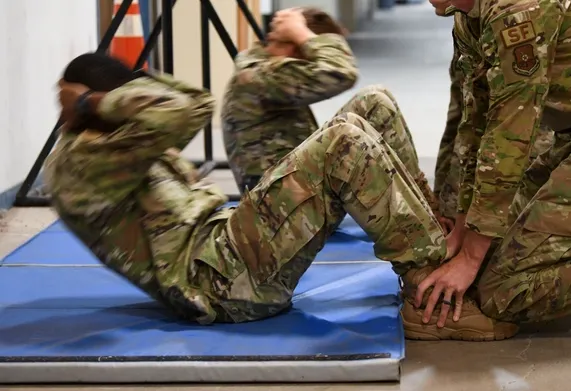
A weighted sit-up is a standard sit-up performed while holding external load, usually a plate, dumbbell, or kettlebell, to build trunk-flexion strength beyond what bodyweight reps can provide. Anchor your feet, hold the weight at your chest, curl up under control, and lower slowly. Start with 10 to 25 pounds and add weight only when every rep stays clean. We build loaded core work like this into our military fitness programs because it has real carryover to the Air Force PFA, which still scores a one-minute sit-up option.
Below you get the exact setup, the muscles it trains, how much weight to use, where to hold it, the decline and equipment variations, and an honest take on when weighted situps earn a place in your week and when they don’t.
Key Takeaways:
Start with 10 to 25 pounds held at the chest, and progress in small jumps only when the last rep looks like the first.
Hugging the weight is easier; holding it overhead lengthens the lever and makes the same load far harder.
Decline sit-ups add range of motion and difficulty; incline sit-ups are the regression.
Loaded spinal flexion at high volume stresses the lumbar discs, so keep reps moderate and balance the movement with anti-extension work like planks and carries.
How to Do a Weighted Sit-Up (Step by Step)
Weighted sit-up form comes down to a fixed foot anchor, a controlled curl, and a slow descent. The load should ride with your torso, never pull it. Follow these steps:
Set your base. Lie on your back with knees bent to roughly 90 degrees. Hook your feet under a pad, a loaded barbell, or a partner’s hands so your heels stay planted.
Lock in the load. Hold a plate or dumbbell flat against your sternum with both arms crossed over it. Keep it pinned so it doesn’t slide toward your throat.
Brace and breathe. Take a breath, tighten your midsection as if bracing for a punch, then exhale as you start the rep.
Curl up, don’t yank. Lift your head, then your shoulder blades, then your lower back off the floor in sequence until your torso is upright. Keep your chin slightly tucked and your neck neutral.
Lower under control. Take two to three seconds to roll back down, one vertebra at a time. The descent is where most of the strength gets built, and where most people cheat.
Reset at the bottom. Touch your shoulder blades to the floor, re-brace, and go again. No bouncing off the deck.
The two errors we see most are pulling the head forward with the hands and dropping the descent. Both shift stress to the neck and low back and away from the abdominals you are trying to train. If you can’t control the lowering phase, the weight is too heavy.
What Muscles Does the Weighted Sit-Up Work?
The weighted sit-up works the rectus abdominis as the prime mover, with the internal and external obliques assisting and the hip flexors finishing the top half of the rep. Adding load raises the strength demand on all three without adding reps, which is the whole point of loading the movement.
Rectus abdominis: flexes the spine through the first part of the curl, lifting your shoulders and ribcage toward your pelvis.
Obliques: stabilize the trunk and help flex it, working harder when the load is held off-center or overhead.
Hip flexors (iliopsoas and rectus femoris): take over once the trunk is partly up and pull your torso toward your thighs. Intramuscular EMG research shows the psoas is highly active during sit-ups, far more than during short-range curl-ups.
That hip-flexor contribution matters. Anchoring the feet lets the hip flexors pull harder, so a full anchored sit-up is part abdominal exercise and part hip-flexor exercise. For tactical athletes that is not a flaw. Strong hip flexors support sprinting, climbing, and getting up off the ground in kit. Trunk strength built this way also feeds into the broader goal of functional strength for military performance, where the trunk transfers force between your legs and your hands under load.
How Much Weight Should You Use, and Where Should You Hold It?
Most athletes should start weighted sit-ups with 10 to 25 pounds hugged to the chest. Pick a load that lets you finish 8 to 12 reps with a controlled descent and no neck strain. Add 2.5 to 5 pounds only after you hit the top of your rep range with clean form across every set.
Hug the Weight or Hold It Overhead?
Hugging the weight to your chest is the easier position, and it is where everyone should start. Holding the weight overhead is harder because it moves the load farther from your hips, which lengthens the lever arm your trunk has to lift. The same plate feels much heavier at arm’s length.
Chest hug: best for building strength safely, progressing load, and learning the movement. Keeps the weight close to your center of mass.
Overhead (arms locked out): a harder variation that also challenges shoulder stability. Expect to use substantially less weight than you hug, and keep the arms locked so the load doesn’t swing forward and drive momentum.
Behind the head: skip it. It encourages pulling on the neck, which is exactly what you are trying to avoid.
How to Progress Plate Weighted Sit-Ups
Progression should be slow because the trunk adapts slower than the ego. Run one load for two to three weeks, hit the top of your rep range, then add a small jump. Progress only inside a structured plan; if you are still choosing a strength & endurance program, make sure it schedules core work around your lifts and runs rather than tacking it on at random.
Decline and Incline Weighted Sit-Up Variations
Decline weighted sit-ups are the most searched and most useful variation. Setting the bench so your head sits lower than your hips forces you to lift your torso against gravity through a longer range of motion, which makes every rep harder than the flat version.
Decline Weighted Sit-Ups
Hook your feet under the pads of a decline bench, hold the weight at your chest, and curl up until your torso is near vertical. Lower until your back is just short of parallel with the bench, then reverse. A steeper angle, such as a 45-degree decline, increases difficulty, so start at a shallow setting and raise the angle before you raise the load. The hip flexors work hard here because of the extended range at the bottom.
Weighted Incline Sit-Ups and Bench Setup
An incline setup, with your head higher than your hips, shortens the range and reduces difficulty. It is a regression for building toward loaded decline work. Be aware that “incline” and “decline” get used loosely in gyms; what matters is head position relative to hips. For weighted sit-ups on a bench, confirm the foot pads are locked before every set and keep the plate pinned, because a slipping foot anchor on a decline drops you backward fast.
Equipment Variations: Dumbbell, Kettlebell, Plate, and Barbell Sit-Ups
Each tool changes the grip, the hold position, and how easily you can progress. Pick the one that matches what you are trying to build.
Plate: the simplest option. Hug it flat to the chest or press it overhead with straight arms. Easy to progress in small jumps.
Dumbbell sit-up: hold the dumbbell vertically against the sternum by one end. Good for home gyms and fine-tuned loading.
Kettlebell situps: hold it by the horns at the chest, or press it overhead for a harder variation that also challenges shoulder stability. The offset handle makes the overhead hold demanding.
Barbell sit-up: usually means anchoring your feet under a loaded barbell, a practical setup when no partner or pad is available. Holding an empty bar across the upper chest or overhead is an advanced option for trained athletes only.
Weighted AbMat sit-ups: the AbMat supports the lumbar curve and lets you reach full range with arms overhead, which is the standard in CrossFit-style weighted sit-ups. Add a light plate or medicine ball once bodyweight reps are easy.
Weighted ball sit-ups: a medicine ball works as load and can be thrown to a partner or wall at the top for a power variation.
Roman chair and GHD sit-ups: extend past parallel and load the hip flexors heavily through the eccentric. Build bodyweight volume slowly before adding weight, because the soreness and hip-flexor stress from an aggressive first session can be severe.
All of these fit inside a broader plan rather than standing alone. Treat them as accessory work after the main lifts in a strength workout for athletes, not as the centerpiece of your session.
Should You Do Weighted Sit-Ups? The Honest Take and Programming
Weighted sit-ups are worth programming if you test on a sit-up event or need more trunk-flexion strength, but they should be dosed carefully and balanced with anti-extension core work. Two to four moderate sets once or twice a week covers most athletes.
Where the Sit-Up Still Counts on Fitness Tests
The sit-up has disappeared from several tests. The Army, Navy, and Marine Corps now score a plank, and the FBI replaced its sit-up event with pull-ups in late 2025. The Air Force PFA still offers a one-minute sit-up as one of three core options, and many police academies continue to test timed sit-ups. If your test scores the sit-up, loaded work builds strength reserve so that bodyweight reps at test pace cost less. Pair it with timed bodyweight sets as test day approaches, because pacing and specificity still decide the score.
The Loaded Flexion Caveat
Here is the trade-off most ab posts skip. Spine biomechanics research has shown that sit-ups produce some of the highest lumbar compressive loads among common abdominal exercises, and laboratory studies on animal spines found that repeated flexion under compression can drive disc injury. Other researchers argue that healthy spines adapt to sensible flexion work and that the movement has a place in moderation. Both views lead to the same coaching rule: keep loaded reps moderate, keep every rep controlled, and don’t chase high-rep burnout with weight in your hands.
Army research also gives useful context. A cluster-randomized trial in soldiers found that swapping traditional sit-up training for core stabilization exercises produced similar injury rates, which suggests sit-ups are not uniquely dangerous when programmed sensibly.
Balance It With Anti-Extension and Anti-Rotation Work
Your trunk’s main job under a ruck, a plate carrier, or a casualty is to resist movement, not create it. That is why every week with weighted sit-ups should also include planks, dead bugs, Pallof presses, and loaded carries. Flexion strength and stiffness work together; one without the other leaves gaps.
Sample Weighted Sit-Up Programming
Frequency: one to two sessions per week, at least 48 hours apart.
Placement: after your main strength work, never before heavy squats or deadlifts.
Volume: two to four sets of 6 to 12 reps with a two- to three-second descent.
Load: start at 10 to 25 pounds at the chest; progress 2.5 to 5 pounds when all sets hit 12 clean reps.
Balance: pair each session with at least one anti-extension and one carry variation.
Back off: drop the load or switch to planks if you feel low-back pain, nerve symptoms, or neck strain.
FAQ: Frequently Asked Questions
What is a weighted sit-up?
A weighted sit-up is a sit-up performed while holding external resistance, typically a plate, dumbbell, kettlebell, or medicine ball. The added load increases the strength demand on the abdominals and hip flexors, letting you build trunk-flexion strength in fewer reps than bodyweight sit-ups require.
What muscles does the weighted sit-up work?
The rectus abdominis is the primary mover, flexing the spine through the first part of the rep. The obliques assist and stabilize, and the hip flexors pull the torso up through the second half. Anchoring your feet increases hip-flexor involvement.
How much weight should you use for weighted sit-ups?
Start with 10 to 25 pounds held at the chest. Choose a load that lets you complete 8 to 12 reps with a controlled two- to three-second descent and no neck pulling. Increase by 2.5 to 5 pounds only after every set hits the top of your rep range cleanly.
Should you hug the weight to your chest or hold it overhead?
Hug it to your chest first. It is the easier, safer position for building strength and progressing load. Holding the weight overhead lengthens the lever arm and makes the same load much harder, so use it as an advanced variation with significantly less weight and locked arms.
Are decline weighted sit-ups better?
Decline weighted sit-ups are harder, not automatically better. The decline adds range of motion and resistance against gravity, which builds more strength per rep. They also load the hip flexors and lower back more, so earn the decline with clean flat or incline reps first.
Are weighted sit-ups bad for your back?
Weighted sit-ups are not inherently bad for a healthy back, but high-volume loaded spinal flexion does stress the lumbar discs. Keep reps moderate, control the descent, avoid neck pulling, and balance them with planks and carries. Anyone with existing back pain or disc issues should get cleared by a clinician first.
How many weighted sit-ups should you do?
Two to four sets of 6 to 12 reps, one or two times per week, covers most tactical athletes. That volume builds strength without accumulating excessive flexion stress. Save higher-rep work for bodyweight sit-ups when preparing for a timed test.
The weighted sit-up earns its place when you load it light, control every rep, and treat it as one tool in a balanced trunk program rather than the whole program. Hug the weight before you press it overhead, master the flat version before the decline, and pair every session with anti-extension and carry work. Your spine handles flexion best in sensible doses.
Knowing the movement is the easy part. Building it into a week that also covers your lifts, runs, and rucks is what moves test scores and job performance. Start a structured plan that programs your core work for you, and spend your effort on the reps instead of the spreadsheet.
References:
Axler CT, McGill SM. Low back loads over a variety of abdominal exercises: searching for the safest abdominal challenge. Medicine & Science in Sports & Exercise. 1997;29(6):804-811.
Callaghan JP, McGill SM. Intervertebral disc herniation: studies on a porcine model exposed to highly repetitive flexion/extension motion with compressive force. Clinical Biomechanics. 2001;16(1):28-37.
Contreras B, Schoenfeld B. To crunch or not to crunch: an evidence-based examination of spinal flexion exercises, their potential risks, and their applicability to program design. Strength and Conditioning Journal. 2011;33(4):8-18.
Juker D, McGill S, Kropf P, Steffen T. Quantitative intramuscular myoelectric activity of lumbar portions of psoas and the abdominal wall during a wide variety of tasks. Medicine & Science in Sports & Exercise. 1998;30(2):301-310.
Escamilla RF, Babb E, DeWitt R, et al. Electromyographic analysis of traditional and nontraditional abdominal exercises: implications for rehabilitation and training. Physical Therapy. 2006;86(5):656-671.
Childs JD, Teyhen DS, Casey PR, et al. Effects of traditional sit-up training versus core stabilization exercises on short-term musculoskeletal injuries in US Army soldiers: a cluster randomized trial. Physical Therapy. 2010;90(10):1404-1412.
Vera-Garcia FJ, Grenier SG, McGill SM. Abdominal muscle response during curl-ups on both stable and labile surfaces. Physical Therapy. 2000;80(6):564-569.
McGill SM. Low Back Disorders: Evidence-Based Prevention and Rehabilitation. 3rd ed. Champaign, IL: Human Kinetics; 2016.
U.S. Air Force. Air Force updates fitness test requirements. Secretary of the Air Force Public Affairs, January 6, 2026.
Federal Bureau of Investigation. FBI New Agent Physical Fitness Test (PFT) Protocol. 2026.
Haff GG, Triplett NT, eds. Essentials of Strength Training and Conditioning. 4th ed. National Strength and Conditioning Association. Champaign, IL: Human Kinetics; 2016.
Disclaimer: This article is for educational purposes and is not medical advice. Consult a qualified healthcare provider before starting a new exercise program, especially if you have a history of back, neck, or disc problems. Stop any exercise that causes pain, numbness, or tingling. Fitness test standards change; confirm current requirements with your branch, agency, or academy before training for a test.


