Sumo Deadlift Muscles Involved, Explained | Combat Fitness
Sumo Deadlift Muscles Involved: What the Wide Stance Targets
The sumo deadlift’s main muscles are the glutes, quadriceps, and adductors. The inner thigh is what sets sumo apart. The hamstrings, spinal erectors, upper back and traps, and forearms work as secondary muscles. Compared with a conventional pull, the wide stance and upright torso move load toward the quads, adductors, and upper back and away from the lower back.
We build heavy hinging into the military fitness programs we write. Sumo is the variation we use when an athlete needs to keep pulling heavy while managing a cranky back or a long-femur build. Below you will find what each muscle does in the pull, why the stance changes the emphasis, how sumo compares with conventional, who it suits, and how to program it.
What Muscles Does the Sumo Deadlift Work?
The sumo deadlift’s primary movers are the glutes, quads, and adductors. The hamstrings, spinal erectors, upper back, traps, and forearms are secondary muscles, extending the hips or holding the spine and bar in position. The primary muscles move the load, and the secondary muscles keep it on track.
Primary muscles
Gluteus maximus: the main hip extensor and the engine of the lockout. The wide, turned-out stance places the glutes in a strong, externally rotated position to drive the hips through.
Quadriceps: extend the knee to break the bar from the floor. Sumo starts with more knee bend and more vertical shins, so the quads take a larger share of the first few inches. In a 2002 electromyography (EMG) study in Medicine & Science in Sports & Exercise, the vastus lateralis and vastus medialis were more active in sumo than in conventional.
Adductors: the inner-thigh group, led by the adductor magnus, is a powerful hip extensor as well as an adductor. The wide stance stretches and loads it through the whole pull. That is why lifters new to sumo feel sore along the inner thigh first.
Secondary muscles
Hamstrings: still extend the hip, but the upright torso reduces how much hip flexion they have to reverse, so they contribute less than in conventional.
Spinal erectors: work isometrically to hold a neutral spine. They still work hard, but less than when the torso is pitched further forward.
Upper back and traps: the lats keep the bar pinned to the legs, while the traps and rhomboids hold the shoulders in place. A tall chest puts more of the posture job on the upper back.
Forearms and grip: hold the bar. In any heavy pull, grip is often the first thing to fail, whatever your stance.
Why the Sumo Stance Changes the Emphasis
The muscle map follows the mechanics. Widening the stance brings the hips closer to the bar, which lets the torso stay more upright. In their 3D analysis of competitive lifters, Escamilla and colleagues found three things:
Sumo pullers kept a more vertical trunk than conventional pullers.
Sumo pullers moved the bar a shorter distance.
Conventional pulling took significantly more mechanical work.
A more upright torso shortens the horizontal distance between the bar and the lumbar spine. That shorter lever is the reason the lower back gets a break. Cholewicki, McGill, and Norman measured spinal loading in competitive powerlifters and found lower lumbar moments in sumo lifters than in conventional lifters at similar loads. McGuigan and Wilson’s analysis of the deadlift showed a similar pattern in trunk angle.
Two other changes complete the picture. The extra knee bend at the start brings in more quad. The turned-out, abducted hip position stretches the adductors and lines up the glutes. The trade-off is hip mobility: sumo needs enough hip external rotation and abduction to reach the bar with a neutral spine. Lifters who lack that range often find the bar slower to leave the floor.
Sumo vs. Conventional Deadlift Muscles: What Is the Difference?
Sumo and conventional deadlifts work the same muscles in different proportions. Both train the full posterior chain and the glutes hard. Sumo biases the quads, adductors, and upper back. Conventional biases the hamstrings and lower back because the torso leans further forward.
Here is how the emphasis shifts:
Glutes: high in both styles.
Quadriceps: higher in sumo, moderate in conventional.
Adductors: high in sumo, lower in conventional.
Upper back: higher postural demand in sumo because of the tall chest.
Hamstrings: higher in conventional.
Lower back and erectors: higher demand in conventional, with longer spinal moment arms.
Range of motion: shorter bar path in sumo.
Read these as tendencies, not fixed rules. A 2020 systematic review in PLoS One found that EMG results across deadlift variations depend heavily on load, lifter skill, and how each study measured. The differences are consistent in direction but modest in size. The point is not that one style “works more muscle.” Each style spreads the work differently, and you can use that on purpose.
Is the Sumo Deadlift Good for You? Who Sumo Suits
The sumo deadlift is a good fit for lifters with long femurs, a short torso, a back that needs less shear, or hips that can open wide comfortably. It is not a cheat lift. It is a legal competition style and a durability tool that keeps heavy pulling in the plan.
Build matters most. Long thighs relative to the torso force a conventional puller to lean far forward to reach the bar. Sumo shortens that lever. Hip anatomy matters too. Hip sockets differ in depth and angle from person to person, so stance width should fit your hips rather than follow a one-size rule. Some athletes pull best close to the plates, others with a moderate stance just outside the knees.
For a tactical athlete, the case is practical. Casualty drags, lifting equipment, and loaded movement all depend on hip-extension strength. Sumo lets you keep training that quality during a season when your lower back is overloaded from rucking or long hours in body armor. That is how we treat it within functional strength for military performance: a variation chosen for what the job needs, not for ego. If you are deciding how heavy pulling fits around runs, rucks, and conditioning, our guide to choosing a strength & endurance program explains how to weigh the options.
Sumo deadlift form: a quick setup
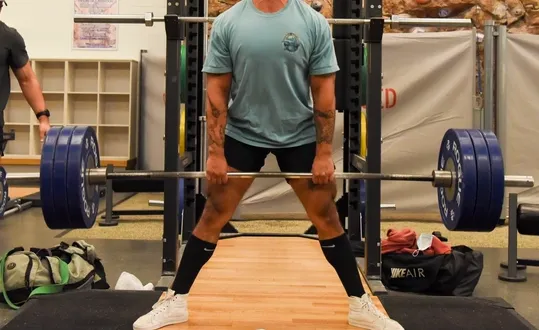
Set the stance. Take a stance wide enough that your shins are close to vertical when you grip the bar. Turn your toes out to match your hips and keep your knees tracking over your toes.
Grip inside the legs. Hands about shoulder width, arms hanging straight down.
Brace before the pull. Take a full breath into the belly and brace all the way around your trunk before the bar leaves the floor.
Lock in the lats. Pull the slack out of the bar, keep it over mid-foot, and keep it touching your shins.
Push the floor apart. Drive your knees out and your hips through, then stand tall without leaning back at the top.
Return on the same path. Lower the bar under control without losing your brace.
How to Program the Sumo Deadlift
For strength, keep heavy sumo work in the 3 to 6 rep range for 3 to 5 sets, once a week. This matches NSCA guidance that maximal strength comes from heavy loads at low reps. Use it as your main pull, or rotate it with conventional in alternating training blocks so both patterns stay sharp. If your build favors conventional, sumo still works as a secondary lift for 2 to 3 sets of 5 to 6, adding quad and adductor work at a lower cost to the back.
Pairing sumo with the Romanian deadlift
Sumo leaves the hamstrings slightly under-trained, so pair it with the Romanian deadlift, which loads the hamstrings through a long stretch. Put sumo first in the session for heavy loading, then the Romanian deadlift as an accessory for 3 sets of 8 to 10.
Building out the pulling day
Since sumo puts more of the posture job on the upper back, support it with compound back exercises such as rows and pull-ups, in the same session or on a separate day. For a full template that places these lifts in a week, see a strength workout for athletes.
FAQ: Frequently Asked Questions
What is the primary muscle in a sumo deadlift?
The gluteus maximus is the primary driver of the sumo deadlift. It extends the hip and finishes the lockout. The quads and adductors are close behind. The quads break the bar from the floor, and the adductor magnus adds hip extension throughout. Together these three make up the sumo deadlift’s primary muscle group.
Does the sumo deadlift work the quads?
Yes. The sumo deadlift works the quads more than a conventional deadlift does. The wide stance starts you with more knee bend and more vertical shins, so the quads do more work off the floor. EMG research on competitive lifters found higher vastus lateralis and vastus medialis activity in sumo. It does not replace squats for quad growth.
Is the sumo deadlift easier on the lower back?
For most lifters, yes. The upright torso shortens the lever between the bar and the lumbar spine. Biomechanics research shows lower lumbar loading in sumo than in conventional at similar weights. “Easier” does not mean “no load,” though. You still need a hard brace and a neutral spine, and a bad setup can overload the back in any style.
Does the sumo deadlift build the glutes?
Yes. The glutes work hard throughout the sumo deadlift, and the turned-out stance lines them up for a strong lockout. Because sumo lets you handle heavy loads over a full hip-extension range, it is an effective glute builder. Pair it with direct hip-extension work if glute size is a specific goal.
Who should do the sumo deadlift?
Sumo suits lifters with long femurs, a short torso, good hip mobility, or a lower back that needs a break from forward-lean pulling. It also suits athletes who want more quad and adductor work from their hinge. Lifters with limited hip external rotation may do better with conventional or a trap bar until that range improves.
The sumo deadlift’s main muscles are the glutes, quads, and adductors, supported by the hamstrings, erectors, upper back, and grip. The stance is what shifts the load. A more upright torso moves work off the lower back and onto the legs and upper back, which is why sumo keeps heavy pulling possible when conventional starts to wear you down. Knowing the muscle map is step one. Step two is placing sumo in a plan with the right loads, the right accessory work, and enough recovery around your conditioning. Start a structured program and train the pull on purpose.
References:
Escamilla RF, Francisco AC, Fleisig GS, Barrentine SW, Welch CM, Kayes AV, Speer KP, Andrews JR. A three-dimensional biomechanical analysis of sumo and conventional style deadlifts. Medicine & Science in Sports & Exercise. 2000;32(7):1265-1275.
Escamilla RF, Francisco AC, Kayes AV, Speer KP, Moorman CT. An electromyographic analysis of sumo and conventional style deadlifts. Medicine & Science in Sports & Exercise. 2002;34(4):682-688.
Cholewicki J, McGill SM, Norman RW. Lumbar spine loads during the lifting of extremely heavy weights. Medicine & Science in Sports & Exercise. 1991;23(10):1179-1186.
McGuigan MRM, Wilson BD. Biomechanical analysis of the deadlift. Journal of Strength and Conditioning Research. 1996;10(4):250-255.
Martín-Fuentes I, Oliva-Lozano JM, Muyor JM. Electromyographic activity in deadlift exercise and its variants: a systematic review. PLoS One. 2020;15(2):e0229507.
Neumann DA. Kinesiology of the hip: a focus on muscular actions. Journal of Orthopaedic & Sports Physical Therapy. 2010;40(2):82-94.
Haff GG, Triplett NT, eds. Essentials of Strength Training and Conditioning. 4th ed. National Strength and Conditioning Association. Human Kinetics; 2016.
McGill SM. Low Back Disorders: Evidence-Based Prevention and Rehabilitation. 3rd ed. Human Kinetics; 2016.
Disclaimer: This article is for educational purposes only and is not medical advice. Consult a qualified healthcare provider before starting a new training program, especially if you have a current or past back, hip, or knee injury. Individual results vary.


