
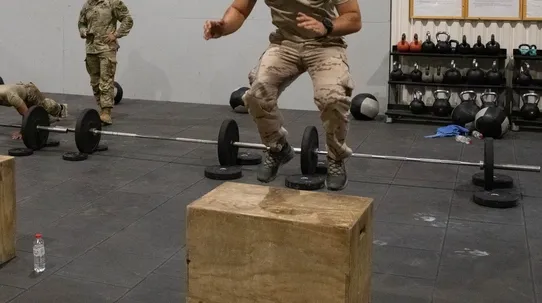
Seated Box Jump: Technique and Benefits | Combat Fitness
The Seated Box Jump: Build Explosive Power From a Dead Stop
A seated box jump is a plyometric jump where you start sitting on a bench, then drive up and forward onto a box from a dead stop. There is no dip and no rebound, so the movement trains pure concentric starting power: explosive hip extension from zero. We build that quality into our military fitness programs because tactical work rarely gives you a running start.
Driving up out of the prone, clearing a gap from a standstill, and exploding off one knee under kit all demand force from a static position. Jump research separates that quality from bounce-driven power. Below you get the step-by-step technique, the prime movers, the benefits, how the seated box jump compares to a standard box jump, the best variations, and how to program it.
How to Do a Seated Box Jump (Step by Step)
To do a seated box jump, sit on a bench at about knee height with your feet flat and hip-width apart. Swing your arms and drive through the floor to jump onto a box in front of you. Land softly in a quarter squat, stand tall, then step down. Every rep starts from a full pause.
Set the bench and box. Choose a bench height that puts your thighs roughly parallel to the floor. Place the box one to two feet in front of you. Start low, around 12 to 20 inches, until every landing is quiet.
Set your feet. Plant them flat, hip-width apart, toes forward, with shins vertical or slightly behind the knees.
Hold the dead stop. Sit tall, brace your trunk, and pause for one to two seconds. Do not rock. Rocking brings momentum back in and defeats the purpose of jumping from a seated position.
Drive. Swing your arms back, then forward and up, as you lean slightly forward and push the floor away. Extend your hips, knees, and ankles together.
Land. Hit the box with your whole foot, knees tracking over your toes and hips back. Your landing should be no deeper than your takeoff position.
Stand and step down. Lock out your hips, then step down one foot at a time.
The step-down matters. Jumping off the box turns every rep into a depth drop, a higher-impact exercise that loads the Achilles and knees without adding anything to the power you came to train.
Seated box jump progression: own quiet landings on a low box first, then raise the box in small increments, then add load or move to single-leg work. If you land deeper than you took off, or your shins clip the edge, the box is too high. Missed jumps and shin scrapes are the real injury risks with this exercise, and both come from ego, not from the movement.
What Muscles Does the Seated Box Jump Work?
The prime movers of a seated box jump are the glutes, quadriceps, hamstrings, and calves, working together to extend the hips, knees, and ankles. The glutes and hamstrings drive hip extension, the quads straighten the knees, and the calves finish the push through the balls of the feet.
The seated start puts your hips in deep flexion, so the glutes have to produce force from a lengthened position with no stretch-reflex assist. That is why the first few inches of the jump feel so hard. Supporting muscles matter too:
Trunk and core hold a rigid torso so hip force transfers into the jump instead of leaking out through a rounded back.
Shoulders and lats drive the arm swing, which measurably increases jump height by adding energy and lengthening the push (Lees et al., 2004).
Hip and ankle stabilizers control knee alignment on the landing.
These muscles get stronger from heavy squats and hinges, not from jumping alone. Power is force multiplied by speed, so the seated box jump sits on top of a strength workout for athletes, not in place of it.
Seated Box Jump Benefits: Why Train From a Dead Stop?
The main seated box jump benefit is training concentric starting power. Without a countermovement, the muscles must generate force from rest with no elastic energy to borrow. That builds rate of force development, cleaner triple extension, and explosive hip drive from static positions.
In a normal jump, the quick dip stretches the muscles and tendons right before the push. That stretch-shortening cycle stores elastic energy and, more importantly, gives the muscles time to build force before upward movement starts (Bobbert et al., 1996; Komi, 2000; Van Hooren and Zolotarjova, 2017). It is why a countermovement jump consistently beats a no-countermovement jump in height. The seated box jump removes that help. What you see is what your muscles produce from zero.
That matters because rate of force development, how fast you reach high force, is often more relevant to performance than peak force itself, and it responds well to explosive training (Aagaard et al., 2002; Maffiuletti et al., 2016). Other benefits:
Low landing stress. The box shortens the fall and you step down, so impact per rep stays low.
Low technical barrier. There is no timing to learn on the dip, so athletes reach quality reps quickly.
Honest feedback. Rocking or a soft start shows up immediately as a missed box.
Why Starting Power Matters for Tactical Athletes
Operators move from static positions constantly: up out of the prone, off a knee behind cover, over a gap from a standstill, or up a wall under load. None of those allow a rhythmic dip-and-bounce. The Army’s H2F doctrine lists power among the physical components soldiers need for combat tasks (Department of the Army, 2020). The seated box jump isolates exactly that quality, which is why it fits a power block built on functional strength for military performance rather than living only in a conditioning circuit.
Seated Box Jumps in CrossFit
Seated box jumps in CrossFit usually appear in high-rep metcons. That trains conditioning, not power. Power output drops fast with fatigue, so once reps turn sloppy you are rehearsing slow jumps and inviting missed landings. We program it the opposite way: low reps, full rest, every jump at maximum intent.
Broader explosiveness and vertical-jump training gets its own full treatment. The seated box jump is one tool inside that system, the one that targets the start of the movement.
Seated Box Jump vs. Box Jump: What’s the Difference?
The difference between a seated box jump and a box jump is the countermovement. A standard box jump uses a fast dip to load the legs elastically before takeoff. The seated version starts from a static seated position, removing that elastic contribution and isolating concentric starting power.
How the two compare:
Start position: standing with a quick dip, versus seated with a full pause.
Energy source: elastic energy plus muscle force, versus muscle force alone.
What it trains: reactive, stretch-shortening power, versus starting strength and rate of force development.
Box height: higher on the standard jump, lower on the seated version.
Best use: athletic, rhythmic movements, versus explosiveness from static positions.
Expect to clear a noticeably lower box seated than standing. A seated box jump to a high box is a demanding test of starting power, and your highest seated box jump is a useful benchmark to retest every training block.
Use both. Comparing countermovement and no-countermovement jump performance shows where an athlete stands: a large gap suggests good elastic ability but weak concentric output, and a small gap suggests the opposite (McGuigan et al., 2006). Program the weaker quality first. The standard box jump deserves its own full technique guide, and the seated version stays the dead-stop specialist.
Seated Box Jump Variations and How to Program Them
Once the basic seated box jump is clean and your landings are quiet, these variations add specificity or intensity. Change one variable at a time.
Single-Leg Seated Box Jump
The seated single-leg box jump starts with one foot planted and the other lifted. It exposes left-to-right power differences and builds the single-leg drive used in sprinting and climbing. Use a much lower box, land on the same leg, and expect a steep drop in height.
Weighted or Dumbbell Seated Box Jump
A weighted seated box jump uses light dumbbells at your sides or a weight vest. Keep the load light enough that jump height drops only a little, because loads that slow the jump shift the stimulus from speed toward strength (Cormie et al., 2011a, 2011b). A vest also mimics jumping under kit.
Seated Box Jump to a High or Tall Box
A seated high box jump raises the target once your form holds. Raise the box only when every rep lands at or above takeoff depth. A high box rewards pulling your knees up, not producing more power, so watch the landing position.
How to Program the Seated Box Jump
Program seated box jumps for 3 to 5 sets of 3 to 5 reps, with 1.5 to 3 minutes of rest between sets. Place them early in the session, after the warm-up and before heavy strength work, when the nervous system is fresh (Haff and Nimphius, 2012).
Frequency: one to three sessions per week, alongside your other plyometric and lower-body work.
Volume: count each jump as a ground contact. Plyometric research supports moderate, progressive volumes rather than high-rep sessions (de Villarreal et al., 2009; Markovic and Mikulic, 2010).
Pairing: follow with a heavy squat or trap-bar deadlift, or contrast it with standard box jumps.
Stop rule: end the set when height or landing quality drops.
If you want this built into a full plan, start with choosing a strength & endurance program to see where power work fits.
Frequently Asked Questions
What is a seated box jump?
A seated box jump is a plyometric exercise where you start seated on a bench and jump onto a box with no countermovement. Because you start from a dead stop, it trains concentric starting power and rate of force development rather than the elastic bounce a standard box jump uses.
What muscles does the seated box jump work?
The seated box jump works the glutes, quadriceps, hamstrings, and calves as prime movers, with the glutes and hamstrings driving hip extension. The trunk braces to transfer force, the shoulders power the arm swing, and the hip and ankle stabilizers control the landing.
What are the benefits of a seated box jump?
Seated box jump benefits include stronger starting power, faster rate of force development, and better hip extension from static positions. It also carries low landing stress because you step down, it is easy to learn, and it gives honest feedback on true concentric power.
Seated box jump vs. regular box jump: what is the difference?
A regular box jump uses a quick dip that stores elastic energy before takeoff. A seated box jump removes that dip, so muscle force alone drives the jump. The regular version trains reactive power and clears higher boxes; the seated version isolates starting power.
How high should the box be for a seated box jump?
Start with a box around 12 to 20 inches and raise it only when every landing is quiet and no deeper than your takeoff position. The right height challenges your drive without making you tuck your knees to clear the edge. Most athletes clear a lower box seated than standing.
Is the seated box jump good for building vertical jump?
Yes. The seated box jump builds the concentric power behind the start of every jump, especially for athletes who rely on bounce and lack raw drive. Results come fastest when you pair it with heavy squats, hinges, and countermovement jumps in a structured plan.
How many sets and reps of seated box jumps should you do?
Do 3 to 5 sets of 3 to 5 reps with 1.5 to 3 minutes of rest, one to three times per week. Keep reps low so every jump is at full speed, and end the set when height or landing quality drops.
The seated box jump strips a jump down to what your muscles produce from zero, which makes it one of the cleanest tools available for starting power. Set the bench at knee height, hold the dead stop, drive hard, land quiet, and step down. Keep the reps low and the intent high.
Knowing the movement is the easy part. Turning it into measurable power means placing it correctly inside a strength base and progressing it block by block. Start a structured CF ONE plan and train the power your job demands.
References:
Aagaard P, Simonsen EB, Andersen JL, Magnusson P, Dyhre-Poulsen P. Increased rate of force development and neural drive of human skeletal muscle following resistance training. Journal of Applied Physiology. 2002;93(4):1318-1326.
Bobbert MF, Gerritsen KG, Litjens MC, Van Soest AJ. Why is countermovement jump height greater than squat jump height? Medicine and Science in Sports and Exercise. 1996;28(11):1402-1412.
Chu DA, Myer GD. Plyometrics. Champaign, IL: Human Kinetics; 2013.
Cormie P, McGuigan MR, Newton RU. Developing maximal neuromuscular power: Part 1. Biological basis of maximal power production. Sports Medicine. 2011;41(1):17-38.
Cormie P, McGuigan MR, Newton RU. Developing maximal neuromuscular power: Part 2. Training considerations for improving maximal power production. Sports Medicine. 2011;41(2):125-146.
de Villarreal ES, Kellis E, Kraemer WJ, Izquierdo M. Determining variables of plyometric training for improving vertical jump height performance: a meta-analysis. Journal of Strength and Conditioning Research. 2009;23(2):495-506.
Department of the Army. FM 7-22, Holistic Health and Fitness. Washington, DC: Headquarters, Department of the Army; October 2020.
Haff GG, Nimphius S. Training principles for power. Strength and Conditioning Journal. 2012;34(6):2-12.
Haff GG, Triplett NT, eds. Essentials of Strength Training and Conditioning. 4th ed. Champaign, IL: Human Kinetics; 2016.
Hewett TE, Stroupe AL, Nance TA, Noyes FR. Plyometric training in female athletes: decreased impact forces and increased hamstring torques. American Journal of Sports Medicine. 1996;24(6):765-773.
Komi PV. Stretch-shortening cycle: a powerful model to study normal and fatigued muscle. Journal of Biomechanics. 2000;33(10):1197-1206.
Lees A, Vanrenterghem J, De Clercq D. Understanding how an arm swing enhances performance in the vertical jump. Journal of Biomechanics. 2004;37(12):1929-1940.
Maffiuletti NA, Aagaard P, Blazevich AJ, Folland J, Tillin N, Duchateau J. Rate of force development: physiological and methodological considerations. European Journal of Applied Physiology. 2016;116(6):1091-1116.
Markovic G, Mikulic P. Neuro-musculoskeletal and performance adaptations to lower-extremity plyometric training. Sports Medicine. 2010;40(10):859-895.
McGuigan MR, Doyle TL, Newton M, Edwards DJ, Nimphius S, Newton RU. Eccentric utilization ratio: effect of sport and phase of training. Journal of Strength and Conditioning Research. 2006;20(4):992-995.
Van Hooren B, Zolotarjova J. The difference between countermovement and squat jump performances: a review of underlying mechanisms with practical applications. Journal of Strength and Conditioning Research. 2017;31(7):2011-2020.
Disclaimer: This article is for educational purposes only and is not medical advice. Plyometric training carries a risk of injury, including falls and impact stress on the knees, ankles, and Achilles tendon. Consult a qualified healthcare provider before starting a new training program, especially if you have a history of lower-body injury. Individual results vary.


