
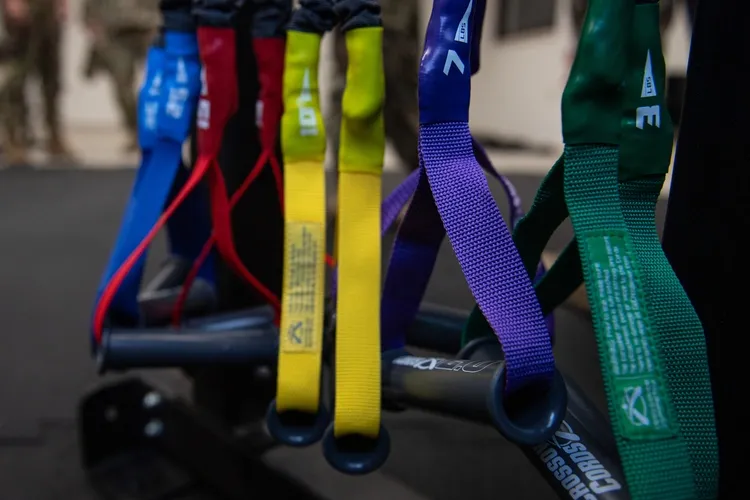
Resistance Band Chest Exercises: 8 Moves | Combat Fitness
Resistance Band Chest Exercises: Build Your Chest Anywhere
Resistance band chest exercises let you build and hold pressing strength anywhere: a barracks room, a hotel floor, the back of a vehicle, or a field site with a fence post. If you want that work built into a structured plan instead of pieced together, our tactical fitness programs program band sessions alongside the rest of your training.
We program band work for service members who lose gym access for weeks at a time, and the research backs it: elastic resistance produces strength gains comparable to free weights and machines when effort and progression are matched. Below are the eight band chest moves worth your time, how to anchor each one, how anchor height shifts the work toward your upper or lower chest, and a complete session you can run from a bag.
Key Takeaways:
Bands build strength comparable to free weights and machines when you train close to failure and progress the load.
The banded chest press is the staple. Anchor behind you at chest height and step out until the band carries tension at the start.
Anchor height steers emphasis: a low anchor biases the upper chest, a high anchor biases the lower chest.
Bands load the lockout heavily and the stretch lightly, so use higher reps, slow lowering phases, and pauses.
One heavy band, one door anchor, and 30 minutes cover a full push session anywhere.
Why Train Chest with Resistance Bands?
Chest resistance band training gives you a full pressing session with no gym, no rack, and almost no weight in your pack. A set of loop bands weighs under two pounds and survives being stuffed into a ruck. That matters when you are deployed, on a TDY, in a training area for three weeks, or working rotating shifts that make gym hours unreliable.
The evidence supports the trade. A 2019 meta-analysis found that training with elastic resistance produced strength gains similar to conventional weights and machines across a range of populations. A separate trial found that elastic-band push-ups and the bench press, matched for muscle activity, produced similar strength gains over five weeks. The mechanism is simple: muscle responds to tension and effort, not to the source of the load.
Bands also behave differently from iron. Tension rises as the band stretches, so resistance is lightest where your shoulder sits in its most vulnerable stretched position and heaviest at lockout, where you are mechanically strongest. That ascending curve is easier on irritated shoulders and elbows, which is why chest exercises with bands are a common choice when a joint needs a break from heavy barbell work.
Bands are a tool, not a whole program. They keep your pressing strength and muscle intact when you are away from a gym, and they fit the broader idea of functional strength for military performance: strength you can build and keep wherever the job puts you. If you are weighing how band work fits into a complete plan, our guide to choosing a strength & endurance program covers what to look for.
How Do You Do a Banded Chest Press?
The banded chest press is a horizontal push performed with a band anchored behind you at chest height, pressing forward until your arms lock out. It is the most direct band substitute for the bench press, and it is the foundation of every resistance band chest workout we program.
How to Anchor the Band
Anchor point determines everything. Use a door anchor closed on the hinge side of a solid door, a sturdy post, a vehicle tow hook, or a pull-up bar upright. Check the anchor before every set, because a band that slips under load snaps straight back at you.
Set the anchor at mid-chest height for a flat press. Then step forward until the band carries noticeable tension with your hands at your chest. That pretension is the fix for the band’s weak spot: without it, the first third of each rep does almost nothing.
Standing Banded Chest Press: Step by Step
Face away from the anchor with a handle or band end in each hand at chest height.
Step forward into a staggered stance, front knee soft, weight over the middle of your feet.
Brace your trunk as if you are about to take a punch, and pull your shoulder blades slightly back.
Press forward and slightly inward until your elbows lock and your hands nearly meet.
Pause one second at lockout, then return over two to three seconds.
The chest press with band rewards control. Rushing the return lets the band yank your shoulders forward, which steals tension from the pecs and loads the front of the shoulder.
Split-Stance Single-Arm Press
Press one arm at a time from a long split stance, opposite leg forward. The band now tries to rotate you toward the anchor, so your trunk works hard to stay square. This version mirrors how you push in the real world: one arm, unstable footing, the rest of your body fighting to stay organized. It also lets you work each side to failure with a band that would be too light for a two-arm press.
How Do You Do a Banded Pec Fly?
The banded pec fly trains horizontal adduction, the pec’s primary job of drawing the upper arm across the body. Anchor at chest height behind you, take a handle in each hand with arms open wide and elbows slightly bent, then sweep your hands forward in a wide arc until they meet in front of your sternum.
Pec flys with resistance bands deliver their peak tension at the point where your hands come together, which is where dumbbell flys go nearly slack. Squeeze for a full second there. Keep the elbow angle fixed throughout; if your elbows bend and straighten, the fly has turned into a sloppy press. These pectoral resistance band exercises work best in the 15 to 20 rep range, where you can hold the arc and own the contraction.
Banded Push-Up and Other Band Chest Moves
A full chest workout using resistance bands needs more than the press and fly. These three round out the roundup.
Banded Push-Up
Loop a band across your upper back and pin each end under your palms, then perform a standard push-up. The band adds the most resistance at the top, where bodyweight push-ups get easy. The resistance band push-up is the most efficient way to keep push-ups productive for anyone who can already crank out 50, and it costs no anchor point at all.
Band Crossover
Anchor two bands (or one long band around a post) above head height and step forward. Pull your hands down and across your body so they cross at hip level, like a cable crossover. The band crossover for chest trains the pec through a different line than the fly and is a strong finisher.
Banded Floor Press
Lie on your back with the band across your upper back and the ends in your hands, then press up. The floor stops your elbows at a safe depth, which makes this the best option for shoulders that dislike a deep stretch. It also lets you use a heavier band than any standing variation, because your trunk does not need to resist being pulled backward.
How Do You Hit Upper vs. Lower Chest with Bands?
Anchor height changes the pressing line, and the pressing line changes which part of the pec does the most work. A low anchor with an upward press biases the upper (clavicular) chest. A high anchor with a downward press biases the lower (sternocostal) chest.
Incline Band Press (Low Anchor)
Anchor the band near the floor behind you and press up and forward at roughly 30 to 45 degrees, finishing with your hands around eye level. Studies on incline bench angles show upper pec activity rises as the press angle climbs, while too steep an angle hands the work to the front delts. Keep the line moderate. This is your primary upper chest resistance band exercise.
Decline Band Press (High Anchor)
Anchor above head height and press down and forward, finishing with your hands around navel level. Research on decline pressing shows greater lower pec activation than incline pressing. Lower chest band exercises like this one also spare the shoulder, since the arm never travels overhead under load.
Resistance Bands vs. Cables vs. Dumbbells for Chest
Each tool loads the chest differently, and the differences dictate when to use which.
Bands vs. Cables
Cable chest exercises deliver near-constant tension through the full range, with weight plates you can change in seconds. Bands copy the cable’s line of pull but not its even tension, since band resistance climbs as it stretches. When you have a cable stack, use it for precise loading. When you do not, a band anchored at the same height reproduces the movement pattern closely enough to keep your training on track.
Bands vs. Dumbbells
The dumbbell fly and dumbbell press load the stretched position heavily and go light at the top. Bands do the reverse. Emerging research suggests training muscles at long lengths may favor growth, which is one honest advantage dumbbells hold. Bands win on portability, joint comfort, and loading the lockout. For most deployed or travelling athletes, the right answer is both: dumbbells when you have them, bands when you do not.
A Sample Resistance Band Chest Workout
This resistance band chest workout runs about 30 minutes with one door anchor and two or three bands of different tension. Rest 60 to 90 seconds between sets. Choose a band that brings you within one or two reps of failure on every working set.
Standing banded chest press: 4 sets of 12 to 15, 3-second return.
Incline band press (low anchor): 3 sets of 12 to 15.
Split-stance single-arm press: 3 sets of 10 to 12 per side.
Banded pec fly: 3 sets of 15 to 20, 1-second squeeze at the finish.
Decline band press (high anchor): 2 sets of 15.
Banded push-up: 2 sets to 1 rep short of failure.
That is 17 working sets, enough for a full chest stimulus in one session. If you are building band work into a broader week, run it as the push day inside a strength workout for athletes and keep your lower body and pulling sessions in place.
How to Program Band Chest Training on Deployment, Travel, and at Home
Bands change three variables: reps, tempo, and how you progress.
Reps run higher. Bands top out lighter than a loaded barbell, so most work lands in the 12 to 20 rep range. That is not a compromise for growth. A meta-analysis comparing low-load and high-load training found similar hypertrophy when sets were taken close to failure, though heavy loads still build more maximal strength. Expect to hold muscle and work capacity on bands and to need a few weeks of reintroduction before testing a heavy bench again.
Tempo does the heavy lifting. A three-second return and a one-second pause at the stretch add time under tension where the band is lightest. This is the simplest way to make a light band hard.
Progress tension, not just reps. Move up in this order: add reps within the range, then slow the tempo, then step farther from the anchor, then double up bands or move to a heavier one. Each step adds load in small increments, which follows the progressive overload principle laid out by the American College of Sports Medicine.
Volume target. Research on training volume links roughly 10 or more hard weekly sets per muscle to greater growth than lower volumes. Two band chest sessions a week of 8 to 10 sets each covers it. On the road, that is two 25-minute sessions in a hotel room.
Frequently Asked Questions
What are the best resistance band chest exercises?
The best resistance band chest exercises are the standing banded chest press, the banded pec fly, the banded push-up, and the incline and decline band presses. Together they train horizontal pressing, horizontal adduction, and both the upper and lower pec. Add the floor press if your shoulders need a shorter range and the crossover as a finisher.
Can you build your chest with just resistance bands?
Yes. Training with elastic resistance produces strength gains comparable to conventional weights, and lighter loads build similar muscle when sets are taken near failure. The limits are maximal strength, which still requires heavy loading, and the light stretched position. For maintaining and building chest size on deployment or travel, bands do the job.
How do you anchor a band for chest exercises?
Close a door anchor in the hinge side of a solid door, or loop the band around a post, rack upright, or tow hook. Set chest height for flat presses, floor level for incline work, and above head height for decline presses and crossovers. Test the anchor before every set and step out until the band is tense at the start.
Are resistance bands as effective as dumbbells for chest?
For strength and muscle gains, research shows elastic resistance performs comparably when effort and progression are matched. The two tools load the range of motion differently: dumbbells are heaviest in the stretch, bands are heaviest at lockout. Dumbbells have a slight edge for loading long muscle lengths; bands win on portability and joint comfort.
How many reps should you do with bands for chest?
Most band chest work belongs in the 12 to 20 rep range, ending each set one or two reps short of failure. Presses sit at 12 to 15, flys and crossovers at 15 to 20. If you pass 25 reps with control, increase tension by stepping farther from the anchor or switching to a heavier band.
Resistance band chest exercises turn any doorframe, post, or vehicle into a pressing station, and they hold your strength together during the weeks when a gym is not an option. Master the banded press, use anchor height to cover the upper and lower chest, and progress tension the same way you would progress a barbell. Pack the bands before your next field problem or deployment, and start the sample session on your first night out. Want the whole week programmed around your schedule and your standard? Start with the program that matches your job.
References:
Lopes JSS, Machado AF, Micheletti JK, de Almeida AC, Cavina AP, Pastre CM. Effects of training with elastic resistance versus conventional resistance on muscular strength: a systematic review and meta-analysis. SAGE Open Medicine. 2019;7:2050312119831116.
Calatayud J, Borreani S, Colado JC, Martin F, Tella V, Andersen LL. Bench press and push-up at comparable levels of muscle activity results in similar strength gains. Journal of Strength and Conditioning Research. 2015;29(1):246-253.
Kikuchi N, Nakazato K. Low-load bench press and push-up induce similar muscle hypertrophy and strength gain. Journal of Exercise Science and Fitness. 2017;15(1):37-42.
Colado JC, Triplett NT. Effects of a short-term resistance program using elastic bands versus weight machines for sedentary middle-aged women. Journal of Strength and Conditioning Research. 2008;22(5):1441-1448.
McMaster DT, Cronin J, McGuigan MR. Quantification of rubber and chain-based resistance modes. Journal of Strength and Conditioning Research. 2010;24(8):2056-2064.
McMaster DT, Cronin J, McGuigan M. Forms of variable resistance training. Strength and Conditioning Journal. 2009;31(1):50-64.
Andersen V, Fimland MS, Kolnes MK, Saeterbakken AH. Elastic bands in combination with free weights in strength training: neuromuscular effects. Journal of Strength and Conditioning Research. 2015;29(10):2932-2940.
Trebs AA, Brandenburg JP, Pitney WA. An electromyography analysis of 3 muscles surrounding the shoulder joint during the performance of a chest press exercise at several angles. Journal of Strength and Conditioning Research. 2010;24(7):1925-1930.
Rodríguez-Ridao D, Antequera-Vique JA, Martín-Fuentes I, Muyor JM. Effect of five bench inclinations on the electromyographic activity of the pectoralis major, anterior deltoid, and triceps brachii during the bench press exercise. International Journal of Environmental Research and Public Health. 2020;17(19):7339.
Glass SC, Armstrong T. Electromyographical activity of the pectoralis muscle during incline and decline bench presses. Journal of Strength and Conditioning Research. 1997;11(3):163-167.
Lauver JD, Cayot TE, Scheuermann BW. Influence of bench angle on upper extremity muscular activation during bench press exercise. European Journal of Sport Science. 2016;16(3):309-316.
Maeo S, Wu Y, Huang M, et al. Triceps brachii hypertrophy is substantially greater after elbow extension training performed in the elongated position. European Journal of Sport Science. 2023;23(7):1240-1250.
Schoenfeld BJ, Grgic J, Ogborn D, Krieger JW. Strength and hypertrophy adaptations between low- vs. high-load resistance training: a systematic review and meta-analysis. Journal of Strength and Conditioning Research. 2017;31(12):3508-3523.
Morton RW, Oikawa SY, Wavell CG, et al. Neither load nor systemic hormones determine resistance training-mediated hypertrophy or strength gains in resistance-trained young men. Journal of Applied Physiology. 2016;121(1):129-138.
Schoenfeld BJ, Ogborn D, Krieger JW. Dose-response relationship between weekly resistance training volume and increases in muscle mass: a systematic review and meta-analysis. Journal of Sports Sciences. 2017;35(11):1073-1082.
American College of Sports Medicine. Position stand: progression models in resistance training for healthy adults. Medicine and Science in Sports and Exercise. 2009;41(3):687-708.
Headquarters, Department of the Army. FM 7-22: Holistic Health and Fitness. Washington, DC; 2020.
Disclaimer: This article is for educational purposes only and is not medical advice. Consult a qualified healthcare provider before starting a new training program, especially if you have a shoulder, elbow, or other injury. Inspect bands for nicks and wear before every session and replace damaged bands immediately. Individual results vary with training history, effort, nutrition, and recovery.


