
Military Calisthenics Workout: 30-Day Plan | Combat Fitness
The Military Calisthenics Workout: No-Equipment Training the Military Way
A military calisthenics workout is bodyweight training done the way the military trains: high volume, little or no equipment, and built around the movements that show up on service fitness tests. If you want it programmed for you instead of pieced together, our military fitness programs build it into a structured plan.
Bodyweight strength is still tested across the services. The Army Fitness Test includes the hand-release push-up and the plank alongside the deadlift, sprint-drag-carry, and two-mile run, and the Marine Corps PFT is pull-ups or push-ups, the plank, and a 3-mile run. Below you get the core movements, a full sample workout, 15-minute and 7-minute versions, a 30-day progression, and scaling for beginners and women, with the reasoning behind each choice.
Key Takeaways:
A military calisthenics workout builds muscular endurance, bodyweight strength, and work capacity with almost no equipment.
The core movements are push-ups, pull-ups, air squats, sit-ups, lunges, burpees, flutter kicks, mountain climbers, and planks.
Train it 3 to 4 days per week, stop most sets 1 to 3 reps short of failure, and progress reps, rounds, rest, and leverage in that order.
Beginners and women use the same movements; what changes is the starting variation and the rep scheme, not the plan.
Calisthenics alone covers most test events, but heavy lifts like the AFT deadlift still need loaded strength work.
What Is a Military Calisthenics Workout?
A military calisthenics workout is a bodyweight training session built on the movements the armed forces use for physical training and testing: push-ups, pull-ups, squats, lunges, sit-ups, and full-body conditioning drills. It trains strength, muscular endurance, and work capacity together, with no gym required.
The term covers several search phrasings (calisthenics military workout, military workout calisthenics, military style calisthenics workout), but they describe the same thing. What separates it from general calisthenics is purpose. A gymnastics-focused calisthenics athlete chases skills like the muscle-up or planche. The military version chases repeatable output: how many quality push-ups you can produce in two minutes, how many pull-ups you can hold form on, and how well you still move after a hard conditioning block.
That focus shaped Army doctrine for decades. Army physical readiness training, first in TC 3-22.20 and now in FM 7-22, uses bodyweight drills as the base for preparation, conditioning, and recovery work because they can be run with a full formation in any open space.
Why Is Calisthenics the Military’s Foundation?
Calisthenics is the military’s foundation because it is the only training method that works anywhere, for everyone, at the same time. A platoon in a parking lot, a recruit in a hotel room before shipping, and an operator on deployment can all run the same session with nothing but floor space and a bar.
The benefits of military calisthenics go beyond convenience:
It trains the tested movements directly. Push-ups and planks are scored events, so practicing them builds the specific endurance the test measures.
It scales instantly. Change hand height, leverage, or tempo and the same movement fits a recruit or a selection candidate.
It builds work capacity. Circuits of bodyweight movements raise heart rate and train you to produce force while breathing hard, which is the condition you face under load.
It produces real strength. Kotarsky and colleagues found that progressively loaded push-ups increased bench press strength and muscle thickness comparably to bench press training over four weeks. Calatayud and colleagues found similar strength gains between push-ups and bench press when muscle activation was matched.
The evidence extends to military populations. Gist and colleagues put Army ROTC cadets through low-volume, high-intensity whole-body calisthenics and found aerobic fitness and muscular endurance improved comparably to traditional endurance training.
Calisthenics vs. a Military Gym Workout
The trade-off is maximal strength. Bodyweight work caps your load at your own mass, so it builds strength well up to a point and then mostly builds endurance. Research on low-load training shows muscle growth is similar between light and heavy loads taken close to failure, but maximal strength gains favor heavier loads (Schoenfeld et al., 2017). That matters when your test includes a three-rep max deadlift.
The practical answer is to treat calisthenics as the base and add loaded lifting when your job or test demands it. If you have barbell access, pair this plan with a strength workout for athletes on separate days. If you are deciding between running calisthenics on your own and following a full structured plan, our guide to choosing a tactical fitness program lays out what to look for.
What Are the Core Military Calisthenics Exercises?
The core military calisthenics exercises are push-ups, pull-ups or chin-ups, air squats, sit-ups, lunges, burpees, flutter kicks, mountain climbers, and planks. Together they cover pushing, pulling, squatting, lunging, trunk stability, and full-body conditioning, which is every pattern a tactical athlete needs from bodyweight work.
These military bodyweight exercises carry over because they train the same patterns you use when you climb, crawl, lift, and carry. That transfer is the core of functional strength for military performance: the strength has to show up in the job, not only on a test.
Push-Ups
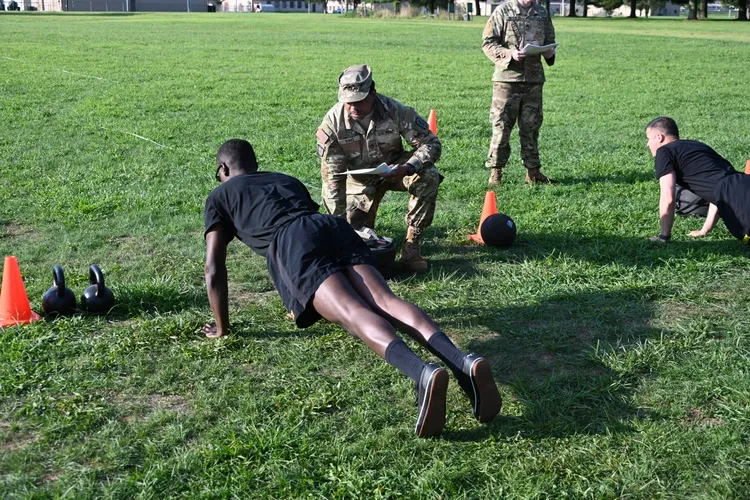
Hands just outside shoulder width, body rigid from heels to head, chest to fist height or lower, full lockout at the top. Train the hand-release variation too, since the Army scores it and it removes the bounce out of the bottom.
Pull-Ups and Chin-Ups
Start from a dead hang with arms fully extended, pull until your chin clears the bar, and lower under control. Overhand pull-ups load the lats and grip harder; underhand chin-ups bring in more biceps and are usually a rep or two easier. Marines who can do pull-ups should, because push-ups cap the upper-body event below a full score.
Air Squats
Feet shoulder width, sit the hips back and down until the crease of the hip drops below the knee, drive up through the whole foot. Air squats build the leg endurance you need for long movements and stair-heavy work.
Sit-Ups
Knees bent, feet anchored or free, curl up until your elbows reach your knees. Keep them in the plan for hip flexor and trunk endurance, even though several branches now test the plank instead.
Lunges
Step forward or back into a long stride, drop the back knee toward the ground, and stand tall. Lunges train single-leg strength and balance, which is the position your legs are in on uneven terrain under a ruck.
Burpees
Squat, kick back to a plank, chest to the deck, snap the feet in, and jump. Burpees combine a push, a hinge, and a jump, so they drive heart rate up faster than almost any other bodyweight movement.
Flutter Kicks
Lie on your back, hands under the hips, legs straight and a few inches off the ground, and alternate small kicks. Count in four-count reps as the military does. The low-back position should stay pressed to the deck.
Mountain Climbers
From a high plank, drive one knee toward the chest and switch legs at speed. They train trunk stability while your heart rate is high, which is the combination that falls apart first late in a test.
Planks
Forearms under shoulders, body in one straight line, glutes and abs braced. The plank is now a scored event in the Army, Marine Corps, and Navy tests, so build holds of two minutes or longer with perfect position.
Dips
If you have parallel bars or two sturdy chairs, dips add a vertical pushing pattern that loads the triceps and chest through a longer range than push-ups. Keep the shoulders down and stop when the upper arm reaches parallel.
A Sample Military Calisthenics Workout Routine
This military calisthenics workout routine takes about 40 to 45 minutes and trains strength first, conditioning second, and trunk last. That order matters: pull-ups and push-ups need to be done fresh to build strength with clean reps, while conditioning work is supposed to be done tired.
Warm-up (2 rounds): 20 jumping jacks, 10 air squats, 10 walking lunges, 5 inchworms. Rest as needed.
Block 1: Strength (4 rounds): 5 to 8 pull-ups (or 2 short of your max), 15 to 25 push-ups, 10 walking lunges per leg. Rest 90 seconds after each round.
Block 2: Conditioning (3 rounds): burpees, mountain climbers, air squats, flutter kicks, and sit-ups, 40 seconds of work and 20 seconds of rest each. Rest 60 seconds between rounds.
Block 3: Core: 3 planks of 45 to 60 seconds, with 30 seconds of rest.
Why it is built this way: stopping strength sets one to three reps short of failure keeps every rep clean and lets you repeat quality volume across four rounds. The timed conditioning block replicates the stop-start effort of a field day or a fitness test. The plank goes last because it trains holding position under fatigue, which is how you will be tested.
Treat this sample military calisthenics workout plan as your default session. The next sections show how to compress it, progress it across 30 days, and scale it.
The 15-Minute and 7-Minute Military Calisthenics Workouts
A 15-minute military calisthenics workout works when you treat density as the goal. You will not match the volume of a 45-minute session, but you can keep strength and conditioning moving forward on busy days, during field time, or on travel.
The 15-Minute AMRAP
Set a clock for 15 minutes and complete as many rounds as possible of:
5 pull-ups
10 push-ups
15 air squats
Record your total rounds. Repeat the workout every two to three weeks and the number gives you a simple benchmark for work capacity. Scale the pull-ups to inverted rows or negatives if you cannot hold quality through the whole clock.
The 7-Minute Version
The 7-minute military calisthenics workout traces back to Klika and Jordan’s 2013 high-intensity circuit, which uses 12 bodyweight exercises for 30 seconds each with 10 seconds of transition. A military version: jumping jacks, wall sit, push-ups, sit-ups, step-ups, air squats, dips on a chair, plank, high knees, lunges, push-up with rotation, and side plank.
Short protocols have support behind them. McRae and colleagues found that a four-minute whole-body bodyweight circuit, done four days per week, improved aerobic fitness and muscular endurance in recreationally active women. Use the short versions to maintain fitness, not as your whole program.
How Does a 30-Day Military Calisthenics Challenge Progress?
A 30-day military calisthenics challenge progresses by adding volume for three weeks, cutting it back in week four, and retesting. That structure lets fitness build and then lets fatigue clear so your retest numbers reflect what you gained.
Week 1 (Days 1 to 7): Day 1 test, then 3 sessions of the sample workout at 3 strength rounds and 2 conditioning rounds. Purpose: baseline and movement quality.
Week 2 (Days 8 to 14): 4 sessions of the full sample workout (4 strength rounds, 3 conditioning rounds). Purpose: build volume.
Week 3 (Days 15 to 21): 4 sessions with strength rest cut from 90 to 60 seconds; one session is the 15-minute AMRAP. Purpose: build density.
Week 4 (Days 22 to 28): 3 sessions with volume down about a third and intensity held. Purpose: shed fatigue.
Days 29 to 30: repeat the Day 1 test, then rest. Purpose: measure progress.
The Day 1 and Day 29 test: max push-ups in two minutes, max strict pull-ups, max plank hold. Running a 28-day military calisthenics workout instead? Retest on day 28 and cut week four to five days.
The plan on this page fits on one printed sheet. Write your Day 1 numbers at the top and log every session below it; the log is what tells you whether to add volume or hold.
How Should Beginners Start a Military Calisthenics Workout?
Beginners should start a military calisthenics workout with easier variations of the same movements, two rounds instead of four, and three sessions per week. The goal for the first month is consistent quality reps, not exhaustion. Tendons and joints adapt slower than muscle, so building volume gradually keeps you training.
That matters for anyone heading to basic training. Knapik and colleagues found that low baseline fitness was a risk factor for training-related injuries in Army basic combat training. Showing up already able to handle bodyweight volume is cheap injury insurance.
Push-up: start with incline push-ups (hands on a bench). Progress to 3 x 10 strict floor push-ups.
Pull-up: start with inverted rows, band-assisted pull-ups, and 3 to 5 second negatives. Progress to 1 strict pull-up, then sets of 3.
Air squat: start by squatting to a bench or box. Progress to 3 x 20 full-depth squats.
Lunge: start with reverse lunges holding a support. Progress to walking lunges.
Burpee: start with step-back burpees, no push-up. Progress to the full burpee.
Sit-up: start with dead bugs or crunches. Progress to a 2-minute sit-up set.
Plank: start with a plank from the knees. Progress to a 60-second full plank.
Free military calisthenics workout for beginners: run the sample workout with two strength rounds and two conditioning rounds using the variations above. When you hit the “progress to” target on a movement for two sessions in a row, move to the next variation.
Military Calisthenics Workout for Women
A military calisthenics workout for women uses the same movements, the same structure, and the same progression as everyone else. What changes is where some women start on the upper-body pulling and pushing movements, and the answer to that is scaling, not a different program.
Standards are moving in the same direction. The Army’s AFT combat standard is sex-neutral and age-normed, and combat arms Marines now follow sex-neutral PFT scoring, while non-combat arms Marines still use sex- and age-normed standards. If you are training for a combat job, train to the same numbers.
The physiology explains where to focus. Women on average have less absolute upper-body strength than men, with a larger gap in the upper body than the lower body (Miller et al., 1993). That makes pull-ups the most common limiter. Women also tend to show greater fatigue resistance in many tasks (Hunter, 2014), which means you can often handle more frequent submaximal pulling practice. Kraemer and colleagues showed that structured resistance training substantially improved women’s upper-body strength and military occupational task performance.
0 reps: for pull-ups, do 5 sets of 1 to 3 slow negatives plus inverted rows, 4 days per week. For push-ups, do incline push-ups, 3 x 8 to 12.
1 to 3 reps: for pull-ups, run ladders (1, 2, 3, repeat) for 3 to 5 ladders. For push-ups, do floor push-ups in sets of 5 to 8.
4+ reps: for pull-ups, do 5 to 8 sets at half your max. For push-ups, do sets at 50 to 60 percent of your 2-minute max.
Military calisthenics workout for women beginners: start with the beginner table above and add the pulling plan from this table on four days per week. The rest of the sample workout stays the same. That is the full military calisthenics for women workout plan.
How Often Should You Do a Military Calisthenics Workout?
Do a full military calisthenics workout three to four days per week, with at least one easier day between sessions that train the same movements hard. Research on resistance training frequency shows total weekly volume drives strength gains more than how many days you split it across (Grgic et al., 2018), so pick the schedule you can repeat.
Daily Practice Without Overtraining
A daily military calisthenics workout can work if most days are submaximal. Short practice sets spread through the day (a few sets of pull-ups at half your max, for example) build skill and volume without the fatigue of hard sets. Keep two or three days per week for the full sample workout and treat the rest as practice.
How to Progress Your Military Calisthenics Workout Program
Progress one lever at a time, in this order:
Reps: add reps until you hit the top of the range.
Sets or rounds: add one round.
Density: cut rest periods.
Leverage: move to harder variations (decline push-ups, archer push-ups, pistol squat progressions).
Tempo: slow the lowering phase to three seconds.
This follows the American College of Sports Medicine’s progression model: steady, small overload increases that the body can adapt to between sessions.
Combining Calisthenics With Runs and Rucks
Most tactical athletes need to run and ruck as well. Concurrent training interference is real but manageable. Wilson and colleagues found that interference with strength and muscle gains was linked most closely to running frequency and duration. Put calisthenics before runs when they share a day, or separate hard runs and hard calisthenics by six hours or more.
A sample week:
Monday: Sample workout + easy 20 to 30 minute run
Tuesday: Run intervals
Wednesday: Sample workout
Thursday: Ruck
Friday: 15-minute AMRAP + core
Saturday: Long easy run
Sunday: Rest
FAQ: Frequently Asked Questions
Can you get military-level fit with just calisthenics?
Calisthenics can take you to a passing score on most military fitness test events, including push-ups, pull-ups, the plank, and the conditioning needed for runs. It falls short on maximal strength events like the Army’s three-rep max deadlift and on load carriage, so add loaded lifting and rucking when your test or job demands them.
What exercises are in a military calisthenics workout?
A military calisthenics workout centers on push-ups, pull-ups or chin-ups, air squats, sit-ups, lunges, burpees, flutter kicks, mountain climbers, and planks. Dips are a useful addition if you have bars. Those movements cover pushing, pulling, squatting, single-leg work, trunk stability, and conditioning, which is every major pattern a tactical athlete needs.
Is there a free printable military calisthenics workout plan?
Yes. The sample workout and the 30-day progression on this page are free and fit on one printed sheet. Print the tables, write your Day 1 test numbers at the top, and log each session. The log matters more than the paper: it shows you when to add volume and when to hold.
How long should a military calisthenics workout be?
A full military calisthenics workout should take 40 to 45 minutes including the warm-up. Short sessions of 7 to 15 minutes work well for maintenance and busy days, but they cannot replace the volume of full sessions. Plan for at least two to three full sessions per week to keep improving.
Can you do military calisthenics every day?
You can do military calisthenics every day if most sessions are submaximal. Hard sets to near failure on the same movements need about 48 hours of recovery. A good split is two to four full sessions per week, with low-intensity practice sets on the other days to build skill without piling up fatigue.
Do military calisthenics build muscle?
Military calisthenics build muscle when sets are taken close to failure and progressed over time. Research shows light and heavy loads produce similar muscle growth when effort is high. Once you can do more than 25 to 30 reps of a movement, switch to a harder variation so each set stays challenging.
A military calisthenics workout gives you the movements the services still test, the work capacity your job demands, and a plan you can run anywhere. Start with an honest Day 1 test, run the 30-day progression, and let your log tell you when to push. Knowing the plan is half of it. Train it four days a week for the next month, then retest and see where you stand.
References:
U.S. Army. Army Fitness Test (AFT).
Army Public Affairs. (2025, April 21). Army establishes new fitness test of record to strengthen readiness and lethality.
Headquarters, Department of the Army. (2020). FM 7-22: Holistic Health and Fitness.
Headquarters, Department of the Army. (2010). TC 3-22.20: Army Physical Readiness Training.
Commandant of the Marine Corps. (2025). MCO 6100.13A w/ Admin Ch-5: Marine Corps Physical Fitness and Combat Fitness Tests (PFT/CFT).
U.S. Marine Corps. (2025). MARADMIN 613/25: Advance notification of changes to the Marine Corps PFT and body composition evaluation process.
U.S. Marine Corps. (2026). MARADMIN 066/26: Change 1 to the advance notification of changes to the Marine Corps PFT and body composition evaluation process.
Department of the Navy. OPNAVINST 6110.1 (series): Physical Readiness Program.
Department of the Air Force. DAFMAN 36-2905: Department of the Air Force Physical Fitness Program.
Kotarsky, C. J., et al. (2018). Effect of progressive calisthenic push-up training on muscle strength and thickness. Journal of Strength and Conditioning Research, 32(3), 651–660.
Calatayud, J., et al. (2015). Bench press and push-up at comparable levels of muscle activity results in similar strength gains. Journal of Strength and Conditioning Research, 29(1), 246–253.
Gist, N. H., Freese, E. C., Ryan, T. E., & Cureton, K. J. (2015). Effects of low-volume, high-intensity whole-body calisthenics on Army ROTC cadets. Military Medicine, 180(5), 492–498.
Schoenfeld, B. J., et al. (2017). Strength and hypertrophy adaptations between low- vs. high-load resistance training: a systematic review and meta-analysis. Journal of Strength and Conditioning Research, 31(12), 3508–3523.
Klika, B., & Jordan, C. (2013). High-intensity circuit training using body weight: maximum results with minimal investment. ACSM’s Health & Fitness Journal, 17(3), 8–13.
McRae, G., et al. (2012). Extremely low volume, whole-body aerobic–resistance training improves aerobic fitness and muscular endurance in females. Applied Physiology, Nutrition, and Metabolism, 37(6), 1124–1131.
Thomas, E., et al. (2017). The effects of a calisthenics training intervention on posture, strength and body composition. Isokinetics and Exercise Science, 25(3), 215–222.
Knapik, J. J., et al. (2001). Risk factors for training-related injuries among men and women in basic combat training. Medicine & Science in Sports & Exercise, 33(6), 946–954.
Miller, A. E., et al. (1993). Gender differences in strength and muscle fiber characteristics. European Journal of Applied Physiology, 66(3), 254–262.
Hunter, S. K. (2014). Sex differences in human fatigability: mechanisms and insight to physiological responses. Acta Physiologica, 210(4), 768–789.
Kraemer, W. J., et al. (2001). Effect of resistance training on women’s strength/power and occupational performances. Medicine & Science in Sports & Exercise, 33(6), 1011–1025.
Grgic, J., et al. (2018). Effect of resistance training frequency on gains in muscular strength: a systematic review and meta-analysis. Sports Medicine, 48(5), 1207–1220.
American College of Sports Medicine. (2009). Progression models in resistance training for healthy adults. Medicine & Science in Sports & Exercise, 41(3), 687–708.
Wilson, J. M., et al. (2012). Concurrent training: a meta-analysis examining interference of aerobic and resistance exercises. Journal of Strength and Conditioning Research, 26(8), 2293–2307.
Yang, J., et al. (2019). Association between push-up exercise capacity and future cardiovascular disease events among active adult men. JAMA Network Open, 2(2), e188341.
Disclaimer: This article is for educational purposes only and is not medical advice. Consult a qualified healthcare provider before starting a new exercise program, especially if you have an injury or medical condition. Military fitness standards change; confirm current requirements with your branch, recruiter, or command.


