
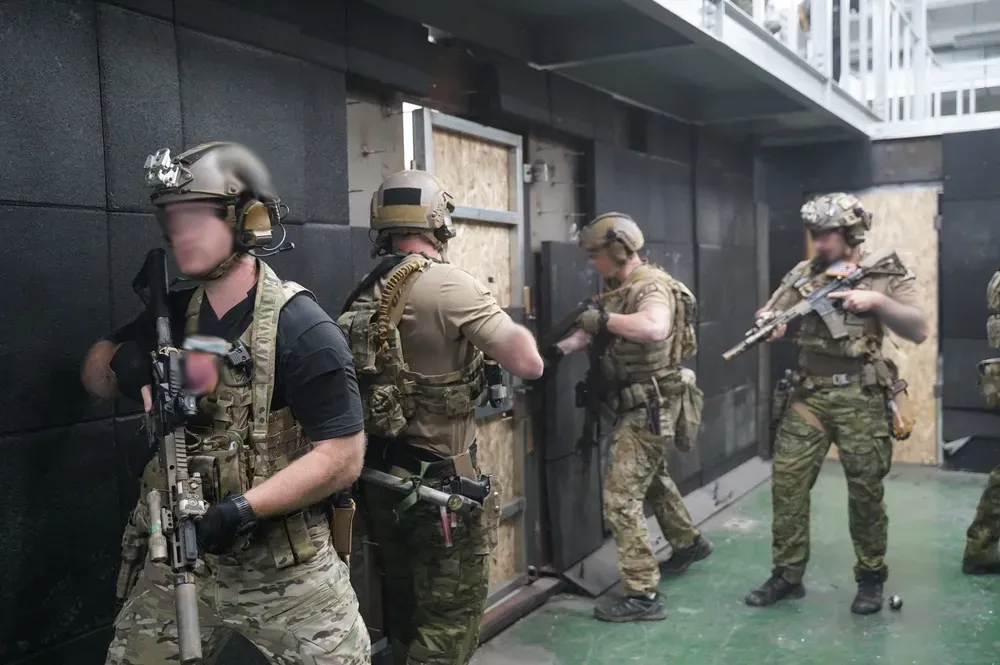
MARSOC Explained: The Marine Raiders | Combat Fitness
MARSOC Explained: Who the Marine Raiders Are and What They Do
MARSOC is the United States Marine Corps Forces Special Operations Command, the Marine Corps component of U.S. Special Operations Command. It was activated on February 24, 2006 and is headquartered at Camp Lejeune, North Carolina. Its operators are called Marine Raiders. That is the full answer, and nearly every other question about the command follows from it.
Most people searching for MARSOC want to know what the organization is. A smaller group wants to know whether they could survive its screening, and for that group the tactical athlete training programs we build are the honest place to start. This guide covers what MARSOC is, why Marine Raiders and MARSOC are the same organization under two names, where the command sits among the other SOF units, how it is organized, whether it is being disbanded, and the published short card PT standard candidates train against.
Key Takeaways:
MARSOC is the command. Marine Raiders are the people and the subordinate units inside it. Both terms are current and correct.
MARSOC is special operations forces, but it is not Army "Special Forces." That proper noun belongs to the Green Berets.
By the informal tier convention, MARSOC is a Tier 2 unit, alongside Army Special Forces and the 75th Ranger Regiment.
MARSOC has not been disbanded. All three of its major subordinate units are listed as active on the command's official site as of July 2026.
The published screening gates are a 225 PFT, a 300-meter uniform swim with a water confidence battery, and a 12-mile ruck under 45 pounds in four hours or less.
What MARSOC Is
MARSOC stands for United States Marine Corps Forces Special Operations Command. It is the Marine Corps service component of U.S. Special Operations Command, which makes it the Marine Corps' contribution to the joint special operations force. Its stated mission is to recruit, train, sustain and deploy scalable expeditionary forces worldwide to accomplish special operations missions assigned by USSOCOM.
The command was announced by the Secretary of Defense on November 1, 2005 and activated at Camp Lejeune on February 24, 2006. The Marine Corps had resisted joining SOCOM for years on the argument that Marine units were already expeditionary and already special operations capable. Post-9/11 demand for persistent, low-signature partner-force work settled that argument.
A MARSOC Marine is a Marine first and a special operator second. That sequence matters, because it shapes both the selection route and the culture of the command.
MARSOC vs Marine Raiders: Same People, Two Names
MARSOC is the command. Marine Raiders are the people and the subordinate units inside it. They are not two organizations, and neither name is outdated.
The naming split came from a 2014 decision, formally effective on June 19, 2015, to redesignate MARSOC's subordinate units under the Raider name. The Marine Special Operations Regiment became the Marine Raider Regiment, its battalions became the 1st, 2nd and 3rd Marine Raider Battalions, and qualified operators became Marine Raiders. The parent headquarters kept the MARSOC designation.
One accuracy point that most pages get wrong: the modern Marine Raiders are named for the World War II Marine Raider battalions, not descended from them in an unbroken line. Edson's and Carlson's Raiders operated from 1942 to 1944 and were disbanded before the war ended. The 2015 redesignation revived the name and the heritage. It did not reactivate the original units.
So if you see "MARSOC raiders," "Marine Raiders" and "MARSOC" used interchangeably, none of them are wrong. They describe the same organization at different levels of resolution.
Is MARSOC Special Forces? Is MARSOC Tier 1?
MARSOC is special operations forces, but it is not Special Forces. Capitalized, that term is a proper noun belonging to U.S. Army Special Forces, the Green Berets. MARSOC operators are Critical Skills Operators, not Special Forces soldiers. The distinction is not pedantry inside the community, and getting it right is the fastest way to sound like you know what you are talking about.
On tiers: MARSOC and the Marine Raider Regiment are conventionally described as Tier 2 special operations units, in the same band as the 75th Ranger Regiment and Army Special Forces, rather than Tier 1 special mission units such as Delta Force or DEVGRU.
Add the qualifier that forum answers leave out. The tier system is an informal convention that describes funding priority and mission tasking, not an official Department of Defense designation. No DoD directive assigns MARSOC a tier. The label is useful shorthand and nothing more, so treat anyone who argues tiers as gospel accordingly.
Force Recon vs MARSOC: The Difference That Confuses Everyone
This is the comparison people get wrong most often, and the difference is structural rather than a matter of quality.
Figure 1.1 - Force Reconnaissance vs. MARSOC (Marine Raiders). Force Recon is a conventional U.S. Marine Corps unit, not a USSOCOM component, three companies support I, II and III Marine Expeditionary Force under MEF operational command, conducting deep reconnaissance and surveillance for a Marine commander. Entry is via Marine Corps reconnaissance screening and the Basic Reconnaissance Course. MARSOC, Marine Forces Special Operations Command, whose operators are Marine Raiders, is the Marine Corps component of U.S. Special Operations Command, activated 24 February 2006, conducting full-spectrum special operations for the joint force including direct action, special reconnaissance and foreign internal defense. Entry is via MARSOC screening, Assessment and Selection, then the nine-month Marine Raider Course. The two are confused because MARSOC was built from Force Recon: the 2nd and 1st Force Reconnaissance Companies were deactivated in 2006 and most of their Marines stood up the 2nd and 1st Marine Special Operations Battalions, with Force Recon re-established in 2008. "Tier 1" and "Tier 2" are journalism shorthand for funding and tasking, not official DoD terminology or a capability ranking. Source: marsoc.marines.mil and Marine Corps unit histories.
If you want the reconnaissance side covered properly, we break it down in our guide to Marine Force Recon.
The clean way to hold the distinction: one supports Marines, the other supports the joint force. Force Recon answers to a Marine commander and exists to feed that commander information ahead of a Marine unit's fight. MARSOC answers to SOCOM and executes special operations tasks that may have nothing to do with any Marine unit in theater.
Both are Marines. Both run hard selection pipelines. They sit in different chains of command with different customers, and that is the entire answer.
MARSOC Compared to SEALs, Green Berets, Rangers and Delta
Figure 1.2 - MARSOC compared to Navy SEALs, Green Berets, Rangers and Delta Force. All five units fall under U.S. Special Operations Command. Marine Raiders serve in MARSOC, the Marine Corps service component, conducting full-spectrum special operations heavy on partner-force work. Navy SEALs fall under Naval Special Warfare Command for maritime and littoral special operations. Green Berets fall under U.S. Army Special Operations Command via 1st Special Forces Command (Airborne) for unconventional warfare and foreign internal defense. The 75th Ranger Regiment also falls under USASOC, for large-scale direct action and airfield seizure. Delta Force (1st SFOD-D) falls under Joint Special Operations Command, a sub-unified command within USSOCOM, not a separate chain, for national-level counterterrorism and hostage rescue. USSOCOM's components are USASOC, Naval Special Warfare Command, AFSOC and MARSOC, plus JSOC and seven theatre special operations commands, roughly 70,000 personnel in total. "Tier 1" and "Tier 2" describe funding and tasking, not capability, and are not official DoD terminology; the Navy also fields a special mission unit, DEVGRU, reporting through JSOC. Source: socom.mil.
Navy SEALs. The maritime specialists of the joint force, with a pipeline built around water confidence and small-team direct action. Raiders swim too, but SEALs own the maritime problem set.
Green Berets. The closest functional cousin to MARSOC, because both are built around training and fighting alongside partner forces. Our breakdown of the Green Beret training pipeline shows how that skill set gets built.
75th Ranger Regiment. A larger direct-action force optimized for mass and speed rather than small-team autonomy.
Delta Force. A national mission unit under JSOC. The differences between it and Delta Force and everything above are tasking and access, not just training.
What Marine Raiders Actually Do
MARSOC's tasked mission set covers five core areas:
Direct action. Short-duration offensive operations against a specific target.
Special reconnaissance. Collecting information in denied or sensitive areas, often for someone else's decision.
Foreign internal defense. Training, advising and fighting alongside partner-nation forces.
Counterterrorism. Operations against terrorist networks and their infrastructure.
Security force assistance. Building the institutional capacity of a partner's military, not just its shooters.
Foreign internal defense and partner-force training are the piece worth understanding, because it is where Raiders spend a disproportionate share of their careers. Advising a partner unit means operating in small teams, far from support, with cultural and language load on top of the tactical load. It rewards maturity and judgment more than raw physical output, which is one reason the pipeline screens for both.
If you want a sense of what the day-to-day looks like beyond the mission list, we cover life inside a special operations unit in detail.
How MARSOC Is Organized: Command, Battalions and MSOTs
MARSOC headquarters sits at Camp Lejeune, North Carolina, on the Stone Bay side of the base, and is commanded by a Marine general officer. Three major subordinate units sit beneath it:
Marine Raider Regiment. The operational element, built from the 1st, 2nd and 3rd Marine Raider Battalions. 1st and 3rd are based at Camp Lejeune, 2nd at Camp Pendleton.
Marine Raider Support Group. Intelligence, communications, logistics, fires and the combat support that makes small teams viable at distance.
Marine Raider Training Center. The organization that screens, assesses, selects and trains, including the MARSOC screening teams that travel to fleet units to find candidates.
Inside a battalion, the building blocks are lettered Marine Special Operations Companies (MSOCs), and each company fields four Marine Special Operations Teams (MSOTs). The MSOT is the unit of action: roughly 14 Marines organized into a headquarters element and two tactical elements, with a Navy Special Amphibious Reconnaissance Corpsman attached. That team is designed to operate independently for extended periods or to plug into a larger joint task force.
On strength: MARSOC is generally reported at roughly 3,000 to 3,500 assigned personnel across more than 120 military occupational specialties, with the Marine Raider Regiment authorized around 1,500. Treat those as approximations. The exact number of qualified Critical Skills Operators is not publicly released, and any page giving you a precise figure is guessing.
Is MARSOC Being Disbanded? What Is Actually Happening
MARSOC has not been disbanded. As of July 2026 it remains an active component of U.S. Special Operations Command, and the Marine Raider Regiment, the Marine Raider Support Group and the Marine Raider Training Center are all listed as active units on MARSOC's official site. The command passed its twentieth year in 2026.
The rumor has two roots. The first is Force Design 2030, the Marine Corps' restructuring effort, which mentions MARSOC exactly once in its published text and does so to direct the Corps to revisit the manpower policies that support the command. That is a personnel-management line, not an elimination line, but it read to a lot of people as a signal. The second root is the ordinary rhythm of force-structure and manpower reviews, which periodically propose reductions across SOCOM and get reported as existential threats.
Here is the useful test. Disestablishing a service component of a combatant command is not a quiet administrative act. It would require the parent service, SOCOM and the Office of the Secretary of Defense to act in concert, and a change of that magnitude would appear in budget documents and in the annual defense authorization long before it happened. None of that is present. When it is, you will read it somewhere other than a comment thread.
The MARSOC Short Card: The PT Standard Candidates Are Screened Against
The MARSOC short card is a published bodyweight circuit the command puts in front of prospective candidates. It is a preparation tool, not a scored test, and understanding that distinction saves you from training for the wrong thing. The scored gates are separate, and both are below.
Figure 1.3 - The MARSOC Short Card, and the physical standards for Assessment and Selection. The Short Card is a bodyweight conditioning circuit published as an enclosure in the Marine Special Operations School's Assessment and Selection Preparation Guide. It runs four blocks. Block one: 30 push-ups, 30 air squats, 30 crunches, 10 burpees, 10 windmills. Block two: 30 push-ups, 30 mountain climbers, 30 flutter kicks, 10 burpees, 10 cherry pickers. Block three: 30 push-ups, 30 star jumpers, 30 back extensions, 10 burpees, 10 chain breakers. Block four: 30 push-ups, 30 lunges, 30 hello dollies, 10 burpees, 10 trunk twists. The finisher is three maximum sets of dead-hang pull-ups. The windmills, cherry pickers, chain breakers and trunk twists are prescribed as stretch and relax intervals rather than work sets. The Short Card is a preparation circuit, not a scored test. The physical standards MARSOC directs candidates to meet before Assessment and Selection are a Physical Fitness Test score of 225 or higher, a 300-metre swim in utilities without boots using breaststroke or sidestroke plus a ten-minute tread, and a 12-mile hike carrying a 45-pound pack in four hours or less. Source: Marine Special Operations School Assessment and Selection Preparation Guide (marsoc.marines.mil). Standards change without notice, confirm with MARSOC or a Marine Corps recruiter.
The MARSOC long card is the extended version of the same idea, running through roughly four dozen movements and finishing with a three-mile run. Same purpose, longer time under tension.
Published MARSOC screening standards
Marine Corps PFT - 225 or higher.
Swim - 300 meters continuous in utility blouse and trousers, without boots, using the modified breaststroke or sidestroke.
Water confidence - tread water in blouse and trousers unassisted for 10 minutes, then transition to the survival float for 5 minutes, using the blouse or trousers for flotation.
Abandon ship - demonstrate a properly conducted abandon ship drill from a six-meter platform.
Ruck march - 12 miles with a 45-pound pack in 4 hours or less. Water is not counted toward the pack weight.
Those figures come from MARSOC's own Assessment and Selection preparation guide. The PFT floor of 225 is a floor, and the Marine Corps PFT score you show up with is a signal to the screening team about how you train, not just whether you qualify. Candidates who arrive at the minimum rarely enjoy what follows. The same logic applies to any pre-selection PT testing across the services.
Two events fail more candidates than the rest, and both fail them for the same reason: people train the number instead of the demand.
The ruck. Twelve miles at 45 pounds in four hours works out to a 20-minute mile, which looks generous on paper. It is generous, once. Selection movements are longer, heavier, and stacked day after day with no recovery between them. The adaptation that carries you is structural, built in the feet, ankles, hips and mid-back over months of progressive loaded volume. You cannot cram it, and cramming it is how stress fractures happen.
The swim. Most candidates have never swum 300 meters in a uniform. Cotton or FROG fabric doubles your drag and turns a comfortable sidestroke into a forearm and hip flexor problem. The 10-minute tread and the survival float punish anyone who fights the water instead of settling into it. Get in a pool in a uniform early, and get comfortable being uncomfortable in it, because water panic under load ends candidacies that better runners never see coming.
How to Become a Marine Raider
The route runs in a fixed sequence:
Screening. MARSOC screening teams recruit from the fleet. Candidates submit a package and meet the command's prerequisites and physical gates.
Assessment and Selection (A&S). The evaluation phase, run by the Marine Raider Training Center. It measures physical capacity, cognitive performance under stress, and how a candidate functions inside a team when tired.
Individual Training Course (ITC). The qualification course that produces a trained operator across weapons, tactics, communications, medicine, language and irregular warfare skills.
Assignment. Graduates are awarded the Critical Skills Operator MOS and assigned to a Marine Raider Battalion.
Before any of that, every Raider is a Marine. If you are not in yet, baseline Marine Corps enlistment requirements are the actual first gate, and there is no lateral entry that skips them.
Women have been eligible to attempt Marine Raider selection since ground combat roles opened across the services in 2016. A female Marine completed the second phase of Raider selection in 2018. Eligibility is settled; the standard did not change.
Specific eligibility criteria, course lengths and selection rates move often enough that they deserve their own treatment, and we cover them separately.
MARSOC Insignia, Uniform and Kit
The Marine Special Operator Insignia was approved in August 2016 and is the badge most people are trying to identify. It shows an eagle with wings outspread, clutching an upward-pointing stiletto dagger, with the stars of the Southern Cross set on the blade and a scroll above the eagle's head reading Spiritus Invictus, meaning unconquerable spirit. The device measures roughly two by two and three-quarter inches and was the first Marine Corps-only uniform device authorized for wear. Critical Skills Operators and Special Operations Officers earn it on completion of ITC, and it functions the way the SEAL Trident does for Naval Special Warfare.
Every element points backward. The dagger is the Marine Raider stiletto, the World War II Raider fighting knife modeled on the British Fairbairn-Sykes design. The Southern Cross is the constellation the original Raiders fought under in the South Pacific, carried over from their wartime patch.
The uniform picture changed recently, and most pages have not caught up. MARSOC issued a memo in September 2024 directing Raiders to stop wearing MultiCam pattern uniforms effective January 1, 2025, on the reasoning that the pattern and the wide variation in non-standard boots undercut the command's professional appearance. Raiders moved to the Corps' flame-resistant organizational gear while a Marine-patterned uniform in olive drab is developed, a process expected to take several years. Mission requirements still dictate what gets worn downrange, so photographs from operational environments will continue to show non-standard kit.
On weapons, one line is enough: the M45A1 Close Quarter Battle Pistol, a Colt-built .45 ACP 1911, is the sidearm most associated with Raiders historically.
Pay, MOS and Where Raiders Go Next
Three MOS codes define the community. 0372 Critical Skills Operator is the enlisted operator MOS and the one most people are searching for. 0370 Special Operations Officer is the officer equivalent, approved as a primary MOS in 2014. 0371 Special Operations Capability Specialist covers the enablers who deploy with teams. If you are mapping elite Marine career fields against each other, Marine scout snipers hold MOS 0317 and sit in the closest adjacent space.
On pay, here is the answer people are looking for: MARSOC does not have its own pay scale. A Raider earns standard military base pay by rank and time in service from the same DoD pay table as every other Marine, plus housing and subsistence allowances. What moves the number is special and incentive pay layered on top, including special duty assignment pay and, where the billet qualifies, parachute pay, dive pay and foreign language proficiency pay. Deployment-related entitlements add more. In practice that stacks into a meaningful premium over a same-rank Marine in a conventional unit, but it comes from accumulating qualifications, not from a separate Raider salary. Pay tables update annually, so check current DFAS figures rather than any number you read on a forum.
Afterward, Raiders move into government service, defense contracting, federal law enforcement, medicine and the training industry, generally on the strength of the language, medical and advisory skills rather than the shooting.
Training for a Marine SOF Pipeline
Most people reading this are curious rather than committed, and that is fine. For the minority who are seriously looking at the pipeline, one point is worth internalizing: the short card and the screening standards are a gate, not a goal.
Passing the gate proves you are trainable. It does not prepare you for A&S or ITC, where the demand is repeated loaded movement, cold and wet exposure, sleep debt and cognitive work performed after all of that. The candidates who fail are rarely the ones who could not hit 225 on the PFT. They are the ones whose ruck volume, swim comfort and durability were built in eight weeks instead of eight months.
That is a programming problem, not a motivation problem. We break down the options in our guide to special operations training programs compared, which answers the questions candidates ask most. If you are still deciding which route fits your timeline and your current base, start with how to choose a SOF training program.
FAQ: Frequently Asked Questions
What does MARSOC stand for?
MARSOC stands for United States Marine Corps Forces Special Operations Command. It is the Marine Corps service component of U.S. Special Operations Command, activated on February 24, 2006 and headquartered at Camp Lejeune, North Carolina. Its qualified operators are called Marine Raiders.
Is MARSOC the same as the Marine Raiders?
Yes, at different levels. MARSOC is the command headquarters. Marine Raiders are the operators and the subordinate units inside it, redesignated under the Raider name in 2015. Both terms are current and correct, and you will see them used interchangeably by the command itself.
Is MARSOC Tier 1?
No. MARSOC is conventionally described as a Tier 2 special operations unit, in the same band as Army Special Forces and the 75th Ranger Regiment, rather than a Tier 1 special mission unit like Delta Force or DEVGRU. The tier system is an informal convention describing funding and mission priority, not an official DoD designation.
Is MARSOC being disbanded?
No. As of July 2026, MARSOC remains an active SOCOM component, and the Marine Raider Regiment, Marine Raider Support Group and Marine Raider Training Center are all listed as active on the command's official site. The rumors trace to Force Design 2030 manpower language and periodic force-structure reviews, which proposed reviewing personnel policy, not elimination.
What is the difference between MARSOC and Force Recon?
Chain of command and customer. Force Recon belongs to the Marine Corps and conducts deep reconnaissance in support of a Marine commander. MARSOC belongs to SOCOM and conducts special operations for the joint force. Both are Marines, both run hard selection, and they answer to different headquarters.
How long does it take to become a Marine Raider?
The route runs in sequence: screening from the fleet, Assessment and Selection, the Individual Training Course, then assignment to a Marine Raider Battalion as a Critical Skills Operator. Course lengths shift between classes and are best checked against current MARSOC recruiting information rather than secondhand figures.
What is the MARSOC short card?
The MARSOC short card is a published bodyweight circuit MARSOC puts in front of prospective candidates: four blocks of push-ups, a lower-body movement, a core movement and burpees, capped with three max sets of dead-hang pull-ups. It is a preparation tool rather than a scored test. The scored gates are a 225 PFT, a 300-meter uniform swim with a water confidence battery, and a 12-mile ruck under 45 pounds in four hours or less.
Are there women in MARSOC?
Yes, women have been eligible to attempt Marine Raider selection since ground combat roles opened across the services in 2016, and a female Marine completed the second phase of Raider selection in 2018. The standards for selection and qualification are the same regardless of sex.
How many Marine Raiders are there?
MARSOC is generally reported at roughly 3,000 to 3,500 assigned personnel across more than 120 military occupational specialties, with the Marine Raider Regiment authorized around 1,500. Those are approximations. The exact number of qualified Critical Skills Operators is not publicly released.
MARSOC is the Marine Corps' answer to a joint force that needed small teams capable of operating far forward with partner militaries, and the Marine Raiders are the Marines who do it. The command is active, its structure is stable, and its published screening standards are visible to anyone willing to look them up.
What separates the people who pass from the people who quit is not access to the standards. It is the eighteen months of loaded rucking, uniform swimming and durability work that happen before the screening team ever sees a candidate. Build that base on purpose, on a schedule, with a plan that progresses instead of repeating. Then the gate takes care of itself.
References:
U.S. Marine Corps Forces Special Operations Command, official site, "About" and subordinate unit pages. (accessed July 30, 2026)
Marine Special Operations School, MARSOC, "Assessment and Selection Preparation Guide."
MARSOC, "Letter to the Candidate."
Marine Raider Recruiting, MARSOC, career paths for Critical Skills Operator and Special Operations Officer.
SOF News, "MARSOC: 20 Years Old," 2026.
SOF News, "MARSOC and Force Design 2030."
Congressional Research Service, "U.S. Marine Corps Force Design Initiative: Background and Issues for Congress," Report R47614.
Military.com, "Marine Special Operators Get Their Own Insignia Pin," August 23, 2016.
Marine Corps Times, "Marine Raiders will soon wear this special insignia on their uniforms," August 23, 2016.
USNI News, "Marine Corps Announces New MARSOC Insignia Pin," August 23, 2016.
Military.com, "Marine Raiders Ordered to Stop Wearing Multicam Uniforms to Align Elite Unit with Broader Service," October 18, 2024.
Marine Corps Times, "Marines approve new primary MOS for MARSOC officers," July 28, 2014.
Marine Corps Times, "First female completes second phase of Marine Raider selection," October 22, 2018.
American Special Operations, "MARSOC," unit organization and MSOT composition.
Defense Finance and Accounting Service, military pay tables and special and incentive pay entitlements.
U.S. Marine Corps, Marine Corps Physical Fitness Test standards, MCO 6100.13A.
Written by the Combat Fitness Team, coaches who program for active military, law enforcement, and first responders preparing for real occupational and selection standards.
Disclaimer: This article is for informational purposes only and is not official U.S. Marine Corps, MARSOC or Department of Defense guidance. Standards, eligibility criteria and pay rates change; verify current requirements with MARSOC recruiting and official Marine Corps sources before making decisions. Training for selection-level physical standards carries injury risk. Consult a qualified medical professional before beginning any new training program. No training program guarantees selection or qualification.


