
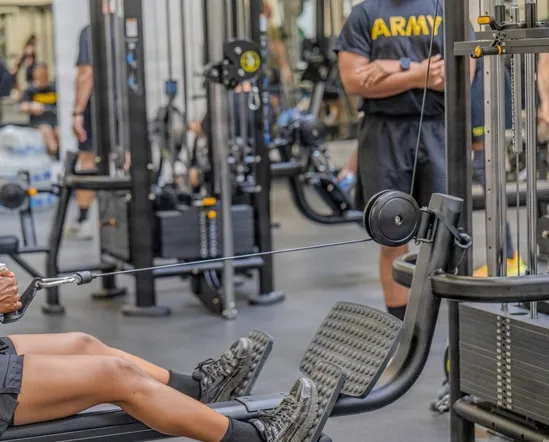
How Many Exercises Per Muscle Group? The Weekly Set Guide
How Many Exercises Per Muscle Group? The Volume That Builds Muscle
How many exercises per muscle group you need comes down to two numbers. The first is 2 to 4 exercises per muscle in a single session. The second is roughly 10 to 20 hard sets per muscle across the week. If you would rather have that math built into a plan that already accounts for your running and rucking, our tactical fitness programs handle it for you.
These ranges come from the dose-response research on training volume, not gym folklore. They shift with your goal, your split, and your training age. Below we cover per workout vs. per week, strength vs. hypertrophy, full body vs. PPL, and beginner vs. advanced. We also cover the part generic lifting sites skip: how few exercises you can get away with while you still run, ruck, and condition.
Quick Answer:
Exercises per muscle, per session: 2 to 4 on a PPL or body-part split, and 1 to 2 on full-body days.
Hard sets per muscle, per week: about 10 to 20 for hypertrophy, individualized.
Strength focus: 1 to 2 main lifts per muscle, heavy, mostly 3 to 6 reps.
Beginners: 1 to 2 exercises per muscle and a lower weekly set count to start.
Maintenance while training endurance: a small fraction of your building volume, provided the sets stay heavy and hard.
Key Takeaways:
Weekly hard sets drive results. Exercise count is just how you package those sets.
Train a muscle more often and you need fewer exercises per session for the same weekly volume.
Strength needs fewer exercises and heavier loads. Hypertrophy needs more total sets and some exercise variety.
Tactical athletes should program the minimum effective volume, because every extra set competes with recovery for running and rucking.
Is It About Exercises or Weekly Sets Per Muscle Group?
Weekly hard sets drive muscle growth more than the number of exercises. A hard set is one taken close to failure, usually within about 0 to 3 reps of it. A meta-analysis of resistance-training studies found a graded dose-response: more weekly sets produced more growth, and 10 or more sets per muscle per week outperformed lower volumes (Schoenfeld, Ogborn & Krieger, 2017).
An exercise is a container for sets. Three exercises at 3 sets each and one exercise at 9 sets look the same on paper: 9 sets. In practice the second option breaks down, because fatigue piles up on one movement pattern and the later sets deliver less.
So the honest answer to how many exercises and sets per muscle group is this: pick a weekly set target first, then split it into enough exercises that each set stays high quality. For trained lifters, a systematic review put the productive range for hypertrophy at roughly 12 to 20 weekly sets per muscle (Baz-Valle et al., 2022). The top of the band costs more recovery, and very high volumes grew muscle in trained men without producing extra strength (Schoenfeld et al., 2019).
Only count working sets. Warm-ups and sets you stop 6 reps shy of failure do not belong in the tally.
How Many Exercises Per Muscle Group Per Workout, Per Day, and Per Week?
Per workout and per day mean the same thing for most lifters: the exercises you do for one muscle in one session, usually 2 to 4. Per week is the number that matters, because it totals every session. Divide your weekly set target by how many times you train that muscle, then choose exercises to fill it.
Here is how a 12-set weekly target plays out by frequency:
Trained once a week: 12 sets in one session, which is 3 to 4 exercises.
Trained twice a week: 6 sets per session, which is about 2 exercises.
Trained three times a week: 4 sets per session, which is 1 to 2 exercises.
Frequency itself matters less than people think. When weekly volume is equated, how often you train a muscle has little effect on hypertrophy (Schoenfeld, Grgic & Krieger, 2019) or strength (Grgic et al., 2018). Spreading volume across two or three sessions is still the smarter move, because each session stays shorter and the sets stay sharper.
That matters more for you than for a bodybuilder. A 90-minute leg session leaves your legs dead for Thursday’s ruck. Two 40-minute sessions with 2 exercises each deliver the same weekly stimulus with far less carryover fatigue.
Does the Number Change for Strength vs. Hypertrophy?
Yes. Strength training needs fewer exercises per muscle and heavier loads, while hypertrophy needs more total sets and more exercise variety. Strength is specific to the lift, so you get better at it by practicing it heavy. Muscle growth responds to accumulated hard sets, so you add volume across several movements.
Training for Strength
For strength, run 1 to 2 exercises per muscle, built around a heavy compound lift. Work mostly in the 3 to 6 rep range with full rest between sets. Weekly set volume still helps strength (Ralston et al., 2017), but returns flatten sooner than they do for size, and early meta-analytic work put the useful dose for trained lifters around 4 sets per muscle per session (Rhea et al., 2003).
The build-out of the main lifts and accessory work is covered in our guide to a strength workout for athletes.
Training for Hypertrophy, Muscle Growth, and Mass
For hypertrophy, run 2 to 4 exercises per muscle, mostly in the 6 to 15 rep range, landing in the 10 to 20 weekly set band. Variety earns its place here. Rotating exercises that load a muscle at different angles produced more uniform growth across the quadriceps than one exercise alone (Fonseca et al., 2014), and a systematic review supports moderate variation for hypertrophy (Kassiano et al., 2022). For maximum growth, push toward the top of the band only if you are recovering from it.
Training for Fat Loss and “Toning”
Fat loss does not change the exercise count. In a calorie deficit, the job of lifting is to keep the muscle you have, so hold your intensity and keep the sets hard. Adding six light pump exercises burns time, not fat. The firm look people search for as “toning” is just muscle plus lower body fat.
If your goal is strength and an engine at the same time, our guide to choosing a strength & endurance program breaks down what to look for.
How Many Exercises Per Muscle on Full Body, PPL, and Upper/Lower Splits?
Your split decides how many exercises you do per session, because it sets how often each muscle gets trained. Full body hits muscles often with fewer exercises per session. Push pull legs and upper/lower hit muscles less often, so each session carries more exercises per muscle. Weekly sets stay in the same band either way.
We cover how to choose between workout splits in a dedicated guide. Here is how exercise count shakes out on the three most common ones:
Full body (3 days a week): 1 exercise per major muscle per session, sometimes 2 for a priority muscle. Three sessions at 3 to 4 hard sets lands you at 9 to 12 weekly sets.
Upper/lower (4 days a week): about 2 exercises per muscle per session, each muscle trained twice.
Push pull legs (3 or 6 days a week): 2 to 3 exercises per muscle. On push day that might be a bench press and an incline press for chest, an overhead press for shoulders, and one triceps movement.
The once-a-week body-part split is where 4 or more exercises per muscle shows up. It works for some bodybuilders. For anyone who also runs and rucks, it concentrates too much damage into one day.
How Many Exercises Per Muscle Group for Beginners, Intermediates, and Advanced Lifters?
Beginners need 1 to 2 exercises per muscle and a modest weekly volume, because almost any well-run stimulus produces gains early. Volume climbs with training age as the easy adaptations run out. Professional guidelines recommend novices start with 1 to 3 sets per exercise and progress from there (ACSM, 2009).
Beginner: 1 to 2 exercises per muscle, low weekly volume, priority on learning the squat, hinge, press, pull, and carry.
Intermediate: 2 to 3 exercises per muscle, working into the 10 to 15 weekly set range.
Advanced: 3 to 4 exercises per muscle where needed, 15 to 20 weekly sets, more exercise rotation, and closer attention to recovery.
The ranges are the same for women. A meta-analysis found that men and women gain similar relative muscle size from resistance training, and women gained relative upper-body strength faster (Roberts, Nuckols & Krieger, 2020).
Calisthenics follows the same set logic. A hard set of push-ups counts if it ends near failure, so progress the movement (deficit, weighted vest, archer variations) once you pass about 20 to 30 reps. Bodyweight work tends to under-load the legs, which is one reason we pair it with loaded carries and rucking.
How Many Exercises Per Muscle Group Does a Tactical Athlete Need?
A tactical athlete needs the minimum effective number: usually 1 to 2 exercises per muscle per session and the low end of the weekly set band. You train concurrently, lifting while you run, ruck, and condition. Every set you add competes for the same recovery your endurance work needs.
The interference effect is real. Combining heavy endurance training with strength training can blunt strength gains (Hickson, 1980). The blunting is greater with running than cycling and grows with endurance frequency and duration (Wilson et al., 2012). More recent analysis found concurrent training does not compromise hypertrophy or maximal strength in most cases, but can blunt explosive strength (Schumann et al., 2022). The takeaway: you can build strength and endurance together, but not at bodybuilder volumes.
The good news is that you need far less volume to hold strength than to build it. In young adults, strength and muscle size were maintained for 32 weeks on one ninth of the original training volume (Bickel, Cross & Bamman, 2011). A review of military-relevant research reached the same conclusion: intensity, not volume, is what preserves strength (Spiering et al., 2021). This is the foundation of functional strength for military performance: lift heavy enough to matter, then stop.
How to trim your exercise list:
Keep one big compound per movement pattern: squat, hinge, press, pull, carry.
Cut isolation work first when running or ruck mileage climbs.
Hold load and effort steady when you cut sets. Volume drops, intensity stays.
Separate hard lifting and hard running by several hours, and lift first when strength is the priority (Murlasits, Kneffel & Thalib, 2018).
Drop to maintenance volume during peak ruck or selection blocks, then rebuild afterward.
This is also how the Army’s H2F doctrine frames it: strength and endurance are both occupational requirements, trained together on purpose (Department of the Army, 2020).
What Does a Sample Weekly Setup Look Like?
A 3-day concurrent plan uses 1 to 2 exercises per muscle per session and lands most major muscles around 8 to 12 hard sets per week. That sits at the efficient end of the research range and leaves room for three endurance sessions. Here is a sample week:
Monday (Lift A): back squat 4x4-6, bench press 4x4-6, chin-up 3x6-8, split squat 2x8-10 per side, farmer carry 3x40 m.
Tuesday: easy aerobic run, 30 to 45 minutes.
Wednesday (Lift B): trap bar deadlift 4x3-5, overhead press 3x5-6, barbell row 3x8-10, step-up 2x10 per side, plank 3 rounds.
Thursday: ruck, moderate load, 60 to 90 minutes.
Friday (Lift C): front squat 3x6-8, incline dumbbell press 3x8-10, pull-up 3 sets 1 to 2 reps short of failure, Romanian deadlift 3x6-8, sandbag carry 3 rounds.
Saturday: intervals or a longer run.
Sunday: off.
Tally it and quads get about 11 hard sets a week, chest 7 direct plus pressing carryover, back 9, and hamstrings and glutes 7 direct plus squat carryover. Each session runs 2 to 3 exercises per muscle group trained that day. Push volume toward 15 sets for a lagging muscle only during a block when running volume drops.
Frequently Asked Questions
How many exercises should you do per muscle group?
Most lifters should do 2 to 4 exercises per muscle in a session that trains that muscle once or twice a week, and 1 to 2 on full-body days. The exercise count matters less than total weekly hard sets. Pick a weekly set target first, then use enough exercises to keep each set high quality.
How many sets per muscle group per week?
About 10 to 20 hard sets per muscle per week is the productive range for hypertrophy, based on the dose-response research. Beginners grow on less. Advanced lifters may need the top of the band. Tactical athletes training endurance alongside lifting usually do best near the low end.
Does the number change for strength vs. hypertrophy?
Yes. Strength work uses 1 to 2 heavy compound exercises per muscle, mostly 3 to 6 reps, because strength is specific to the lift you practice. Hypertrophy uses 2 to 4 exercises and more total weekly sets, with some exercise variety to load the muscle across different angles.
How many exercises per muscle on a full-body vs. PPL split?
Full body uses 1 exercise per major muscle per session, sometimes 2, because you train each muscle about three times a week. Push pull legs uses 2 to 3 exercises per muscle per session, because each muscle is trained less often. Weekly set totals end up similar either way.
How many exercises per muscle group for beginners?
Beginners should start with 1 to 2 exercises per muscle and a low weekly set count. Nearly any consistent, well-run stimulus produces gains in the first months, so the priority is learning the squat, hinge, press, pull, and carry with clean technique. Add sets and exercises as progress slows.
What is the minimum volume to maintain muscle while training endurance?
Strength and size can be maintained on a small fraction of your building volume. One study held gains for 32 weeks on one ninth of the original volume. The rule: keep loads heavy and sets hard, and reduce sets and exercises rather than intensity.
How many exercises per muscle group you need is set by your weekly hard sets, your split, and how much endurance work you carry. For most tactical athletes that means 1 to 3 exercises per muscle per session, heavy compound lifts first, and only as much volume as you can recover from while still hitting your runs and rucks.
Knowing the ranges is the easy part. Holding them steady through a ruck block, a PT test, or a selection prep phase is where most self-built plans fall apart. Pick the Combat Fitness program built for your next standard and let the volume be programmed for you.
References:
Schoenfeld BJ, Ogborn D, Krieger JW. Dose-response relationship between weekly resistance training volume and increases in muscle mass: A systematic review and meta-analysis. Journal of Sports Sciences. 2017;35(11):1073-1082.
Schoenfeld BJ, Contreras B, Krieger J, et al. Resistance training volume enhances muscle hypertrophy but not strength in trained men. Medicine & Science in Sports & Exercise. 2019;51(1):94-103.
Baz-Valle E, Balsalobre-Fernández C, Alix-Fages C, Santos-Concejero J. A systematic review of the effects of different resistance training volumes on muscle hypertrophy. Journal of Human Kinetics. 2022;81:199-210.
Ralston GW, Kilgore L, Wyatt FB, Baker JS. The effect of weekly set volume on strength gain: A meta-analysis. Sports Medicine. 2017;47(12):2585-2601.
Rhea MR, Alvar BA, Burkett LN, Ball SD. A meta-analysis to determine the dose response for strength development. Medicine & Science in Sports & Exercise. 2003;35(3):456-464.
Schoenfeld BJ, Grgic J, Krieger J. How many times per week should a muscle be trained to maximize muscle hypertrophy? A systematic review and meta-analysis. Journal of Sports Sciences. 2019;37(11):1286-1295.
Grgic J, Schoenfeld BJ, Davies TB, et al. Effect of resistance training frequency on gains in muscular strength: A systematic review and meta-analysis. Sports Medicine. 2018;48(5):1207-1220.
American College of Sports Medicine. Progression models in resistance training for healthy adults. Medicine & Science in Sports & Exercise. 2009;41(3):687-708.
Fonseca RM, Roschel H, Tricoli V, et al. Changes in exercises are more effective than in loading schemes to improve muscle strength. Journal of Strength and Conditioning Research. 2014;28(11):3085-3092.
Kassiano W, Nunes JP, Costa B, et al. Does varying resistance exercises promote superior muscle hypertrophy and strength gains? A systematic review. Journal of Strength and Conditioning Research. 2022;36(6):1753-1762.
Roberts BM, Nuckols G, Krieger JW. Sex differences in resistance training: A systematic review and meta-analysis. Journal of Strength and Conditioning Research. 2020;34(5):1448-1460.
Hickson RC. Interference of strength development by simultaneously training for strength and endurance. European Journal of Applied Physiology and Occupational Physiology. 1980;45(2-3):255-263.
Wilson JM, Marin PJ, Rhea MR, et al. Concurrent training: A meta-analysis examining interference of aerobic and resistance exercises. Journal of Strength and Conditioning Research. 2012;26(8):2293-2307.
Schumann M, Feuerbacher JF, Sünkeler M, et al. Compatibility of concurrent aerobic and strength training for skeletal muscle size and function: An updated systematic review and meta-analysis. Sports Medicine. 2022;52(3):601-612.
Fyfe JJ, Bishop DJ, Stepto NK. Interference between concurrent resistance and endurance exercise: Molecular bases and the role of individual training variables. Sports Medicine. 2014;44(6):743-762.
Murlasits Z, Kneffel Z, Thalib L. The physiological effects of concurrent strength and endurance training sequence: A systematic review and meta-analysis. Journal of Sports Sciences. 2018;36(11):1212-1219.
Bickel CS, Cross JM, Bamman MM. Exercise dosing to retain resistance training adaptations in young and older adults. Medicine & Science in Sports & Exercise. 2011;43(7):1177-1187.
Spiering BA, Mujika I, Sharp MA, Foulis SA. Maintaining physical performance: The minimal dose of exercise needed to preserve endurance and strength over time. Journal of Strength and Conditioning Research. 2021;35(5):1449-1458.
Headquarters, Department of the Army. FM 7-22: Holistic Health and Fitness. Washington, DC; 2020.
Haff GG, Triplett NT, eds. Essentials of Strength Training and Conditioning. 4th ed. National Strength and Conditioning Association. Human Kinetics; 2016.
Disclaimer: This article is for educational purposes and is not medical advice. Training volume needs vary with age, injury history, health status, and occupational demands. Consult a qualified medical professional before starting or significantly changing a training program, and stop any exercise that causes pain.


