
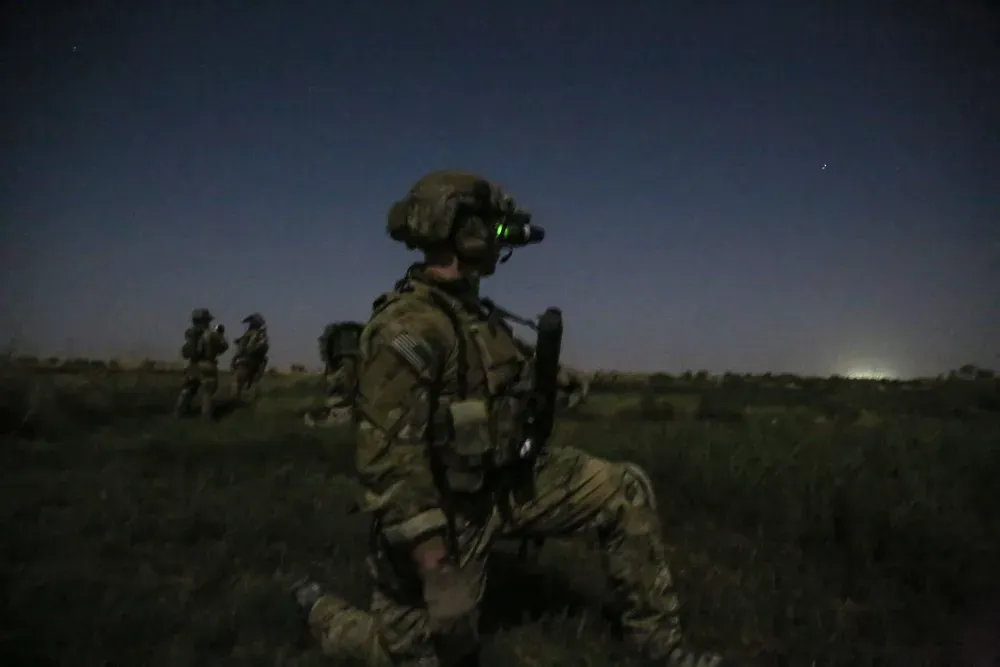
Green Beret Guide: Missions, Groups & Pay | Combat Fitness
Green Berets Explained: Who They Are and What They Do
A Green Beret is a U.S. Army Special Forces soldier trained to fight by, with, and through foreign partner forces in places a conventional unit cannot operate. The Army calls the job the 18-series career field. Everyone else calls it by the headgear President Kennedy sanctioned in 1961. The physical standard is the entry fee and nothing more, which is why our military fitness programs build selection-grade durability before they build anything else. This guide covers what Special Forces is, how it differs from the Rangers, Delta Force, and the SEALs, the seven Special Forces Groups, the 18-series MOS and the 12-man ODA, the selection pipeline, current pay, and the insignia. One disambiguation first: this is the Army unit, not the 1966 Barry Sadler ballad, the 1968 John Wayne film, or the knife brand that borrowed the name.
Key Takeaways:
Green Berets are U.S. Army Special Forces, organized under 1st Special Forces Command (Airborne) and USASOC, in five active and two National Guard groups of roughly 1,400 soldiers each (CRS, December 2025).
The defining mission is unconventional warfare and foreign internal defense: a 12-man team that trains, advises, and leads a much larger indigenous force. Language training is part of the qualification, not an add-on.
The pipeline runs about 83 weeks of Special Forces specific training after Basic and Airborne: a 6-week prep course, roughly 24 days of SFAS, and a 53-week Q Course.
Green Berets are not a "Tier 1" unit. That term has no official DoD definition. The real term is special mission unit, and Special Forces groups are not SMUs.
A mid-career Green Beret draws basic pay plus jump pay, special duty assignment pay, and foreign language proficiency bonus, which stack on top of allowances.
What Is a Green Beret?
A Green Beret is a soldier in U.S. Army Special Forces, the branch built to conduct unconventional warfare and foreign internal defense. Army doctrine defines Special Forces as a force organized to achieve military, political, economic, or informational objectives by generally unconventional means in hostile, denied, or politically sensitive areas (FM 3-18).
The term is a nickname taken from the headgear. The Army had already sanctioned the beret when President Kennedy visited the Special Warfare Center at Fort Bragg on October 12, 1961, and his public endorsement made it permanent. In his April 1962 message he called it "a symbol of excellence, a badge of courage, a mark of distinction in the fight for freedom."
Special Forces sits inside a clear chain: Special Forces Groups report to 1st Special Forces Command (Airborne) at Fort Bragg, which reports to U.S. Army Special Operations Command, which reports to U.S. Special Operations Command. USASOC fields roughly 36,000 personnel across all its formations, and Special Forces is one part of that (USSOCOM 2026 Fact Book).
What separates the job from every other elite unit is the partner force. Rangers seize an airfield. SEALs come out of the water. A Green Beret is dropped into a country and expected to raise, train, and lead a battalion of people who do not speak English. Everything in the training pipeline exists to support that.
Green Berets vs Other Special Operations Units
Green Berets, Army Rangers, Delta Force, and Navy SEALs are all special operations forces, but they solve different problems. Special Forces builds and leads partner armies. The 75th Ranger Regiment executes large-scale direct action. Delta Force handles national-level counterterrorism. SEALs own the maritime approach.
Green Berets vs Rangers vs Delta Force vs Navy SEAL
Figure 1.1 - U.S. special operations units compared: Green Berets, 75th Ranger Regiment, Delta Force and Navy SEALs. Army Special Forces sit under 1st Special Forces Command (Airborne) within USASOC, the 75th Ranger Regiment under USASOC, Delta Force (1st SFOD-D) under Joint Special Operations Command as a special mission unit, and Navy SEALs under Naval Special Warfare Command. Green Beret candidates attend Special Forces Assessment and Selection (SFAS), reported at about 24 days, then a Special Forces Qualification Course of MOS and SERE, tactical skills, Robin Sage and language training, reported at about 83 weeks. Ranger candidates attend RASP 1, an eight-week course for junior enlisted soldiers (E-1 to E-5), or RASP 2, three weeks for officers, warrant officers and senior NCOs from E-7 up, plus MOS training and Airborne School. Delta candidates attend Assessment and Selection, reported at roughly four weeks, followed by a reported six-month Operator Training Course. SEAL candidates complete 56 weeks of initial training for enlisted and 62 for officers, BUD/S, Parachute Jump School and SEAL Qualification Training, then roughly 18 months of pre-deployment training. Base elements are the 12-man Operational Detachment Alpha (ODA) for Special Forces, the rifle platoon for Rangers within a Regiment of five battalions (1st, 2nd and 3rd Ranger Battalions plus a Regimental Special Troops Battalion and a Military Intelligence Battalion), reported assault squadrons for Delta, and the 16-man platoon for SEALs. Core missions run from unconventional warfare, foreign internal defense, direct action and special reconnaissance (Special Forces) to raids, forcible entry and airfield seizure (Rangers), counterterrorism and hostage rescue (Delta), and maritime and coastal special operations (SEALs). Entry is via an 18X contract or in-service transfer, RASP after OSUT and Airborne School, Army-wide recruitment with no direct civilian entry, or direct SEAL enlistment and officer accession respectively. Sourcing: RASP durations, Ranger Regiment structure and SEAL pipeline lengths are officially published; SFAS, SFQC and BUD/S phase durations are widely reported but not, and DoD releases nothing on 1st SFOD-D. Verified July 25, 2026.
Green Beret vs Army Ranger
This is the comparison most people arrive with, and the honest answer is that the two units are not competing for the same job. Rangers are light infantry organized for scale and speed. When the mission is to put several hundred shooters on an objective in the dark and be gone before sunrise, that is the Regiment.
Two distinctions matter. First, RASP is the selection for the 75th Ranger Regiment. Ranger School is a 61-day leadership course open to the whole Army, and passing it does not make you a Ranger in the Regiment. Second, the Regiment builds a specialist in the raid; Special Forces builds a generalist who teaches. If you are weighing the two, the Army Ranger requirements lay out what the Regiment screens for.
Green Beret vs Delta Force
Delta Force recruits heavily from Special Forces and the Ranger Regiment, which tells you the relationship. It is a downstream assignment, not a parallel career. Delta operates under Joint Special Operations Command against the highest-priority national targets, and its selection and training are largely unpublished. Our breakdown of Delta Force explained covers what is on the record and what is not.
Green Beret vs Navy SEAL
The clean split is environment and duration. SEALs are the maritime force, with combat diving and over-the-beach infiltration as core qualifications. Green Berets are a land force with a language requirement, built for long-duration presence rather than short-duration insertion. Attrition tells a similar story at both doors: a 2023 Naval Special Warfare Command investigation found BUD/S has averaged 68 percent attrition since November 1998, most of it in First Phase.
What Green Berets Do
Special Forces executes nine doctrinal core activities: unconventional warfare, foreign internal defense, security force assistance, counterinsurgency, direct action, special reconnaissance, counterterrorism, counter-proliferation of weapons of mass destruction, and operational preparation of the environment (DA PAM 600-25, February 2025).
Two of those carry the identity. Unconventional warfare means enabling a resistance movement or insurgency to coerce or overthrow a government or occupying power. Foreign internal defense is the mirror image: helping a partner nation defend itself against insurgency, lawlessness, and subversion. Both require a small team to make a large foreign force more effective, which is why the ODA is built the way it is.
The rest are the tools that make those two possible. Direct action and special reconnaissance are conducted, but they are means, not the point. USSOCOM's SOF Truths get at the reason: humans are more important than hardware, quality is better than quantity, and special operations forces cannot be mass produced.
The occupational demand that follows is unusual. You need the aerobic base to move under load for days, the strength to carry a partner force's casualty, and enough cognitive reserve to teach a foreign squad leader an ambush while running on no sleep. If you want the training side of that broken down, our SOF training FAQ answers the questions candidates ask most.
The Special Forces Groups
There are seven Special Forces Groups (Airborne): five active duty and two in the Army National Guard. Each active group runs roughly 1,400 soldiers, and each is regionally oriented so that language and cultural training compound over a career (CRS, December 2025).
1st SFG(A), Joint Base Lewis-McChord, Washington. The lead group for Asia and the Pacific, with a forward battalion on Okinawa.
3rd SFG(A), Fort Bragg, North Carolina. Reoriented to Africa in 2014, with elements still supporting Middle East requirements.
5th SFG(A), Fort Campbell, Kentucky. Detachments remain deployed across the CENTCOM area of operations, and this is the group most associated with Iraq and Afghanistan.
7th SFG(A), Eglin Air Force Base, Florida. Latin America and the Caribbean, 32 countries in the assigned area.
10th SFG(A), Fort Carson, Colorado. Long associated with the European theater.
19th SFG(A), Army National Guard, Camp Williams, Utah, with battalions across Utah, Washington, Texas, West Virginia, Ohio, Rhode Island, Colorado, and California.
20th SFG(A), Army National Guard, Birmingham, Alabama, historically oriented toward Latin America.
National Guard Special Forces is a real path, not a lesser one. Guard candidates attend the same SFAS and the same Q Course, and the first woman to earn the beret came from the Guard. The entry point is a state-run Special Forces Readiness Evaluation, a drill-weekend tryout with published gates including a 12-mile ruck under 45 pounds in under three hours.
The 18-Series MOS and the ODA
Special Forces is organized as career management field 18. Every Green Beret holds one of these codes (DA PAM 600-25, February 2025):
18A Special Forces Officer, the detachment commander, a captain.
180A Special Forces Warrant Officer, the assistant detachment commander.
18B Weapons Sergeant, who employs and maintains U.S. and foreign small arms and crew-served weapons.
18C Engineer Sergeant, responsible for demolitions, explosives, field fortification, and construction.
18D Medical Sergeant, trained as a non-physician provider operating independent of a medical officer.
18E Communications Sergeant, running conventional and unconventional HF, VHF, UHF, and SHF networks.
18F Intelligence Sergeant, which requires two years on a detachment first.
18Z Team Sergeant and Operations Sergeant, the senior enlisted roles.
Standard 12-man ODA composition
Figure 1.2 - Standard composition of a 12-man Special Forces Operational Detachment Alpha (ODA). An ODA is led by a Detachment Commander (MOS 18A, pay grade O-3) and an Assistant Detachment Commander (180A, CW2), supported by an Operations or Team Sergeant (18Z, E-8) and an Assistant Operations and Intelligence Sergeant (18F, E-7). Four technical specialities are each held by two soldiers: a Senior Weapons Sergeant (18B, E-7) and Weapons Sergeant (18B, E-6); a Senior Engineer Sergeant (18C, E-7) and Engineer Sergeant (18C, E-6); a Senior Medical Sergeant (18D, E-7) and Medical Sergeant (18D, E-6); and a Senior Communications Sergeant (18E, E-7) and Communications Sergeant (18E, E-6). Doubling each speciality allows a single detachment to split into two six-man elements that both retain every capability, and ensures no skill is lost if a team member is wounded or detached. The Assistant Detachment Commander position is filled by a Special Forces warrant officer and may be held at WO1 or CW2. Actual detachment manning varies by group, mission and MTOE authorisation. Verified July 25, 2026.
Note the pattern: two of every specialty, one senior and one junior. That is deliberate. The team can split into two six-man elements and still carry weapons, demolitions, medical, and communications capability in each half. Six ODAs make up a company, whose headquarters is the ODB, and companies roll up into battalions and groups.
One code is not a career field at all. 18X is the Special Forces candidate enlistment contract for civilians, and it converts to a real 18-series MOS only on Q Course graduation. Our explainer on the Army 18X contract covers the obligation length and what happens if you do not get selected.
How Do You Become a Green Beret?
There are two doors. Civilians enlist on an 18X contract and route through Infantry OSUT, Airborne School, the Special Forces Preparation Course, and then SFAS. Soldiers already in uniform apply in service, generally E-3 through E-7 for enlisted and as a promotable first lieutenant or captain for officers.
The published gates are narrow. Per current Army recruiting guidance, an 18X applicant must be 18 to 34, hold a qualifying ASVAB technical line score of 110 or higher, be eligible for a SECRET clearance, meet Army height and weight standards, and qualify for Airborne School. In-service applicants must be airborne qualified or volunteer for it, meet the medical standards in AR 40-501, and hold at least 36 months of remaining service at graduation. The Army published gender-neutral Special Forces prerequisites in March 2016, and no separate scoring tables exist.
Understand what those gates measure. They screen out the unprepared, not the unqualified. Land navigation, load carriage, and the ability to keep making sound decisions on four hours of sleep decide who gets selected, and none of that shows on an ASVAB line score.
The full application timeline, packet requirements, and preparation blocks live in our dedicated walkthrough on how to become a Green Beret.
Selection and Training: SFAS to the Q Course
The pipeline is roughly 83 weeks of Special Forces specific training after Basic and Airborne, per current Army recruiting figures. It runs in three blocks.
Special Forces Preparation Course, about 6 weeks. Physical conditioning, land navigation, and map reading, designed to get candidates to the SFAS start line intact.
Special Forces Assessment and Selection, about 24 days at Camp Mackall, North Carolina. Long-distance day and night land navigation, obstacle courses, weighted team events, ruck movements, a swim assessment, psychological and aptitude testing including the DLAB, and peer evaluations. There are no published phases. Log PT was removed because of injury rates.
Special Forces Qualification Course, about 53 weeks. Orientation and SF history, small unit tactics and SERE, MOS training that runs 14 to 50 weeks depending on specialty, language and culture training of 18 to 24 weeks taught at Fort Bragg rather than at Monterey, and then Robin Sage.
Robin Sage and the attrition math
Robin Sage is the culminating unconventional warfare exercise, a 14-day field problem in the fictional country of Pineland spread across more than two dozen North Carolina counties. Candidates link up with guerrilla role players and civilian volunteers, and the evaluation is as much about judgment and rapport as it is about tactics.
The attrition is the part candidates underestimate. USSOCOM data provided to the Defense Advisory Committee on Women in the Services covering fiscal years 2012 through 2017 showed SFAS attrition of 64 percent for enlisted candidates and 51 percent for officers, and Q Course attrition of 35 percent and 27 percent. Compounded, that is 77 percent enlisted attrition across the pipeline. Reported failure drivers at SFAS: land navigation, ruck marches, and peer evaluations, in that order. No official selection rate has been published for 2023 through 2026.
What to train before you show up
Land navigation is a skill, not a fitness quality, and it fails more candidates than the rucks do. Everything else is load carriage under fatigue. A useful reference point is the published entry standard for the Ranger Regiment's door, since the pre-RASP PT test standards give you a concrete number to clear before you start layering ruck volume.
The mistake we see most often is candidates arriving at their fittest instead of arriving fresh. Selection is a durability test, and a body carrying accumulated fatigue and a hot tendon will fail on day nine regardless of test scores. Timing matters as much as volume, which is why peaking for special ops selection is a programming problem, not a motivation problem.
Choosing a preparation program is its own decision. The SFAS training buying guide walks through what separates real selection prep from repackaged general fitness, and the SFAS training FAQ answers the tactical questions about ruck progression, taper, and injury management.
Green Beret Pay and Salary
A Green Beret is paid on the same basic pay tables as every other soldier, then draws special and incentive pays on top. The 2026 tables took effect January 1, 2026, with a 3.8 percent raise.
2026 monthly basic pay, representative Special Forces grades (DFAS)
Figure 1.3 - 2026 monthly and annual basic pay at representative U.S. Army Special Forces grades, with special and incentive pays. Using Defense Finance and Accounting Service basic pay rates effective 1 January 2026: an E-5 with over 6 years earns $4,110.00 per month ($49,320 per year); an E-6 over 8 years earns $4,612.80 ($55,354); an E-7 over 12 years earns $5,591.70 ($67,100); an E-8 over 18 years earns $6,811.20 ($81,734); a CW2 over 6 years earns $5,585.40 ($67,025); and an O-3 over 6 years earns $7,737.00 ($92,844). Special Forces is overwhelmingly a mid-career field, although the 18X enlistment contract allows direct civilian entry, most Green Berets arrive by in-service transfer, so a typical Green Beret is an E-6 or E-7 with roughly eight to fourteen years rather than a first-term soldier. Basic pay is identical across all services at a given grade and longevity; the Special Forces difference lies in special and incentive pays. Current Defense Finance and Accounting Service rates effective 5 March 2026 include parachute duty pay of $150 per month generally, temporarily raised to $200 per month for Army static-line jumpers from 1 October 2025 through 20 May 2029; military free fall (HALO) pay of $240 per month, which replaces rather than adds to static-line pay; and demolition duty pay of $150 per month, relevant to 18C engineer sergeants. Foreign Language Proficiency Bonus rates reach $400 per month at the highest Interagency Language Roundtable proficiency level per modality, with an aggregate monthly cap of $4,583. Special Duty Assignment Pay is service-managed and varies by assignment. Basic Allowance for Housing and Basic Allowance for Subsistence are non-taxable, vary by duty station and dependent status, and are typically the largest addition of all. Every incentive pay is tied to a status, qualification or assignment rather than to the Special Forces tab itself. Basic pay is taxable; allowances are not. Sources: DFAS 2026 basic pay tables, DFAS Hazardous Duty Incentive Pay rates and DFAS Foreign Language Proficiency Bonus table. Verified July 25, 2026.
Special Forces is a reclassification field, so the typical Green Beret is an E-6 or E-7 with eight to fourteen years, not a first-term soldier. On top of basic pay:
Parachute duty pay, raised to $200 per month for static line effective October 1, 2025, the first adjustment since 1998. Military free fall pays $225 per month.
Special duty assignment pay. Per ALARACT 084/2021, CMF-18 soldiers in documented USASOC positions draw SD-3 through SD-6, which under published Army guidance runs roughly $225 to $450 per month.
Foreign language proficiency bonus, capped by statute at $1,000 per month and $12,000 per certification year, scaled to test score and language.
Selective retention bonus. Under MILPER 26-059, CMF 18 is always paid at the top quality-step tier. The dollar multipliers are published by MILPER and change annually.
Add the 2026 basic allowance for subsistence ($476.95 per month enlisted) and a non-taxable housing allowance that varies by duty station, and an E-7 Green Beret with twelve years, jump status, and mid-band special duty pay lands in the range of roughly $100,000 to $130,000 in total 2026 compensation. That figure is arithmetic from published DFAS rates, not an official Army salary statement.
Can Women Be Green Berets?
Yes. All military occupations and positions, including Special Forces, were opened to women by Secretary of Defense Ash Carter on December 3, 2015, effective in early 2016. The Army published gender-neutral Special Forces prerequisites in March 2016, applying identical push-up, sit-up, run, and pull-up standards to every candidate, and raising the GT score requirement to 110 with no waivers.
A woman first passed SFAS in November 2018. On July 9, 2020, a National Guard soldier became the first woman to complete the Special Forces Qualification Course and receive the green beret, in a class of roughly 400 graduates at Fort Bragg. USASOC withheld her name, consistent with its policy for personnel assigned to the command. The USASOC commander at the time told the class that every graduate had "demonstrated the ability to meet the baseline standards and competencies for admission to our Special Forces Regiment."
The numbers stay small. Pentagon data reported in March 2024 showed 41 women had volunteered for SFAS since 2016 and three had completed the Q Course and been assigned as Green Berets. That count may be higher now, since individual graduations are not announced.
One current caveat: the Department of Defense has an ongoing assessment of combat arms integration, reassigned in April 2026 to the Johns Hopkins Applied Physics Laboratory with a roughly twelve-month timeline. No policy has been issued closing any special operations position to women, and the standards remain sex-neutral.
Motto, Insignia, and the Beret
De Oppresso Liber is the Special Forces motto. 1st Special Forces Command renders it "To Free the Oppressed"; the Institute of Heraldry renders it "Liberate From Oppression." Both are in official use, and both say the same thing about the mission.
The regimental distinctive insignia, the crest, is a pair of silver arrows crossed in saltire, points up, surmounted by a silver dagger with a black handle, over a black scroll carrying the motto. The crossed arrows trace back to the Indian Scouts and the First Special Service Force. The dagger's lineage runs to the V-42 stiletto of that same unit. Special Forces became a formal Army branch on April 9, 1987.
The shoulder sleeve insignia, approved in 1955, is an arrowhead bearing a dagger and three lightning bolts. The official symbolism: the arrowhead alludes to the skills Special Forces soldiers are trained in, the dagger represents the unconventional nature of the work, and the three lightning flashes signify the ability to strike by air, water, or land. The AIRBORNE tab became an integral part of it in November 1958.
The Special Forces Tab, a teal blue tab with yellow lettering, was approved in June 1983 and is awarded on completion of the Q Course. The beret flash identifies the group. Each group wears its own, and the flashes carry history: 5th SFG(A) restored its Vietnam-era flash in March 2016, incorporating the colors of 1st and 7th Groups to honor the 785 Special Forces soldiers lost in that war.
FAQ: Frequently Asked Questions
What branch is a Green Beret?
Green Berets are in the U.S. Army. Special Forces is an Army branch, formally established on April 9, 1987. Units report through 1st Special Forces Command (Airborne) to U.S. Army Special Operations Command, and then to U.S. Special Operations Command, which is a joint command. There is no Navy, Air Force, or Marine Corps Green Beret.
How long is Green Beret training and how long does it take?
Special Forces specific training runs about 83 weeks: a 6-week preparation course, roughly 24 days of SFAS, and a 53-week Q Course. Add Infantry OSUT and Airborne School for a civilian on an 18X contract and the realistic timeline from enlistment to an ODA is about two years, longer for an 18D medic or a difficult language.
How hard is it to become a Green Beret?
Hard enough that most candidates do not finish. USSOCOM data for fiscal years 2012 through 2017 showed 64 percent enlisted attrition at SFAS and another 35 percent at the Q Course, which compounds to roughly 77 percent across the pipeline. Those figures exclude anyone who washes out before SFAS. Land navigation and load carriage account for most of the failures.
Is a Green Beret the same as a Ranger?
No. Green Berets are Army Special Forces, selected through SFAS and organized in 12-man teams built to train and lead partner forces. Rangers serve in the 75th Ranger Regiment, selected through RASP and organized as light infantry battalions for raids and airfield seizure. Ranger School is a separate Army-wide leadership course and does not make anyone a Regiment Ranger.
Is a Green Beret Tier 1?
No, and the term is unofficial. No Department of Defense publication defines "Tier 1." The real doctrinal term is special mission unit, defined in Joint Publication 3-05.1, and in practice "Tier 1" refers to the SMUs under Joint Special Operations Command. Special Forces groups are special operations forces but are not SMUs, and SMUs recruit from them.
Do Green Berets still exist?
Yes. Five active Special Forces Groups and two Army National Guard groups remain in the force, and the Q Course continues to graduate classes, including 168 new Green Berets in a single August 2025 class. The Army did announce a reduction of roughly 3,000 Army special operations authorizations in February 2024, which drew congressional pushback, but no group or battalion has been inactivated.
The Green Beret is not a fitness credential. It is a job description: a soldier who can move under load through hard country, speak a second language, and turn a foreign militia into something that fights. Selection screens for durability and judgment because the mission demands both, and the 77 percent pipeline attrition is what happens when preparation is treated as an afterthought.
If that is the path you want, build for it on a timeline instead of a whim. Start the load carriage progression a year out, treat land navigation as a trainable skill, and arrive at Camp Mackall fresh rather than fried. Train for the standard, then train past it.
References:
U.S. Army Field Manual 3-18, Special Forces Operations, 28 May 2014.
Congressional Research Service, RS21048, "U.S. Special Operations Forces (SOF): Background and Issues for Congress," updated 22 December 2025.
U.S. Special Operations Command, 2026 Fact Book.
1st Special Forces Command (Airborne), U.S. Army Special Forces Command.
U.S. Army, "The Green Berets and Kennedy: Two Legacies Forever United."
Department of the Army, DA PAM 600-25, CMF 18 Career Progression Plan, 1 February 2025.
U.S. Army Special Forces Command, MOS fact sheet.
USASOC History Office, Veritas 19:1, "Evolution of the Special Forces ODA."
GoArmy.com, Special Forces career page (pipeline lengths, 18X prerequisites).
U.S. Army, "Army Special Operations Adds 168 New Special Forces Warriors," August 2025.
U.S. Army, Ranger Regiment portal (RASP 1, RASP 2, Ranger School).
Joint Publication 3-05.1, Joint Special Operations Task Force Operations, 26 April 2007 (special mission unit definition).
USSOCOM, SOF Truths.
SOFREP, "Which US Special Operations Unit Has the Highest Attrition," reporting USSOCOM data submitted to DACOWITS, FY2012 to FY2017.
Naval Special Warfare Command, Seaman Kyle Mullen line-of-duty investigation, 2023 (BUD/S attrition data).
Coombs, A.K. and Hauenstein, N.M.A., "Predicting Ranger Attrition," Military Psychology, Vol. 37, No. 1 (2025), pp. 73-84.
Defense Finance and Accounting Service, 2026 Military Pay Tables, effective 1 January 2026.
Defense Finance and Accounting Service, 2026 Basic Allowance for Subsistence rates.
U.S. Army, "Eligible Paratroopers Now Receive Increased Parachute Duty Pay," 14 November 2025.
ALARACT 084/2021, Special Duty Assignment Pay.
Department of Defense Financial Management Regulation, Volume 7A, Chapters 8, 19, and 24 (SDAP, FLPB, HDIP).
U.S. Department of Defense, "Carter Opens All Military Occupations, Positions to Women," 3 December 2015.
U.S. Army, "Female Soldier Graduates Special Forces Qualification Course," 9 July 2020.
Military Times, "Few Women Are Trying for Elite Special Operations Roles, New Data Shows," 8 March 2024.
Army Times, "These Are the Army's New Gender-Neutral Rules for Special Forces," 16 March 2016.
Government Accountability Office, GAO-23-105168, "Women in Special Operations," 15 December 2022.
U.S. Army, "Beret Flash Changeover Ceremony Ties Together Past, Present 5th SFG(A) Soldiers."
U.S. Army Quartermaster Museum, Special Forces Tab history.
USASOC History Office, "Special Forces Patches," ARSOF History.
Department of the Army, Army Force Structure Transformation white paper, February 2024.
Written by the Combat Fitness Team, coaches who program for active military, law enforcement, and first responders preparing for real occupational and selection standards.
Disclaimer: This article is for informational purposes only and does not constitute medical, legal, or official military guidance. Pay rates, entry standards, and training pipelines are set by the Department of Defense and the Department of the Army and change without notice. Verify all requirements with an Army recruiter or your unit chain of command before making a career decision. Training for military selection carries injury risk; consult a qualified medical professional before starting any new program. Combat Fitness is not affiliated with, endorsed by, or sponsored by the U.S. Army or the Department of Defense.


