
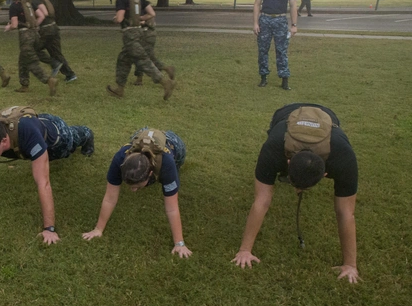
GPP Workout: What It Is + a Sample Session | Combat Fitness
GPP Workouts: What General Physical Preparedness Is and How to Train It
A GPP workout is a session that builds general physical preparedness: a broad base of strength, aerobic endurance, mobility, and work capacity that is not specialized for any one sport or test. A typical session pairs a few full-body lifts with loaded carries and 15 to 20 minutes of moderate conditioning. It is the foundation layer our military fitness programs are built on.
The concept comes from sports-science periodization, and it matters more for tactical athletes than for almost anyone, because your job does not tell you in advance what it will ask for. Below: what GPP means, how it differs from SPP, why it is the base of tactical fitness, and a done-for-you GPP session you can run this week.
What Is a GPP Workout?
A GPP workout trains general physical qualities instead of one event. It mixes strength, aerobic conditioning, carries, and mobility at moderate intensity, using full-body movements. The goal is a bigger general engine: more work capacity that you can later point at a specific test, selection course, or job.
What GPP Stands For
GPP stands for General Physical Preparedness, also called general physical preparation. The term comes from Soviet-era periodization, where Lev Matveyev split an athlete's year into general preparation and special preparation (Matveyev, 1981). General work raised overall capacity. Special work turned that capacity into performance in the sport. Western coaches carried the same split into modern periodization (Bompa & Buzzichelli, 2019; Verkhoshansky & Siff, 2009).
The plain-English GPP meaning: get broadly fit before you get narrowly fit.
What a GPP Session Looks Like
GPP sessions share four traits:
Full-body movement patterns: squat, hinge, push, pull, and carry.
Moderate loads and effort, usually 6 to 7 out of 10.
Strength and conditioning in the same session or the same week.
Enough volume to build capacity without the fatigue of max testing (Haff & Triplett, 2016).
The conditioning leans aerobic because the aerobic system fuels long efforts and drives recovery between hard ones; well-trained endurance athletes do most of their volume at low to moderate intensity (Seiler, 2010). Building an aerobic base is the conditioning engine inside GPP.
GPP vs. SPP: What Is the Difference?
GPP builds broad, general fitness. SPP (Specific Physical Preparedness) trains the exact demands of an event: the distances, loads, movements, and pacing of a test or selection. GPP raises your ceiling. SPP converts that ceiling into a score. You need both, in that order.
The difference shows up on four axes:
Goal: GPP builds general capacity; SPP builds event performance.
Exercises: GPP uses broad full-body patterns; SPP uses the test events and close variations.
Intensity: GPP sits mostly at moderate effort; SPP climbs toward race pace and test loads.
Timing: GPP dominates early in a training cycle; SPP dominates the final weeks before an event.
When Each Dominates in a Training Cycle
Classic periodization runs from general to specific. Block models describe the same idea as accumulation (general abilities, high volume), transmutation (specific abilities), and realization (peaking for the event) (Issurin, 2010). For a candidate with selection 16 weeks out, that might look like this:
Weeks 1 to 8: mostly GPP. Strength, aerobic volume, carries, and mobility.
Weeks 9 to 13: GPP shrinks and SPP grows. Ruck at selection weight, run test distances, rehearse the events.
Weeks 14 to 16: mostly SPP, then a taper. GPP drops to short maintenance work.
Outside a selection window, most tactical athletes should live closer to the GPP end. If you are weighing a plan that handles that balance for you, our guide to choosing a strength & endurance program walks through what to look for.
Why Is GPP the Base of Tactical Fitness?
Tactical work is unpredictable. A shift or deployment can ask for a sprint, a long movement under load, a casualty drag, and hours on your feet in the same day. A broad GPP base prepares you for demands you cannot rehearse, which is why we program it as the foundation layer of tactical fitness (NSCA, 2017).
Military physiology research supports that approach. Occupational tasks draw on strength, power, and aerobic fitness together, and military researchers conclude that soldiers need both aerobic and strength qualities, not one at the expense of the other (Friedl et al., 2015; Kraemer & Szivak, 2012; Kyröläinen et al., 2018). The Army's Holistic Health and Fitness doctrine trains the same mix of strength, endurance, mobility, and movement skill (Department of the Army, 2020).
Low general fitness also costs you on the injury side. In Army basic combat training, recruits with slower run times had a higher risk of training injury (Knapik et al., 2001). A bigger base gives you more margin when training volume spikes.
GPP is also where you build the whole-body strength that shows up on the job, the quality we break down in functional strength for military performance.
GPP Is the Base, Not the Whole Plan
GPP alone will not peak you for selection. A long ruck at selection weight demands foot conditioning, pacing, and load tolerance that only rucking builds. When endurance volume runs high, concurrent training can blunt some strength and power gains (Wilson et al., 2012), so the mix has to be dosed, not stacked. Build GPP first, then layer SPP on top.
A Sample GPP Workout
This GPP workout takes 50 to 60 minutes and trains every major quality in one session. Run it at moderate effort: you should finish tired but able to train again tomorrow. Use it two to three times per week in a base phase, alongside your running and rucking, and rotate exercise variations weekly.
Warm-up (8 to 10 minutes): 5 minutes easy row, bike, or jog, then 2 rounds of 5 inchworms, 3 world's greatest stretches per side, and 15 band pull-aparts.
Strength block (3 to 4 rounds, rest 60 to 90 seconds): trap-bar or kettlebell deadlift x 6 to 8, push-ups x 10 to 15, ring or inverted rows x 8 to 12. Leave 2 to 3 reps in reserve on every set.
Carry block (3 rounds): farmer's carry x 40 meters, then sandbag bear-hug carry x 40 meters. Carries train grip, trunk, and posture under load, the same demand as hauling gear.
Conditioning block (4 rounds of 4 minutes on, 1 minute off): 200-meter row, 10 kettlebell swings, and 10 step-ups per leg, repeated for the full 4 minutes. Hold a pace where you can still speak in short sentences.
Cooldown (5 minutes): easy walk, then hip flexor and upper-back mobility.
The strength block follows the same principles as a strength workout for athletes, which covers loading and progression for the main lifts in more detail.
GPP Workout for Beginners
Scale the session down without changing its shape:
Swap deadlifts for goblet squats, push-ups for incline push-ups, and rows for band rows.
Run 2 to 3 strength rounds instead of 4.
Cut carries to 20 to 30 meters with a lighter load.
Shorten conditioning to 3 rounds of 3 minutes at a conversational pace.
Progress one variable per week: add a round, then load, then conditioning time.
Frequently Asked Questions
What is a GPP workout?
A GPP workout builds general physical preparedness: all-around strength, aerobic endurance, mobility, and work capacity. It uses full-body lifts, carries, and moderate conditioning instead of event-specific drills, creating a broad base you can later direct toward a specific test, selection, or job.
What does GPP stand for?
GPP stands for General Physical Preparedness, sometimes written as general physical preparation. The term comes from Soviet periodization, which split training into general and special preparation. Its counterpart is SPP, Specific Physical Preparedness. GPP builds the broad base; SPP sharpens it for one event.
What is the difference between GPP and SPP?
GPP builds broad fitness with general exercises at moderate intensity. SPP trains the exact demands of an event, such as test distances, ruck weights, and selection tasks, at higher specificity. GPP dominates early in a training cycle; SPP takes over in the final weeks before the event.
Why is GPP important for tactical athletes?
Tactical athletes face unpredictable demands: sprints, carries, drags, and long movements under load. A broad GPP base prepares you for tasks you cannot rehearse, and research on military trainees links lower fitness to higher injury risk, so a bigger base adds margin when volume climbs.
What does a GPP workout look like?
A typical GPP workout runs 50 to 60 minutes: a warm-up, a full-body strength block (deadlift, push-up, row), loaded carries, and 15 to 20 minutes of moderate mixed conditioning. Effort stays around 6 to 7 out of 10 so you can train again the next day.
How often should you do GPP training?
Most tactical athletes should run two to four GPP sessions per week during a base phase, well above the general health floor of two strength days and about 150 minutes of moderate aerobic work (Garber et al., 2011). As an event approaches, cut GPP to one or two short maintenance sessions so the specific training gets your best effort while the base holds.
A GPP workout builds the broad base of strength, endurance, mobility, and work capacity that every specific goal sits on. Train it first, dose it at moderate effort, and layer the event-specific work on top as your test or selection gets closer. Run the sample session for four weeks, then start a Combat Fitness program that sequences GPP and SPP for the job you are training for.
References:
Bompa TO, Buzzichelli C. Periodization: Theory and Methodology of Training. 6th ed. Champaign, IL: Human Kinetics; 2019.
Department of the Army. FM 7-22, Holistic Health and Fitness. Washington, DC: Headquarters, Department of the Army; 2020.
Friedl KE, Knapik JJ, Häkkinen K, et al. Perspectives on aerobic and strength influences on military physical readiness: report of an international military physiology roundtable. Journal of Strength and Conditioning Research. 2015;29(Suppl 11):S10-S23.
Garber CE, Blissmer B, Deschenes MR, et al. Quantity and quality of exercise for developing and maintaining cardiorespiratory, musculoskeletal, and neuromotor fitness in apparently healthy adults. Medicine and Science in Sports and Exercise. 2011;43(7):1334-1359.
Haff GG, Triplett NT, eds. Essentials of Strength Training and Conditioning. 4th ed. Champaign, IL: Human Kinetics; 2016.
Issurin VB. New horizons for the methodology and physiology of training periodization. Sports Medicine. 2010;40(3):189-206.
Knapik JJ, Sharp MA, Canham-Chervak M, et al. Risk factors for training-related injuries among men and women in basic combat training. Medicine and Science in Sports and Exercise. 2001;33(6):946-954.
Kraemer WJ, Szivak TK. Strength training for the warfighter. Journal of Strength and Conditioning Research. 2012;26(Suppl 2):S107-S118.
Kyröläinen H, Pihlainen K, Vaara JP, Ojanen T, Santtila M. Optimising training adaptations and performance in military environment. Journal of Science and Medicine in Sport. 2018;21(11):1131-1138.
Matveyev L. Fundamentals of Sports Training. Moscow: Progress Publishers; 1981.
National Strength and Conditioning Association. NSCA's Essentials of Tactical Strength and Conditioning. Alvar BA, Sell K, Deuster PA, eds. Champaign, IL: Human Kinetics; 2017.
Seiler S. What is best practice for training intensity and duration distribution in endurance athletes? International Journal of Sports Physiology and Performance. 2010;5(3):276-291.
Verkhoshansky Y, Siff MC. Supertraining. 6th ed. Rome: Verkhoshansky; 2009.
Wilson JM, Marin PJ, Rhea MR, et al. Concurrent training: a meta-analysis examining interference of aerobic and resistance exercises. Journal of Strength and Conditioning Research. 2012;26(8):2293-2307.
Disclaimer: This article is for educational purposes and is not medical advice. If you have an injury, pain, or a diagnosed condition, get cleared by a qualified medical provider before starting a new exercise program. Stop any exercise that causes sharp or worsening pain.


