
Cooper Standards Charts for Police Fitness | Combat Fitness
Cooper Standards: The Law Enforcement Fitness Test Explained
The Cooper standards are the percentile-based fitness norms from The Cooper Institute that most U.S. police academies and agencies use to decide who is fit enough to start training. If you are preparing for that test, our tactical fitness programs put the run, the push-ups, and the power work into one structured plan, so you show up ready instead of hoping.
Each event is scored against people your age and sex, and your agency picks the percentile you must hit. This post covers what each event measures, the 40th percentile charts, why law enforcement relies on this battery, how cutoffs change by state, and how to train for each event.
Key Takeaways:
The Cooper standards are age- and sex-adjusted percentile norms, not one fixed score. Your agency chooses the cutoff.
The 40th percentile is the most common entry bar. Agencies range from the 15th to the 50th percentile to enter, and some require up to the 70th to graduate.
The core law enforcement battery is the 1.5-mile run, 300-meter run, 1-minute sit-ups, 1-minute push-ups, and vertical jump.
In published research, push-ups and the 1.5-mile run are the two events most strongly tied to academy graduation.
Train the run aerobically first, then add speed. Train push-ups and sit-ups with frequent submaximal volume and timed test practice.
What Are the Cooper Standards?
The Cooper standards are physical fitness norms published by The Cooper Institute in Dallas, Texas. They rank your performance on each test event as a percentile of people your age and sex. Law enforcement agencies select a percentile, often the 40th, as the minimum score an applicant or recruit must reach.
The name traces back to Dr. Kenneth Cooper. His 1968 research showed that the distance a person covers in a 12-minute run closely predicts maximal oxygen uptake, and that finding became the original Cooper test. The 1.5-mile run used today comes directly from that work. Cooper test standards, Cooper fitness standards, and Cooper Institute standards all refer to this normative system and the battery built on it.
One distinction matters. The Cooper Institute publishes norms, not policy. Its own researchers stress that a norm describes how you rank against peers, while a standard is the cutoff an agency chooses to enforce. The Institute does not tell departments which percentile to require, which is why passing numbers differ between academies.
What Events Are in the Cooper Fitness Test?
The Cooper test covers five fitness qualities, and each event targets one of them. Agencies that cite the Cooper Institute’s norms booklet typically list the same five-event battery, run in a set order with rest between events.
Vertical jump: lower-body explosive power. Power drives a sprint start, a fence climb, or getting off the ground in a fight.
1-minute sit-ups: abdominal and hip flexor muscular endurance. Trunk endurance protects your back under a duty belt and during arrests.
300-meter run: anaerobic power. It mirrors a foot pursuit: full effort, no pacing.
1-minute push-ups: upper-body muscular endurance. The Cooper Institute does not recommend the modified, knees-down version.
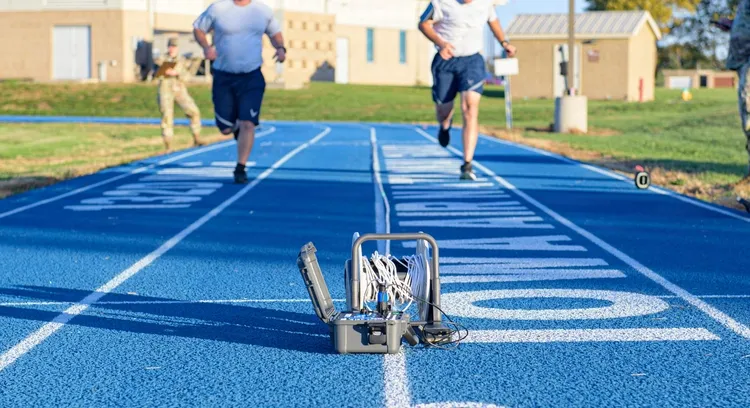
1.5-mile run: aerobic capacity. This is the classic Cooper standards event.
Some agencies add or swap events. Pennsylvania’s commission has historically included a 1-repetition maximum bench press scored as a ratio of body weight, and some agencies test sit-and-reach flexibility. Check your agency’s exact list before you build a plan.
Event order matters for your preparation. A common sequence is vertical jump, sit-ups, 300-meter run, push-ups, and then the 1.5-mile run last. You run your longest event already fatigued from four others, so your training has to rehearse that.
Cooper Standards by Age and Gender: The 40th Percentile Chart
The Cooper standards chart below lists the 40th percentile, the cutoff most agencies use for entry. These figures are the Cooper Institute norms as a Minnesota police department published them in a 2015 updated chart. Your agency may use an older edition or a different percentile, so confirm the numbers it gives you.
Men, 40th percentile:
Ages 20 to 29: 38 sit-ups, 29 push-ups, 1.5-mile run in 12:51
Ages 30 to 39: 35 sit-ups, 24 push-ups, 1.5-mile run in 13:36
Ages 40 to 49: 29 sit-ups, 18 push-ups, 1.5-mile run in 14:29
Ages 50 to 59: 24 sit-ups, 13 push-ups, 1.5-mile run in 15:26
Ages 60 and over: 19 sit-ups, 10 push-ups, 1.5-mile run in 16:43
Women, 40th percentile:
Ages 20 to 29: 32 sit-ups, 23 push-ups, 1.5-mile run in 15:26
Ages 30 to 39: 25 sit-ups, 19 push-ups, 1.5-mile run in 15:57
Ages 40 to 49: 20 sit-ups, 13 push-ups, 1.5-mile run in 16:58
Ages 50 to 59: 14 sit-ups, 12 push-ups, 1.5-mile run in 17:55
Ages 60 and over: 6 sit-ups, 5 push-ups, 1.5-mile run in 18:44
The 300-meter run and vertical jump cutoffs vary more between agencies and editions. As one official example, Pennsylvania’s commission sets its entry bar at the 30th percentile. For ages 18 to 29, that means a 300-meter run in 62.1 seconds for men and 75 seconds for women.
Two things to know about these police percentiles. First, the Cooper norms have been revised over time, which is why different agency sheets show slightly different numbers. Second, the 40th percentile is a floor, not a target. If you train to just touch 12:51, a bad night of sleep or a windy course puts you under. Build a margin.
Why Law Enforcement Uses the Cooper Standards
Cooper standards for law enforcement exist because police work demands physical capacity, and agencies need a hiring test that is both job-related and legally defensible. The Cooper battery measures the fitness qualities behind sprinting, grappling, climbing, and sustained effort. Its norms are drawn from both general and law enforcement populations.
Defensibility drives much of this. Courts have held that physical hiring standards must be tied to the job. A widely cited federal case, Lanning v. Southeastern Pennsylvania Transportation Authority, examined a transit police running standard on exactly that question. Pennsylvania’s police training commission states that the Cooper tests have evidence of construct and criterion validity for job-related factors. One testing consortium reports that the law enforcement norms behind its standard came from roughly 4,000 officers randomly selected from 40 municipal, state, and federal agencies.
The research on recruits supports the battery. A Massachusetts study of municipal academies found that recruits with fewer push-ups and slower 1.5-mile run times had several times higher odds of failing to graduate. A follow-up prospective study confirmed both measures as predictors and also flagged sit-ups. A 2021 review of law enforcement fitness testing reached the same conclusion: push-ups and the 1.5-mile run have the strongest link to academy graduation. Other work has tied low push-up scores to higher injury risk in recruits.
The Cooper police test has limits. General fitness is not the same as job task performance, which is why some agencies add an obstacle course or job-simulation test. Passing the Cooper battery gets you into the academy. It does not get you through it.
How to Train for and Pass the Cooper Standards
You pass the Cooper standards by training each event for the quality it measures, then rehearsing the full battery in order. Build an aerobic base for the 1.5-mile run, add speed work for the 300 meters, use high-frequency submaximal sets for push-ups and sit-ups, and keep strength and power work in your week.
If you are comparing ready-made plans before you commit, our guide to choosing a strength & endurance program explains what to look for when one plan has to cover both running and strength.
This is the order we use to prepare a candidate over 8 to 12 weeks:
Take a baseline test. Run the full battery in your agency’s order and score every event against your age and sex. The event where your percentile is lowest gets the most attention.
Build the aerobic base. Most of your weekly running should be at an easy, conversational pace. Endurance research consistently shows that a large share of low-intensity volume, with a smaller share of hard work, drives aerobic gains.
Add one interval session per week. Intervals such as 4 x 4 minutes at a hard but sustainable effort raise maximal oxygen uptake more than moderate steady running alone.
Train push-ups and sit-ups often. Do several submaximal sets across the week, stopping a few reps short of failure, and take one timed 1-minute test every week or two.
Keep one or two strength and power sessions. Squats, presses, and jumps maintain the force you need for the vertical jump and any bench test.
Rehearse the full battery. Every two to three weeks, run the whole test in order with the same rest periods you will get on test day.
Taper. Cut volume in the final week so you arrive fresh.
The 1.5-Mile Run
Your 1.5-mile time is mostly an aerobic capacity problem, which is why Cooper’s original research measured aerobic capacity with a run. Easy mileage raises your aerobic ceiling and lets you hold a faster pace with less effort. Interval work then teaches you to run close to that ceiling. Pace evenly: most failed runs come from a fast first lap.
The 300-Meter Run
The 300 meters punishes anyone who only trains distance. It runs mostly on anaerobic energy, so you need repeat sprints of 150 to 400 meters with full recovery between them. Shuttle and sprint drills build the same acceleration and lactate tolerance, and we cover that conditioning in our upcoming guide to the shuttle run.
Push-Ups and Sit-Ups
Timed push-ups and sit-ups reward muscular endurance and pacing more than raw strength. Frequent submaximal sets build that endurance without the fatigue of training to failure every session. A structured military calisthenics workout, which we cover in an upcoming guide, gives you the volume template. On test day, a steady rhythm beats a fast start followed by long pauses.
Bench Press and Vertical Jump
Strength and power events need heavy, low-rep work, not more cardio. If your agency tests a bench press ratio, follow a progressive plan such as a strength workout for athletes built around compound lifts. For the vertical jump, pair squats or trap bar deadlifts with box jumps and broad jumps. That strength also carries past the test, which is why we frame this work as functional strength for military performance rather than gym numbers for their own sake.
Do Cooper Standards Vary by State or Agency?
Yes. States and agencies adopt the Cooper norms but set their own percentile cutoffs, event lists, and pass rules, so the score you need depends on where you apply. Entry bars commonly range from the 15th to the 50th percentile, and many academies require a higher percentile to graduate than to enter.
A few verified examples show the range:
New York: the New York State Police set entry at the 50th percentile and graduation at the 70th. The state’s Division of Criminal Justice Services (DCJS) requires the 50th percentile for officers in the basic police course.
Pennsylvania: the 30th percentile in each event to enter the academy, and the 50th percentile to graduate.
Connecticut: the 40th percentile to enter basic training and the 50th percentile for initial certification.
Wyoming: the 40th percentile in each event, or a 50th percentile average across all three events with none below the 25th.
Maine and Iowa: the 40th percentile to enter, with Maine requiring the 50th to exit.
Texas Department of Public Safety: raised its requirement from the 25th to the 50th percentile in 2013.
New Jersey, North Carolina, New Hampshire, and other states set their rules through their own training commissions and individual departments, and those rules change. Get the current standard in writing from your agency, then train to beat it with room to spare.
Frequently Asked Questions
What are the Cooper standards?
The Cooper standards are age- and sex-adjusted fitness norms from The Cooper Institute. They rank your performance on events like the 1.5-mile run, push-ups, and sit-ups. Police agencies pick a percentile from those norms, often the 40th, as their passing score.
What events make up the Cooper fitness test?
The core law enforcement battery is the vertical jump, 1-minute sit-ups, 300-meter run, 1-minute push-ups, and 1.5-mile run. Some agencies add a bench press or sit-and-reach, and some test only push-ups, sit-ups, and the run.
What is the passing score for the Cooper standards?
There is no single passing score. Each agency selects a percentile, and the 40th is the most common entry cutoff. For a man aged 20 to 29, the 40th percentile is 38 sit-ups, 29 push-ups, and a 1.5-mile run in 12:51. Some states require the 50th percentile to enter or the 70th to graduate.
Why do police agencies use the Cooper standards?
Agencies use the Cooper standards because they measure job-related fitness qualities against scientifically grounded norms and have held up as a defensible hiring tool. Push-up and 1.5-mile run scores also predict academy graduation.
What is a good 1.5-mile run time for the Cooper test?
A good 1.5-mile time is one that clears your agency’s cutoff with margin. At the 40th percentile, that is 12:51 for men and 15:26 for women aged 20 to 29. If your academy grades at the 50th or 70th percentile, the target is faster.
How do you train to pass the Cooper standards?
Train each event for what it measures. That means easy aerobic mileage plus weekly intervals for the run, sprint repeats for the 300 meters, frequent submaximal sets for push-ups and sit-ups, and strength work for the power events. Rehearse the full battery in order, then taper.
Do Cooper standards vary by state or agency?
Yes. Every state and agency chooses its own percentile and event list. The New York State Police require the 50th percentile to enter, Pennsylvania the 30th, and Connecticut the 40th.
The Cooper standards are not complicated: five events, a chart by age and sex, and a percentile your agency picks. Candidates who pass with room to spare train each quality on purpose and rehearse the test in order. Get your agency’s exact cutoff, take a baseline this week, and start a structured plan that fixes your weakest event first. Train for the margin, not the minimum, because the academy will ask for more than the entry test did.
References:
Cooper KH. A means of assessing maximal oxygen intake: correlation between field and treadmill testing. JAMA. 1968;203(3):201-204.
The Cooper Institute. Physical Fitness Assessments and Norms for Adults and Law Enforcement. Dallas, TX: The Cooper Institute.
Farrell SW. Fitness Norms and Fitness Standards are Apples and Oranges. The Cooper Institute, December 17, 2017.
City of Shakopee, MN. Cooper Fitness Standards for Law Enforcement (40th Percentile), updated August 4, 2015.
Pennsylvania Municipal Police Officers’ Education and Training Commission. Physical Fitness: Basic Police Officer Training.
Pennsylvania Municipal Police Officers’ Education and Training Commission. Frequently Asked Questions Regarding Physical Fitness Tests and Standards.
Cumberland County Police Testing Consortium. Physical Fitness Standards Disclaimer.
Nebraska Law Enforcement Training Center. Cooper Institute Test Results Example (event order).
New York State Police. Fitness Requirements.
Cornell Chronicle. Police officers graduate from academy at top of their class (DCJS 50th percentile requirement).
Connecticut Police Officer Standards and Training Council. General Notice 01-07: Updated Physical Fitness Standards.
City of Douglas, WY. Physical Fitness Standards (Wyoming Law Enforcement Academy).
Maine Criminal Justice Academy. PFT Standards (2013).
City of Davenport, IA. Police Officer Information Packet 2024 (Iowa Law Enforcement Academy standards).
Texas Department of Public Safety. Physical Fitness Program presentation.
Tri-C Basic Police Academy. Physical Fitness Assessment.
Lanning v. Southeastern Pennsylvania Transportation Authority, 181 F.3d 478 (3d Cir. 1999).
Shusko M, Benedetti L, Korre M, et al. Recruit fitness as a predictor of police academy graduation. Occupational Medicine. 2017;67(7):555-561. doi:10.1093/occmed/kqx127
Korre M, Loh K, Eshleman EJ, et al. Recruit fitness and police academy performance: a prospective validation study. Occupational Medicine. 2019;69(8-9):541-548.
Zulfiqar MM, Wooland J, Schram B, Dawes JJ, Lockie RG, Orr RM. Battery Fitness Testing in Law Enforcement: A Critical Review of the Literature. International Journal of Exercise Science. 2021;14(4):613-632.
Lockie RG, Dawes JJ, Orr RM, Dulla JM. Fitness changes from hiring to academy in law enforcement recruits who graduate or separate. Work. 2021;68(4):1081-1090. doi:10.3233/WOR-213438
Lockie RG, Dawes JJ, Dulla JM, Orr RM, Hernandez E. Physical fitness, sex considerations, and academy graduation for law enforcement recruits. Journal of Strength and Conditioning Research. 2020;34(12).
Helgerud J, Hoydal K, Wang E, et al. Aerobic high-intensity intervals improve VO2max more than moderate training. Medicine and Science in Sports and Exercise. 2007;39(4):665-671.
Seiler S. What is best practice for training intensity and duration distribution in endurance athletes? International Journal of Sports Physiology and Performance. 2010;5(3):276-291.
Disclaimer: This article is for educational purposes and does not replace guidance from your hiring agency or a medical professional. Fitness standards, percentiles, and events change and differ by state and department. Always confirm the current requirements in writing with the agency you are applying to. Get medical clearance before starting a new training program or attempting maximal fitness testing.


