
Cable Chest Exercises: 8 Best Moves | Combat Fitness
Cable Chest Exercises: The Best Cable-Machine Moves for Your Chest
Cable chest exercises keep tension on your pecs through the full range of motion and let you set the line of pull for the upper, middle, or lower chest. That makes the cable fly, the cable press, and their angle variations some of the most useful accessory work you can add behind your pressing. In our tactical fitness programs, cables back up the heavy presses rather than replace them, and that frame runs through everything below.
We program for soldiers, police officers, and firefighters who need a chest that holds up under push-up events, body armor, and hard physical contact on the job. This guide covers why cables work, how to execute the cable chest fly, which angle hits which part of the chest, the press and the other moves worth knowing, a complete cable-only session, and how to fit it into your training week.
Key Takeaways:
Cables hold tension where dumbbells lose it, especially near the top of a fly.
Pulley height decides the target: low-to-high for the upper chest, high-to-low for the lower chest, shoulder height for the middle.
The cable chest fly is the staple. The standing cable press adds a trunk-stability demand the bench press does not.
Treat cable chest work as accessory volume after heavy pressing, or as a joint-friendly push session when your shoulders need a lighter week.
Why Use Cable Chest Exercises Instead of Only Free Weights?
Cable chest exercises are worth programming because the cable pulls along its own line rather than straight down. That keeps resistance on the pecs at positions where a dumbbell goes slack, lets you match the pull to the direction of the muscle fibers, and gives you smooth, adjustable loading that is easy on the shoulders.
Gravity is the problem with free-weight flys. With a dumbbell, the load always pulls toward the floor, so as your arms close over your chest the lever arm shrinks and tension on the pecs fades toward zero. EMG work on the dumbbell fly shows pec activity concentrated in the stretched portion of the rep and dropping off as the arms come together (Welsch et al., 2005). A cable set at shoulder height still pulls sideways at the top, so the squeeze is loaded instead of resting.
The second advantage is angle. Move the pulley and you change which fibers line up with the resistance, which is why chest workouts with cables can bias the upper or lower chest without a single bench adjustment. The third is joint tolerance. Your hands are free to find their own path, the load stays smooth through the range, and you can train meaningful volume without the shoulder stress of a fixed barbell. That makes cable machine chest exercises a strong option for higher-rep work and lighter weeks.
None of this makes cables a primary tactical lift. Pushing strength on the job comes from heavy compound pressing and full-body work, which is why we build accessories around functional strength for military performance instead of the other way around (Kraemer and Szivak, 2012). Chest cable exercises fill in the volume the big lifts leave on the table and support push-up events such as the Army’s hand-release push-up (Department of the Army, FM 7-22). If you are still deciding what those big lifts should look like inside a full plan, our guide to choosing a strength & endurance program walks through what to look for.
How Do You Do a Cable Chest Fly?
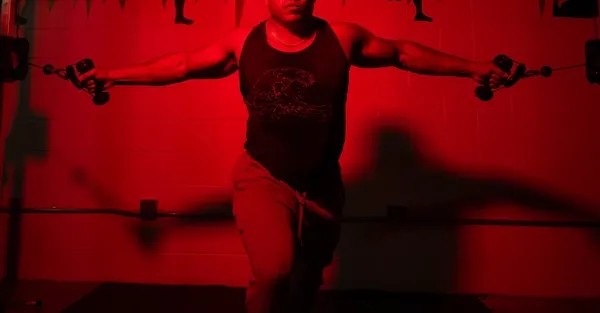
The cable chest fly is a pec isolation movement: you stand between two pulleys set at shoulder height, hold a soft bend in your elbows, and sweep your hands together in a wide arc in front of your chest. The elbow angle stays fixed, so the pecs do the work instead of the triceps.
Set both pulleys at shoulder height and attach single D-handles.
Grab the handles, step forward into a staggered stance, and brace your trunk.
Start with your arms open wide, elbows slightly bent and pointing back, chest up.
Sweep your hands forward and together in an arc, as if hugging a large tree.
Squeeze for one second when the handles meet in front of your sternum.
Return under control until you feel a stretch across the chest, with your hands no farther back than your body line.
The fixed elbow angle is the whole exercise. Bend and extend the elbows and the fly turns into a sloppy press, shifting work to the triceps and shrinking the stretch on the pecs. Research comparing the bench press with the fly shows the fly keeps triceps involvement low, which is exactly why it complements pressing rather than duplicating it (Solstad et al., 2020). Keep the load moderate. A cable fly that needs body English to finish is too heavy.
Cable chest flys, cable chest flyes, chest cable fly, chest fly cable: the gym has several names for it, and cable flys for chest all follow the same mechanics. The dumbbell fly trains the same pattern with a different resistance curve, heavy in the stretch and nearly empty at the top. We use the cable version as the default because it spreads tension across the whole rep, and we save the dumbbell version for when you want to bias the stretched position or train without a cable station.
High, Flat, and Low Cable Fly Angles: Which Hits the Upper or Lower Chest?
The pectoralis major has two main regions. The clavicular head (upper chest) runs from the collarbone, and the sternocostal head (middle and lower chest) runs from the sternum and ribs. Research on incline pressing shows that steeper angles shift activity toward the clavicular head and the front delts (Trebs et al., 2010; Lauver et al., 2016; Rodríguez-Ridao et al., 2020). Fly angles follow the same fiber-direction logic. Direct EMG data on cable fly angles is thinner than for pressing, so treat this as well-grounded practical extrapolation rather than settled lab fact.
Low-to-High Cable Fly (Upper Chest)
A low-to-high cable fly is a fly where the pulleys sit near the floor and your hands travel upward to finish around upper-chest or chin height. That line of pull matches the upward-running fibers of the clavicular head, which makes it the standard upper chest cable fly. Keep your shoulders down and back; shrugging hands the work to your upper traps. The front delts help here, so use a little less load than on the flat version.
Most low cable chest exercises, including this one, actually target the upper chest. The pulley is low, but the target is high. A low chest cable workout built around low pulleys is an upper-chest session.
Flat Cable Fly (Middle Chest)
Pulleys at shoulder height, hands meeting at sternum height. This is the standard fly described above and the best all-around choice when you only have time for one angle.
High-to-Low Cable Fly (Lower Chest)
For the high cable chest fly, set the pulleys above head height and sweep your hands down and together to finish around belly-button height. Lean your torso slightly forward from the hips. The downward line matches the lower sternocostal fibers, which makes this the main lower chest cable exercise. Pair it with dips if your program already includes them.
Cable Chest Press: Standing and Single-Arm Options
The cable chest press is a horizontal push performed against a cable, usually standing in a split stance with the pulleys at chest height. It trains the same pattern as the bench press but forces your trunk and hips to resist being pulled backward, which changes what the exercise builds.
That trunk demand is the point. In a direct comparison, the standing cable press was limited by balance to loads around 40 percent of body mass, far below bench press loads, while trunk muscle activity rose and pec activity fell relative to the bench (Santana et al., 2007). The standing cable chest press will never replace the bench for maximal strength. What it trains is a push transmitted through a braced body on your feet, the posture you work from when you drive through a door or push against a resisting subject.
To set it up, stand in a split stance facing away from the stack, handles at chest height. Brace, press forward and slightly together until your arms are straight, then return under control without letting the cable pull your shoulders forward.
The single arm cable chest press takes it further. Pressing one side at a time forces your obliques and hips to resist rotation, which builds unilateral pushing strength and exposes side-to-side differences. Use it as a cable press chest option that doubles as anti-rotation core work.
Other Cable Chest Moves Worth Knowing
These pectoral cable exercises round out the toolbox. Each earns a slot for a specific reason.
Cable Crossover
The cable crossover is a high-pulley fly where your hands cross past the midline at the finish, adding a few degrees of shoulder adduction beyond a standard fly. Some lifters call it a cable chest pull because you pull the handles toward and past each other. Alternate which hand crosses on top each rep. It works best as a light, high-rep finisher.
Single-Arm Cable Fly
Working one arm at a time lets the working hand travel across your body for a longer range of motion. Brace your free hand on the upright and keep your hips square. It is the best cable option for correcting a side that lags, and longer ranges of motion generally favor muscle growth (Schoenfeld and Grgic, 2020).
Cable Pullover
Lie on a bench with a rope or straight bar on a low pulley behind your head, then pull it in an arc over your chest with near-straight arms. The cable pullover chest variation keeps tension at the top where a dumbbell pullover goes slack. EMG data on the pullover show both the pecs and the lats contribute (Marchetti and Uchida, 2011), so treat it as a hybrid push-pull accessory rather than a pure chest move.
Sample Cable Chest Workout (Cable Machine Only)
A good cable chest workout covers three things: a press, flys at more than one angle, and a finisher. The session below runs on a single dual-cable station in about 40 minutes.
Standing cable chest press (split stance): 3 sets of 10 to 12, rest 90 seconds.
Low-to-high cable fly: 3 sets of 12 to 15, rest 60 seconds.
Flat cable chest fly: 3 sets of 12 to 15, rest 60 seconds.
High-to-low cable fly: 2 sets of 12 to 15, rest 60 seconds.
Single-arm cable fly: 2 sets of 12 per side, rest 45 seconds.
Cable crossover finisher: 2 sets of 15 to 20, rest 45 seconds.
Take each set to within one to three reps of failure. Moderate loads in higher rep ranges build muscle comparably to heavy loads when sets are taken close to failure (Schoenfeld et al., 2017), which is why this chest workout with a cable machine stays in the 10 to 20 rep range. Progress by adding reps first, then a plate on the stack once you hit the top of the range on every set. Good chest workouts with cables are built on control, not on the heaviest pin you can move.
How to Program Cable Chest Work: Accessory or Standalone?
You have two ways to use cable chest work, and the right one depends on where you are in your training cycle.
As a cable chest accessory, it goes after your main press. Pick two of the moves above, run 4 to 8 hard sets total, and leave. This is the default for most of the year. The heavy work it supports should follow a structure like a strength workout for athletes, built around pressing, hinging, squatting, and pulling. In a push pull workout split, cable chest slots into push day right after the main press and before triceps.
As a standalone cable chest day, it replaces heavy pressing for a session. Use it during a deload, when your shoulders are irritated from heavy volume, or in the weeks after a selection event when your body needs work without the joint load of a barbell. The sample session above is built for this role.
Either way, count total weekly chest sets. More weekly sets produce more growth up to a point (Schoenfeld, Ogborn, and Krieger, 2017), and splitting that volume across at least two sessions per week works better than piling it into one (Schoenfeld, Ogborn, and Krieger, 2016). Keep cable volume in proportion to your pressing and to the rest of your training load (ACSM, 2009).
Frequently Asked Questions
What are the best cable chest exercises?
The best cable chest exercises are the cable chest fly, the low-to-high cable fly, the high-to-low cable fly, and the standing cable chest press. Together they cover the upper, middle, and lower chest plus a trunk-loaded push. Add the single-arm fly or crossover for extra range, and use the pullover only as a hybrid chest and lat accessory.
How do you target the upper vs. lower chest with cables?
Pulley height controls the target. Set the pulleys low and sweep upward to bias the upper chest, because that line matches the clavicular fibers. Set them high and sweep downward to bias the lower chest. A shoulder-height pulley trains the middle. Keep the elbow bend fixed at every angle so the pecs, not the triceps, move the handles.
Can you build your chest with just a cable machine?
Yes, a cable machine can build chest size, because muscle growth responds to hard sets and progressive overload more than to the specific tool. Cables are less suited to building maximal pressing strength, since the standing press is balance-limited. For a tactical athlete, cables work best alongside barbell or dumbbell pressing, or alone for short blocks.
Cable fly vs. dumbbell fly: which is better?
The cable fly is better for most lifters because it keeps tension across the full range, including the top, and lets you change angles easily. The dumbbell fly loads the stretched position harder and needs no cable station. Neither is wrong. Use cables as your default fly and the dumbbell version when you want stretch emphasis or lack equipment.
How many cable chest exercises should a workout have?
Two cable chest exercises are enough when cables are accessory work after a main press, totaling about 4 to 8 hard sets. A standalone cable chest day can use four to six exercises, as in the sample workout above. Choose movements that cover different angles rather than repeating the same fly with a different handle.
Cable chest exercises earn their place by holding tension where free weights cannot and by letting you aim each set at a specific part of the chest. Start with the cable fly, add the low-to-high and high-to-low angles, use the standing press for trunk-loaded pushing, and keep all of it behind your heavy pressing. The next step is putting it into a plan that progresses week to week. Start a structured program and make every accessory set serve the standard you are training for.
References:
American College of Sports Medicine. Progression models in resistance training for healthy adults. Medicine and Science in Sports and Exercise. 2009;41(3):687-708.
Department of the Army. FM 7-22: Holistic Health and Fitness. Washington, DC: Headquarters, Department of the Army; 2020.
Haff GG, Triplett NT, eds. Essentials of Strength Training and Conditioning. 4th ed. Champaign, IL: Human Kinetics (NSCA); 2016.
Kraemer WJ, Szivak TK. Strength training for the warfighter. Journal of Strength and Conditioning Research. 2012;26(Suppl 2):S107-S118.
Lauver JD, Cayot TE, Scheuermann BW. Influence of bench angle on upper extremity muscular activation during bench press exercise. European Journal of Sport Science. 2016;16(3):309-316.
Marchetti PH, Uchida MC. Effects of the pullover exercise on the pectoralis major and latissimus dorsi muscles as evaluated by EMG. Journal of Applied Biomechanics. 2011;27(4):380-384.
Rodríguez-Ridao D, Antequera-Vique JA, Martín-Fuentes I, Muyor JM. Effect of five bench inclinations on the electromyographic activity of the pectoralis major, anterior deltoid, and triceps brachii during the bench press exercise. International Journal of Environmental Research and Public Health. 2020;17(19):7339.
Santana JC, Vera-Garcia FJ, McGill SM. A kinetic and electromyographic comparison of the standing cable press and bench press. Journal of Strength and Conditioning Research. 2007;21(4):1271-1277.
Schoenfeld BJ, Grgic J. Effects of range of motion on muscle development during resistance training interventions: a systematic review. SAGE Open Medicine. 2020;8:2050312120901559.
Schoenfeld BJ, Grgic J, Ogborn D, Krieger JW. Strength and hypertrophy adaptations between low- vs. high-load resistance training: a systematic review and meta-analysis. Journal of Strength and Conditioning Research. 2017;31(12):3508-3523.
Schoenfeld BJ, Ogborn D, Krieger JW. Dose-response relationship between weekly resistance training volume and increases in muscle mass: a systematic review and meta-analysis. Journal of Sports Sciences. 2017;35(11):1073-1082.
Schoenfeld BJ, Ogborn D, Krieger JW. Effects of resistance training frequency on measures of muscle hypertrophy: a systematic review and meta-analysis. Sports Medicine. 2016;46(11):1689-1697.
Solstad TEJ, Andersen V, Shaw M, Hoel EM, Vonheim A, Saeterbakken AH. A comparison of muscle activation between barbell bench press and dumbbell flyes in resistance-trained males. Journal of Sports Science and Medicine. 2020;19(4):645-651.
Trebs AA, Brandenburg JP, Pitney WA. An electromyography analysis of 3 muscles surrounding the shoulder joint during the performance of a chest press exercise at several angles. Journal of Strength and Conditioning Research. 2010;24(7):1925-1930.
Welsch EA, Bird M, Mayhew JL. Electromyographic activity of the pectoralis major and anterior deltoid muscles during three upper-body lifts. Journal of Strength and Conditioning Research. 2005;19(2):449-452.
Disclaimer: This article is for educational purposes only and is not medical advice. Consult a qualified healthcare provider before starting a new training program, especially if you have a shoulder injury or other medical condition. Individual results vary with training history, recovery, and consistency.


