
Bodyweight Split Squat: How to Do It Right | Combat Fitness
The Bodyweight Split Squat: How to Do It and Build Single-Leg Strength
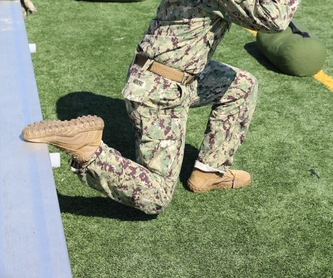
The bodyweight split squat is a stationary single-leg squat: one foot forward, one foot back, drop straight down until the front thigh is near parallel, then drive back up. You should feel it in the front-leg quad and glute. It builds unilateral strength, balance, and hip stability with no equipment, which is why it sits at the base of the lower-body work in our military fitness programs.
Every ruck step, stair climb, and casualty carry happens on one leg at a time. Below: the setup, where to feel it, how to scale it down, and how to progress it.
How Do You Do a Bodyweight Split Squat?
To do a bodyweight split squat, set a long split stance with feet hip-width apart, keep your torso vertical, and lower straight down until the back knee nearly touches the floor. Drive up through the whole front foot. Your feet never move between reps, which is what separates it from a lunge.
Set the stance. Step one foot back two to three feet, both feet pointing forward on two tracks, hip-width apart.
Load the front foot. Most of your weight goes there; the back foot is a kickstand on its toes.
Brace. Ribs stacked over hips, hands on hips or crossed at the chest.
Descend straight down. Take two to three seconds until the back knee is an inch off the floor.
Track the front knee. Keep it over your second and third toes. Forward is fine; caving inward is not.
Drive up. Push through the whole front foot until the knee is almost straight.
Switch legs. Start with your weaker side and match its reps on the stronger one.
The cue that fixes most reps: vertical torso, knee tracks toe. A knee-friendly note: some forward knee travel is normal and shares load between knee and hip. If the front of the knee aches, lengthen the stance and shorten the range for a few weeks. Persistent pain needs a clinician.
Where Should You Feel the Bodyweight Split Squat?
You should feel the bodyweight split squat mainly in the front-leg quad and glute. The rear leg balances and gets a stretch through the front of the hip, but it should not be doing the lifting. If the back leg burns first, your stance is too short or you are pushing off the back toes.
Muscles Worked
Quadriceps (front leg): the prime mover out of the bottom.
Gluteus maximus (front leg): extends the hip, more with a longer stance.
Adductors: assist hip extension from the deep position.
Gluteus medius and trunk: keep the pelvis level and the knee from caving.
Hip flexors (rear leg): stretched under load, a counter to hours in a seat.
Research comparing single-leg and two-leg squats shows the single-leg versions demand more from the glute medius and hip stabilizers.
Why It Matters for Tactical Athletes
Load carriage raises the force each leg absorbs per step, and lower-limb injuries dominate Army musculoskeletal injury data. Single-leg strength handles those forces. Training studies found unilateral programs matched bilateral squatting for strength and sprint gains, and single-leg work exposes left-to-right gaps a back squat hides. That is the case behind our approach to functional strength for military performance.
What If You Can’t Do a Bodyweight Split Squat Yet?
If you can’t do a bodyweight split squat yet, hold a support and shorten the range. Balance and front-leg strength are the usual limits, and both scale down cleanly. Work these regressions until you own 3 sets of 10 per leg, full range, unsupported.
Supported split squat. Hold a doorframe, chair back, or TRX for balance, not to pull yourself up.
Partial range. Stack a pad under the back knee and lower only to touch it. Remove layers as you get stronger.
Split-stance hold. Hold the bottom for 15 to 30 seconds per leg to build strength where you fail.
Slow lowering. Lower for four seconds, then use the support to stand.
How Do You Make the Bodyweight Split Squat Harder?
Make the bodyweight split squat harder by adding range, instability, or speed before you add load: slow tempo, then a deficit, then a rear-foot-elevated Bulgarian setup, then jumps. Move up one step when you can complete 3 sets of 12 per leg with clean form.
Tempo and Pauses
Lower for three seconds and pause for two at the bottom. More time under tension makes the same bodyweight harder.
Deficit Split Squat
Stand the front foot on a plate or step two to four inches high. The back knee drops below the front foot, adding range and loading the glute and quad at their longest.
Bodyweight Bulgarian Split Squat (RFE)
Rest the top of the back foot on a bench or stair. Biomechanics research on the rear-foot-elevated split squat confirms the front leg carries most of the load. The bodyweight Bulgarian split squat alone can drive weeks of progress.
Jump Split Squat
Lower under control, drive up hard enough to leave the floor, and land softly in the same stance. Keep reps at 5 to 6 per leg and stop when landings get loud.
When bodyweight stops being enough, add a loaded backpack, then dumbbells, and graduate to weighted lunges as your main loaded single-leg lift. If the split stance bothers your knees at any stage, our guide to split squat alternatives matches a swap to the reason. Slot your single-leg work into a strength workout for athletes alongside your hinge and upper-body lifts, and if you would rather follow a complete plan, start with choosing a strength & endurance program.
Common Bodyweight Split Squat Mistakes
The most common bodyweight split squat mistakes all move work away from the front leg or onto the knee.
Short stance. It drives the front heel up and the knee far forward. Lengthen it.
Tightrope feet. Feet in one line wreck balance. Keep them hip-width.
Folding forward. A slight lean is fine; collapsing at the waist is not.
Knee caving in. Drive the front knee out over the middle toes.
Bouncing the back knee. Stop short of the floor and control the turnaround.
Pushing off the back foot. If you can’t lift it an inch mid-rep, shift weight forward.
Frequently Asked Questions
What is a bodyweight split squat?
A bodyweight split squat is a stationary single-leg squat with no external load. You hold a staggered stance, lower until the back knee nearly touches the floor, and drive up through the front foot. It builds unilateral strength, balance, and hip stability anywhere.
How do you do a bodyweight split squat?
Step one foot back two to three feet, keep the feet hip-width apart, and put most of your weight on the front foot. Keep the torso vertical, lower until the back knee is just off the floor, then drive up through the whole front foot. Finish all reps on one side before switching.
Where should you feel the split squat?
You should feel the split squat in the quad and glute of your front leg. The rear leg balances and gets a hip flexor stretch. If the back leg does most of the work, lengthen your stance and shift weight forward onto the front foot.
What muscles does the bodyweight split squat work?
The bodyweight split squat works the quadriceps and gluteus maximus of the front leg as prime movers, with the adductors assisting. The gluteus medius, calves, and trunk stabilize the narrow base, and the rear-leg hip flexors are stretched under load.
What if you can’t do a bodyweight split squat yet?
Hold a doorframe, chair back, or TRX for balance, and place a pad under the back knee to shorten the range. Add split-stance holds and slow four-second lowering. Progress until you can do 3 sets of 10 per leg with full range and no support.
How do you make the bodyweight split squat harder?
Slow the tempo and add a pause, then stand the front foot on a step for a deficit, then raise the rear foot onto a bench for the Bulgarian version, then add jumps. After that, add a loaded backpack or dumbbells.
Split squat vs. Bulgarian split squat: what is the difference?
Both feet are on the floor in a split squat. In a Bulgarian split squat, the rear foot rests on a bench behind you, which shifts more load onto the front leg and increases the balance and range demands. Master the split squat first, then progress to the Bulgarian.
The bodyweight split squat is the no-equipment foundation of single-leg strength: a long stance, a vertical torso, and a straight drop that loads the front-leg quad and glute. Scale it down with support until you own it, then progress through deficit, Bulgarian, and jump versions before you add load. Grab our free single-leg lower-body routine and build legs that hold up under a pack.
References:
Mackey ER, Riemann BL. Biomechanical differences between the Bulgarian split-squat and back squat. International Journal of Exercise Science. 2021;14(1):533-543.
DeForest BA, Cantrell GS, Schilling BK. Muscle activity in single- vs. double-leg squats. International Journal of Exercise Science. 2014;7(4):302-310.
McCurdy K, O’Kelley E, Kutz M, Langford G, Ernest J, Torres M. Comparison of lower extremity EMG between the 2-leg squat and modified single-leg squat in female athletes. Journal of Sport Rehabilitation. 2010;19(1):57-70.
McCurdy KW, Langford GA, Doscher MW, Wiley LP, Mallard KG. The effects of short-term unilateral and bilateral lower-body resistance training on measures of strength and power. Journal of Strength and Conditioning Research. 2005;19(1):9-15.
Speirs DE, Bennett MA, Finn CV, Turner AP. Unilateral vs. bilateral squat training for strength, sprints, and agility in academy rugby players. Journal of Strength and Conditioning Research. 2016;30(2):386-392.
Appleby BB, Cormack SJ, Newton RU. Specificity and transfer of lower-body strength: influence of bilateral or unilateral lower-body resistance training. Journal of Strength and Conditioning Research. 2019;33(2):318-326.
Bishop C, Turner A, Read P. Effects of inter-limb asymmetries on physical and sports performance: a systematic review. Journal of Sports Sciences. 2018;36(10):1135-1144.
Fry AC, Smith JC, Schilling BK. Effect of knee position on hip and knee torques during the barbell squat. Journal of Strength and Conditioning Research. 2003;17(4):629-633.
Escamilla RF, Zheng N, MacLeod TD, et al. Patellofemoral joint force and stress between a short- and long-step forward lunge. Journal of Orthopaedic and Sports Physical Therapy. 2008;38(11):681-690.
Schoenfeld BJ. Squatting kinematics and kinetics and their application to exercise performance. Journal of Strength and Conditioning Research. 2010;24(12):3497-3506.
Kubo K, Ikebukuro T, Yata H. Effects of squat training with different depths on lower limb muscle volumes. European Journal of Applied Physiology. 2019;119(9):1933-1942.
Knapik JJ, Reynolds KL, Harman E. Soldier load carriage: historical, physiological, biomechanical, and medical aspects. Military Medicine. 2004;169(1):45-56.
Orr RM, Pope R, Johnston V, Coyle J. Soldier occupational load carriage: a narrative review of associated injuries. International Journal of Injury Control and Safety Promotion. 2014;21(4):388-396.
Molloy JM, Pendergrass TL, Lee IE, et al. Musculoskeletal injuries and United States Army readiness part I: overview of injuries and their strategic impact. Military Medicine. 2020;185(9-10):e1461-e1471.
American College of Sports Medicine. Progression models in resistance training for healthy adults. Medicine and Science in Sports and Exercise. 2009;41(3):687-708.
Schoenfeld BJ, Ogborn D, Krieger JW. Dose-response relationship between weekly resistance training volume and increases in muscle mass: a systematic review and meta-analysis. Journal of Sports Sciences. 2017;35(11):1073-1082.
Headquarters, Department of the Army. FM 7-22, Holistic Health and Fitness. Washington, DC; 2020.
Disclaimer: This article is for educational purposes and is not medical advice. Consult a qualified healthcare provider before starting a new exercise program, especially if you have a knee, hip, or ankle injury. Stop any exercise that causes sharp or worsening pain.


