
Split Squat Alternatives: 9 Swaps by Reason | Combat Fitness
Split Squat Alternatives: The Best Swaps for Knees, Balance, and No Equipment
The best split squat alternatives depend on why you are swapping: bad knees call for the reverse lunge, step-up, or box squat; balance problems call for the supported split squat, leg press, or hack squat; no equipment calls for the reverse lunge, step-up, or skater squat. Every option on this list keeps you training one leg at a time, which is how our tactical fitness programs treat lower-body work.
That principle matters more than the exercise you pick. Rucking, stairs, and carrying a casualty all happen on one leg at a time, so dropping single-leg work to dodge the Bulgarian split squat trades a short-term annoyance for a long-term weakness. Below, you get the swap that fits your reason, why it works, and how to program it.
Why Swap the Bulgarian Split Squat?
The Bulgarian split squat gets swapped for four reasons: it aggravates the front knee, the balance demand limits how much you can load, you lack a bench or dumbbells, or you simply hate it. Each has a different fix. None of them is “stop training single-leg strength.”
Biomechanics research shows the Bulgarian split squat places most of the load on the front leg with a deep knee and hip angle. That makes it effective, and a problem for sore knees or shaky balance. The goal of a swap is to change that one variable while keeping the unilateral stimulus.
Why keep it at all? Load-carriage research shows marching under a pack raises the force each leg absorbs per step, and lower-limb injuries dominate soldier injury data. Unilateral strength is the capacity that handles those forces. Training studies in athletes found single-leg programs matched two-leg squatting for strength and sprint gains, so you lose nothing by keeping it. It is why we build functional strength for military performance around patterns you use on the job, not gym tradition.
If you are deciding whether to fix the exercise yourself or follow a plan that already accounts for it, our guide to choosing a strength & endurance program lays out what to look for.
What Are the Best Split Squat Alternatives for Bad Knees?
The best split squat alternatives for bad knees are the reverse lunge, the step-up, and the box squat. Each one lets you control knee travel and depth, which lowers stress on the patellofemoral joint (where the kneecap meets the thigh bone) while still loading the quads and glutes hard.
This is coaching guidance, not medical advice. Sharp or worsening knee pain needs a clinician, not an exercise swap.
1. Reverse Lunge
Stepping backward keeps the front shin more vertical and makes the planted leg control the descent. Research on lunge step length found shorter steps raised patellofemoral stress, so take a full step back. Our guide to weighted lunges covers setup and loading.
2. Step-Up
The step-up is a concentric-first movement: you drive up, then lower under control. EMG research on loaded step-up variations shows strong quad and glute activation. Start with a box that puts your thigh near parallel.
3. Box Squat
The box squat is technically bilateral, so use it as a bridge, not a permanent home. A box caps depth at the range your knee handles, and sitting back shifts work toward the hips.
What Are the Best Alternatives for Balance and Stability?
The best alternatives for balance and stability are the supported split squat, the leg press, and the hack squat. Each removes or reduces the balance challenge so your legs, not your stabilizers, set the limit on load.
4. Supported Split Squat
Hold a rack, cable column, or TRX with one hand and run the same split stance. You keep the full range and the single-leg load. This is the closest match to the original, which makes it the first alternative to single-leg split squats we program when balance is the only issue.
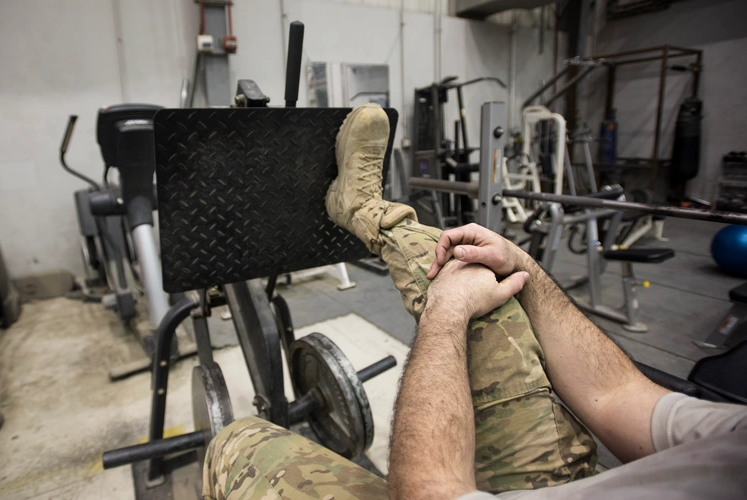
5. Leg Press (Single-Leg or Staggered)
The leg press removes balance from the equation entirely. Press one leg at a time, or run a staggered stance with the working foot high and centered.
6. Hack Squat
The hack squat runs on a fixed track, so it delivers deep quad work with almost no balance demand. A Smith machine split squat does a similar job: the bar path is locked.
Best No-Equipment and At-Home Swaps
The best no-equipment split squat alternatives are the reverse lunge, the step-up, the skater squat, and the walking lunge. A staircase and a loaded backpack cover it.
7. Skater Squat
Stand on one leg, reach the other knee back toward the floor, and lean the torso forward to counterbalance. It is a demanding bodyweight single-leg squat that trains the glutes and hip stabilizers hard.
8. Walking Lunge
The walking lunge moves you forward under load on one leg per step, the closest gym match to a ruck march. It is also the first choice if you dislike Bulgarians, because it feels less punishing at the same effort.
9. Goblet Split Squat
If you just dislike the rear-foot-elevated setup, drop the bench. The goblet split squat keeps both feet on the floor, holds the load at your chest to keep you upright, and keeps nearly all the training effect.
How to Program Split Squat Alternatives
Program split squat alternatives in the slot the original held, with matched volume: 3 to 4 sets of 6 to 12 reps per leg, once or twice a week, stopping one to three reps short of failure. Train the weaker leg first and match its reps on the stronger side.
Research shows weekly sets per muscle drive growth more than exercise choice, so a matched swap keeps the stimulus. Keep these rules:
Put the swap first or second in the session while you are fresh.
Go heavier (6 to 8 reps) on the leg press, hack squat, and reverse lunge; moderate (10 to 12) on step-ups, skater squats, and walking lunges.
Add load or reps each week until form breaks, then hold.
Retest the Bulgarian split squat every 4 to 6 weeks if knees or balance were the issue.
A sample single-leg lower-body day: reverse lunge 4x6-8 per leg, supported split squat or leg press 3x10 per leg, step-up 3x10-12 per leg, walking lunge 2x20 steps. Slot it into a strength workout for athletes alongside your hinge and upper-body work.
Frequently Asked Questions
What is a good alternative to the Bulgarian split squat?
The reverse lunge is the best all-round alternative to the Bulgarian split squat. It keeps the split stance and single-leg load, is easier on the knees, demands less balance, and needs no bench.
What can I do instead of split squats with bad knees?
With bad knees, use the reverse lunge, step-up, or box squat. Each lets you control depth and knee travel, which reduces stress on the front of the knee. Start in a pain-free range and progress depth before load. See a clinician if pain persists or worsens.
What is the best no-equipment split squat alternative?
The reverse lunge is the best no-equipment split squat alternative, followed by the step-up onto a stair or sturdy bench. The skater squat is the hardest bodyweight option. Add a loaded backpack and three-second lowering phases to keep progressing.
Is the reverse lunge a good split squat replacement?
Yes. The reverse lunge is the most direct split squat replacement because it uses the same split stance and loads the front leg the same way. Stepping back keeps the shin more vertical, which most lifters find easier on the knees.
Do split squat alternatives build the same muscles?
Single-leg alternatives train the same quads, glutes, and adductors as the split squat, with small shifts in emphasis. Step-ups lean toward the glutes, the hack squat and leg press toward the quads. Matched weekly volume matters more for results than the exact exercise.
Why are Bulgarian split squats so hard?
Bulgarian split squats are hard because one leg carries most of the load through a deep range while your hips and trunk fight to stay balanced on a narrow base. That combination of high local load and stability demand drives effort and soreness up fast.
The right split squat alternatives match your reason for swapping: knee-friendly patterns for sore knees, supported or machine options for balance, and lunges, step-ups, and skater squats when you have no equipment. What you never swap out is single-leg strength, because the job demands it every time you step off a ramp under a pack. Grab our free single-leg lower-body routine and train it on a schedule built for the work.
References:
Mackey ER, Riemann BL. Biomechanical differences between the Bulgarian split-squat and back squat. International Journal of Exercise Science. 2021;14(1):533-543.
Speirs DE, Bennett MA, Finn CV, Turner AP. Unilateral vs. bilateral squat training for strength, sprints, and agility in academy rugby players. Journal of Strength and Conditioning Research. 2016;30(2):386-392.
Appleby BB, Cormack SJ, Newton RU. Specificity and transfer of lower-body strength: influence of bilateral or unilateral lower-body resistance training. Journal of Strength and Conditioning Research. 2019;33(2):318-326.
McCurdy K, O’Kelley E, Kutz M, Langford G, Ernest J, Torres M. Comparison of lower extremity EMG between the 2-leg squat and modified single-leg squat in female athletes. Journal of Sport Rehabilitation. 2010;19(1):57-70.
Escamilla RF, Zheng N, MacLeod TD, et al. Patellofemoral joint force and stress between a short- and long-step forward lunge. Journal of Orthopaedic and Sports Physical Therapy. 2008;38(11):681-690.
Escamilla RF, Zheng N, MacLeod TD, et al. Patellofemoral joint force and stress during the wall squat and one-leg squat. Medicine and Science in Sports and Exercise. 2009;41(4):879-888.
Willy RW, Meira EP. Current concepts in biomechanical interventions for patellofemoral pain. International Journal of Sports Physical Therapy. 2016;11(6):877-890.
Simenz CJ, Garceau LR, Lutsch BN, Suchomel TJ, Ebben WP. Electromyographical analysis of lower extremity muscle activation during variations of the loaded step up exercise. Journal of Strength and Conditioning Research. 2012;26(12):3398-3405.
Knapik JJ, Reynolds KL, Harman E. Soldier load carriage: historical, physiological, biomechanical, and medical aspects. Military Medicine. 2004;169(1):45-56.
Orr RM, Pope R, Johnston V, Coyle J. Soldier occupational load carriage: a narrative review of associated injuries. International Journal of Injury Control and Safety Promotion. 2014;21(4):388-396.
Schoenfeld BJ, Ogborn D, Krieger JW. Dose-response relationship between weekly resistance training volume and increases in muscle mass: a systematic review and meta-analysis. Journal of Sports Sciences. 2017;35(11):1073-1082.
Schoenfeld BJ, Grgic J, Van Every DW, Plotkin DL. Loading recommendations for muscle strength, hypertrophy, and local endurance: a re-examination of the repetition continuum. Sports. 2021;9(2):32.
Department of the Army. FM 7-22, Holistic Health and Fitness. Washington, DC: Headquarters, Department of the Army; 2020.
Haff GG, Triplett NT, eds. Essentials of Strength Training and Conditioning. 4th ed. Champaign, IL: Human Kinetics (NSCA); 2016.
Disclaimer: This article is for educational purposes only and is not medical advice. Knee pain, joint injury, or any condition that limits training should be assessed by a qualified healthcare provider before you start or change an exercise program. Training results vary by individual, and no specific outcome is guaranteed.


