
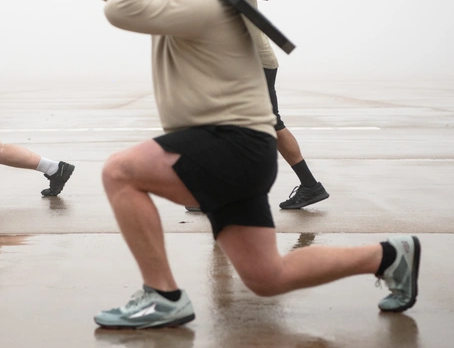
Weighted Lunges: Form, Variations, Workout | Combat Fitness
Weighted Lunges: The Single-Leg Builder for Stride and Load Carriage
Weighted lunges build the quads, glutes, and hamstrings one leg at a time, while your core and hip stabilizers hold the split stance steady. Every running stride, ruck step, and stair climb under kit happens on one leg, which is why our tactical fitness programs treat single-leg strength as a staple, not an afterthought.
The Army agrees: both the forward and rear lunge sit in the Preparation Drill in FM 7-22. This guide covers what lunges with weights work, how to do them, which variations and implements to use, and how many sets and reps to run, then closes with a free printable workout.
Key Takeaways:
Weighted lunges train the quads, glutes, and hamstrings, with the adductors and trunk stabilizing.
Single-leg work exposes and corrects left-to-right imbalances that squats can hide.
Loaded walking lunges are the closest gym simulation of moving under a pack.
The reverse lunge is the best default; side lunges cover the frontal plane.
Start with 3 to 4 sets of 6 to 12 reps per leg, once or twice a week.
What Muscles Do Weighted Lunges Work?
Weighted lunges work the quadriceps, gluteus maximus, and hamstrings of the front leg, while the adductors, glute medius, calves, and trunk stabilize the narrow base. Because one leg carries most of the load, the lunge builds unilateral strength and balance that two-legged lifts do not fully train.
Setup decides where the work lands. A short step and upright torso bias the quads. A longer step and slight forward lean shift demand to the glutes and hamstrings, as research on trunk position during the forward lunge confirms.
How to Do a Weighted Lunge (Step by Step)
The best way to do weighted lunges is to control the descent, keep the front knee tracking over the toes, and drive up through the whole front foot.
Set the load. Dumbbells at your sides, arms long, shoulders down and back.
Brace. Feet hip-width apart, ribs stacked over hips, midsection tight.
Step. Go far enough that both knees reach roughly 90 degrees at the bottom. Keep your feet on two tracks, hip-width apart, never on a tightrope.
Descend straight down. Lower the back knee to just short of the floor.
Track the front knee. Keep it in line with your second and third toes. Drifting forward past the toes is fine; caving inward is not.
Stay upright. A slight forward lean is acceptable. Folding at the waist is not.
Drive back. Push through the whole front foot, heel included.
One cue covers most errors: knee over toes, ribs over hips, load over the midfoot. Bouncing the back knee, pushing off the back toes, or narrowing the stance all move work away from the working leg.
Which Weighted Lunge Variations Should You Use?
Each variation changes direction, balance demand, or joint stress. Pick by the job.
Weighted Walking Lunges
Weighted walking lunges are the most specific variation for tactical athletes. You move forward under load, absorbing and producing force on one leg every step, which is what a ruck march or casualty drag demands. Treat each step as a full rep.
Forward and Stationary Lunges
The forward lunge trains the front leg to brake your bodyweight, useful for downhill rucking and sprint deceleration. The stationary lunge (a split squat) removes the step so you can load heavier.
Weighted Curtsy Lunges
The curtsy lunge steps the rear leg behind and across, raising demand on the glute medius, the muscle that keeps your knee from collapsing inward under a pack. Keep the load moderate.
Weighted Jump Lunges
Jump lunges add a midair switch, making the pattern plyometric. Load lightly with a vest, keep reps low, and chase speed, not fatigue.
Split Squats, Bulgarian, and Raised-Foot Lunges
Raising the rear foot (the Bulgarian split squat) shifts more load to the front leg. Raising the front foot on a plate adds range at the bottom. Range-extended work like the deficit reverse lunge has its own guide on our site.
Weighted Reverse Lunges: The Knee-Friendly Default
Weighted reverse lunges are the best default for most athletes. Stepping backward keeps the front shin more vertical and lets the planted leg control the descent, so most lifters find it easier on the knees than the forward lunge while it still loads the glutes and quads hard.
Because the working foot never moves, the reverse lunge with dumbbells progresses cleanly. We program it first for high-mileage runners.
Weighted Side Lunges: Strength in the Frontal Plane
Weighted side lunges train side-to-side strength that running and rucking ignore, loading the adductors and glutes for cutting, uneven terrain, and stepping off a vehicle under kit. Biomechanics research shows forward and side lunges load the knee differently, so this is not a duplicate pattern.
Hold one dumbbell or kettlebell at your chest, step wide, sit the hips back over the working foot, and keep the trailing leg straight. Run lateral lunges with weights as a secondary lift for 8 to 10 reps per side.
Choosing an Implement: Dumbbells, Barbell, Kettlebell, Plate, or Vest
Research on the anterior lunge under different external loads found that load placement changes joint demands, so choose the implement on purpose.
Dumbbell Lunges
Dumbbells are the default. The load hangs low near your center of mass, balance is manageable, and you can drop the bells if you lose a step. Most athletes should start here.
Barbell Lunges
Barbell lunges allow heavier loads once grip limits you, at the cost of balance. Reserve them for experienced lifters and favor the reverse or stationary variation.
Kettlebell Lunges
The goblet hold suits side lunges. The double front rack loads the trunk. A single suitcase bell forces your obliques to resist leaning, which carries straight over to hauling a jerry can.
Weighted Overhead Walking Lunges
A plate or dumbbell overhead turns the lunge into a shoulder and trunk stability test. Use it as an accessory, not your main leg builder.
Weight Vest, Backpack, and Sandbag Lunges
A vest or loaded backpack sits on your torso the way kit does, making it the most direct carryover to load carriage. A sandbag adds a shifting load.
Benefits of Weighted Lunges for Tactical Athletes
The benefits of weighted lunges come down to transfer. Training studies found single-leg work improved strength, sprint, and change-of-direction measures comparably to bilateral training, so you give up nothing and gain a closer match to how you move.
Single-leg strength. Running and rucking are single-leg events, and split-stance strength shows up in stride power.
Imbalance correction. Research links larger left-to-right strength gaps with poorer jump and change-of-direction performance. Lunges expose the weak side.
Load-carriage durability. Heavy packs are tied to lower-limb and back injuries. Stronger glutes and quads absorb more of each loaded step.
Muscle and glutes. Weighted lunges build muscle, glutes included, when weekly volume is sufficient.
If you are comparing plans, our guide to choosing a strength & endurance program breaks down what to look for, and our breakdown of functional strength for military performance explains why single-leg strength matters on the job.
How Many Weighted Lunges Should You Do?
Most tactical athletes should do 3 to 4 sets of 6 to 12 reps per leg, one to two times per week, ending each set with 1 to 3 reps in reserve. That range builds strength and muscle without wrecking your legs for the next run or ruck.
For strength, stay at 6 to 8 reps with about 2 minutes of rest. For muscle, the full range works, since hypertrophy occurs across a wide span of loads when sets are taken close to failure. For walking lunges, count 16 to 24 total steps per set.
How much weight? Pick a load you can lift for your target reps with clean form and 1 to 3 reps left. It will sit well below your squat, because a split stance narrows your base. When you hit the top of the range on every set, add the smallest increment. Lunges slot in as the main single-leg lift in a strength workout for athletes.
Free Weighted Lunge Workout (Printable)
Run this weighted lunges workout twice a week for six weeks, 48 hours apart, after a 5-minute warm-up.
Dumbbell reverse lunge: 4 sets of 6 to 8 per leg, 2 minutes rest.
Weighted walking lunge (dumbbells or vest): 3 sets of 20 total steps, 90 seconds rest.
Goblet side lunge: 3 sets of 8 per side, 60 to 90 seconds rest.
Rear-foot-raised split squat: 2 sets of 10 per leg, 60 seconds rest, weaker leg first.
Suitcase carry: 3 walks of 40 meters per hand.
Add reps until you hit the top of each range on every set, then add load and drop back to the bottom. In week 6, halve the sets to recover.
Frequently Asked Questions
How do you do weighted lunges correctly?
Brace your trunk, step far enough that both knees reach about 90 degrees, lower straight down until the back knee nearly touches the floor, and drive up through the whole front foot. Keep the front knee in line with your toes and your ribs stacked over your hips on every rep.
Walking vs. reverse vs. side lunge: which should you do?
Use all three for different jobs. The reverse lunge is the best main strength lift because it is the most stable and knee-friendly. The walking lunge is the best load-carriage simulator. The side lunge covers lateral strength that running and rucking skip. Anchor the plan with reverse lunges and rotate in the others.
Dumbbell vs. barbell weighted lunges: which is better?
Dumbbell lunges are better for most athletes. The load sits low, balance is easier, and you can drop the weights if you lose a step. Barbell lunges allow heavier loading once grip limits you, but they raise balance demand and the cost of a missed rep. Move to the barbell only after dumbbell technique is solid.
Are weighted lunges good for glutes?
Weighted lunges are good for glutes because the front hip extends from a deep, loaded position on every rep. To bias the glutes further, take a slightly longer step, allow a small forward lean, and favor reverse lunges or Bulgarian split squats. Growth still depends on enough weekly sets taken close to failure.
How many weighted lunges should you do?
Do 3 to 4 sets of 6 to 12 reps per leg, one to two times per week, or 16 to 24 total steps per set for walking lunges. Stop each set with 1 to 3 reps in reserve so form holds and you recover for your runs and rucks.
How much weight should you use for lunges?
Use a weight you can lift for your target reps with clean form and 1 to 3 reps in reserve. It will sit well below your squat. Add reps first, then the smallest available load once you top out the range on every set.
Weighted lunges earn their place in a tactical program because they build the single-leg strength, balance, and durability that running, rucking, and carrying demand. Master the reverse lunge, add walking and side lunges, and progress the load steadily. When you want single-leg strength programmed alongside your runs and rucks, start training with Combat Fitness and build legs for the job, not just for leg day.
References:
Headquarters, Department of the Army. FM 7-22: Holistic Health and Fitness. Washington, DC; 2020.
Farrokhi S, Pollard CD, Souza RB, Chen YJ, Reischl S, Powers CM. Trunk position influences the kinematics, kinetics, and muscle activity of the lead lower extremity during the forward lunge exercise. J Orthop Sports Phys Ther. 2008;38(7):403-409.
Mausehund L, Skard AE, Krosshaug T. Muscle activation in unilateral barbell exercises: implications for strength training and rehabilitation. J Strength Cond Res. 2019;33(Suppl 1):S85-S94.
Jönhagen S, Halvorsen K, Benoit DL. Muscle activation and length changes during two lunge exercises: implications for rehabilitation. Scand J Med Sci Sports. 2009;19(4):561-568.
Escamilla RF, Zheng N, MacLeod TD, et al. Patellofemoral compressive force and stress during the forward and side lunges with and without a stride. Clin Biomech. 2008;23(8):1026-1037.
Riemann BL, Lapinski S, Smith L, Davies G. Biomechanical analysis of the anterior lunge during 4 external-load conditions. J Athl Train. 2012;47(4):372-378.
Speirs DE, Bennett MA, Finn CV, Turner AP. Unilateral vs. bilateral squat training for strength, sprints, and agility in academy rugby players. J Strength Cond Res. 2016;30(2):386-392.
McCurdy KW, Langford GA, Doscher MW, Wiley LP, Mallard KG. The effects of short-term unilateral and bilateral lower-body resistance training on measures of strength and power. J Strength Cond Res. 2005;19(1):9-15.
Bishop C, Turner A, Read P. Effects of inter-limb asymmetries on physical and sports performance: a systematic review. J Sports Sci. 2018;36(10):1135-1144.
Knapik JJ, Reynolds KL, Harman E. Soldier load carriage: historical, physiological, biomechanical, and medical aspects. Mil Med. 2004;169(1):45-56.
Orr RM, Pope R, Johnston V, Coyle J. Soldier occupational load carriage: a narrative review of associated injuries. Int J Inj Contr Saf Promot. 2014;21(4):388-396.
Schoenfeld BJ, Ogborn D, Krieger JW. Dose-response relationship between weekly resistance training volume and increases in muscle mass: a systematic review and meta-analysis. J Sports Sci. 2017;35(11):1073-1082.
Ralston GW, Kilgore L, Wyatt FB, Baker JS. The effect of weekly set volume on strength gain: a meta-analysis. Sports Med. 2017;47(12):2585-2601.
Schoenfeld BJ, Grgic J, Van Every DW, Plotkin DL. Loading recommendations for muscle strength, hypertrophy, and local endurance: a re-examination of the repetition continuum. Sports (Basel). 2021;9(2):32.
American College of Sports Medicine. American College of Sports Medicine position stand: progression models in resistance training for healthy adults. Med Sci Sports Exerc. 2009;41(3):687-708.
Helms ER, Cronin J, Storey A, Zourdos MC. Application of the repetitions in reserve-based rating of perceived exertion scale for resistance training. Strength Cond J. 2016;38(4):42-49.
Disclaimer: This article is for educational purposes only and is not medical advice. Consult a qualified healthcare provider before starting a new training program, especially with a knee, hip, or back injury. Results vary with training history, recovery, and consistency, and no specific outcome is guaranteed.


