
Best Core Exercises for Athletes: 7 Picks | Combat Fitness
The Best Core Exercises for Athletes (Built for Performance, Not a Six-Pack)
The best core exercises for athletes do two jobs: they move force between your hips and shoulders, and they stop your spine from moving when it shouldn't. Every one of our military fitness programs trains the core that way, because a ruck, a sprint, or a heavy lift fails when the trunk leaks force.
Endless crunches don't build that kind of core. Below you'll get the framework that decides what "best" means, seven exercises with the reasoning behind each, short notes for your sport, and a routine you can run this week.
What Is Athletic Core Training, Really About?
Athletic core training builds a trunk that transfers force between the lower and upper body and resists unwanted motion under load. The best athletic core exercises train four functions: anti-extension, anti-rotation, anti-lateral-flexion, and bracing. Strength in those four is what carries over to sport and to the job.
Researchers describe the core as the link in the kinetic chain. Force made by the legs and hips has to pass through the trunk to reach the arms, and a trunk that bends or twists under load loses part of it (Kibler et al., 2006). Core stability for athletes is the ability to stop that leak.
The Four Functions
Anti-extension: keeping your lower back from arching when load pulls you into extension, as when you sprint, carry a plate carrier, or press overhead.
Anti-rotation: keeping your torso square when force tries to twist you, as when you plant, cut, or take a hit on one side.
Anti-lateral-flexion: keeping your spine upright when load sits on one side, as with a single water can, a casualty drag, or a rifle held off to one side.
Bracing: tensing the whole trunk at once to stiffen the spine before you lift or absorb force.
Bracing deserves its own line. Stuart McGill's lab showed that tensing all the trunk muscles together makes the spine more stable than pulling the belly button in (Grenier and McGill, 2007). That is the skill a powerlifter uses under a max squat and a soldier uses under a 60-pound ruck.
Why This Matters More Than Six-Pack Work
Trunk control predicts injury. In a study of college athletes, those with weaker hip and trunk stability were more likely to suffer lower-limb injuries (Leetun et al., 2004). Poor trunk control also predicted knee injury in female athletes (Zazulak et al., 2007). The core protects the joints above and below it.
One honest note: core training won't give you visible abs. Ab exercises do not burn fat off your stomach (Vispute et al., 2011). Body fat comes down through diet and total training volume. That isn't the job of this work. Its job is to keep you moving and in one piece.
If you want the bigger picture of how trunk strength fits into job-ready training, our guide to functional strength for military performance shows the core as the force-transfer link in a full tactical program.
The 7 Best Core Exercises for Athletes (and Why Each Works)
The top core exercises below were picked for one reason: each trains one of the four functions under load you can progress. They are ranked by how much they carry over to sport and duty, not by how much they burn.
1. Dead Bug (Anti-Extension)
Lie on your back, arms up, hips and knees at 90 degrees. Press your lower back into the floor, then lower one arm and the opposite leg without letting your back arch. The dead bug teaches you to keep your ribs down while your limbs move, which is the exact pattern of sprinting. It is the safest place to learn anti-extension, and it is our first pick for anyone coming back from back pain.
2. Ab Wheel Rollout (Anti-Extension)
The rollout loads anti-extension hard. EMG work shows the rollout produces high activity in the rectus abdominis and obliques compared with standard crunches (Escamilla et al., 2006). Start from your knees, roll out only as far as you can hold a flat back, and pull back with your abs, not your hips. Plank variations sit on the same line. Once a standard plank is easy, the elevated plank is the next step and has its own full breakdown in our plank guide.
3. Pallof Press (Anti-Rotation)
Stand side-on to a cable or band, hold the handle at your chest, and press it straight out. The band tries to twist you, and your trunk refuses. The Pallof press trains the anti-rotation strength you need to plant a foot, change direction, or hold a rifle steady while someone bumps you. Progress with heavier bands, a split stance, or a longer hold at full extension.
4. Suitcase Carry (Anti-Lateral-Flexion)
Pick up one heavy dumbbell or kettlebell and walk. Stay tall and don't lean away from the weight. McGill's group found that carrying a load in one hand demands more from the trunk muscles on the opposite side than splitting the same load between two hands (McGill et al., 2013). That is the job: water cans, ammo cans, a litter handle.
5. Farmer's Carry (Bracing Under Load)
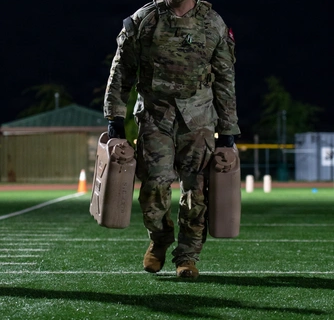
Two heavy implements, a full brace, short steps, 40 to 60 meters. Loaded carries train grip, posture, and bracing at the same time, and they look more like real work than any floor exercise. If you only have time for one core movement on a busy day, carry something heavy.
6. Hanging Leg Raise (Anti-Extension With Hip Flexion)
Hang from a bar, brace, and raise your legs by tilting your pelvis up, not by swinging. The hanging leg raise trains the hip flexors and lower abs together, which matters for sprinters and anyone who climbs. A full pull-up bar core workout builds this out with knee tucks, toes-to-bar, and windshield wipers if you want a deeper progression.
7. Hollow Body Hold (Full-Trunk Tension)
Lie on your back, press your lower back down, and lift your shoulders and legs a few inches off the floor. Hold. The hollow hold teaches total-body tension, the same position you need at the top of a pull-up and in a strong rope climb. Shorten the lever by bending your knees until you can hold 30 seconds with your back flat.
Where Do Crunches Fit?
Crunches and sit-ups train spinal flexion, which is the one thing most athletes need least. Repeated flexion under load is one of the ways discs get damaged in lab models (Callaghan and McGill, 2001). They aren't banned, but they rank well below the seven above for athletic carryover.
What Are the Best Core Exercises for Your Sport?
The best core exercises for your sport depend on where the force comes from and which direction it tries to bend you. Every athlete needs all four functions, but the emphasis shifts. Use these notes to weight your picks.
Sprinters
Sprinters need anti-rotation and strong hip flexion. Each stride throws rotational force through the trunk, and a stable pelvis lets the hip drive the knee forward. Prioritize the dead bug, Pallof press, and hanging leg raise.
Powerlifters and Olympic Weightlifters
Powerlifters and Olympic weightlifters live and die by the brace. Heavy squats, pulls, and overhead positions demand a stiff trunk for a few seconds at a time. Prioritize farmer's carries, ab wheel rollouts, and heavy suitcase carries, and practice bracing on every warm-up set.
Baseball Players
Baseball players need rotational power and the control to stop it. Core training has been linked to small gains in throwing velocity (Saeterbakken et al., 2011). Prioritize the Pallof press and add rotational medicine ball throws once anti-rotation strength is solid.
Football Players
Football players and footballers need to absorb hits and change direction without folding. That is anti-rotation and anti-lateral-flexion under contact. Prioritize the Pallof press, suitcase carry, and heavy farmer's carry.
Put It Together: An Athletic-Core Routine
The routine below programs the seven picks into two sessions. Add each one to the end of a training day, two to three times per week. Integrated core training that matches sport demands transfers better than isolated work alone (Reed et al., 2012), so keep these short and heavy enough to matter.
Day A (anti-extension and bracing):
Dead bug: 3 sets of 8 per side, slow
Ab wheel rollout: 3 sets of 6 to 10
Farmer's carry: 3 trips of 40 meters, heavy
Hollow body hold: 3 sets of 20 to 30 seconds
Day B (anti-rotation and anti-lateral-flexion):
Pallof press: 3 sets of 10 per side, 2-second hold
Suitcase carry: 3 trips of 30 meters per side
Hanging leg raise: 3 sets of 8 to 12
Add load before you add reps. A core routine that takes 15 minutes and gets heavier each week beats a 40-minute circuit that never changes. To see how this fits a full week of lifting, our strength workout for athletes shows where the core work sits next to squats, presses, and pulls.
If you're comparing plans that already program this for you, our guide to choosing a strength & endurance program explains what to look for, including whether core work is built around function or filler.
Named routines are another option. Cold War Core is a specific core routine we cover on its own, and it slots into this framework as a ready-made session.
FAQ: Frequently Asked Questions
What are the best core exercises for athletes?
The best core exercises for athletes are the dead bug, ab wheel rollout, Pallof press, suitcase carry, farmer's carry, hanging leg raise, and hollow body hold. Each trains anti-extension, anti-rotation, anti-lateral-flexion, or bracing, which are the functions that transfer force and protect the spine in sport.
What does core training do for athletic performance?
Core training builds a trunk that passes force from the legs to the arms without leaking it, and that resists bending or twisting under load. Better trunk control is linked to lower injury risk and more efficient movement, though performance gains depend on how well the core work matches the sport.
Are crunches good for athletes?
Crunches aren't harmful in small doses, but they train spinal flexion, which most athletes need least. Repeated loaded flexion is linked to disc stress in lab studies. Anti-movement exercises like the dead bug and Pallof press give athletes far more carryover for the same time.
What is anti-rotation core training?
Anti-rotation core training teaches your trunk to resist twisting when force pulls you to one side. The Pallof press is the standard example. It matters for cutting, throwing, tackling, and carrying uneven loads, because it keeps your torso square while your limbs produce or absorb force.
What are the best core exercises for sprinters?
The best core exercises for sprinters are the dead bug, Pallof press, and hanging leg raise. Sprinting throws rotational force through the trunk with every stride, and strong hip flexors drive knee lift. A stable pelvis lets the hips do their work without the lower back taking over.
How often should athletes train their core?
Most athletes do well training the core two to three times per week, in short sessions of 10 to 15 minutes at the end of a workout. Heavy compound lifts and carries also train the trunk, so dedicated core work should add load over time rather than volume.
Do core exercises prevent back injuries?
Core exercises can lower back injury risk by improving trunk control and bracing, but no exercise guarantees prevention. Athletes with weaker trunk stability show higher injury rates in research. Pair anti-movement core work with sound lifting technique and sensible load progression for the best protection.
The best core exercises for athletes aren't the ones that burn the most. They're the ones that make your trunk stiff when it needs to be and let force pass through it cleanly. Train anti-extension, anti-rotation, anti-lateral-flexion, and bracing, load them over time, and your sprints, lifts, and rucks get stronger at the weakest link.
Start with the two-day routine above this week. When you're ready for the core work to be programmed inside a full plan built around your test, selection, or job, choose a Combat Fitness program and train for the demand you'll face.
References:
Kibler WB, Press J, Sciascia A. The role of core stability in athletic function. Sports Medicine. 2006;36(3):189-198.
Hibbs AE, Thompson KG, French D, Wrigley A, Spears I. Optimizing performance by improving core stability and core strength. Sports Medicine. 2008;38(12):995-1008.
Reed CA, Ford KR, Myer GD, Hewett TE. The effects of isolated and integrated "core stability" training on athletic performance measures: a systematic review. Sports Medicine. 2012;42(8):697-706.
McGill SM. Core training: evidence translating to better performance and injury prevention. Strength and Conditioning Journal. 2010;32(3):33-46.
Grenier SG, McGill SM. Quantification of lumbar stability by using 2 different abdominal activation strategies. Archives of Physical Medicine and Rehabilitation. 2007;88(1):54-62.
Leetun DT, Ireland ML, Willson JD, Ballantyne BT, Davis IM. Core stability measures as risk factors for lower extremity injury in athletes. Medicine & Science in Sports & Exercise. 2004;36(6):926-934.
Zazulak BT, Hewett TE, Reeves NP, Goldberg B, Cholewicki J. Deficits in neuromuscular control of the trunk predict knee injury risk. American Journal of Sports Medicine. 2007;35(7):1123-1130.
Vispute SS, Smith JD, LeCheminant JD, Hurley KS. The effect of abdominal exercise on abdominal fat. Journal of Strength and Conditioning Research. 2011;25(9):2559-2564.
Escamilla RF, Babb E, DeWitt R, et al. Electromyographic analysis of traditional and nontraditional abdominal exercises: implications for rehabilitation and training. Physical Therapy. 2006;86(5):656-671.
McGill SM, Marshall L, Andersen J. Low back loads while walking and carrying: comparing the load carried in one hand or in both hands. Ergonomics. 2013;56(2):293-302.
Callaghan JP, McGill SM. Intervertebral disc herniation: studies on a porcine model exposed to highly repetitive flexion/extension motion with compressive force. Clinical Biomechanics. 2001;16(1):28-37.
Saeterbakken AH, van den Tillaar R, Seiler S. Effect of core stability training on throwing velocity in female handball players. Journal of Strength and Conditioning Research. 2011;25(3):712-718.
Willardson JM. Core stability training: applications to sports conditioning programs. Journal of Strength and Conditioning Research. 2007;21(3):979-985.
Behm DG, Drinkwater EJ, Willardson JM, Cowley PM. The use of instability to train the core musculature. Applied Physiology, Nutrition, and Metabolism. 2010;35(1):91-108.
Headquarters, Department of the Army. FM 7-22: Holistic Health and Fitness. Washington, DC; 2020.
Disclaimer: This article is for educational purposes only and is not medical advice. Consult a qualified healthcare provider before starting a new training program, especially if you have a history of back pain or injury. Results vary by individual, and no exercise program guarantees injury prevention or specific performance outcomes.


