
Backward Sled Drag: Form, Muscles, Benefits | Combat Fitness
The Backward Sled Drag: Build Quad and Knee Strength Without the Soreness
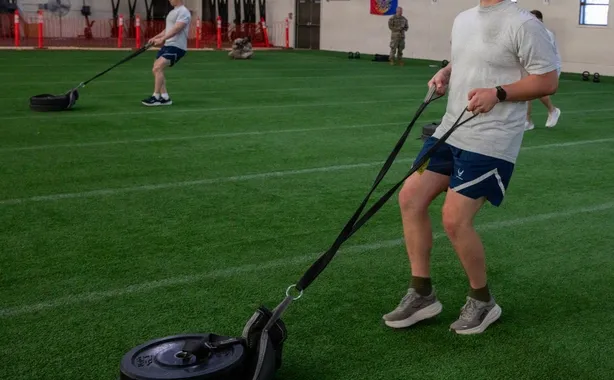
The backward sled drag (also called the reverse sled drag) means pulling a loaded sled while you walk backward, driving every step through a straightening knee. The sled only moves when you push away from it, so the work is almost entirely concentric. There is no lowering phase. That means you build quad strength and knee resilience with little next-day soreness. That is why sled drags sit inside our tactical fitness programs as a leg and conditioning tool you can run several times a week without paying for it on your next run or ruck.
This guide covers the setup, the muscles worked, why the missing eccentric matters for your knees, how backward drags compare with forward drags, and how to program them with or without a sled.
How to Do a Backward Sled Drag (Step by Step)
A backward sled drag needs four things: a sled heavy enough to slow you to a walk, straps or a handle held at arm’s length, an upright torso, and short, driving steps. Every foot of travel comes from pushing the ground away through the ball of your foot and straightening your knee.
Load and attach. Clip two straps or a single rope to the sled. Start light enough to move it smoothly for 20 yards. The surface (turf, concrete, grass) changes resistance as much as the plates do.
Face the sled. Hold the handles at arm’s length with straight arms and your shoulders pulled down and back. Your arms are hooks, not the engine.
Sit into a quarter squat. Hips slightly back, knees bent and tracking over your toes, torso close to upright. Leaning far back shifts the work off the quads.
Step back and drive. Reach one foot back, land on the ball of the foot, then push the ground away until the knee nearly straightens. The sled moves on that extension.
Keep steps short and continuous. Short steps keep tension on the quads and momentum in the sled. Long, lunging steps let it stall and turn the drill into a hinge.
Finish the distance, then reset. The walk back to the start is your rest.
Dragging a sled backwards at a lighter load for several continuous minutes becomes the backward sled walk (or reverse sled walk). The mechanics stay the same; the pace becomes a brisk walk and the goal shifts from strength to aerobic volume and knee tolerance.
What Muscles Does the Backward Sled Drag Work?
The backward sled drag trains the quadriceps as the prime mover, with the calves and hip extensors assisting each step and the grip, upper back, and trunk holding position against the pull. Reverse sled drag muscles worked track knee extension, which is why the drill reads as a quad builder.
Quadriceps: extend the knee on every step and do most of the work.
Calves: push off through the ball of the foot and stabilize the ankle.
Glutes and hip extensors: assist the drive and stabilize the pelvis, with less demand than a forward drag.
Grip, forearms, and upper back: hold the straps under constant isometric tension.
Trunk: braces to keep the torso upright as the sled pulls you forward.
The quad bias has a mechanical basis. Research on backward running found the knee extensors shift toward concentric work when you move backward, where forward running relies on them for eccentric braking. Dragging a sled exaggerates that pattern under load.
Why the Backward Sled Drag Is Uniquely Joint-Friendly (No Eccentric)
Backward sled drags produce little soreness because they have almost no eccentric phase. Delayed-onset muscle soreness comes mainly from eccentric contractions, where a muscle lengthens under load, as in the lowering half of a squat or the braking of downhill running. A sled never pushes back on you, so the quads only shorten under load.
This finding is decades old. Early comparisons of concentric and eccentric work showed soreness and lasting fatigue followed the eccentric bouts, and later reviews traced most exercise-induced muscle damage to lengthening contractions. A study of a hard backward sled drag session (sleds loaded at 75 percent of body mass) in strength-trained men found neuromuscular function restored within three hours. For a tactical athlete, that recovery profile is the whole point: you can train your quads hard on Monday and still run intervals or ruck on Tuesday.
The knee case is just as practical. Backward running produces lower patellofemoral compressive forces than forward running. In a randomized trial of people with knee osteoarthritis, a six-week backward walking program improved pain, function, and quadriceps strength more than forward walking. That is why the knees-over-toes and ATG training community leans on reverse sled drags: the knee travels past the toes under a load you control, with no eccentric spike, which builds tolerance for deep knee flexion.
Durable knees are a core piece of functional strength for military performance: carrying load downhill, climbing, and getting up off the ground hundreds of times in a day. Backward sled drag benefits stop short of treatment, though. Persistent knee pain belongs with a clinician, not a sled.
Forward vs. Backward Sled Drag: What Is the Difference?
Direction changes the emphasis, not the value. Backward drags load the quads and knees with an upright torso. Forward drags, with a harness at the hips or straps over the shoulders and a forward lean, shift more work to the glutes, hamstrings, and calves, closer to sprinting or a loaded hill climb. Both build work capacity.
Backward: quad dominant, upright torso, knee-flexion focused, near-zero eccentric, the better choice for knee resilience.
Forward: posterior-chain dominant, forward lean, closer to sprint and uphill mechanics, also low in eccentric load.
No Sled? Backward Sled Drag Alternatives and Programming
Alternatives to the Backward Sled Drag
A good substitute for a backward sled drag keeps the quad bias and, where possible, the low eccentric load.
Reverse band walk: anchor a heavy band to a post, hold it at your waist, and walk backward against it with short steps.
Backward incline walk: walk backward on an incline treadmill or a hill. Unloaded, but the same concentric quad pattern.
Plate drag on turf: stand on a towel or slide a bumper plate with a strap and walk it backward across turf.
Peterson step-up: a short step-up with the heel raised that targets the final range of knee extension.
Leg press or leg extension: loads knee extension well but includes a lowering phase, so expect more soreness.
How to Program Backward Sled Drags
Use the drag as a supplement to your main lower-body work, not a replacement. It does not train the hinge or full-depth squat strength that a strength workout for athletes builds. Three starting points cover most needs:
Strength: heavy enough to slow you to a grinding walk, 4 to 6 trips of 15 to 20 yards, full rest.
Conditioning finisher: moderate load, 6 to 10 trips of 20 to 30 yards, or MTI-style 30-second pulls with 60 seconds rest.
Recovery and volume: a light backward sled walk for 10 to 20 minutes at conversational effort.
Progress distance and rounds before load. Plate weight is an unreliable measure when surface friction changes from one day to the next, so effort and distance are the better gauges. If you want sled drags placed inside a week that already balances lifting, running, and rucking, start with choosing a strength & endurance program that fits your goal.
Frequently Asked Questions
What is a backward (reverse) sled drag?
A backward sled drag is a lower-body exercise where you face a loaded sled, hold straps at arm’s length, and walk backward with short, driving steps. Each step straightens the knee against resistance, making it a quad-dominant movement. “Reverse sled drag” and “backwards sled drag” describe the same exercise.
Why do backward sled drags cause no soreness?
Backward sled drags cause little soreness because the muscles work almost entirely concentrically. Muscle soreness comes mainly from eccentric contractions, where a muscle lengthens under load. The sled never pushes back on you, so the quads shorten under tension and never brake a falling weight. Recovery is fast enough to train again the next day.
Are backward sled drags good for your knees?
Backward sled drags are among the most knee-friendly loaded exercises available. They strengthen the quads through bent-knee positions with no eccentric spike, and backward locomotion places lower compressive force on the kneecap than forward running. They suit knee-resilience work, but persistent pain or a known injury needs a clinician’s assessment first.
What is the difference between forward and backward sled drags?
Forward sled drags emphasize the glutes, hamstrings, and calves with a forward lean, close to sprint or hill mechanics. Backward sled drags emphasize the quads and knees with an upright torso.
What can you do instead of a backward sled drag?
The closest substitutes are a reverse band walk against a heavy band, backward walking on an incline, or dragging a plate backward across turf. For direct quad work, use Peterson step-ups or the leg press. The machine options add a lowering phase, so expect more soreness.
How much weight and distance should you use?
For strength, use a load that slows you to a grinding walk for 4 to 6 trips of 15 to 20 yards. For conditioning, use a moderate load for 6 to 10 trips of 20 to 30 yards. Progress distance and rounds before adding weight, because surface friction changes the effective load.
The backward sled drag does one thing better than almost any other exercise: it builds quad strength and knee durability without the soreness that would wreck your next session. That makes it a tool you can use often, as a finisher, a strength accessory, or a low-cost conditioning block. The next step is placing it in a week that already accounts for your lifting, running, and rucking. Choose the CF ONE track that matches your goal and train it with a plan built around the job.
References:
West DJ, Cunningham DJ, Finn CV, et al. The metabolic, hormonal, biochemical, and neuromuscular function responses to a backward sled drag training session. J Strength Cond Res. 2014;28(1):265-272.
Newham DJ, Mills KR, Quigley BM, Edwards RHT. Pain and fatigue after concentric and eccentric muscle contractions. Clin Sci. 1983;64(1):55-62.
Proske U, Morgan DL. Muscle damage from eccentric exercise: mechanism, mechanical signs, adaptation and clinical applications. J Physiol. 2001;537(2):333-345.
Clarkson PM, Hubal MJ. Exercise-induced muscle damage in humans. Am J Phys Med Rehabil. 2002;81(11 Suppl):S52-S69.
Hody S, Croisier JL, Bury T, Rogister B, Leprince P. Eccentric muscle contractions: risks and benefits. Front Physiol. 2019;10:536.
Flynn TW, Soutas-Little RW. Mechanical power and muscle action during forward and backward running. J Orthop Sports Phys Ther. 1993;17(2):108-112.
Flynn TW, Soutas-Little RW. Patellofemoral joint compressive forces in forward and backward running. J Orthop Sports Phys Ther. 1995;21(5):277-282.
Alghadir AH, Anwer S, Sarkar B, Paul AK, Anwar D. Effect of 6-week retro or forward walking program on pain, functional disability, quadriceps muscle strength, and performance in individuals with knee osteoarthritis: a randomized controlled trial. BMC Musculoskelet Disord. 2019;20(1):159.
Petrakos G, Morin JB, Egan B. Resisted sled sprint training to improve sprint performance: a systematic review. Sports Med. 2016;46(3):381-400.
American College of Sports Medicine. Progression models in resistance training for healthy adults. Med Sci Sports Exerc. 2009;41(3):687-708.
Disclaimer: This article is for educational purposes and does not replace individualized medical advice. Consult a qualified healthcare provider before starting a new training program, especially if you have a current knee injury, joint pain, or a medical condition. Results vary by individual, and Combat Fitness makes no guarantee of specific performance outcomes.


